

8 Best Nurse Call Systems for Hospitals & Care Facilities
In this article
By the end, you'll know which systems log automatically, which cut alert noise, and which fit your care setting and team size.
What is a nurse call system?
A nurse call system has three layers.
Input devices include pull cords, call buttons, wearable pendants, and bed or chair exit sensors that patients or residents activate to request help.
Call stations: bedside, bathroom, or staff buttons that start an alert
Nurse station: audible and visual call notifications at a central point
Corridor and zone lights: visual signals that show where help is needed
Reset controls: buttons that cancel an alert once staff respond
Routing hardware delivers alerts to central monitors, pagers, or staff mobile apps based on location or role.
Modern platforms add dashboards, audit trails, and response-time analytics.
Hospitals and nursing homes use clinical-grade wired or IP systems with pull cords, cardiac alarms, and EHR integrations. Vendors like Tunstall Healthcare supply these to regulated acute and long-term care settings.
Assisted and senior living communities use wearable-based platforms with wander management and predictive analytics.
Lifeline's CarePoint system covers over 1,000 communities.
Home care settings use lightweight sensor kits with app notifications and no professional installation required.
Modern nurse call systems go beyond button-press alerts. Passive sensors monitor bed exits, falls, and inactivity automatically, without residents needing to press anything.
AI-driven platforms learn individual resident routines and only fire alerts when behavior deviates from baseline, reducing false alarms. Two-way voice, wander detection at exits, and location-aware escalation are now standard on enterprise-grade platforms.
How we evaluated these systems
1. Alerting quality: signal-to-noise ratio
Alert fatigue is a documented safety risk. Nurses managing high alert volumes develop alert blindness, where real events get missed alongside false ones.
2. Target environment fit
Systems in this list span four distinct environments: hospitals, senior living facilities, small care homes, and private residences. A system rated highly for one setting scores differently in another. Tunstall Healthcare is the only system here rated as a core strength for hospital environments; Smart Caregiver and SensorsCall are not designed for acute clinical use.
3. Scalability and deployment complexity
Systems were assessed on maximum resident count, wireless range, and whether deployment requires cabling, IT projects, or vendor engineers. Home-grade systems like Nomosmartcare and Envoy at Home work for single residences but have no multi-resident or facility-level architecture.
System | Hospital | Senior Living | Small Care Home | Private Residence |
|---|---|---|---|---|
Guardian | ✓ | ✓✓ | ✓✓ | ✓ |
Smart Caregiver | ✗ | ✗ | ✓✓ | ✓ |
Alarm | ✗ | ✓✓ | ✓ | ✗ |
Tunstall Healthcare | ✓✓ | ✓ | ✓ | ✗ |
Lifeline CarePoint | ✗ | ✓✓ | ✓ | ✗ |
Nomosmartcare | ✗ | ✗ | ✗ | ✓✓ |
Envoy at Home | ✗ | ✗ | ✗ | ✓✓ |
SensorsCall | ✗ | ✗ | ✗ | ✓✓ |
4. Reporting depth and integration
If reporting is only one gap, compare broader care software options by live alerts, visit proof, compliance evidence, and EHR-connected documentation before shortlisting vendors.
5. Pricing transparency and total cost of ownership
Four of the eight systems require contacting sales for pricing. Smart Caregiver, SensorsCall, and Nomosmartcare publish hardware costs publicly.
Smart Caregiver is hardware-only with no subscription; home-care tools range from free (SensorsCall claimed) to $19.99/month.
6. Real-world validation
User validation scores range from Smart Caregiver (4.2/5 from 1,206 reviews, widely deployed in US facilities) to systems with only vendor testimonials and no independent ratings on G2, Capterra, or Trustpilot.
Independent review counts were weighted above marketing testimonials.
Where vendor case studies were the only evidence available, those systems are noted accordingly.
7. Maintenance and support
Systems were assessed for battery replacement, low-battery warnings, vendor responsiveness, and support contracts.
Wireless systems need routine checks after installation. Low-battery alerts and scheduled site reviews help facilities catch device and coverage issues before an alert fails.
Facility-focused resident monitoring and alert systems
A resident rings the call button at 2am. The alert fires to a pager nobody is carrying, and the response log shows nothing. That is the daily cost of the wrong system.
This category covers care homes, nursing facilities, and small-to-mid-size residential settings that need reliable resident monitoring without enterprise complexity. Guardian uses a wireless sensor network with floor-plan mapping for location-aware alerts, while Smart Caregiver focuses on standalone hardware for straightforward fall and wandering prevention.
Start with Guardian if you need location-aware alerts and fleet visibility. Jump to Smart Caregiver if hardware-only with zero subscription is the priority.
1. Guardian
Guardian starts as a scoped 6-8 week pilot in one ward or team and closes with a written ROI report built on your own response times (Guardian pilot programme).
The platform itself is wireless and camera-free, built for care homes and home care providers.
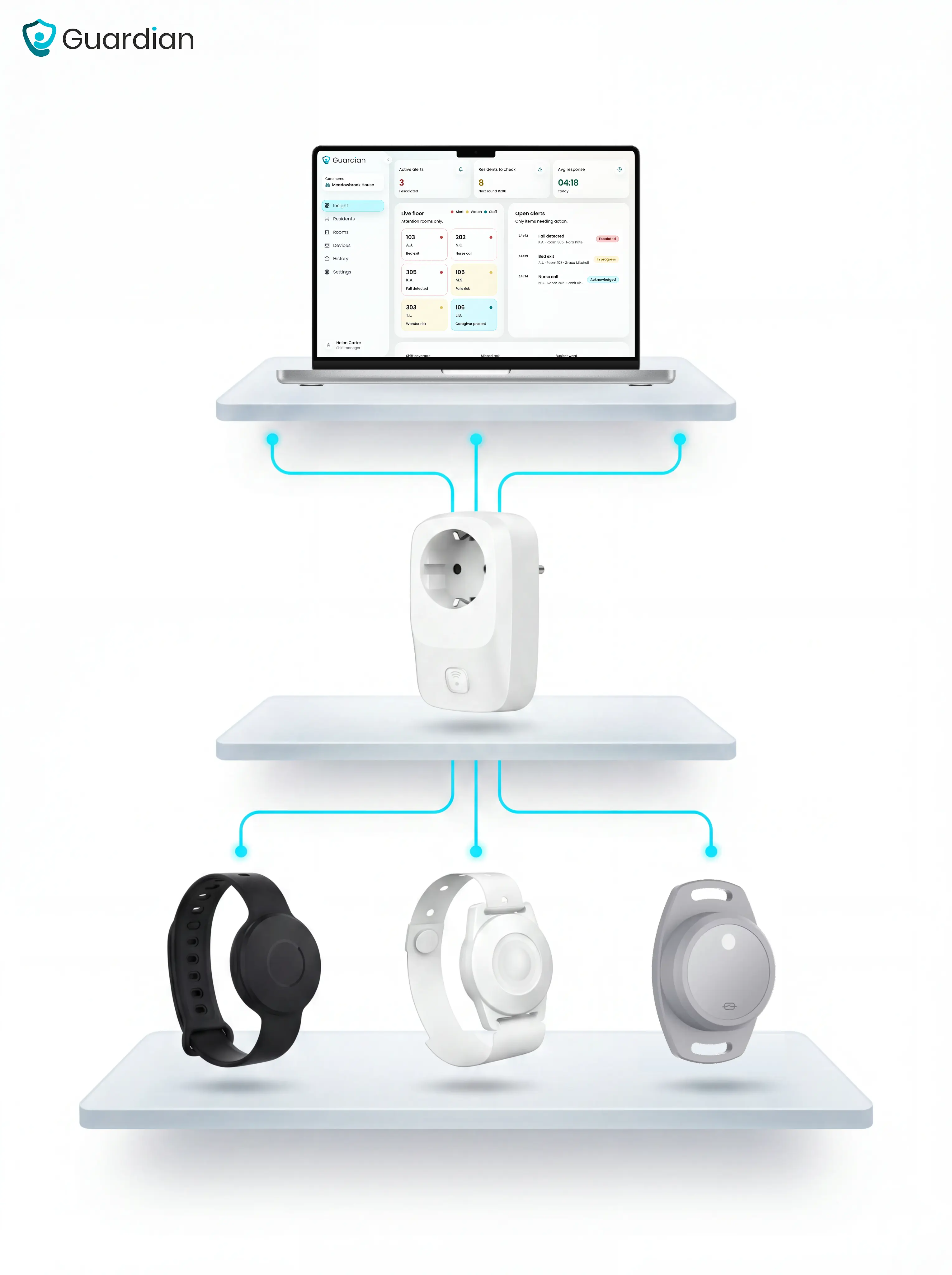
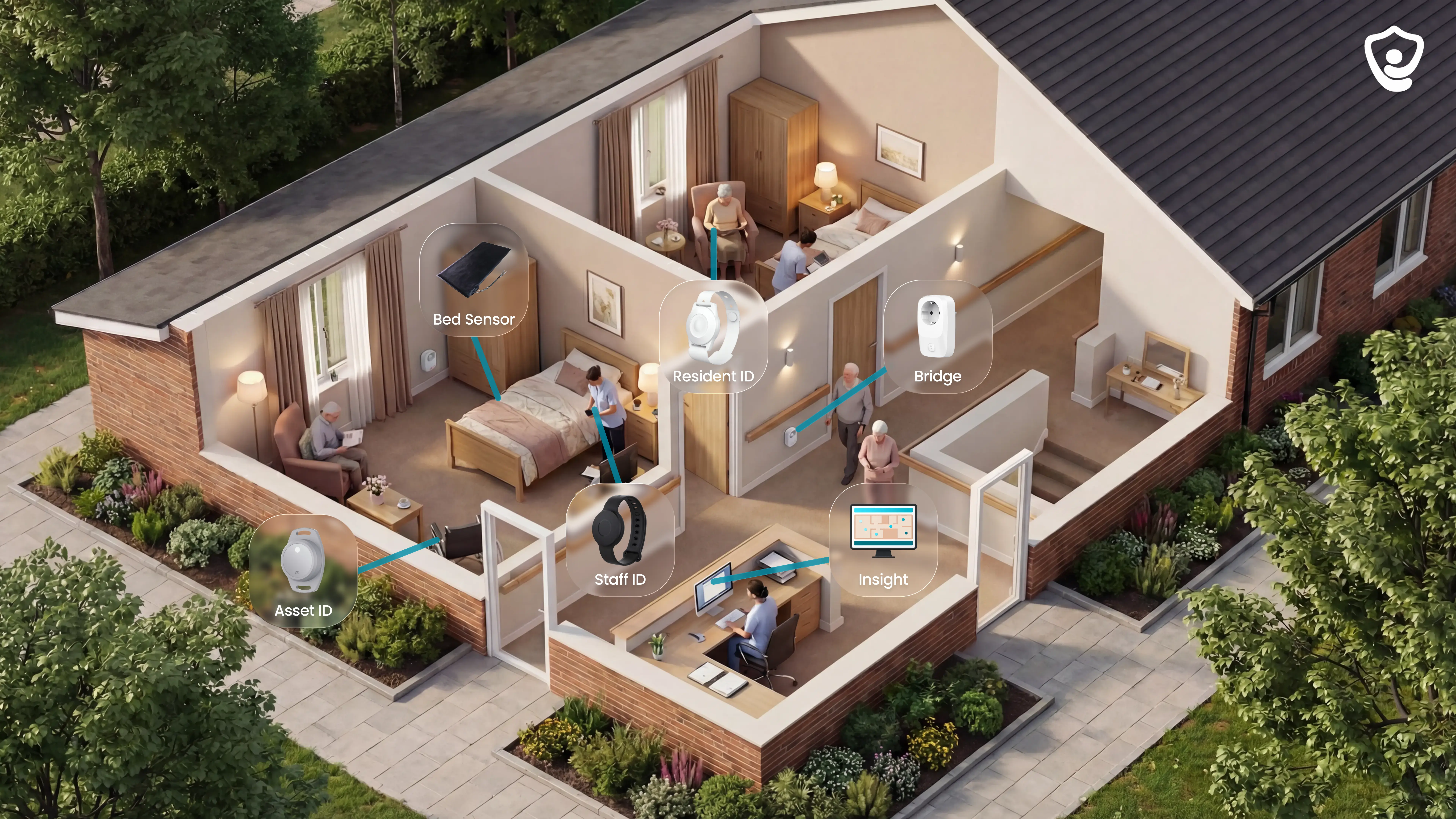
Wearable sensors, in-room devices, and a live dashboard give operators real-time visibility over residents, caregivers, and assets without cameras or cabling.
Most systems on this list do one thing: a pendant, a wall button, or a wander lock. Guardian covers resident wearables, in-room sensors, vehicle trackers, and a live dashboard in one wireless platform.
Unlike pendant-only providers, Guardian does not require residents to press a button. Bed exit, motion, and door sensors detect events automatically.
Guardian is built for care home directors, nursing managers, and home care agency operators running multiple wards or a distributed fleet. These operators need verifiable records for families, funders, and regulators.
Best for
Guardian is best for care home directors and home care agency operators who need wireless, camera-free resident and fleet monitoring with verifiable visit records.
Why it stands out
Alert rules filter normal activity at the sensor level. A resident out of bed for more than 15 minutes at night triggers an alert; a brief movement does not.
Three things make Guardian fast to deploy:
No drilling, cabling, or IT project required
Pre-configured wireless devices ship ready to use
A ward goes live in about a week
The entry point is a scoped 6-8 week pilot in one ward or team. At close, you get a written report showing your actual response times, visit records, and ROI in numbers.
Key features
Resident wristbands with nurse call and automatic fall detection
Caregiver SOS bands for staff safety alerts
Bed, motion, door, fridge, and stove sensors for passive in-room monitoring
Exit detection and restricted-area alerts without wall-mounted hardware
Floor plan mapping with room and bed-level location for every alert
Vehicle and asset trackers for home care fleets and facility equipment
All feed into Guardian Insight, a single live dashboard on devices staff already carry.
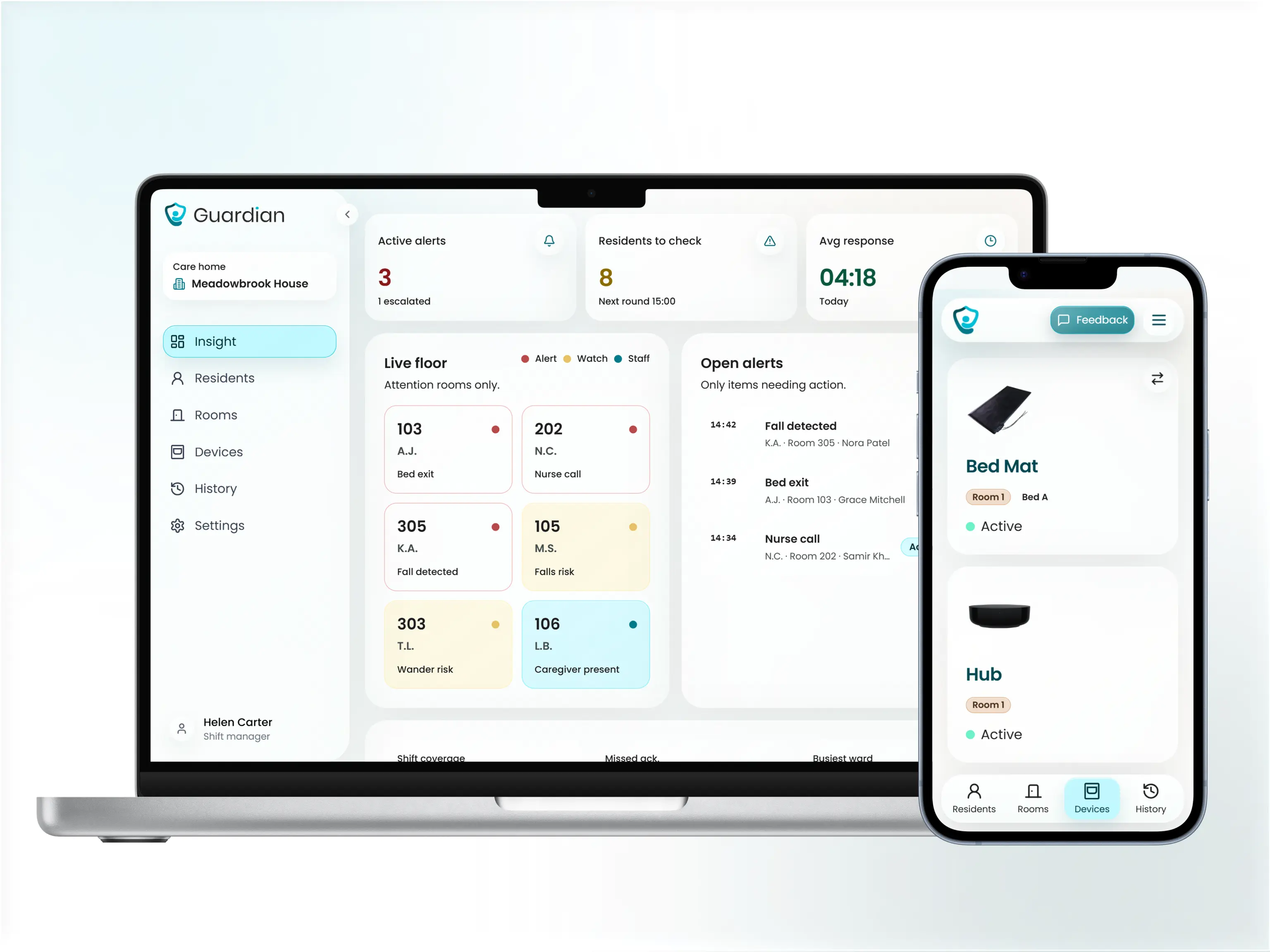
Guardian Insight maps every alert to a named room on a live floor plan. Staff see the resident's name and location at a glance.
Considerations
Guardian is not suited for hospitals that require hardwired UL-1069 pull cord infrastructure. If that compliance requirement is on your list, look elsewhere. Guardian is also not designed for individual family caregivers who need a single personal pendant rather than a facility-wide operations platform.
2. Smart Caregiver
It has no subscriptions or software dashboards.
Smart Caregiver is the only pure-hardware option in this article. No cloud dashboard, no EHR integration, no AI. Systems like Lifeline and Tunstall Healthcare layer analytics and enterprise integrations on top of hardware. Smart Caregiver skips all of that and is widely deployed in US care facilities.
Best for
Smart Caregiver is best for small care homes, nursing facilities, and home caregivers managing fall prevention and wandering alerts on a tight budget, without needing software or analytics.
Small to large care homes, including nursing homes and memory care units. Practical for US facilities where staff carry pagers and need reliable fall or door-exit alerts without cloud infrastructure. This remains a hardware alert system without analytics or EHR reporting.
No subscription fees. Basic pager kits start at $22.95, while monitor pricing is:
40-channel monitor: $99.95
60-channel monitor: $139.95
Large-facility monitor: $499.95
Envoy at Home charges $99/month on top of $399 hardware. Smart Caregiver's recurring cost is zero.
Why it stands out
Zero monthly fees, zero cloud subscriptions, and no software licence. The hardware purchase is the entire cost, with free shipping on orders over $60.
Nomosmartcare charges $19.99/month and Envoy at Home charges $99/month. SensorsCall publishes hardware pricing with free lifetime monitoring.
Plug-and-play, battery-powered, and wireless. No wiring or IT setup required. Wireless range covers 150 to 300 feet, which fits typical small-facility floor plans without additional infrastructure.
4.2 out of 5 from 1,206 reviews. Deployed across a large network of US care facilities serving hundreds of thousands of residents, making it one of the most widely used entry-level alert systems in US care settings.
Key features
Smart Caregiver includes call buttons, bed and chair sensors, motion detectors, pager receivers, and multi-channel monitors that alert staff wirelessly without cameras, software, or cloud connectivity.
The system covers four alert types:
Call buttons — resident-initiated alerts for direct staff notification
Bed and chair sensors — passive detection of exit or pressure absence
Motion sensors — room-level activity detection, useful on night shifts
Pager and monitor alerts — gentle chimes notify mobile staff without disturbing other residents
Multi-channel monitors support different facility sizes. The 60-channel unit handles 60 assigned sensors or residents.
Smart Caregiver also sells a large-facility monitor that accepts identifiers from 1 to 9999 (Smart Caregiver central-monitoring specifications).
Considerations
Smart Caregiver has no software dashboard, no analytics, no EHR integration, and limited wireless range, making it unsuitable for large facilities or teams that need data-driven care reporting.
No dashboards, reporting tools, EHR connectors, or third-party integrations. The system delivers hardware alerts only, with no data capture or trend analysis.
Facilities needing audit trails or response-time reporting should consider Lifeline or Tunstall Healthcare instead.
The 60-channel unit is one monitor option rather than a platform-wide cap.
Wireless range can fall short in multi-story or large-footprint buildings. Tunstall Healthcare supports multi-site deployments.
All sensors are battery-powered. Routine battery checks are required, and user reviews cite battery upkeep as a recurring maintenance task.
Enterprise senior living nurse call and monitoring platforms
The corporate office wants a dashboard showing response times across 12 communities. Your current system cannot produce one, because every site is running a different platform.
Enterprise senior living platforms combine IP-based or cloud-hosted nurse call infrastructure, wander management, predictive analytics, and multi-site dashboards built for operators managing dozens of communities. Alarm, Tunstall Healthcare, and Lifeline each take a different approach to that scope.
Alarm leads with passive AI monitoring, Tunstall with clinical-grade wired infrastructure, and Lifeline with wearable pendants and voice AI.
3. Alarm
Passive AI-driven routine learning tracks resident ADL patterns and generates predictive wellness alerts. Alarm is a cloud-based sensor platform for senior living.
Alarm sits in the enterprise senior living tier alongside Tunstall Healthcare and Lifeline, targeting multi-resident facilities rather than home care. Unlike Tunstall and Lifeline, Alarm relies entirely on passive sensors with no resident-initiated alerts.
Best for
Alarm is best for enterprise senior living operators running assisted living, independent living, or memory care communities who want non-intrusive predictive monitoring.
Alarm fits facilities focused on ADL pattern monitoring and reducing preventable ER visits, not instant resident-initiated call response. It is not designed for hospital wards or high-acuity settings requiring UL-listed nurse call hardware with pull cords and zone panels.
Why it stands out
Alarm stands out for passive AI-driven routine learning that generates predictive wellness alerts before incidents occur, without requiring residents to press a button.
Alarm's sensors learn each resident's individual ADL patterns over time, covering sleep, meals, and bathroom visits. Anomalies are flagged against that personal baseline without any button press required.
Tunstall and Lifeline both require a resident or staff member to initiate an alert via pull cord or wearable button. Alarm generates alerts passively.
The optional Wellcam module adds two-way video communications, providing a visual layer that pure sensor platforms like Smart Caregiver do not offer.
The enterprise dashboard supports multi-resident and multi-campus visibility with over-the-air sensor updates. It scales well beyond the 60-resident ceiling of smaller single-site systems.
Key features
Alarm's core features include passive wireless sensors for ADL monitoring, a predictive Wellness Insights engine, a real-time enterprise dashboard, optional Wellcam video, two-way communications, and OTA sensor updates.
Passive wireless sensors track ADL patterns including sleep, meals, and bathroom visits. No cameras or wearables are required.
The Wellness Insights module analyzes sensor data and surfaces predictive alerts when a resident's routine deviates from their learned baseline. Staff get a heads-up before a situation escalates rather than after.
The enterprise dashboard supports real-time monitoring across multiple residents and sites with built-in reporting. Deployment and scaling run through authorized providers.
Wellcam is an optional add-on providing video visibility and two-way communication between staff and residents. It covers scenarios where sensor data alone is not enough to assess a situation.
Alarm integrates with the broader Alarm.com security and smart building platform. This suits senior living operators already using Alarm.com for access control or building monitoring.
Considerations
Alarm does not publish pricing. Quotes come through authorised providers on request.
Facilities needing upfront pricing transparency have clearer options:
Smart Caregiver — hardware from $22.95, no subscription
SensorsCall — one-time hardware from $149, free lifetime monitoring claimed
Alarm has no G2 or Capterra ratings for its Wellness platform. User validation comes mainly from general Alarm.com app reviews and one older academic study on its predecessor, BeClose. Tunstall Healthcare publishes multiple facility case studies with measurable efficiency outcomes.
Alarm includes no pull cords, wearable emergency buttons, or UL-listed nurse call panels. Facilities that require residents to self-initiate emergency calls need Lifeline or Tunstall Healthcare.
The optional Wellcam module places video inside resident spaces, which can face regulatory scrutiny. Families and residents in settings where camera-free monitoring is expected may object.
4. Tunstall Healthcare
Support for 63 ward managers and 99 locations per installation suits large care estates.
Tunstall Healthcare is a clinical-grade IP nurse and warden call system with pull cords, VoIP, location-aware alerts, and EHR integrations for hospitals and care homes.
Tunstall is the most hospital-grade option in this article, with active pull cords, VoIP speech, and EHR integrations that passive-sensor platforms like Alarm do not match for acute care. Unlike Smart Caregiver, which ships hardware only with no dashboards or integrations, Tunstall includes real-time dashboards, KPI reporting, audit trails, and multi-site management.
Best for
Hospitals, NHS trusts, and multi-site care organisations that need compliant clinical alerting get this from Tunstall.
Tunstall serves hospitals, nursing homes, care homes, supported living, and retirement communities across the UK and Europe, with over 50 years of deployment history.
The system scales to 63 ward managers and 99 locations per installation. A documented case study at Park View, a 41-bed care home, showed measurable efficiency gains from Tunstall's IP system.
Why it stands out
Tunstall stands out for its active clinical hardware (pull cords, cardiac alarms, VoIP speech) combined with location-aware escalation logic and deep system integrations unavailable in passive-sensor alternatives.
Tunstall supports active pull cords, cardiac alarms, WC call switches, and two-way VoIP speech at the room level. Staff can assess a situation remotely before walking to the room.
Tunstall integrates with EHR systems, fire alarms, PA systems, and telecare infrastructure. Audit trails and KPI dashboards support CQC-style compliance reporting.
Hybrid upgrade capability lets facilities migrate from legacy analogue nurse call to IP/VoIP without full rewiring, reducing deployment disruption.
Tunstall's welfare check-in feature lets staff confirm resident wellbeing remotely through the system. This reduces unnecessary room visits and frees caregiver time for higher-priority tasks.
Key features
Feature | What it does |
|---|---|
Pull cords & cardiac alarms | Active hardware for acute clinical settings |
Two-way VoIP | Remote staff assessment before room entry |
Location-aware escalation | Configurable rules route alerts to the right person |
Audit trails | Every alert and response logged for CQC compliance |
EHR/telecare integration | Fire, PA, EHR, telecare all in one interface |
Considerations
Service reliability is the main operational risk. Tunstall's 2.6/5 rating from 26 Trustpilot reviews includes concerns about aftercare and support responsiveness, which matter for a system embedded in care workflows.
Tunstall lists no pricing on its website. All quotes require direct sales contact, which slows procurement comparison.
Smart Caregiver — hardware kits from $22.95
Nomosmartcare — $199.99 kit plus $19.99/month
Tunstall's IP infrastructure and multi-site management tools are built for institutional scale. Small residential homes and home-care environments will find it disproportionate to their needs.
Home-care use cases are better served by Nomosmartcare (plug-and-play sensors, $199.99 kit) or SensorsCall (hardware from $149, free lifetime monitoring claimed).
5. Lifeline

Lifeline centers its enterprise nurse call platform on UL-2560 certified wearables with automatic fall detection. It also includes wander management and AI-powered check-ins.
Lifeline CarePoint sits at the enterprise tier alongside Tunstall Healthcare. Where Tunstall focuses on IP-based pull cords and wired infrastructure, Lifeline centers on wearable pendants with active fall detection and voice AI through Amazon Alexa.
Best for
Lifeline CarePoint is best for senior living operators in assisted living, memory care, and retirement communities that need UL-certified nurse call with fall detection and wander management.
Lifeline supports 1,000+ senior living communities and 100,000+ residents. Deployment is available as cloud or on-premises, with white-glove installation for operators who prefer a managed rollout.
Memory care operators benefit from built-in wander tags that trigger alerts at doors and elevators. This is a specific capability not found in systems like Alarm or Smart Caregiver.
Why it stands out
Three capabilities separate Lifeline from the rest of the enterprise tier:
GRACE AI voice check-ins automate routine welfare visits, reducing staff footsteps on night shifts.
UL-2560 certified fall detection sends prioritized alerts to staff mobile devices without a button press.
PointClickCare sync via ADT feed pushes alert and resident data into the EHR without manual re-entry.
Key features
Lifeline CarePoint includes UL-2560 certified wearable pendants with auto fall detection, wander management tags, mobile app alerts, a central analytics dashboard, GRACE AI voice check-ins, and integrations with Alexa and PointClickCare.
Wearable pendants with auto fall detection — UL-2560 certified pendants detect falls without a button press and send prioritized alerts to staff mobile devices.
Wander management tags — door and elevator alerts notify staff when memory care residents approach exit points; each event is logged automatically in the central software.
Central analytics dashboard and mobile app — aggregates alerts, tracks response times, and generates trend reports; staff receive prioritized notifications through a dedicated mobile app.
GRACE AI and Alexa integration — GRACE AI automates resident wellness check-ins by voice; Alexa lets residents trigger alerts and access information hands-free.
Considerations
The thin independent review record is worth noting before a large-scale rollout. One COO testimonial and a processed-alerts count are not the same as facility-level case studies.
Lifeline uses an enterprise contact-sales model with no public pricing. Buyers wanting cost benchmarks can look at Smart Caregiver (hardware kits from $22.95) or SensorsCall (1-pack from $149), though both serve different scales and settings.
Lifeline CarePoint targets assisted living, memory care, and retirement communities only. Operators needing hospital-grade infrastructure should consider Tunstall Healthcare's Flamenco IP+ system.
Home-care and caregiver alert systems
Between visits, your team has no overnight movement record and no alert when a client's activity stops.
From the office, a fall and a late start look identical.
The tools in this category are designed for private homes and family caregivers monitoring a single senior. They rely on passive sensors and app alerts rather than staff pagers, and prioritize low-cost, no-installation setups over clinical-grade compliance.
Nomosmartcare, Envoy at Home, and SensorsCall each take a different approach: Nomosmartcare on sensor-based activity routines, Envoy at Home on AI-driven behavior analysis, and SensorsCall on plug-and-play motion detection.
6. Nomosmartcare
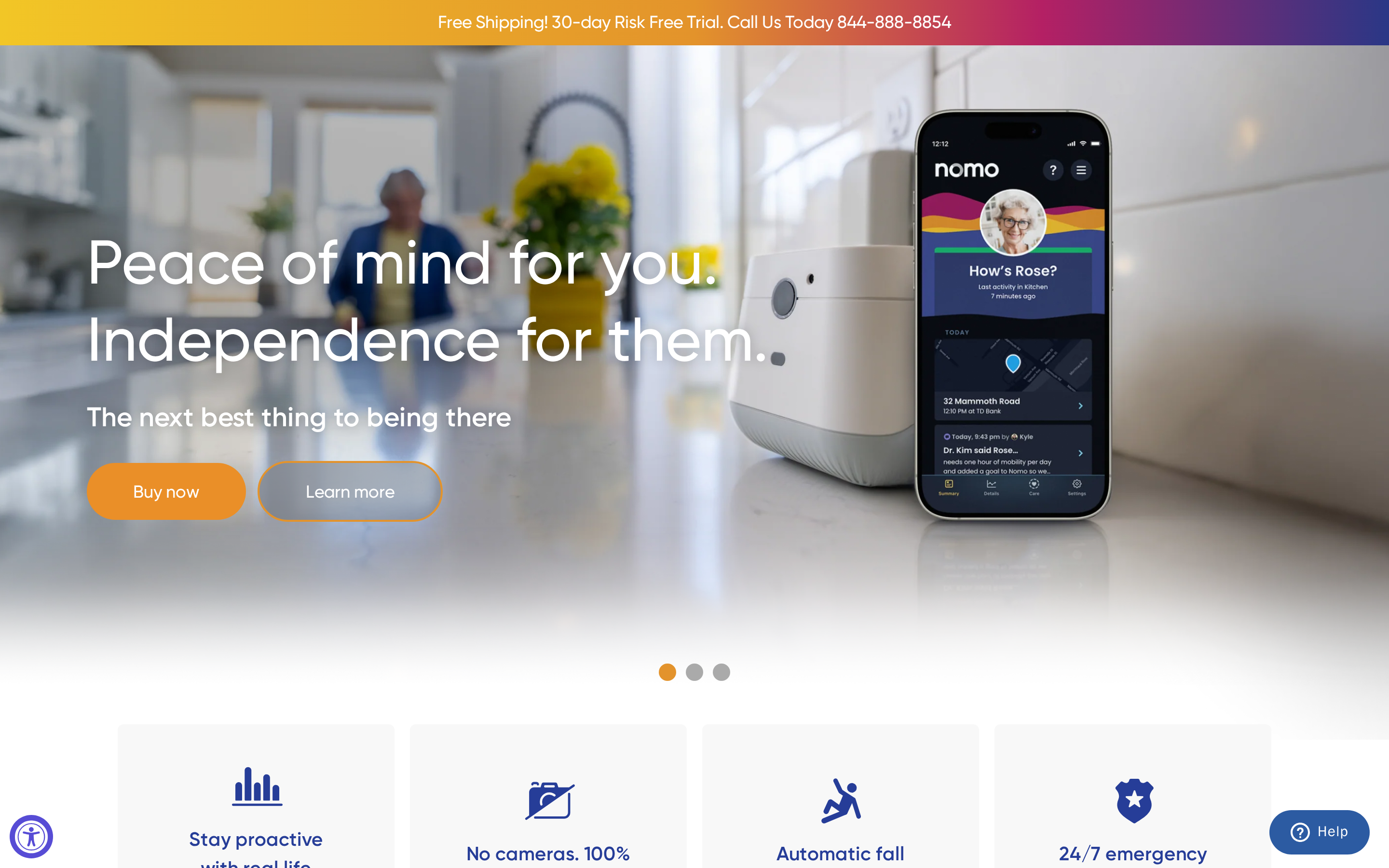
Nomosmartcare is an AI-powered plug-and-play home sensor kit for remote monitoring of independent seniors, using motion and activity detection without cameras or wearables.
Nomosmartcare uses AI routine learning and RapidSOS 911 dispatch, features not offered by Envoy at Home or SensorsCall. SensorsCall claims free lifetime monitoring after a one-time hardware purchase; Nomosmartcare requires a $19.99/month subscription.
Best for
Remote family caregivers monitoring a solo senior at home get the most from Nomosmartcare.
Designed for a single home with a WiFi-connected hub and satellite sensors. Suits seniors who resist wearables or cameras, since all monitoring is passive and requires no body-worn device.
Why it stands out
Nomosmartcare stands out for AI-learned routine monitoring with direct 911 dispatch via RapidSOS, combining proactive anomaly alerts with no cameras or wearables.
Sensors learn each resident's daily patterns (sleep, meals, movement) over time. Alerts fire when activity deviates from the established baseline, not simply when motion is detected.
RapidSOS integration sends live location data directly to 911 dispatchers during confirmed emergencies.
Motion, activity, and tag-based sensors track presence and movement through walls without any body-worn device. The app includes hands-free voice memos, so caregivers can log notes without interacting with a screen.
Key features
Key features include a WiFi hub with satellite sensors and tags, AI routine learning, multi-channel app alerts, RapidSOS 911 dispatch, and optional biometric add-ons.
The Essential Care kit includes a central hub and satellite sensors for room coverage. Add-on tags range from $24.99 to $69.99 each.
Kit price: $199.99 to $249.99 upfront
Subscription: $19.99/month for alerts and 911 dispatch
30-day free trial for the Essential+ subscription (Nomosmartcare Nomo App page)
The app sends push notifications, phone calls, and texts to a defined care circle when anomalies are detected. RapidSOS 911 integration auto-dispatches emergency services with location data during confirmed emergency events.
An optional blood pressure monitor and thermometer connect to the app, adding health data alongside activity monitoring.
Considerations
The $19.99/month subscription is required for full alert and 911 dispatch functionality. SensorsCall claims free lifetime monitoring after hardware purchase, making it a lower long-term cost for families focused purely on routine monitoring.
Amazon reviews rate Nomosmartcare 4.1/5 across 53 ratings, with some users noting missed fall detections. Sensor-based inference without wearables or dedicated impact hardware means edge cases can be missed.
For high-risk dementia patients with a history of falls, sensor inference is not enough. Use Envoy at Home's multi-layer detection or a dedicated wearable instead.
Nomosmartcare has no multi-resident management, staff dashboards, or enterprise analytics. Facility operators should consider Smart Caregiver or Guardian instead.
7. Envoy at Home
Envoy at Home turns passive sensor data into app alerts and doctor-shareable reports for family dementia care at home.
Envoy at Home sits between Nomosmartcare ($19.99/month) and SensorsCall (free lifetime monitoring) on price and complexity. It targets family caregivers of dementia patients only, with no facility or enterprise scaling.
Best for
Envoy at Home is best for family caregivers of dementia or memory-loss patients aging in place at home, not for professional facility or hospital use.
Envoy at Home suits non-professional caregivers who need long-term behavioral trend data on a dementia patient, including nighttime behaviors and pre-fall risk signals. SensorsCall costs less over time, but Envoy at Home is the better fit when dementia-specific insights and doctor-shareable reports are the priority.
Why it stands out
Dementia-specific behavioral tracking is what separates Envoy at Home from every other system in this article.
The system tracks over 35 senior behaviors using passive motion and contact sensors, covering sleep, bathroom visits, and kitchen activity. The resident does not wear or interact with any device.
Fall detection combines impact detection with long-lie recognition, requiring multi-sensor confirmation before alerting.
The app generates weekly behavioral reports that family caregivers can share directly with physicians, framing activity data as a clinical reference rather than a safety log. Nomosmartcare and SensorsCall do not offer physician-report formats.
All monitoring uses battery-powered motion and contact sensors placed around the home. The resident does not wear or interact with any device, and no video is recorded at any point.
Key features
Envoy at Home's standard kit includes 8 passive sensors for motion and contact detection, a central hub, a mobile app with real-time alerts, weekly behavioral reports, and multi-layer fall detection.
The standard kit covers a single home with 8 battery-powered sensors. No wiring or professional installation is required; the system runs via an internet-connected hub.
The app delivers real-time push alerts for detected events such as falls, inactivity, and anomalies. Weekly summaries are formatted for sharing with doctors or care team members.
Fall detection combines impact sensors with long-lie monitoring to confirm a fall before alerting. This two-layer approach reduces false positives compared to single-trigger systems.
The sensor network infers behavioral patterns across 35+ daily activities by monitoring movement and contact events throughout the home. Pre-fall risk signals come from behavioral pattern changes, not only from acute events.
Considerations
At $99/month plus $399 one-time equipment, the first-year total is approximately $1,587. Nomosmartcare costs $19.99/month after hardware; SensorsCall claims free lifetime monitoring on the base plan.
At nearly $1,600 in year one, Envoy at Home is the most expensive option in this category. Confirm the behavioral-report capability is actively needed before committing. Most family caregivers do not use it.
Envoy at Home covers a single home only, with no multi-resident dashboards, staff paging tools, or enterprise deployment options. Facilities managing multiple residents should look at Smart Caregiver or Tunstall Healthcare instead.
Envoy at Home has no EHR or API integrations. Reports can be shared manually with doctors, but there is no automated clinical data sync.
Independent reviews are thin: no listings on G2, Trustpilot, or Capterra. Available testimonials come from company materials and Reddit mentions, not verified review platforms.
8. SensorsCall
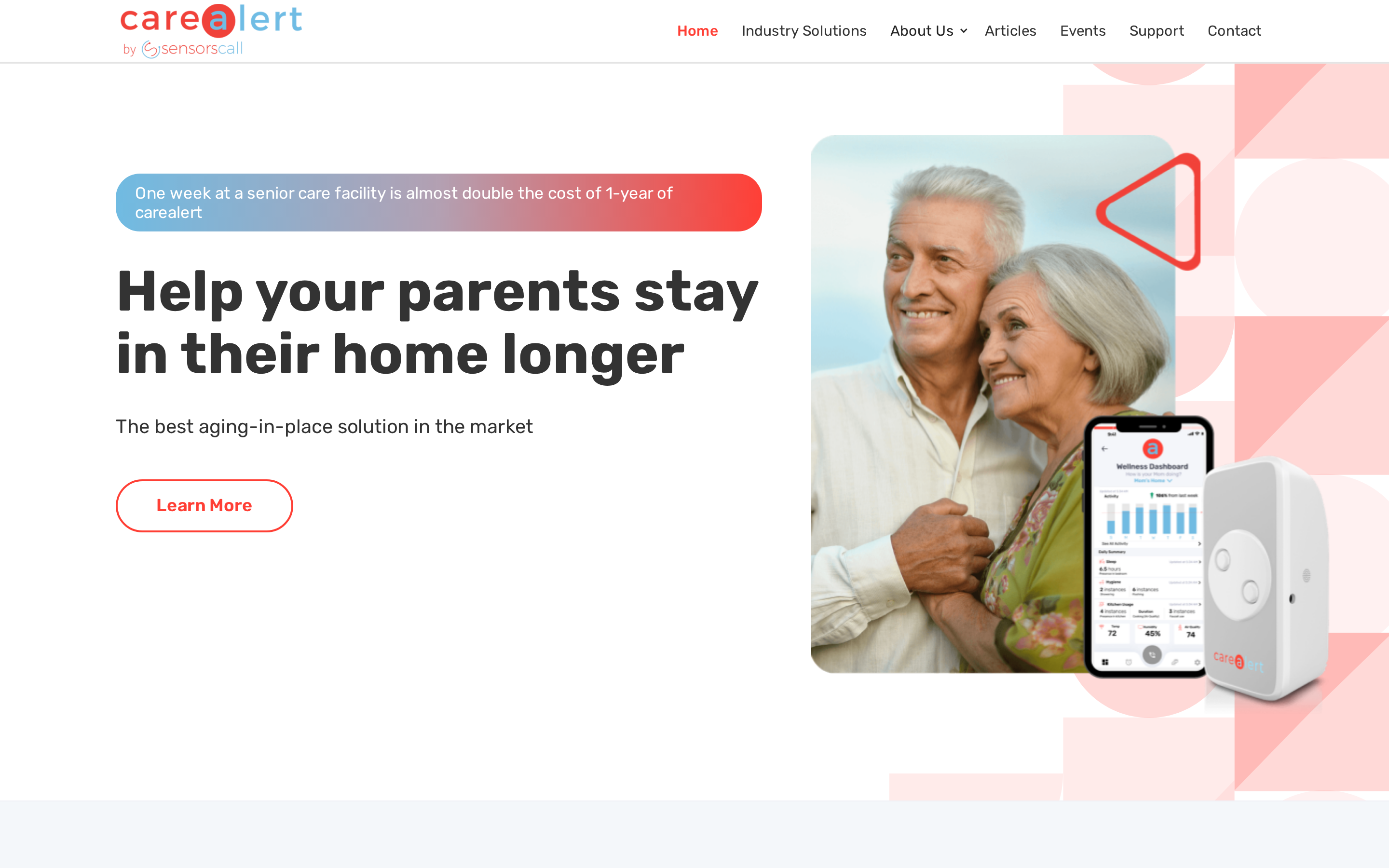
Plug-in nightlight sensors give SensorsCall a low-installation format for home aging-in-place monitoring. The system includes app alerts and an open API for biometric integrations.
SensorsCall targets family caregivers and aging-in-place alongside Nomosmartcare and Envoy at Home. Its current published offer is $149 for one CareAlert or $415 for three, with free lifetime monitoring included.
Best for
Budget-conscious family caregivers who want passive monitoring with no monthly bill get the best deal from SensorsCall.
SensorsCall supports some assisted living deployments on a per-unit basis but is not built for large-scale hospital infrastructure. Home care agencies can manage multiple clients from a single enterprise dashboard.
Why it stands out
SensorsCall stands out for its claimed free lifetime monitoring, a hardware-only pricing model, and an open API that connects FDA-registered biometric devices into a single activity dashboard.
SensorsCall charges no recurring fees after hardware purchase.
SensorsCall supports Apple HealthKit, FDA-registered biometric devices, and an open API for custom integrations. Envoy at Home has no API; Nomosmartcare supports optional health add-ons but without a documented open API. SensorsCall is the only one of the three with a publicly documented open API.
Key features
SensorsCall includes plug-in nightlight sensors for activity patterns, environmental monitoring, app alerts and reports, an intercom, biometric device integration, and an enterprise multi-home dashboard.
Plug-in sensors monitor bathroom, kitchen, and sleep activity to build routine baselines. Environmental alerts cover conditions such as temperature and air quality.
Fall detection relies on vibration and sound inference rather than dedicated impact hardware. The system does not include native fall detection.
An enterprise dashboard lets home care agencies monitor multiple homes from a single interface, with activity logs and trend reports. A partner claim reports 30% fewer caregiver visits through remote monitoring, though this is not independently verified.
Supports Apple HealthKit, FDA-registered biometric peripherals (blood pressure, weight monitors), and an open API for custom integrations.
Considerations
Nomosmartcare and Envoy at Home charge monthly subscriptions.
SensorsCall infers falls from vibration and sound rather than dedicated impact sensors, which is less reliable than purpose-built fall detection. For residents with high fall risk, Envoy at Home's multi-layer detection or Nomosmartcare's dedicated fall sensor are stronger options.
Do not rely on SensorsCall as your primary fall-detection system. It infers falls from vibration and sound. For residents with documented fall risk, use Envoy at Home or Nomosmartcare instead.
Independent reviews are sparse; validation relies mainly on media mentions from CNET and AARP and one unverified partner efficiency claim. The system is not designed for multi-wing or hospital-grade infrastructure. Facilities needing that scale should consider Tunstall Healthcare or Lifeline instead.
Nurse call systems compared: features, facility fit, and deployment
Five steps to a shortlist
Facility-grade platforms (Tunstall, Lifeline) carry UL-certified clinical nurse call, EHR integrations, and enterprise multi-site management for regulated hospitals and large nursing homes.
Wireless facility-grade systems (Guardian, Smart Caregiver) target small-to-mid care homes with no existing wired infrastructure. Both deploy without cabling or an IT project.
Home-care tools (Nomosmartcare, Envoy at Home, SensorsCall) are built for single-home use. None support multi-resident dashboards at nursing home or hospital scale.
Key differentiators across all three categories:
Pricing model: Facility-grade wired systems carry upfront installation and maintenance costs; enterprise senior living uses per-bed subscriptions; home-care tools combine device and monitoring fees; Guardian's pilot is scoped to one ward or team and closes with a written impact and ROI report, with commercial terms for the rollout set from that scope
Scalability: Wired facility-grade systems have high retrofit costs and low scalability; wireless enterprise platforms scale with minimal disruption; home-care tools are single-unit only
Fall detection: Standard in enterprise senior living platforms via motion/bed-exit sensors and RTLS; an optional add-on in facility-grade nurse call; limited in home-care tools, mostly manual activation or a basic pendant button
Which system fits your setting?
If you manage a care home or home care team and need wireless, camera-free monitoring with verifiable records, the next section covers where Guardian fits in this picture.
Why Guardian fits where others fall short
Most systems on this list solve one problem. Pendants, pull cords, and sensors each cover a single moment, with no unified view of residents, caregivers, and assets.
You get one live view of the floor and records that are already written when the shift ends.
Guardian covers all of it in one wireless, camera-free platform.
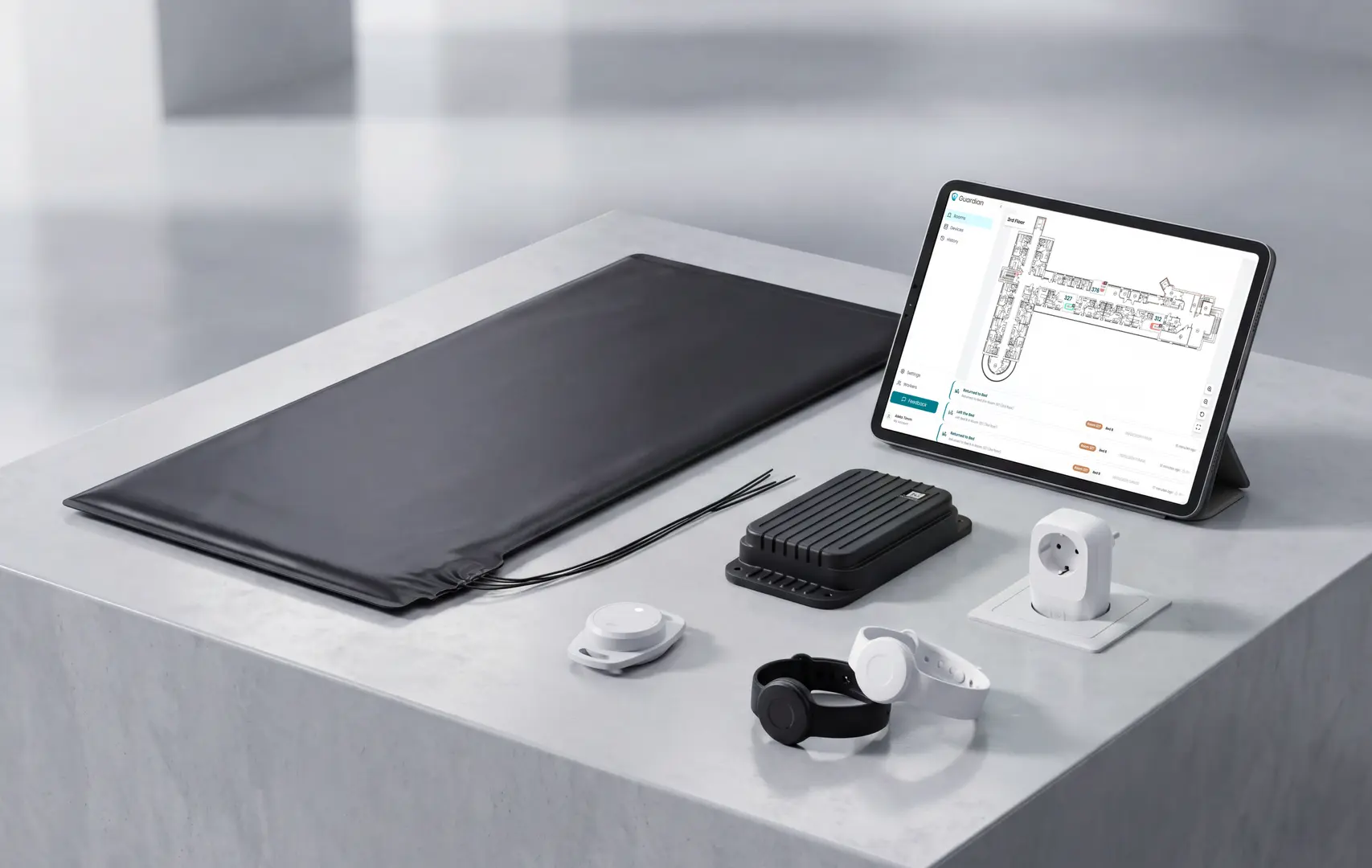
The platform includes:
Resident wearables and in-room sensors that detect falls and bed exits with no button press
Caregiver location on a live floor plan, so every alert arrives with a named room
Vehicle and asset tracking in Guardian Insight, so staff stop hunting for a wheelchair or a lift
Automatic visit records and response time logs
Wireless fits most care homes. Wired suits hospitals that need hardwired reliability and UL 1069 compliance.
Wireless held 62.65% of global nurse call revenue in 2025, with an 11.67% CAGR projected through 2031. Research on wireless nurse call implementations has found significant reductions in staff response times compared to traditional systems.
Wired install complexity: Requires wall and ceiling cabling throughout, making retrofits in operational care homes disruptive and expensive
Wireless retrofit advantage: No structural modifications needed, so deployment is faster and less disruptive in live care settings
Wired reliability edge: No RF interference or battery dependency; UL 1069 mandates fault notification within 90 seconds and more than 100,000 signaling cycle endurance
Wireless battery burden: Device batteries need replacement every 12-18 months, plus quarterly RF checks and annual site surveys to prevent dead zones
For care homes retrofitting an occupied building, wireless is almost always the right call. Wired makes sense only when you are building new or running a high-acuity ward where reliability trumps speed of deployment.
Nurse call systems cost $2,500 to $4,250 per room on average for hardware and base software.
Annual software maintenance agreements typically run 15-18% of the initial system cost. A full IP system for a 400-bed hospital can reach $500K-$2M in total lifetime cost.
Hardware: 40-60% of total project cost for wired and IP-based nurse call installations
Installation labor: 40-60% of project cost for IP-based systems requiring extensive cabling
Subscription/OpEx alternative: $3-$15/bed/month (roughly $180-$900 per bed over five years) versus a CapEx lump sum; wireless five-year maintenance runs about 20% lower than wired
Real-world example: Crest Haven Nursing Center received installation bids of $300,535-$355,145 plus $9,000 in maintenance for Years 1-2
Yes. US facilities must meet NFPA 99, UL 1069 (hospitals), and CMS F919 (nursing homes). UK NHS and care homes follow HTM 08-03. Enterprise systems like Tunstall Healthcare and Lifeline are designed to meet these standards; home-care systems like Smart Caregiver, Nomosmartcare, and SensorsCall are not compliance-certified for regulated clinical environments.
In the US, facilities must comply with NFPA 99, UL 1069, and CMS F919, which requires nurse call coverage from bed, toilet, and bath areas. UK NHS and care homes follow HTM 08-03, mandating pull-cords, priority alarms, visual indicators, and monitored circuits.
EU operators should also check EN ISO 10651 and local telecare standards. Operators running CareDocs, Nourish, or similar UK/EU care management platforms will need to export Guardian's records manually until a connector is available.
Integration capability varies significantly by system tier. Enterprise platforms like Tunstall Healthcare (EHR, fire, PA, telecare) and Lifeline (PointClickCare, Inovonics, Alexa) offer deep integrations. Mid-tier systems like Alarm integrate with their parent smart-building platform. SensorsCall provides an open API and Apple HealthKit support. Smart Caregiver and Envoy at Home have no documented third-party integrations. Guardian sends alerts to existing staff devices and consolidates wearables, sensors, and vehicle trackers into one dashboard, but does not publish HL7 or EHR connector documentation.
Tunstall integrates with EHR systems, fire alarms, PA, and telecare; Lifeline syncs with PointClickCare and supports Inovonics hardware; SensorsCall offers an open API and Apple HealthKit; Alarm.com connects to its broader security platform. Smart Caregiver and Envoy at Home have no documented API, HL7, or EHR integrations. Guardian routes alerts to staff devices via the Guardian Insight web portal without requiring an EHR connector.
For most small care homes, the absence of EHR sync is irrelevant. If your operator group shares a single EHR across sites, check integration capability before signing anything.
Can you show alarm frequency data from a live installation similar to ours?
What happens to alert records if your servers go down?
How long does a full deployment take, and who manages it on your side?
What is the process for adding residents or changing alert rules?
Do you publish case studies with measurable response-time outcomes?
What are the contract terms and minimum commitment period?
Can we run a scoped pilot before committing to a full rollout?

Author
Aleks Timm
Aleks Timm leads Guardian and builds privacy-first operations technology for care homes and home care providers. Teams get location-aware alerts they can act on, clearer situational awareness, and measured insight into how care work actually runs.
Read MoreRecommended reads
Keep reading
Smart Nurse Call Systems for Care Homes and Home Care Providers
Smart nurse call systems for care homes and home care providers: compare features, improve response times, and choose the right...
Read more
WiFi nurse call system guide for care homes
WiFi nurse call systems explained: alerts, clean records, and no wiring—compare options and choose the right setup for your care...
Read more
Nurse call button systems for care homes and hospitals
Nurse call button systems for care homes and hospitals: compare smart alerts, sensors, and response tracking to improve safety and...
Read more