Patient bed alarms for elderly & hospital care

Patient bed alarms

Patient bed alarms for elderly and hospital care

A fall in a care home rarely comes out of nowhere. Most start with a bed exit that nobody reached in time.

This guide covers every main bed alarm type, what to look for when choosing one, and how to match the right sensor to your residents and your ward.
Bed sensors used in a care-home monitoring system

Definition

What is a patient bed alarm?

A patient bed alarm is a sensor that detects when a resident leaves, shifts, or moves toward leaving their bed and sends a real-time alert to caregivers.

Traditional systems use a pressure pad under the sheet or mattress. When the resident's weight lifts off, the alert fires. Under-mattress and motion-based options work without direct contact, so there is no pad to displace during linen changes.

Unsupervised bed exits are a leading cause of falls in care homes, especially overnight when staffing is thinnest.
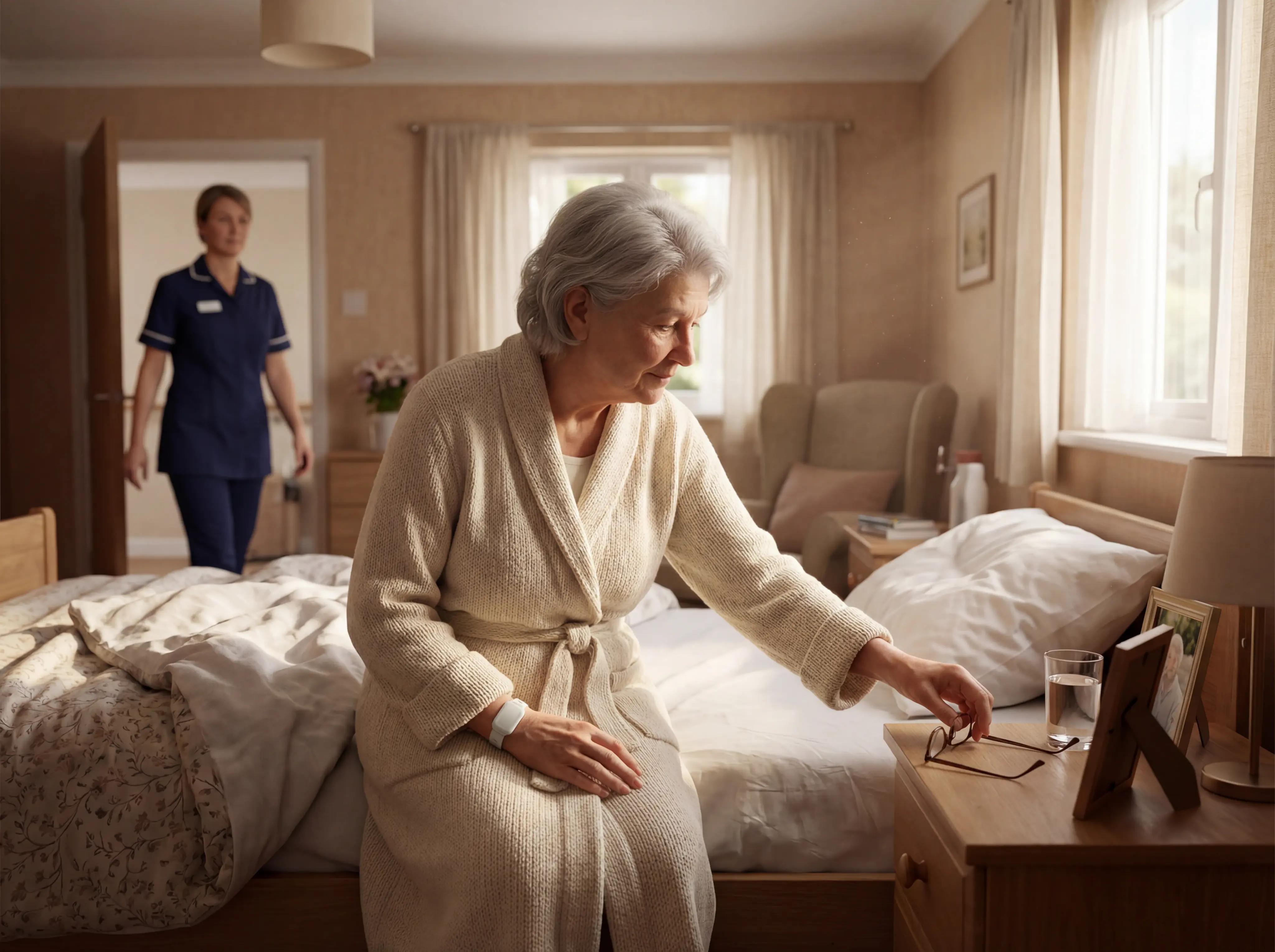
Bed sensors used in a care-home monitoring system

Resident fit

Who needs a bed alarm?

Bed alarms are used for residents who cannot safely leave bed without assistance.

The right setup depends on mobility, cognition, medication, recovery stage, and the level of supervision available in the ward or home.

Previous falls

Repeated incidents signal ongoing risk that should not rely only on scheduled rounds.

Dementia or cognitive impairment

Residents may forget to call for help or leave bed without understanding the risk.

Balance or gait problems

Unsteady movement makes any unsupported exit dangerous, especially at night.

Muscle weakness

Weakness limits the ability to recover from a stumble or misstep.

Sedating medications

Medication can impair coordination and reaction time during overnight exits.

Post-surgical recovery

Pain and residual anaesthesia can make independent movement unsafe.

Types of bed alarms

The four main bed alarm types

Bed alarms fall into four main types, each triggering at a different point in the exit sequence.
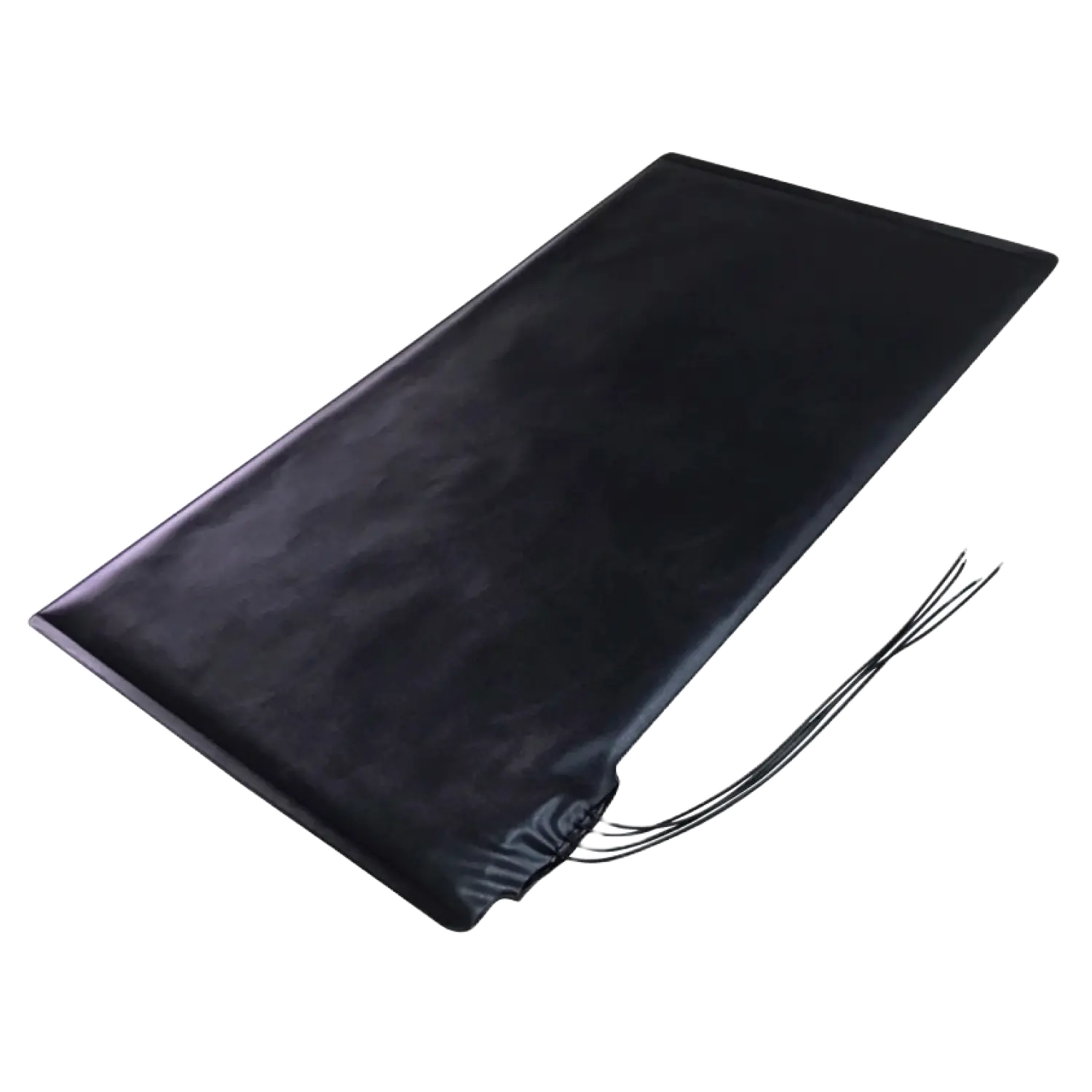
Pressure pad bed alarm sensor

Pressure pads

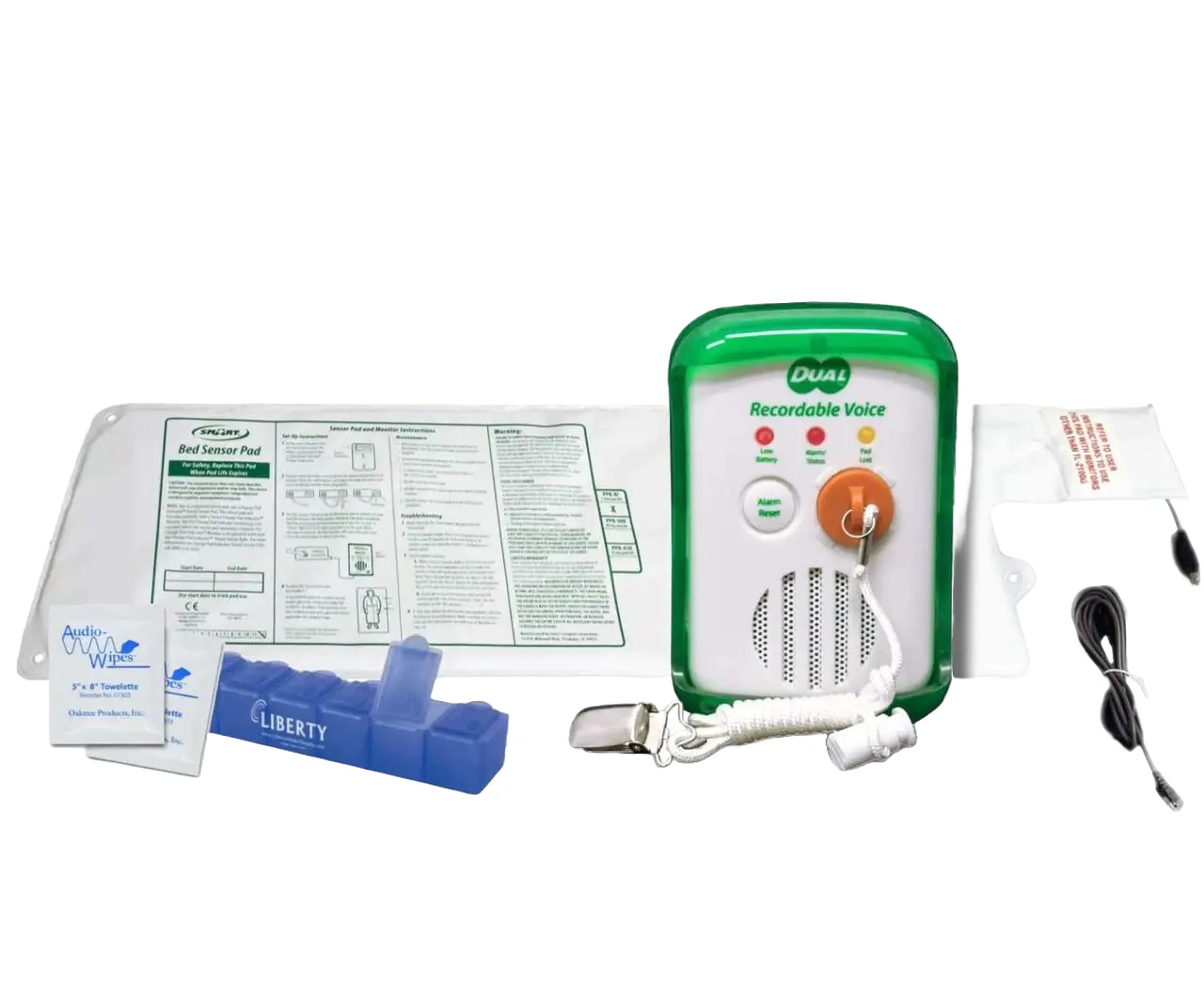
A foam pad under the sheet that triggers when the resident's weight lifts off; simple to deploy but gives no room context.
Early-alert bed alarm sensor

Early-alert alarms

Detects the weight shift before the resident stands, giving staff a few extra seconds to respond.
Under-mattress bed sensor

Under-mattress sensors

Sits between mattress and base, fires before full exit, and nothing needs moving during linen changes.
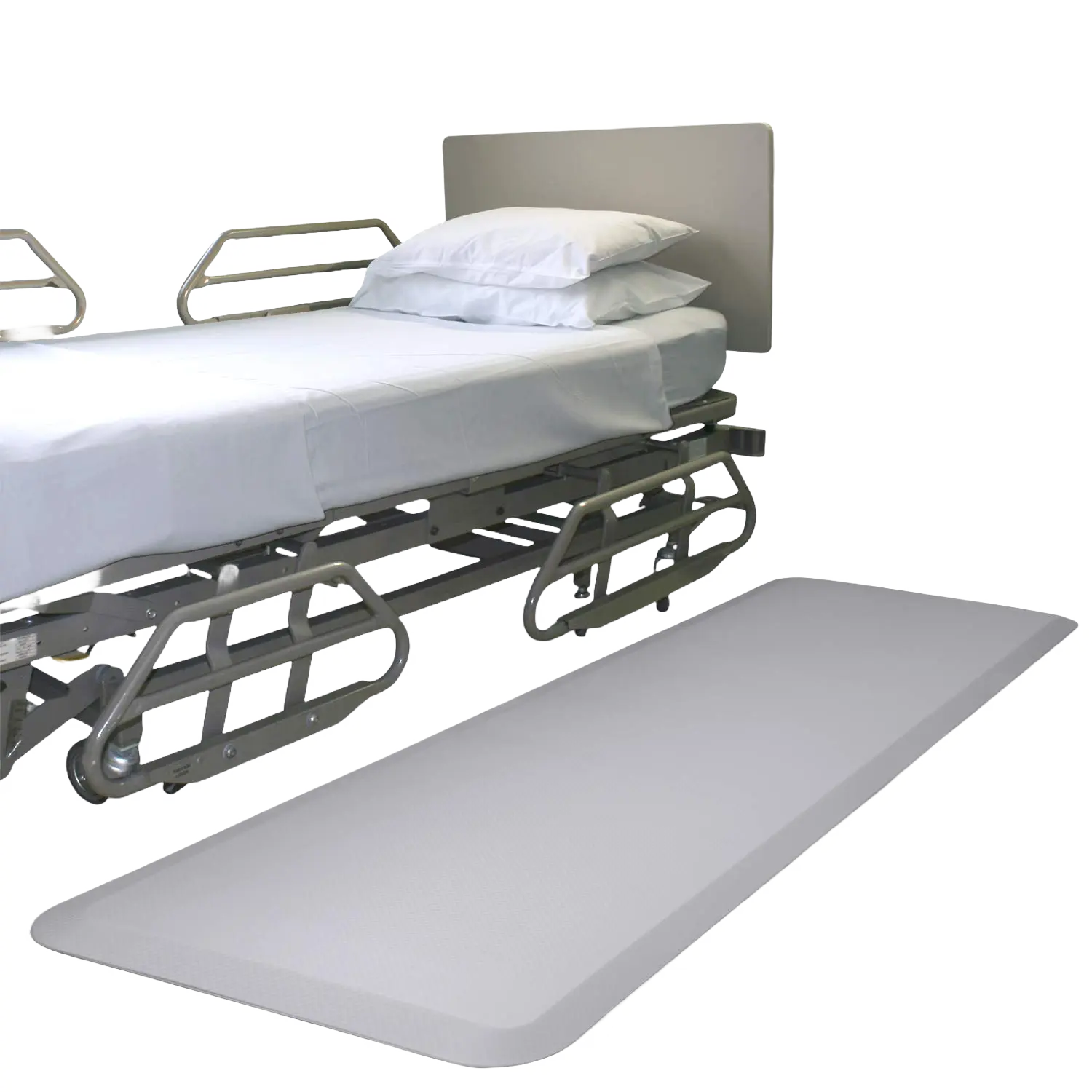
Floor mat bed alarm sensor

Floor mats

Triggers when the resident steps onto it — simplest to deploy but fires after the resident is already up.

Sensor comparison

Which bed alarm type fits which situation?

Knowing what each type does is the first step. Which one fits depends on your resident, your building, and how staff receive alerts.
Sensor typeTrigger pointBest forKey limitation
Pressure padWeight lifts off padSingle-room care, home settingsNo location data; pad disrupted by linen changes
Early-alertResident shifts toward edgeHigh fall-risk residents, multi-bed wardsRequires correct pad positioning to stay accurate
Under-mattressPressure pattern changes pre-exitResidents sensitive to contact; frequent linen changesHigher cost than surface pads
Floor matResident steps onto matBackup layer; low-risk notificationTriggers after exit - too late to prevent a fall

Buying criteria

How to choose the right bed alarm

Four factors drive the decision. Here's a quick reference before the detail:
FactorLow-risk / home care settingHigher-risk / care facility
Mobility & cognitionMobile resident: pressure-pad or floor matMobile + cognitively impaired: early-alert sensor
EnvironmentAudible alarm in client's home is enough20-30 residents per ward needs silent, routed alerts
Alert routingLocal audio or single-carer appDevice-specific alert with room and bed context
Monitoring typeActive: pendant or call button acceptablePassive: pressure pad, under-mattress, or motion sensor

Selection context

Mobility and cognitive state

A mobile resident who can stand unaided needs an early-alert or pressure-pad alarm. These trigger before a full bed exit, giving staff time to respond.

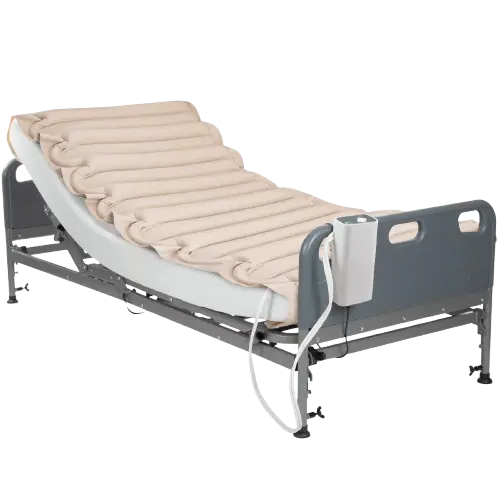
A largely immobile resident may only need a floor mat as a secondary safeguard. Unsupported standing is unlikely, so a floor exit alert is usually sufficient.
Early-alert bed monitoring for mobile residents

Home care vs. care facility

In a home care setting with a single carer visiting a client, a local audible alarm is often enough. In a care facility with 20-30 residents per ward, routed alerts are usually a better fit because staff need room and bed context immediately.

Choose the alert method based on who needs to respond and how quickly they can reach the bed. A carer visiting a home care client may do fine with local audio, while ward staff usually need a quiet alert sent to the right device with the room and bed named.
Caregiver workflow in home care and facility settings

Alert routing

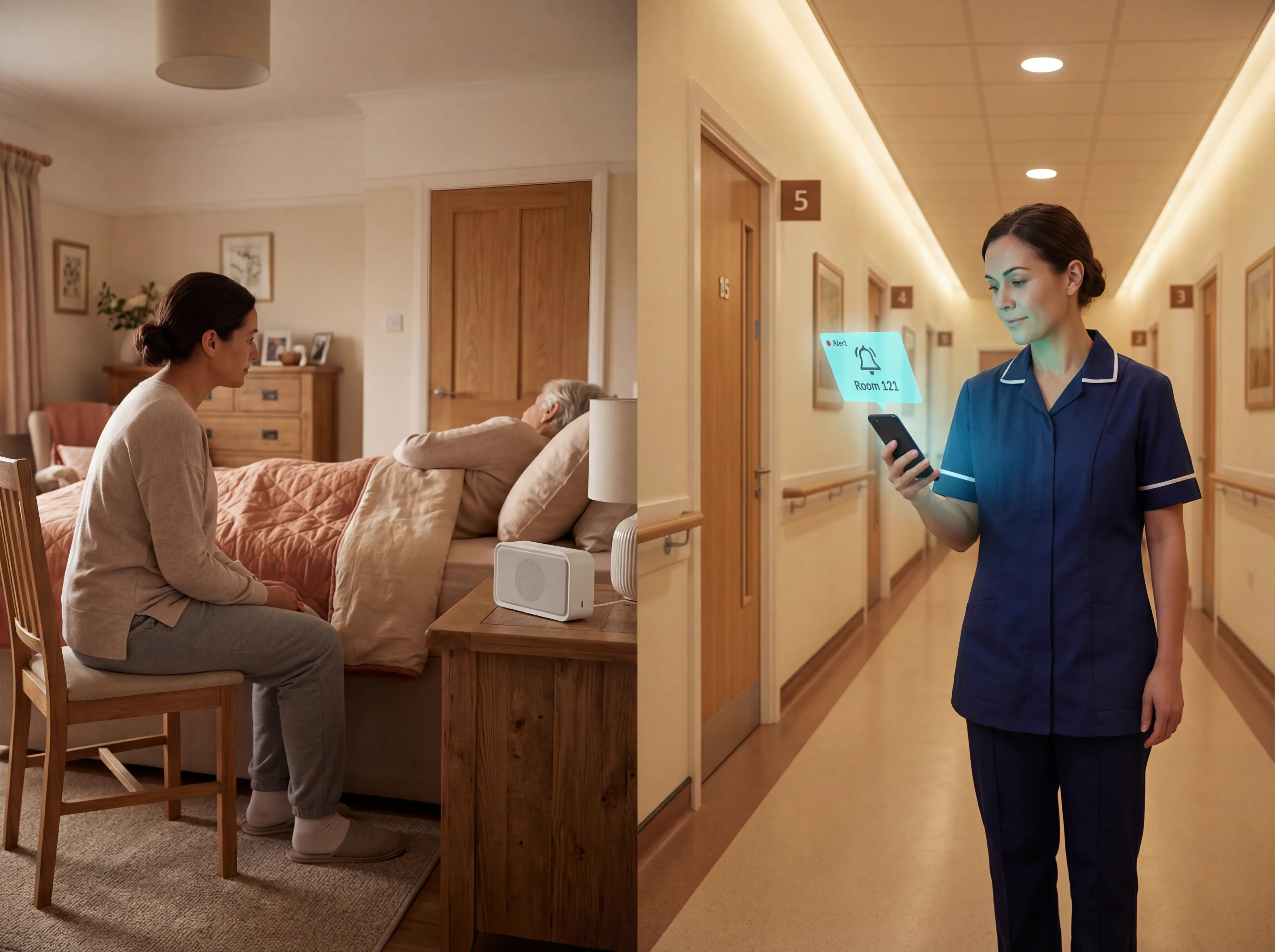
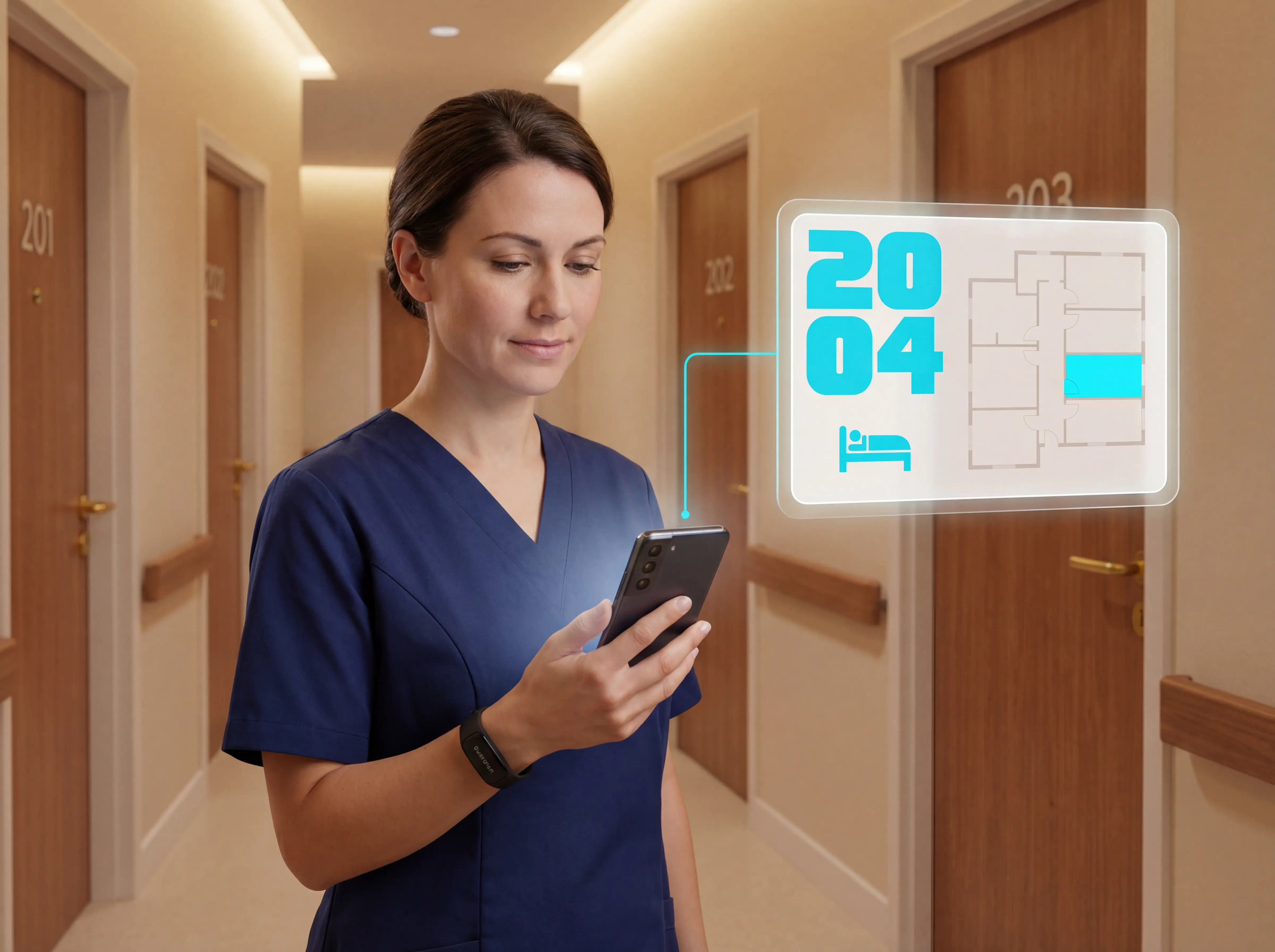
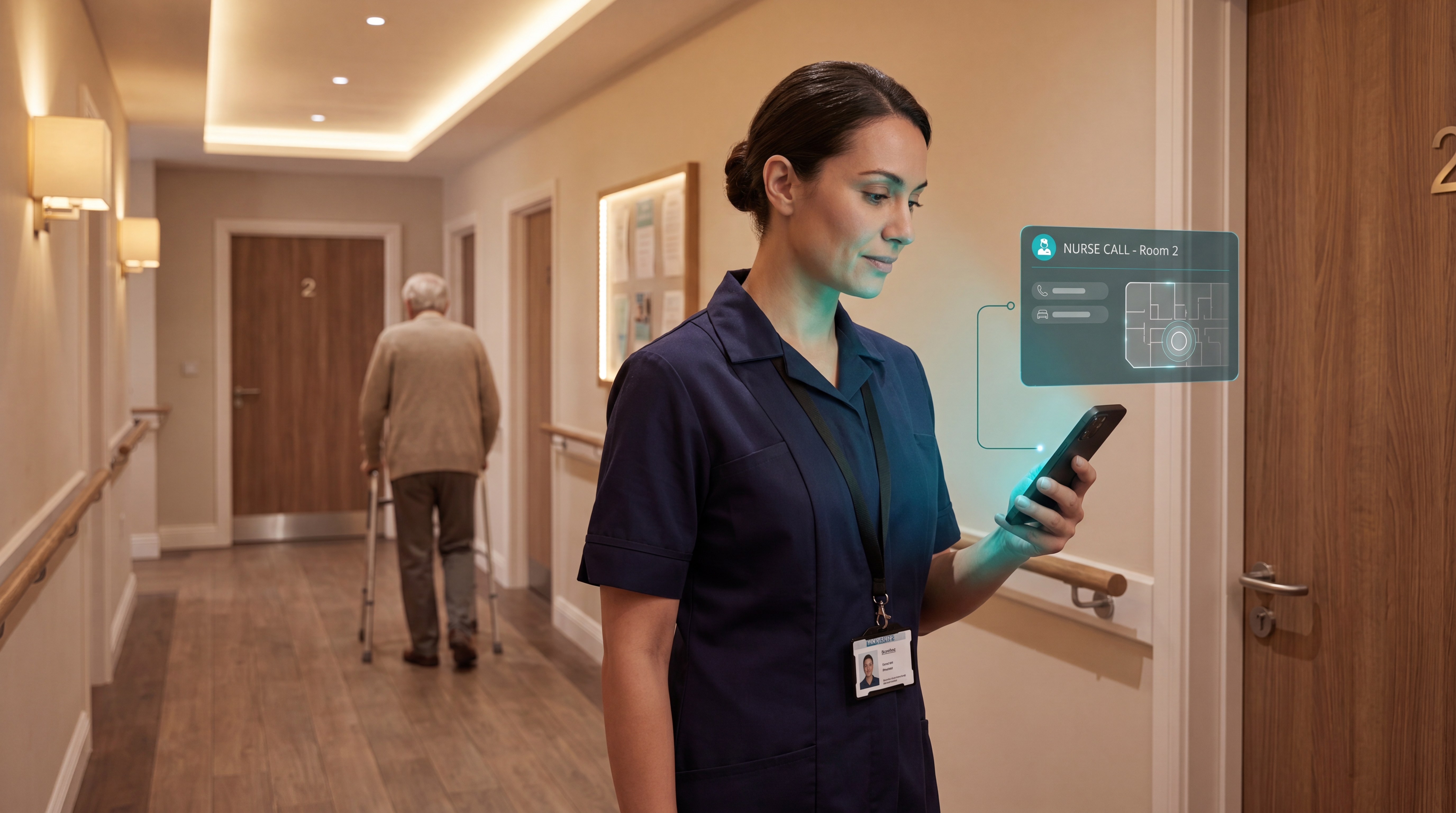
Location-aware routing sends the alert to the right caregiver with the room and bed attached, so staff can respond directly instead of first figuring out where to go. That matters most on larger wards, where one caregiver may be covering several residents at once.

For home care settings, consider where the carer will be during a visit. Some systems reach a carer anywhere in a client's home or off-site via a smartphone app; others are local audio-only.

Systems that integrate with an existing nurse-call setup route alerts through the same workflow staff already use, which reduces the learning curve.
Location-aware alert routing for caregivers

Passive vs. active monitoring

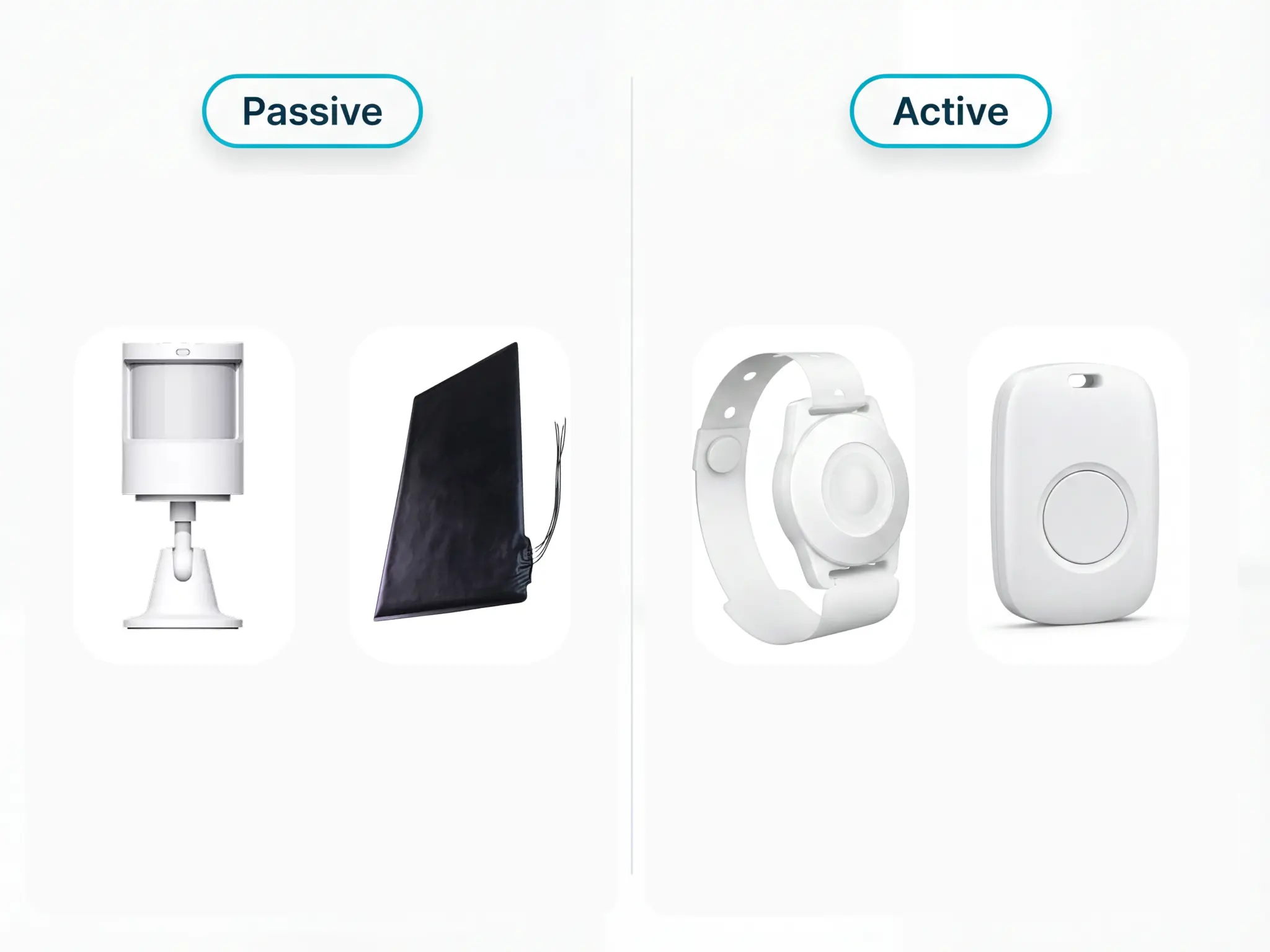
Pendants and call buttons only work if the resident remembers to press them. Falls and confusion events often remove both the memory and the ability to press at the same time.

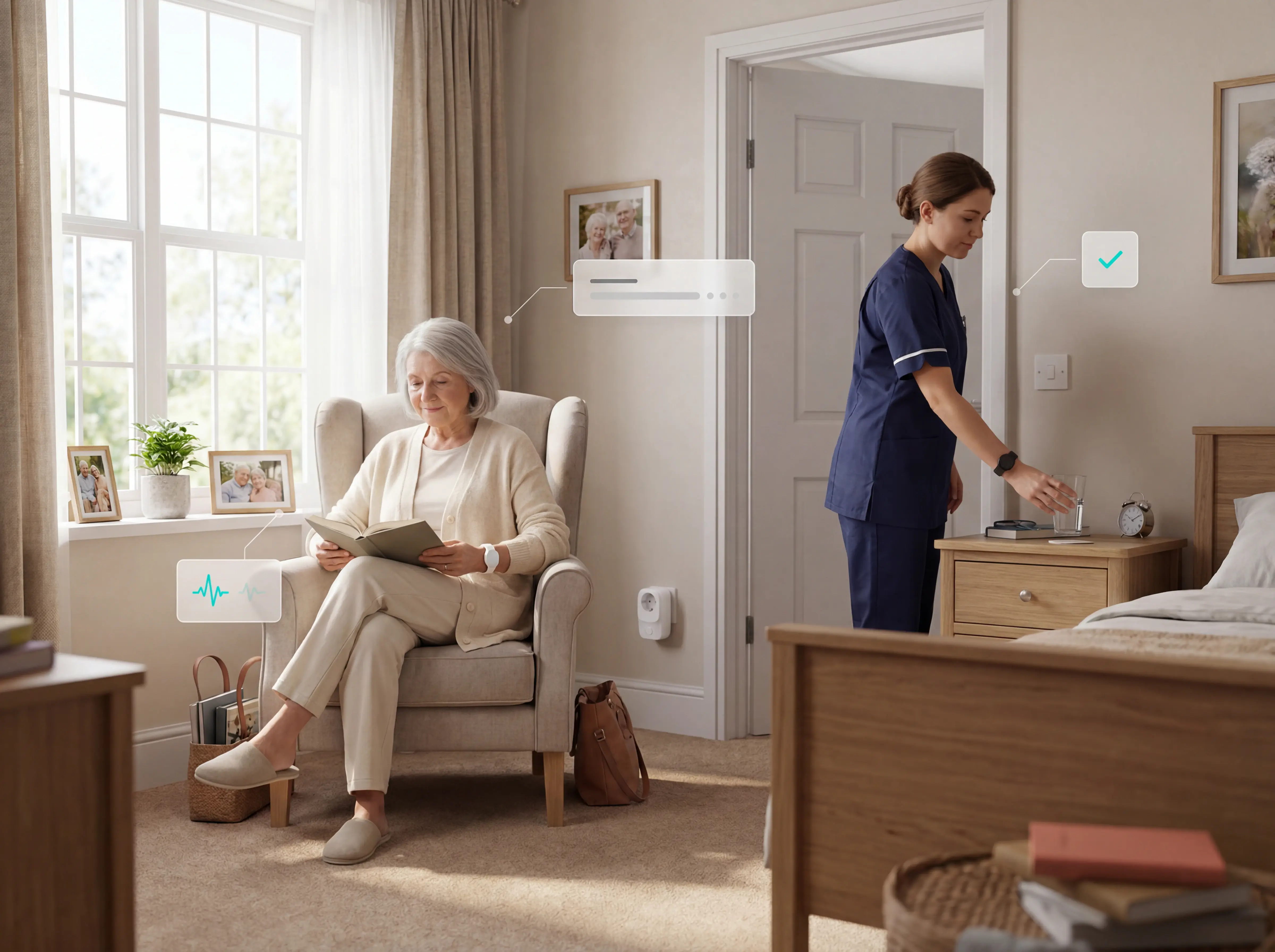
Passive sensors (pressure pads, under-mattress sensors, motion detectors) require no action from the resident and are the safer default for high-risk and cognitively impaired residents. Key differences:
  • Passive sensors — trigger automatically on movement or bed exit; no resident action needed
  • Active devices — pendants and call buttons; resident must initiate the alert
  • Who benefits most from passive — residents with dementia, post-surgical patients, anyone with high fall risk
Passive bed monitoring sensors in resident room

Feature checklist

Key features to compare

The features below determine whether an alert reaches the right caregiver before a fall is already in progress.
  1. 1

    Early detection vs. exit detection

    Exit-only alarms fire when a resident's feet hit the floor. By then, a fall-risk resident is already upright and moving, and staff have seconds to close the distance.

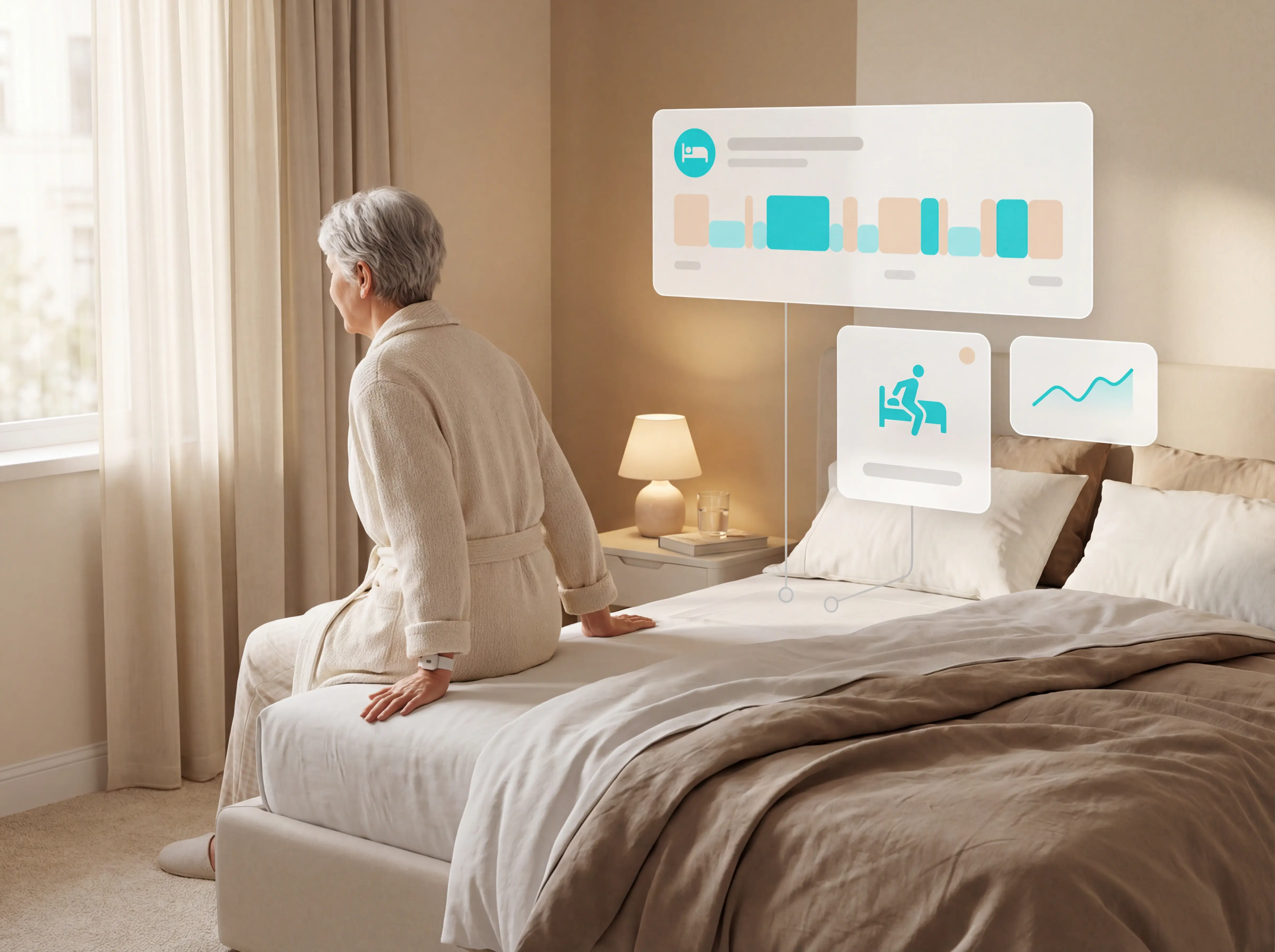
    Early-alert systems detect the shift in weight and posture that precedes a bed exit, giving caregivers a 30-60 second window to reach the room before the resident stands.

    Look for systems that distinguish repositioning from rising, so overnight shifts are not flooded with false alerts.
  2. 2

    Alert routing and location context

    A standalone alarm that beeps at the nurses' station tells staff nothing about which room, which bed, or which resident triggered it. The result is a manual search across the ward while the resident is already mobile.

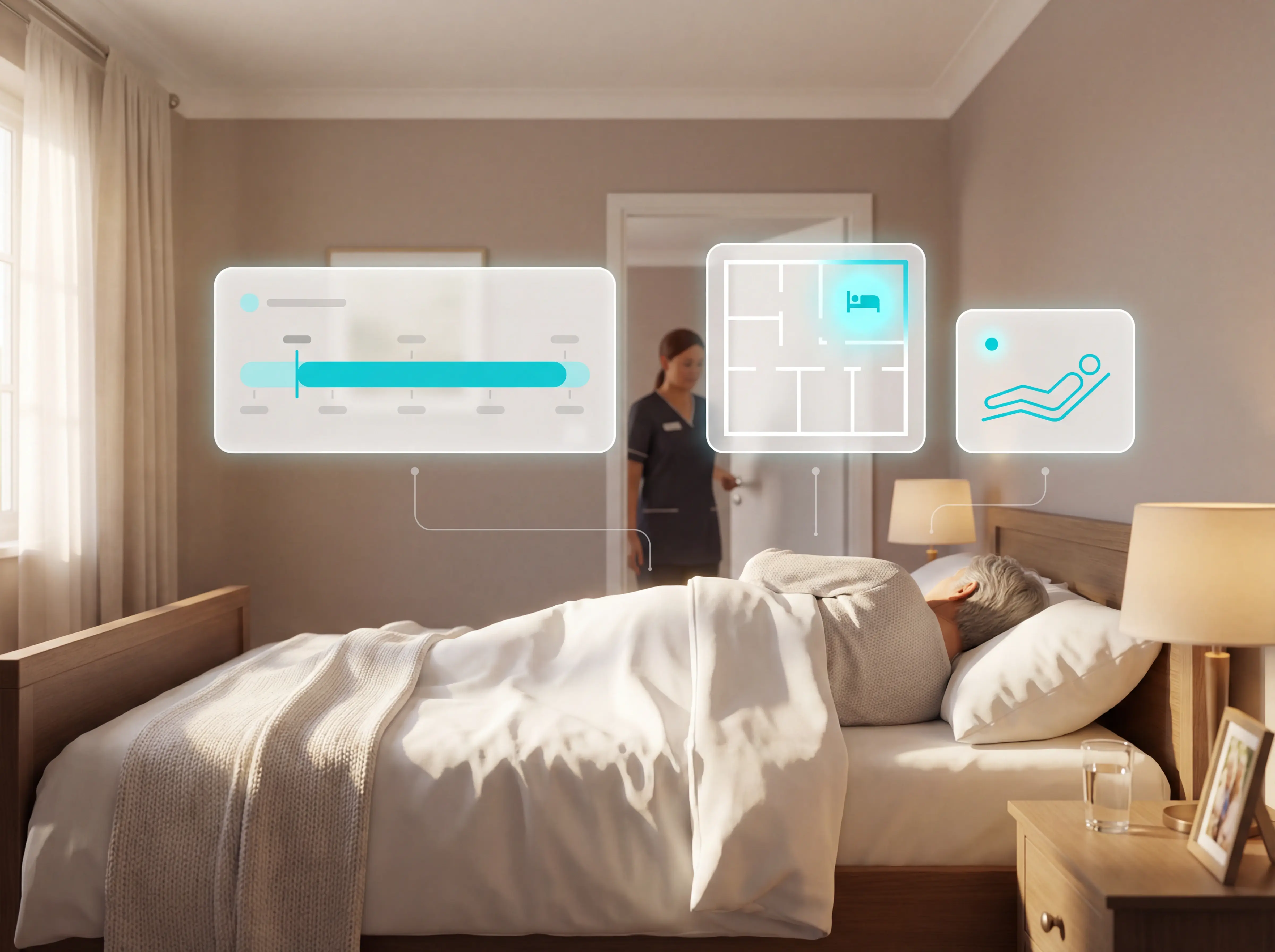
    In a 30-bed ward, floor plan mapping that pinpoints the exact bed can cut response time from several minutes to under one minute.

    A beep from the nurses' station is a search. An alert naming Room 4, Bed B on the floor plan is an instruction.
  3. 3

    False alarm filtering and alert fatigue

    Alarms get muted because they cannot distinguish a resident turning over from one attempting to stand. Without room or time-of-night context, every movement triggers the same noise.

    Configurable rules reduce that noise:
    • Night hours keep sensitivity high for fall-risk residents
    • Scheduled routines like bathroom trips are filtered out
    • Per-resident settings adjust for individual mobility and risk profile
  4. 4

    Wireless range testing

    A quoted range of 400 feet applies to open, unobstructed space. Thick walls, stairwells, and long ward corridors routinely cut actual coverage to less than half that figure.

    Before committing to a system, test coverage on the specific ward layout. A sensor that loses signal in a corner room defeats the purpose.

    Pro tip: Walk the ward with the sensor active and verify signal at the furthest corner rooms and behind stairwells before sign-off.
  5. 5

    Response tracking and incident documentation

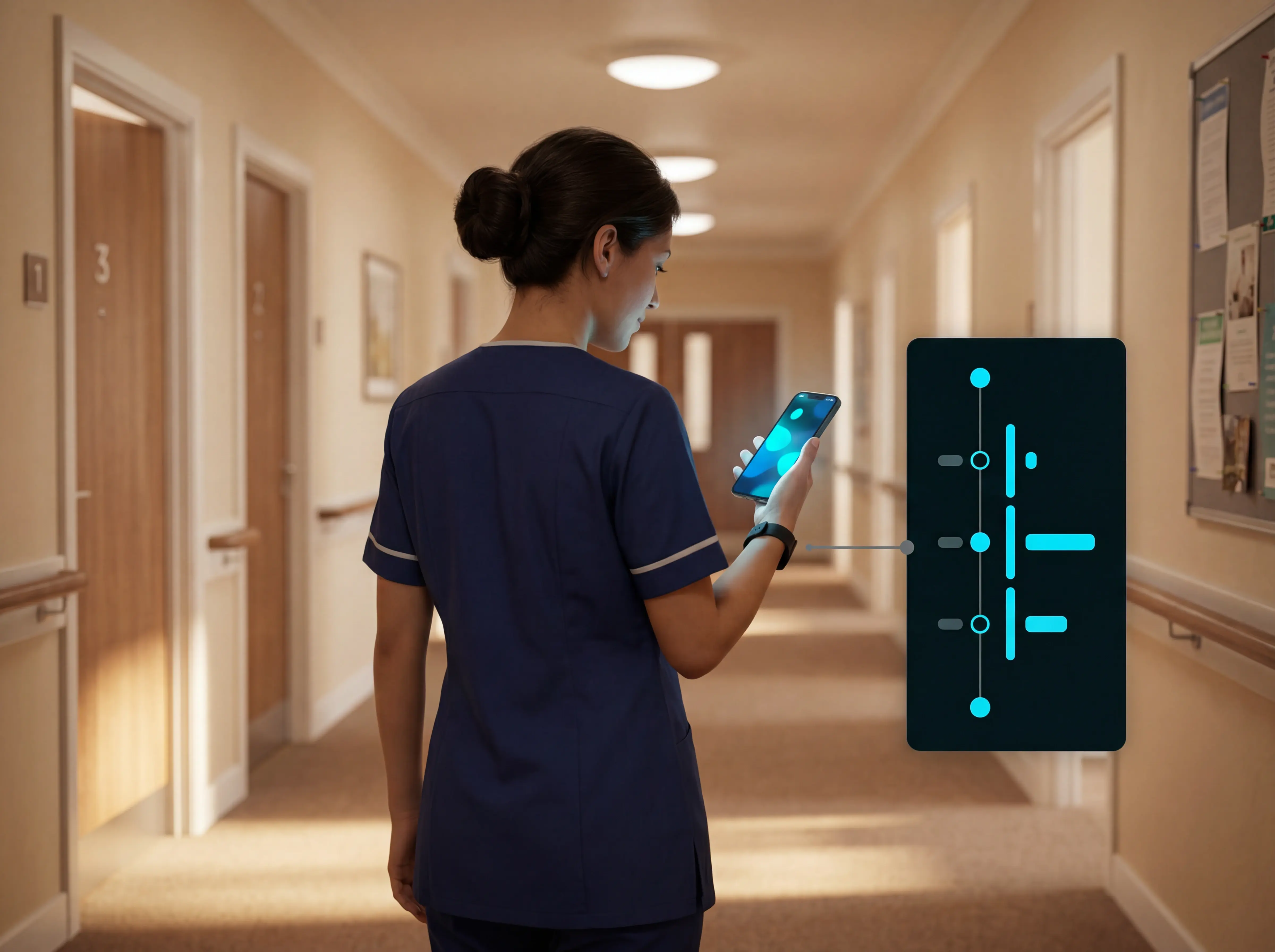
    Standalone alarms leave no record of when an alert fired, how long it took staff to respond, or whether anyone acknowledged it. That gap makes it impossible to spot repeat-incident residents or demonstrate duty of care to regulators.

    A management dashboard closes that gap. Supervisors can review timestamped alert logs, average response times by shift, and patterns across individual residents. Families ask for this evidence. Regulators expect it.

Standalone vs connected

Standalone alarms detect. Connected systems guide response.

The limitation on busy wards is usually not the bed sensor itself. It is the lack of context after the alarm fires.
FeatureStandalone alarmConnected system (Guardian)
Alert destinationAudible beep at nurses' stationNamed alert to caregiver's phone or tablet
Room and bed locationNoneRoom number and bed shown on floor plan
False alarm filteringNoneConfigurable rules per resident and time of day
Response time logNoneTimestamped log with acknowledgement record
Incident documentationManual, paper-basedDashboard with shift-level response data
Wireless range testingNot applicablePilot available before full ward rollout

Care-home reality

When a bed alarm isn't enough

Bed exit monitoring still matters. The limit on busy wards is the standalone audible alarm, not the sensor itself.

The issue is context. Staff need to know which resident needs help, where to go, and whether the alert signals real fall risk.

Three common ward situations show why connected bed exit monitoring works better than a basic bedside alarm.

Advanced dementia changes movement patterns.

Some residents shift weight slowly or leave the bed without fully crossing a pressure pad threshold.

The alarm sound can increase agitation.

For residents with cognitive impairment, a sudden audible alarm can trigger rushing instead of waiting for help.

False positives wear staff down.

When alerts fire too often, staff start to deprioritise or disable them.
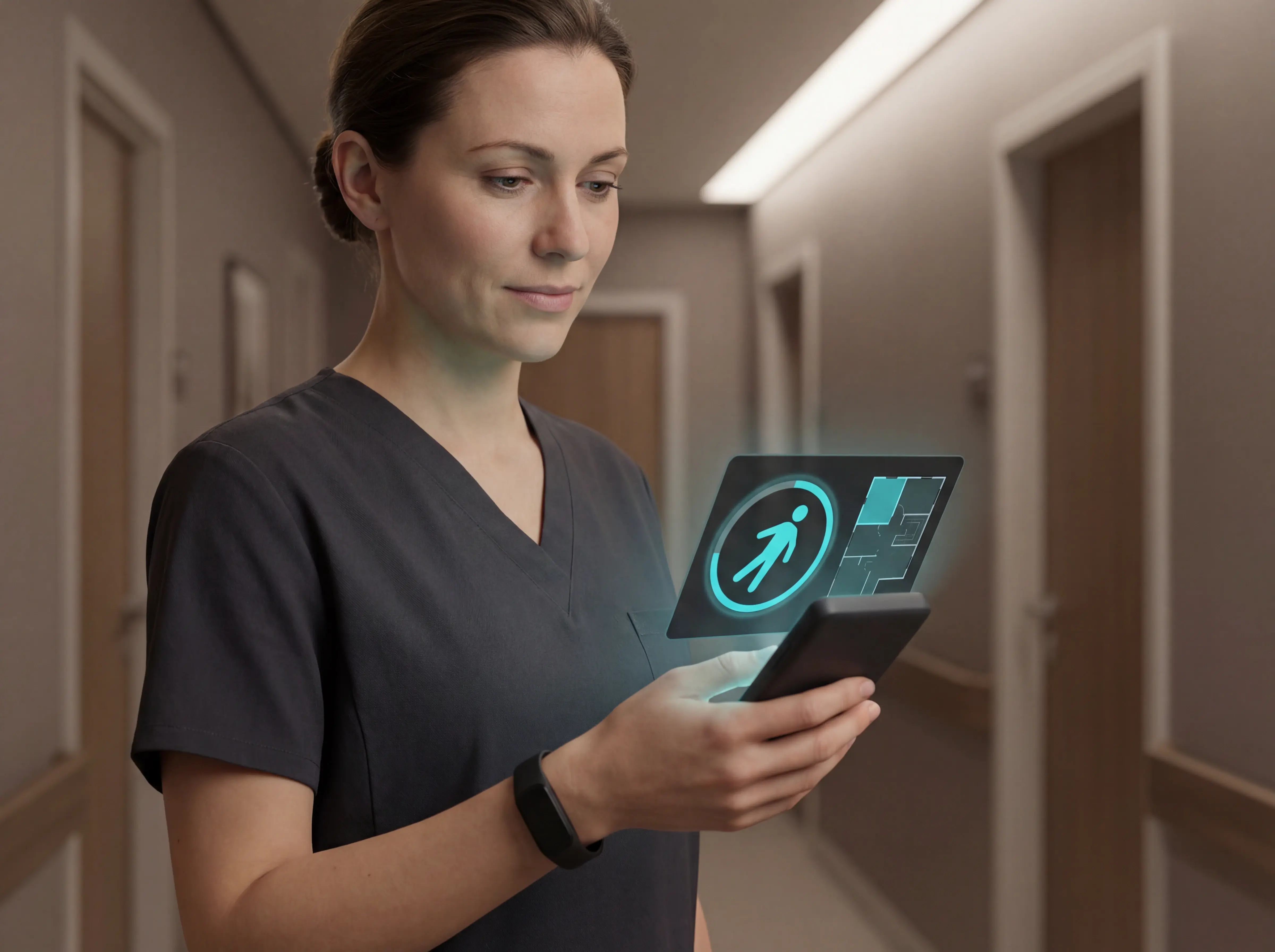
Fall detection and bed exit monitoring in a care environment

Guardian in care homes

How Guardian works in a care home

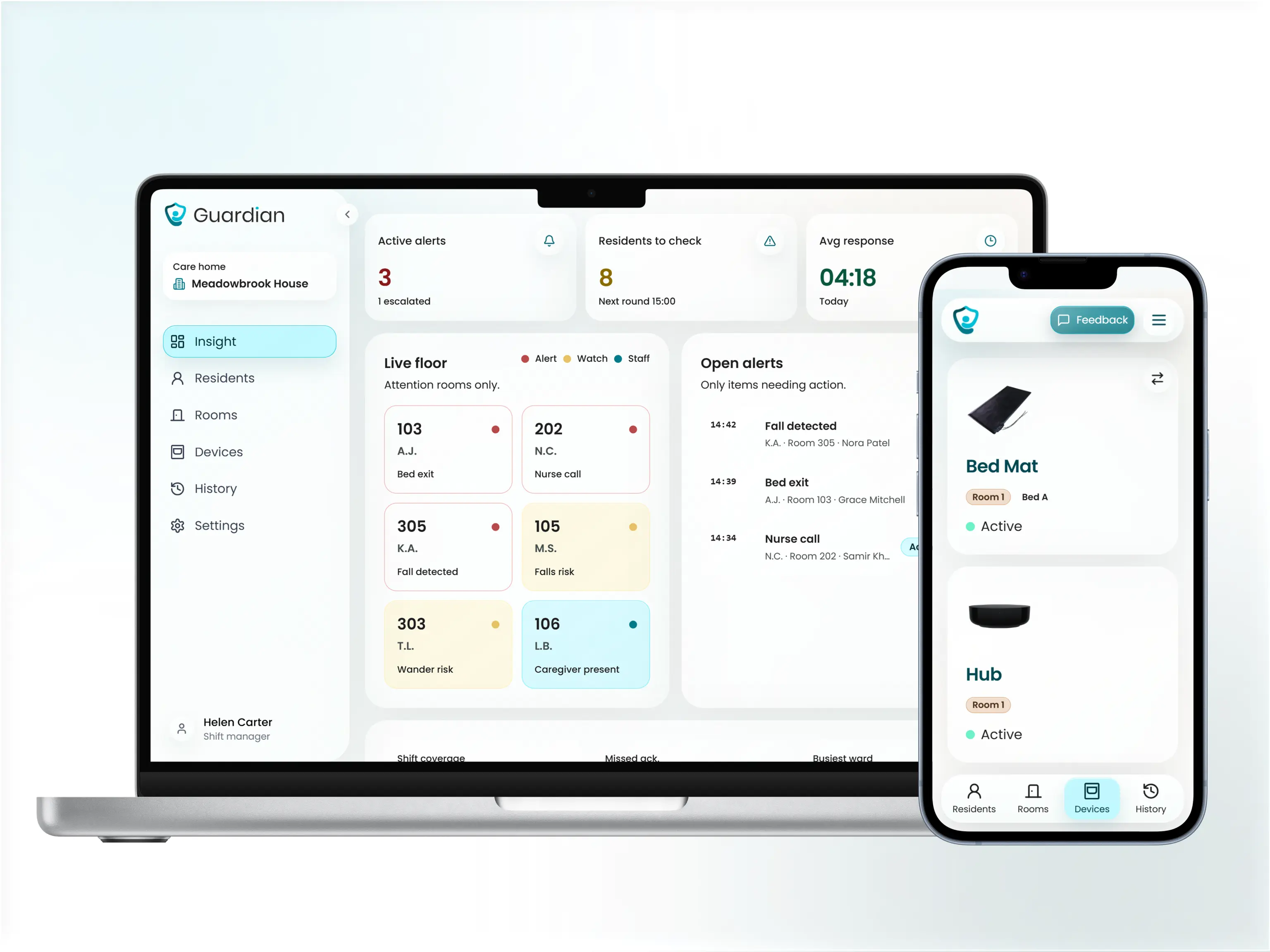
Guardian is a wireless monitoring system built for care homes. No cameras. Sensors on beds, in rooms, and on residents' wrists. Every alert goes straight to staff with the room and bed already named on the floor plan.

A ward can be live within a week. Here is how setup works:
  1. 1

    Sensors arrive pre-configured and ready to place

  2. 2

    Staff attach them with adhesive pads. No drilling, no cabling.

  3. 3

    Guardian digitises your floor plan and maps each sensor to a room and bed

  4. 4

    A short training session shows staff how alerts work and how to configure rules

  5. 5

    The ward goes live, and monitoring begins

Guardian in practice

Sensors that cover the moments that matter

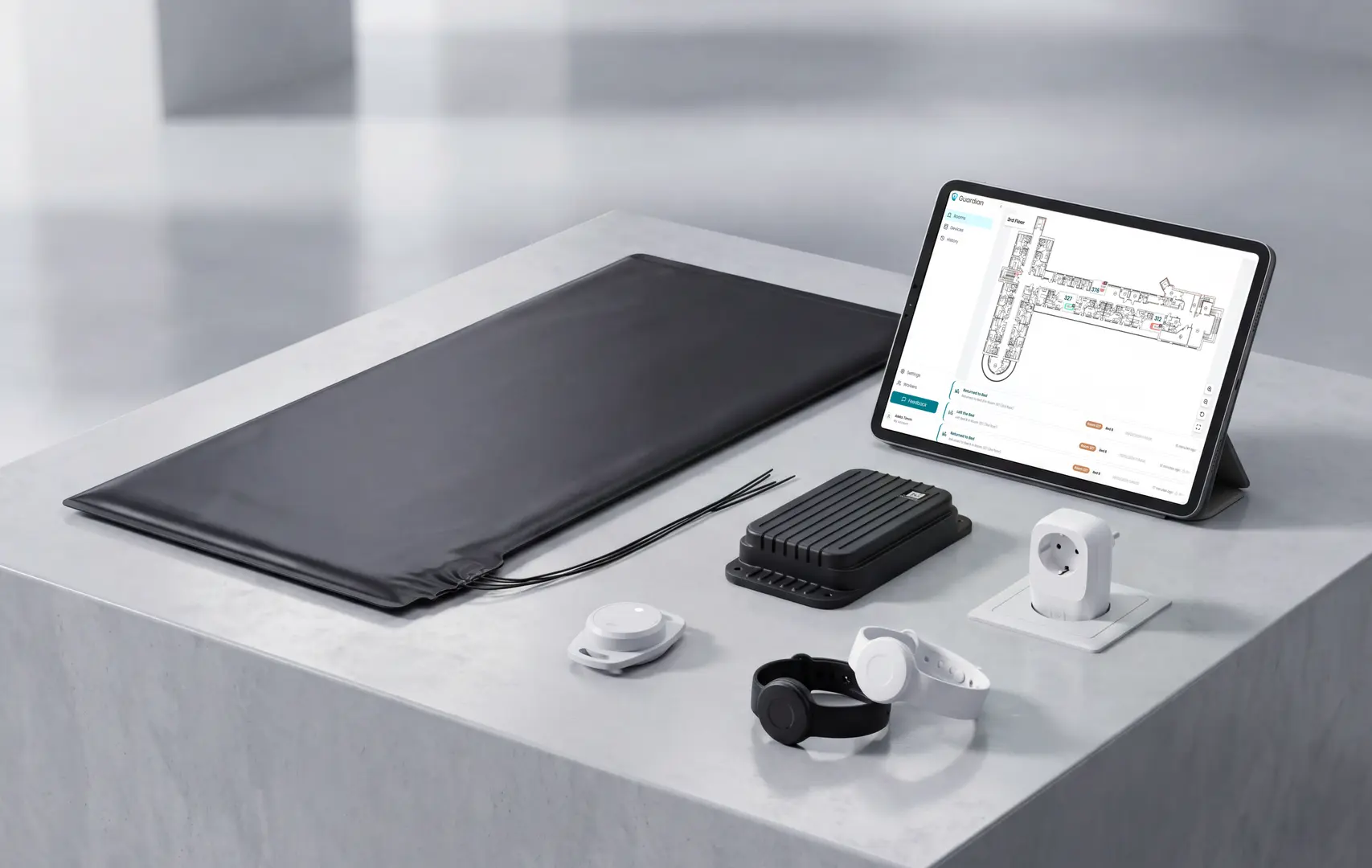
Three sensor types cover the moments that matter most.

An alert from Guardian is not a generic beep. Staff receive a notification tied to a specific room, bed, and resident, so they know exactly where to go before they move.

Bed exit sensors

Detect when a resident leaves their bed.

Motion sensors

Track movement in rooms and corridors.

SOS call buttons

Let residents summon help directly.
Guardian sensors for bed exits, room movement, and SOS calls

Smarter alerts and a clearer management view

Smart alert logic filters out routine movement. Alerts only fire at preset times and flag when a resident has not returned to bed within a set window.

Staff who used to walk every room on a round now respond only when a room actually needs them. Those hours add up. Guardian calculates the saving against your local wage rate so the number is real, not estimated.

The Guardian Portal is a web-based dashboard accessible from any browser, with no software to install. Care managers can track safety metrics, configure notification rules, and review night summaries from one screen.
Guardian Portal dashboard for alerts and night summaries
6-8 weeks
Pilot duration
Run Guardian on a single ward before deciding on a broader rollout.
1 week
Typical go-live window
Sensors can be placed and mapped without drilling or cabling.
30+
Incidents detected
One pilot detected more than 30 events that would otherwise have gone untracked.
€1000+/mo
Capacity freed
One pilot ward freed up caregiver capacity by reducing unnecessary rounds.

Common questions

Patient bed alarm questions

These answers cover the practical and regulatory questions care teams ask before choosing a bed exit monitoring system.
Why can't nursing homes use bed alarms? +
Nursing homes can use bed alarms, but most have moved away from them. The evidence on standalone audible alarms is not encouraging, and regulators now require facilities to justify their use.

In the US, CMS rules require a documented clinical reason, a practitioner order, and evidence that less-restrictive alternatives were tried first. Residents also have the right to refuse.

An alarm that restricts how freely a resident moves can be classified as a physical restraint under federal regulations.

Three findings explain why facilities are cautious:

Clinical evidence: A 2021 meta-analysis of three randomised controlled trials covering nearly 30,000 patients found that bed and chair alarms increased first falls by 19% compared to control groups.

Alarm fatigue: False alarm rates on standalone bed alarms run between 50% and 99%. When more than 80% of alerts are false positives, staff stop treating them as urgent.

Reduction findings: Facilities that reduced alarm use saw fall rates hold steady or improve. The alarm itself was not the protective factor. What mattered was the quality of the response.

These findings point to the same gap: a loud beep does not tell staff which resident needs them, how urgently, or where to go. The alarm detects. The response is still a guess.

Guardian addresses that gap directly. Every alert names the room, the bed, and the resident. Staff know where to go before they leave the corridor. That is what turns detection into response.
Is there an alarm for when someone gets out of bed? +
Yes. Several device types can alert caregivers the moment a resident leaves their bed.

Standard pressure pad alarms sit under the bed sheet on top of the mattress and trigger when the resident's weight lifts off the pad.

The types section above covers the full range of sensor options and their trade-offs.

Key factors to compare when choosing a bed exit alarm:
  • Sensitivity and false-alarm rate - traditional pressure pads average around 36% false alarms; advanced sensor systems approach near-zero
  • Alert routing - direct to staff smartphones, tablets, or nurse-call systems
  • Connectivity - wireless versus wired
  • Sensor type - pressure pads, infrared beam sensors, radar sensors, or wearable tags each suit different resident profiles

Position-change alarms can be classified as physical restraints for some residents if they inhibit freedom of movement. They are not automatically considered non-restrictive alternatives under CMS guidance.

Bed exit alarms work best as one layer in a broader fall-prevention plan, alongside scheduled rounds and individualised risk assessments.
Are personal alarms for the elderly free? +
It depends on where you live. Free or subsidised alarms exist in several countries. Whether you qualify depends on where you are and your care situation.

Free or subsidised personal alarms are available in several countries. UK councils can provide them after a social care needs assessment, US Medicaid HCBS waivers cover personal emergency response systems in over 40 states, and Ireland's Seniors Alert Scheme offers free equipment for people aged 65 and over living alone with limited means.

For care homes, the question is usually different. The cost of a monitoring system needs to be weighed against the staff time it saves and the incidents it catches. Guardian's pilot runs on a single ward over 6 to 8 weeks and gives you a full impact report before any commitment to a wider rollout.

Move beyond standalone bed alarms

Turn bed exit detection into faster care response

Guardian gives care teams the room, bed, resident context, and response history behind every alert. Start with one ward and receive a full pilot report with response times, incident data, and a rollout plan before any wider commitment.
Request a pilot