

Nurse Call Systems for Care Homes
In this article
Nurse call systems vary more than their spec sheets suggest. The architecture (wired, wireless, or hybrid), how alerts are routed, and whether the system supports passive monitoring without button presses all determine how useful the system actually is on a busy ward.
This guide covers the differences between wired, wireless, and hybrid systems, the features that matter most for resident safety and staff response, and how to run a structured pilot before committing to a rollout.
What is a nurse call system for a care home?
A nurse call system for a care home is a dedicated communication network that lets residents request help and enables staff to receive, prioritise, and respond to alerts in real time.
More than 50% of people living in residential care facilities or nursing homes fall every year. Residents are typically elderly with complex health needs, so a delayed response to a fall or medical event can quickly lead to serious injury.
CQC inspection records include examples where three-quarters of a care home's falls happened during the night shift, when staffing is thinnest. That gap between when incidents happen and when staff find out is what nurse call systems are designed to close.
A basic system includes three elements: a resident-facing alert device (pendant, wrist button, or pull cord), a central hub or controller that receives and routes the signal, and a staff notification output such as a corridor display panel, pager, or mobile app.
Wireless and IP-based systems add motion sensors, bed-exit sensors, and environmental detectors (smoke, flood, carbon monoxide) that trigger automatic alerts without requiring the resident to press anything. These cover residents who cannot press a button.
How a care home nurse call system works
A resident presses a call button or wearable device, which sends a signal through wired, wireless, or IP infrastructure to alert nurses via corridor displays, pagers, or mobile apps in real time.
Wired systems transmit signals over physical cabling to a central controller, which routes the alert to corridor display panels outside the resident's room. IP-based and wireless systems send alerts directly to nurse apps and mobile devices, with no cabling required.
Wireless and IP-based systems can include real-time location modules, so each alert carries the resident's room or zone. Staff see not just that an alarm has fired, but exactly where to respond.
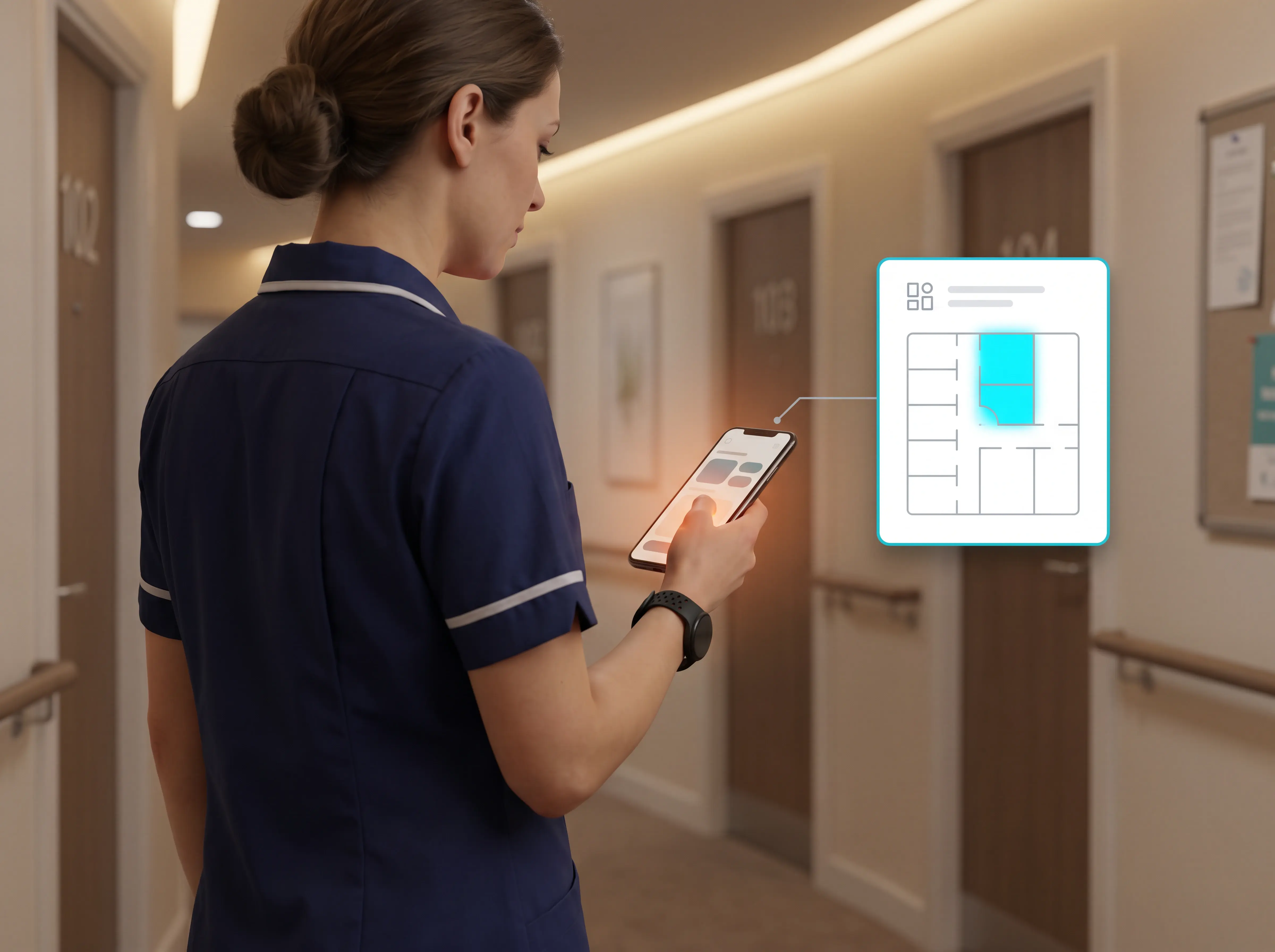
Systems like Guardian's Internal Positioning System map location data onto a live floor plan, so staff see alert and position simultaneously.
When an alert fires, multiple endpoints activate at once.
In wireless setups, resident tags also relay live location to a monitoring station, so staff see the alert and the resident's position together.
Corridor lights illuminate outside the resident's room
Central display logs the call with resident name and location
Staff receive a notification on their pager or smartphone app
IP-based systems with EHR integration pull in clinical context alongside the alert, so caregivers arrive at the room informed.
High alert volumes create alarm fatigue: staff become desensitised over time and begin missing critical events, especially when alert thresholds are not calibrated to each resident's baseline.
Smart alert rules reduce volume by 30-50% through time-based suppression, threshold rules calibrated to each resident's baseline, and behaviour profiles built up over days. The critical constraint: SOS and fall triggers must remain non-suppressible regardless of rule configuration.
Call lights are also frequently ignored when staff are occupied with tasks like medication passes, even when a resident has fallen or needs urgent help.
Types of nurse call systems
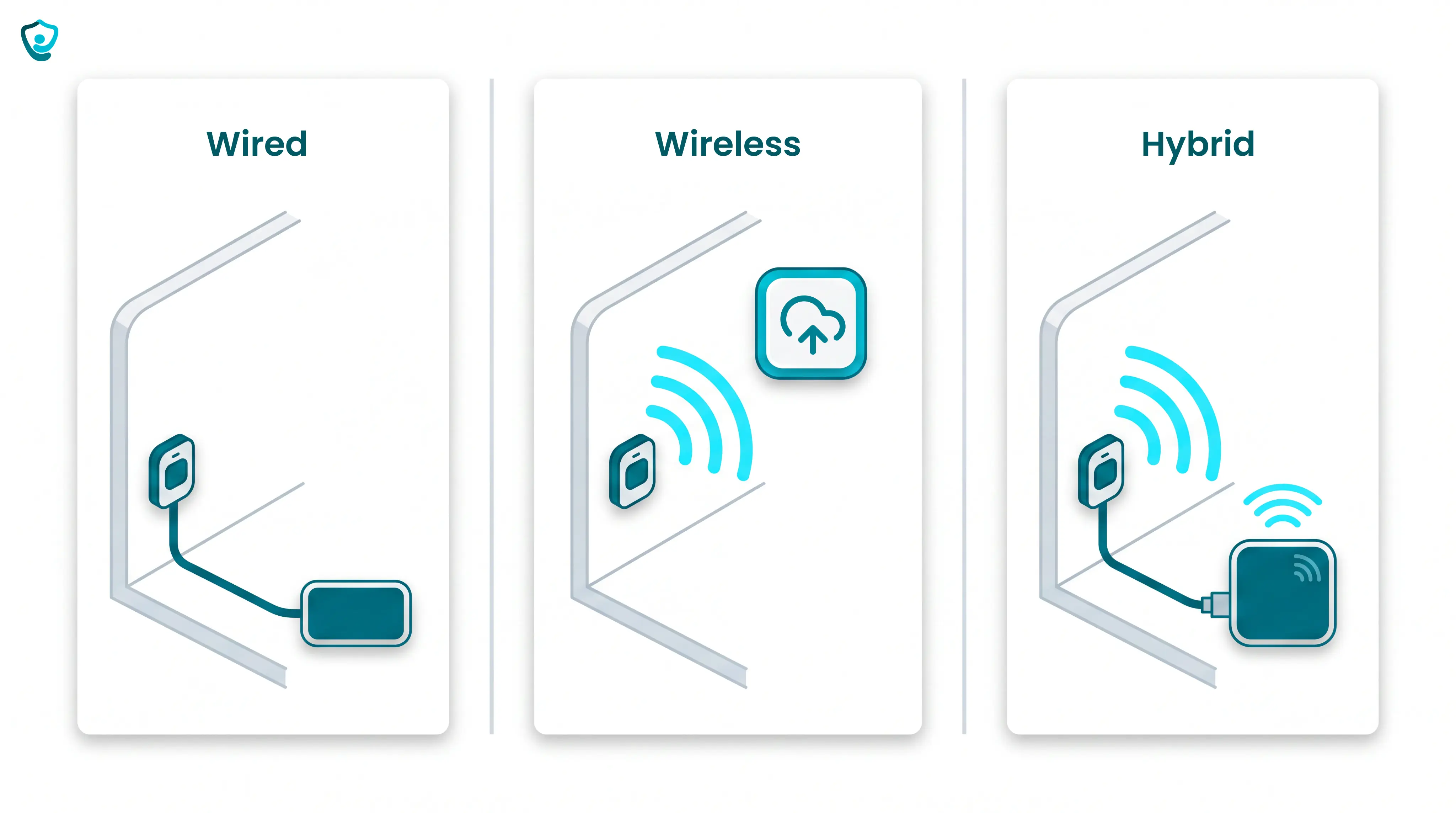
Nurse call systems fall into three categories: wired, wireless, and hybrid. For most UK care homes, wireless is the practical starting point. Wired suits new-builds where cabling goes in before the walls close; hybrid is a sensible bridge when existing wired infrastructure still works.
System Type | Best for | Typical install | Main limitation |
|---|---|---|---|
Wired | New-builds | Weeks (cabling phase) | Disruptive to retrofit |
Wireless | Existing occupied homes | About 1 week | Needs Wi-Fi coverage |
Hybrid | Homes with existing wired base | Varies | Complex integration |
Wired systems
Wired nurse call systems transmit alerts from resident call points to central consoles via physical cabling installed through walls, floors, and ceilings.
Wired systems are a reliable choice for new-builds, where cabling can be designed into the construction phase before walls and floors are finished. Retrofitting one into an existing care home means routing cables through occupied walls and ceilings, which typically disrupts residents and staff for weeks.
Wired systems like Cornell's typically monitor bedroom and bathroom call stations and display status on corridor panels outside each room. Call points connect via a shared cable run to a central console, which signals staff through corridor lights and annunciator panels.
Pro tip: if specifying a wired system for a new-build, ask the contractor to run conduit rather than direct cable. Future sensor additions cost significantly less and avoid re-opening finished walls.
Wireless systems
Wireless nurse call systems use radio-frequency signals between resident devices and a central hub, with no fixed cabling required.
A wireless system can be deployed across a full ward in roughly a week, including delivery, configuration, and staff setup. No wall or ceiling penetrations are needed, making wireless practical for occupied care homes where construction would disrupt residents mid-care.
Wireless systems with pre-configured devices typically deploy in days to a week. Wired retrofits in occupied buildings often require 4–6 weeks of contractor access.
Guardian's wireless devices arrive pre-configured and connect directly without a central hub. SOS wristbands, motion sensors, bed exit sensors, and environmental monitors such as fridge and stove sensors all pair wirelessly. Adding a sensor to a new room takes minutes, with no cable routing and no contractor visit.
Passive sensors matter because they detect emergencies automatically when a resident cannot press a button, covering the gap that button-only systems leave for residents with dementia or reduced cognition. A bed sensor fires an alert the moment a high-fall-risk resident gets up at night, regardless of whether they are able to call for help. Motion sensors track room-level activity through the night shift, flagging unusual stillness or unexpected movement without cameras.
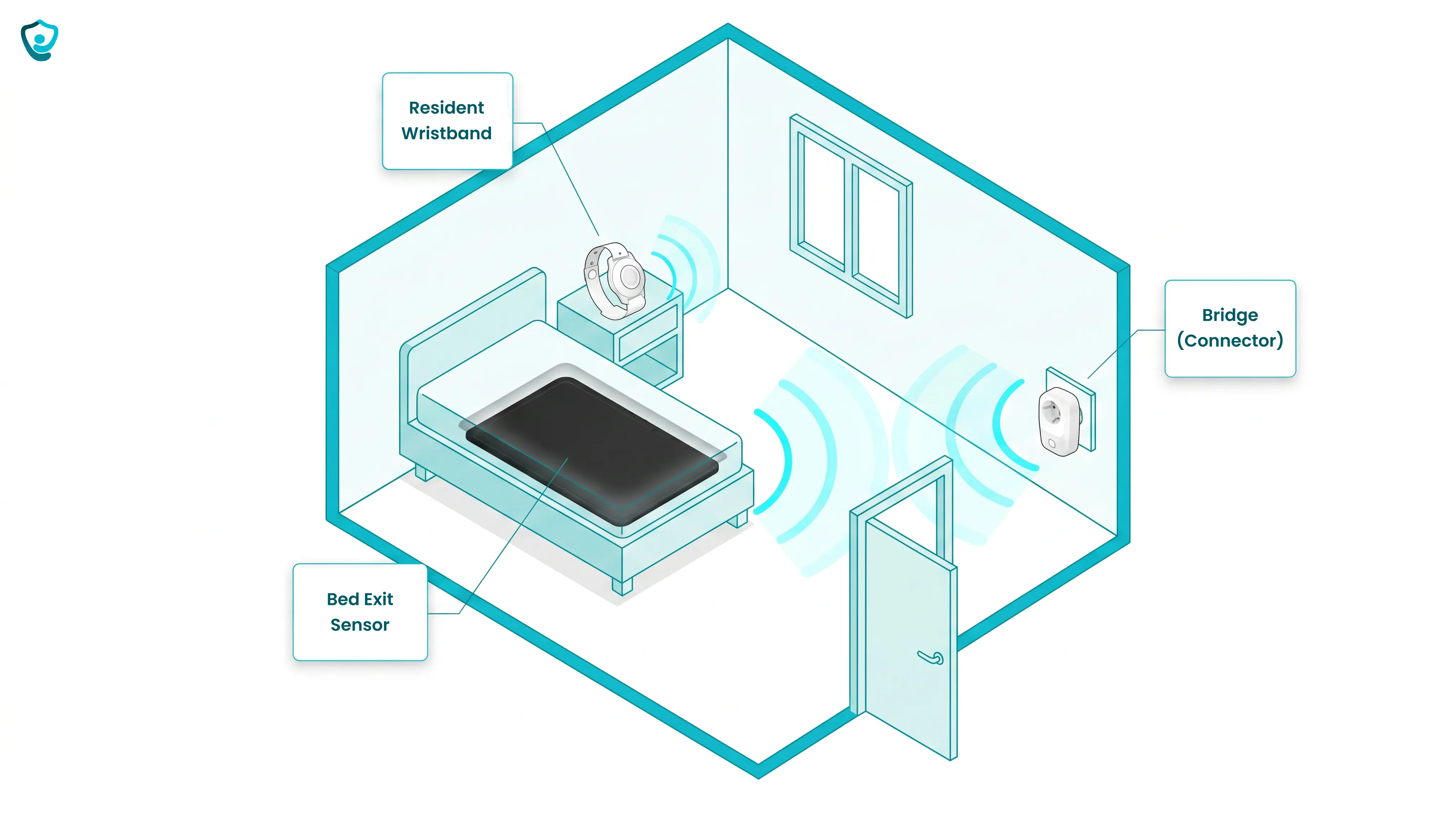
Guardian, for instance, combines SOS wristband alerts with bed exit and motion detection in one wireless platform. Environmental monitors for fridge and stove add routine-deviation detection, useful where residents retain some independence.
Hybrid systems
Hybrid nurse call systems combine a wired backbone infrastructure with wireless devices, allowing care homes to extend or modernise existing installations without full rewiring.
Care homes with a functioning wired system can add wireless call points and sensors to new wings or refurbished rooms without replacing the central infrastructure. Tunstall platforms, for example, support peripheral wireless sensors including fall detectors, smoke alarms, flood sensors, and CO detectors, all layered onto an existing base station.
Whichever architecture you choose, the system is only as useful as the features running on top of it.
Core features to look for
A nurse call system is only as effective as its weakest layer. The right setup covers resident-facing safety hardware, how alerts reach and move between staff, and the reporting tools that let managers spot gaps before they become incidents.
Resident safety essentials
Standard nurse call hardware covers four key risk moments:
SOS wristbands for residents who can self-alert
Bed exit sensors for those who may fall when getting up at night
Bathroom call points for slip and fall risk during personal care
Passive motion sensors for residents with dementia or reduced cognition who cannot reliably press anything
Together, wristbands, bed sensors, bathroom points, and motion sensors cover the key risk moments in a resident's day without requiring active input from residents with reduced cognition.
Staff communication and response
When an alert fires, staff need more than a noise. They need to know who, where, and whether someone has already responded.
Real-time alert routing to mobile devices or pagers
Escalation protocols that reassign unanswered calls within seconds
Zone-based duty assignment
Escalation protocols automatically reassign an unanswered alert to the next available caregiver within seconds of the initial call, closing the gap between an event and a response.
Argentum's 2025 Technology Report found predictive analytics is the most common AI/ML use case among senior living operators, cited by 70% of respondents.
Alerts reach staff through wearable pagers, smartphones, or fixed display panels, depending on system configuration and building layout.
Ascom's Telligence nurse call system routes alerts to mobile devices and integrates with nurse station infrastructure, so staff receive notifications wherever they are on the floor, including during handover periods when fixed panels go unmonitored.
Common mistake: routing all alerts to every staff device on the floor. This creates noise rather than accountability.
Alerts need to reach a specific role, not everyone simultaneously.
Ask vendors for alarm frequency reports from live deployments, not demo environments.
Monitoring, reporting, and management
Monitoring and management features include:
Real-time location tracking
Activity and bed-exit sensors
Software dashboards that log events, generate compliance reports, and surface response-time metrics
Digital reporting gives managers queryable records of response times, alert logs, and round completion. These are the records CQC inspectors increasingly expect when assessing safe, well-led care.
72% of adult social care providers in England have moved to digital social care records, driven partly by national mandates for accurate, real-time data sharing.
The NHS Transformation Directorate's Digital Social Care programme sets the data standards care homes must meet to qualify for NHS-funded digital investment. Nurse call systems that export structured data are better placed to meet those requirements.
Monitoring dashboards draw data from bed exit detectors, motion sensors, door contacts, and fall detectors, each feeding a continuous activity log that managers can query after any incident. A 5-minute response time from alert to arrival is a useful baseline to measure against when evaluating pilot data.
Ask vendors for a before/after measurement framework. Record baseline response times for four weeks before installation, then compare against pilot period data.
For broader facility visibility, the facility-wide senior monitoring roundup compares systems that extend beyond call handling alone.
Civica RTLS In Motion provides room-level location tracking and supports wander management and elopement alerts. Tunstall platforms extend coverage further, integrating automatic fall detectors, smoke alarms, flood sensors, and CO detectors into a single central monitoring station.
Which system suits your care home?
The right nurse call system depends on three factors: your building type (new-build vs. existing), your resident care profile (general elderly, dementia, or high-acuity), and your budget and growth trajectory. Use the questions below to narrow the field before approaching vendors.
New-builds suit wired or hybrid systems: cabling goes in during construction at lower cost, with no disruption to residents. Existing care homes typically benefit from wireless systems, because retrofitting cabling through occupied buildings is disruptive and costly.
Existing homes with a functioning wired base may benefit from a hybrid extension rather than full wireless replacement, adding wireless call points to new wings while existing wired infrastructure handles current rooms.
Dementia residents need wandering detection, door alerts, and simplified call points they can operate without confusion. High infection-control settings benefit from sealed touchscreen call points that can be sanitised without mechanical wear.
Basic tone-and-visual systems allow a phased start, with networked voice or touchscreen capability added as needs expand. Systems that deliver alerts to devices staff already carry, such as smartphones and tablets, reduce upfront hardware costs and cut training time.
Fall response triggers documentation, family notification, and clinical assessment protocols, so the system must fit into those existing care home workflows, not operate in isolation. Mapping those workflows before you approach vendors is the first of five checks. Each step below builds on the last.
How to choose the right system
Mapping those workflows before you approach vendors is Step 1 of five. Each step below builds on the last. Skipping any risks buying a system that passes a feature checklist but fails under real shift conditions.
1. Start with a building and workflow audit before talking to vendors
Map your building's layout, number of floors, wall materials, and existing cabling before requesting any quotes. Wired systems require structural access; wireless systems need Wi-Fi coverage verified room by room.
Document how alerts are received today, which devices staff carry, and where response delays occur.
Routing: Confirm alerts go to devices staff already carry. Adding a new app most staff will not check creates noise, not safety.
2. Check your specific compliance obligations early — they narrow the field
UK care homes fall under CQC's single assessment framework. As of August 2025, 29.07% of care homes were rated Requires Improvement and 4.41% Inadequate, meaning 33.48% fell below Good. Any system you buy must support the evidence trail inspectors now expect.
Confirm whether your building category requires specific audible or visual alert standards under national accessibility regulations. Some facilities must meet requirements that dictate alert output types regardless of system preference.
Your Situation | Recommended System |
|---|---|
New-build construction | Wired or hybrid |
Existing occupied home | Wireless |
Existing wired infrastructure working | Hybrid add-on |
Dementia-specialist ward | Wireless with passive sensors |
In the UK, BS EN 60849 covers audible alert performance requirements. Verify whether your facility type falls under its scope before specifying equipment.
3. Assess scalability and deployment speed, not just day-one fit
Ask vendors three questions before committing:
How long does installation take per ward, and does it require contractor access or drilling?
Can the system scale to additional rooms, wings, or sites without full reinstallation?
Is integration with existing nurse station hardware included in the quoted scope?
4. Require a structured pilot with a written impact report before full commitment
A credible pilot should produce a written report covering staff response times, incident prevention data, staff feedback, a clear ROI calculation, and a structured rollout plan. Guardian's pilot model delivers this within 6 to 8 weeks.
A well-run pilot should show measurable reduction in response times. Studies using remote monitoring in care settings have found up to 31% reduction in hospital costs and 49% fewer ambulance calls (npj Digital Medicine). Use your own pilot data as the baseline before scaling.
Agree the success metrics and reporting format with the vendor before the pilot starts, not after. Vendors who cannot commit to a written output are asking for long-term commitment without evidence.
Limit the initial pilot to one ward or team. A contained test with clear metrics is more useful than a broad rollout with no baseline.
5. Clarify support terms and ongoing costs before signing
Common mistake: buyers focus on per-bed hardware costs and underestimate training overhead. When a care home turns over 30–40% of its staff annually, re-training new starters on a complex system adds up faster than the subscription fee.
Falls are among the highest liability risk categories in care settings. The LeadingAge CAST guide provides a useful industry baseline when calculating the cost of inaction against a system's contract price.
Before signing, audit these hidden cost categories:
Hardware and software (including replacement and upgrade cycles)
Installation and contractor access fees
Staff training, both initial and for new hires
Ongoing maintenance and subscription or licensing fees
System upgrade costs as the platform evolves
SLA terms to require in writing:
24/7 support — not just business hours
Response time SLA — guaranteed for critical faults
Offline failsafe — defined behaviour during outages
Warranty — covering hardware and software
Guardian: camera-free monitoring in action
Most falls happen on the night shift, when staffing is thinnest. Residents with dementia cannot press a button. High alert volumes make it easy for staff to start ignoring alarms. Guardian is designed around all three.
Wireless motion and bed-exit sensors cover the night-shift gap without requiring any resident action. No cameras, no wiring, and no button to press. Alerts and activity data surface in a single web-based dashboard mapped to the facility floor plan, so staff see where to go before they leave the nurses station.
Guardian's Internal Positioning System maps real-time staff and asset locations onto a digitised facility floor plan. Motion sensors, bed exit sensors, and SOS wristbands feed activity data into the IPS, giving staff a live, location-aware view of every alert.
The system runs passively in the background and requires no action from residents, so protection is in place even when a manual alarm cannot be triggered. Using environmental sensors rather than cameras also means residents are less likely to feel watched, which makes wearable use more consistent and protects dignity.
Guardian sensors attach with adhesive pads. No drilling, no wiring, and no contractor involvement means a ward can be operational in about a week without disrupting residents or daily care routines.
Guardian Insight maps every sensor event onto the facility floor plan in real time, so staff see which room triggered an alert and where care resources currently are.
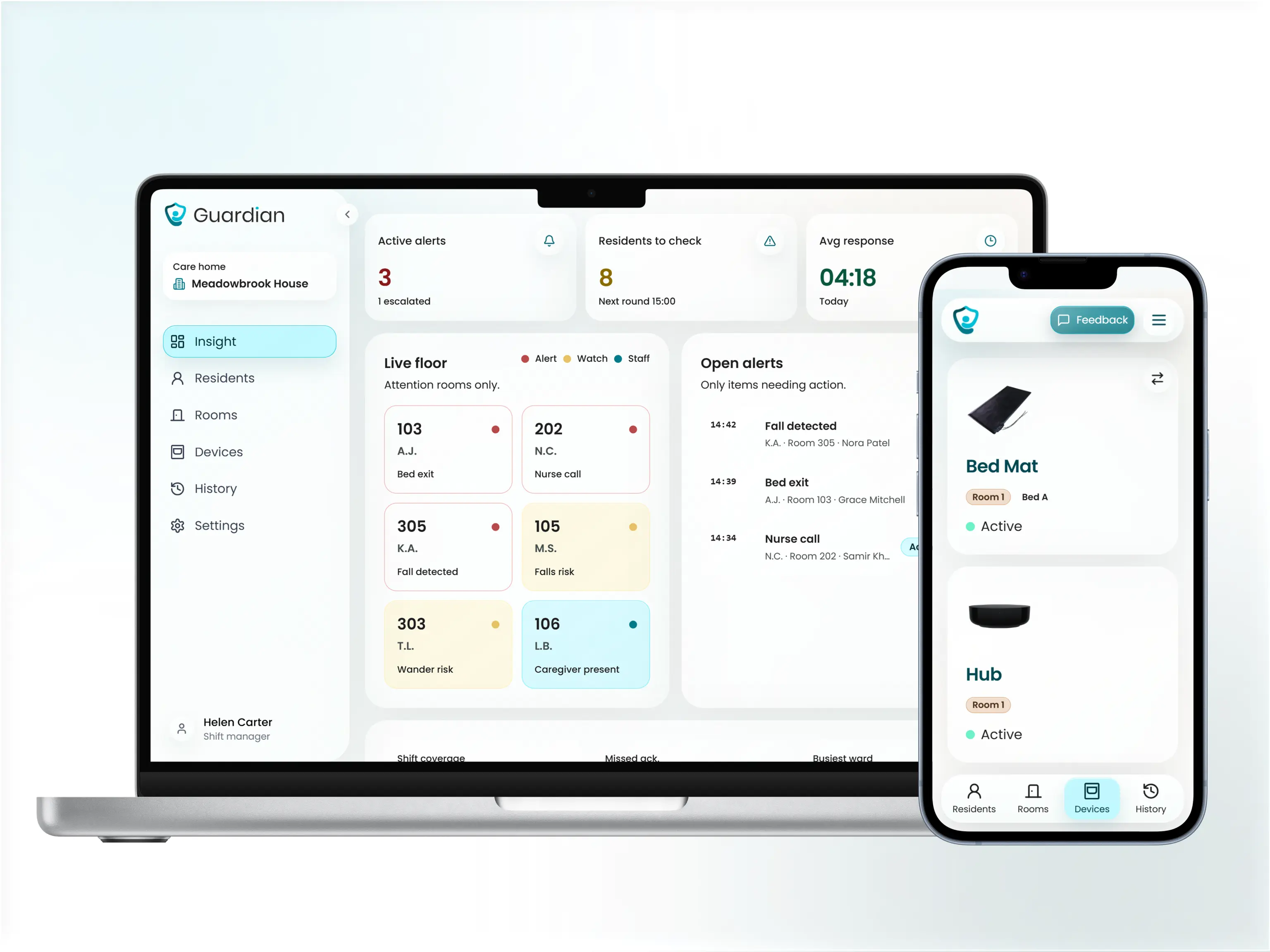
That location awareness is what separates IPS from a standard alert. Response starts from the moment a notification fires, not after someone calls around to find out.
Guardian alert rules can be set to flag, for example, a resident out of bed for more than 15 minutes at night, filtering normal movement and cutting the noise that causes staff to start ignoring alerts. Response times and activity logs are already in the portal when the manager logs in, with no separate reporting step.
Guardian automatically sends a notification to designated relatives when sensors detect events such as a bed exit at night or an SOS activation, with no staff intervention required. This removes the cycle of relatives calling the nurses station to check on residents, freeing staff for care tasks.
Nurse call systems commonly integrate with EHRs, RTLS, sensors, and other platforms through HL7 messaging, vendor APIs, and other interoperability interfaces. FHIR support varies by vendor.
Guardian combines motion sensors, bed-exit sensors, and SOS wristbands in a single wireless portal that maps every alert to a specific room on your floor plan. Staff see exactly where to go without switching between systems.
Traditional call-based systems largely fail residents who cannot reliably press a button when needed. A BMJ prospective cohort study of people over 90 found call alarms went unused in 80% of falls where the person was alone, rising to 94% in institutional settings.
Passive sensors remove the need for any resident action. Motion sensors, bed-exit sensors, pressure mats, floor mats, and door contacts all trigger alerts automatically.
A 12-week pilot combining pressure mats, motion sensors, door contacts, cue lighting, and audio prompts redirected residents with dementia at night with zero negative reactions. In Norwegian residential care facilities, 98% of staff expected increased resident safety after a wireless nurse call and sensor system was introduced.
Costs typically split into hardware (sensors, wristbands, call points) and ongoing fees. Buyers should budget for:
Per-bed licensing — the most common model for ward-based deployments
Installation and commissioning — varies significantly between wired and wireless systems
Staff training — initial and refresher sessions
Annual maintenance and support contracts
Subscription vs. one-off purchase — subscription models spread cost over time; outright purchase requires higher upfront spend
A structured pilot lets you scope actual costs against measurable outcomes before committing to a full rollout. Guardian's 6–8 week pilot produces a clear ROI report and a rollout recommendation before any scale decision is made.
Nurse call systems face legal requirements that vary by country, often mandating reliability, fault monitoring, and specialist installation in care homes.
Germany's DIN VDE 0834 standard illustrates how prescriptive nurse call regulation can be: it sets detailed rules for system planning, installation, power-failure safeguards, and requires trained specialists to commission and maintain the equipment.
Guardian's wireless, pre-configured design supports these requirements through real-time alerts, automatic fault visibility, and a low-maintenance dashboard that requires no cabling or specialist installation work. The result is a system that keeps response paths clear and reduces the operational overhead of ongoing compliance.

Author
Aleks Timm
Aleks Timm leads Guardian and builds privacy-first operations technology for care homes and home care providers. Teams get location-aware alerts they can act on, clearer situational awareness, and measured insight into how care work actually runs.
Read MoreRecommended reads
Keep reading
WiFi nurse call system guide for care homes
WiFi nurse call systems explained: alerts, clean records, and no wiring—compare options and choose the right setup for your care...
Read more
Wireless Patient Monitoring Systems for Care Homes
A complete guide to wireless patient monitoring systems, connected sensors, alert logic, care-home deployment, privacy, and...
Read more
Remote patient monitoring: a complete guide
Remote patient monitoring: the complete guide to sensors, benefits, and buying tips for safer care homes and better resident...
Read more