

Assisted Living Operations Management: A Practical Guide
In this article
Assisted living runs on hundreds of small actions across every shift. The hard part is knowing what happened, when it happened, and whether the record can prove it.
The blind spot becomes visible when a regulator asks for proof of a visit, or when a family asks how quickly staff responded to a fall. With 50% to 75% of care home residents falling at least once a year, memory-based records cannot show the sequence.
This guide is for operations managers and care home directors running 24/7 settings where shortages, handovers, and alert fatigue make live verification difficult.
Use the framework to check where operations need better evidence:
which daily records still depend on recollection
where handovers lose room-level traceability
which workflows need automatic capture, escalation, or audit evidence
What assisted living operations cover
Assisted living operations cover the daily coordination behind care delivery and the services that keep a residential community running.
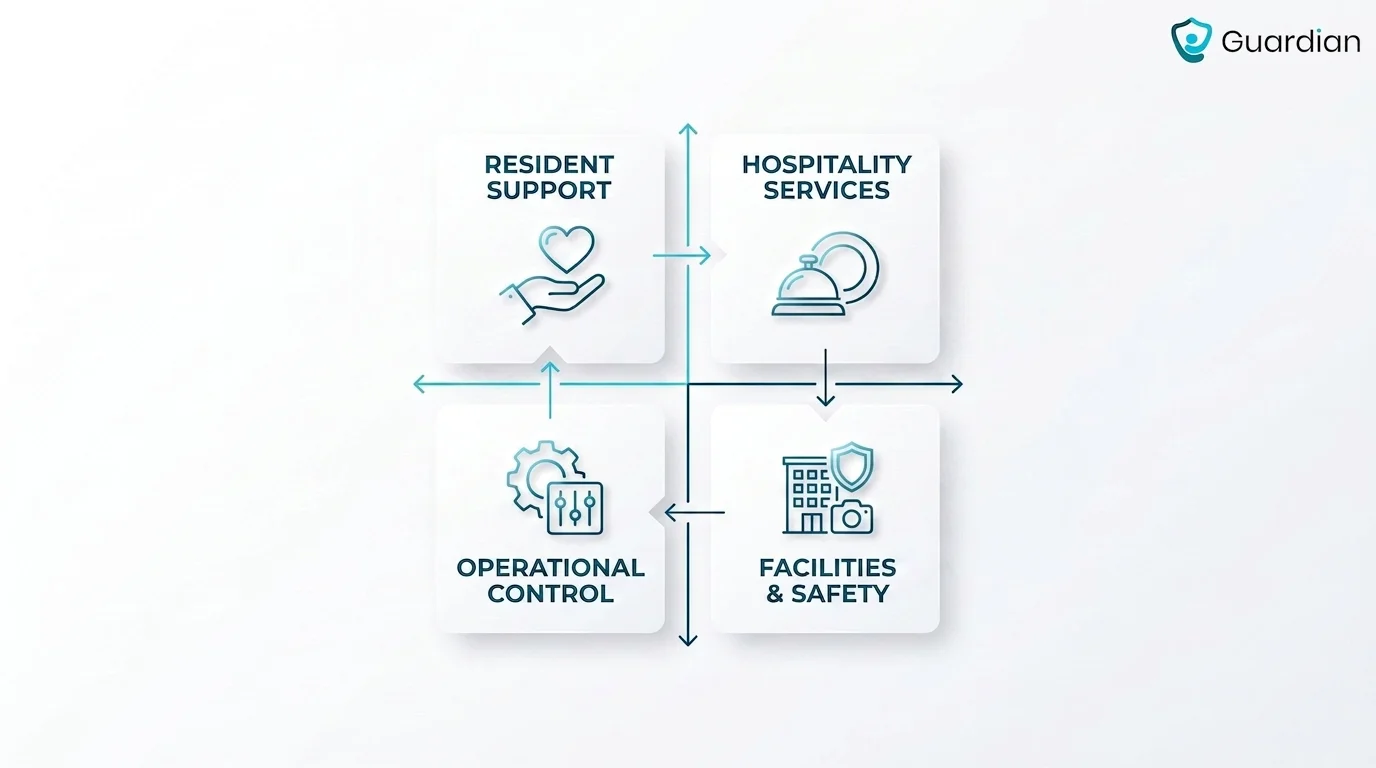
A practical operating map splits the work into four streams:
Resident support: care planning, daily assistance, medication support, activities, and family communication.
Hospitality services: dining, housekeeping, laundry, cleaning, shopping, and errands.
Operational control: staff oversight, scheduling, finances, compliance, and coordination with community resources.
Facilities and safety: equipment maintenance, code compliance, regulator interaction, and falls response workflows.
How assisted living differs from other care settings
Assisted living is a residential care setting with daily living support for people who need help but not regular nursing care.
The setting differs by where the resident lives and how much clinical oversight is built into the day:
Home care: daily-life support happens in the person's own home.
Independent living: residents live in a community but are expected to manage daily tasks with minimal personal-care support.
Assisted living: residents live in a staffed community and receive help with daily activities.
Memory care: the setting adds cognitive-safety routines, including wandering prevention and routine stability.
Long-term nursing care: the setting carries ongoing nursing oversight, heavier incident protocols, and more clinical documentation.
The five goals that shape operations
Five goals shape assisted living operations, and each one depends on evidence staff can trust after a shift ends.
Resident comfort and happiness is the first goal, because everything else is built on residents wanting to stay. It covers the day-to-day living experience, which reaches beyond clinical safety.
Safety and security is where operations carry the most weight. Falls are a constant risk in this setting, so risk reduction and fast incident response are ongoing work, not occasional events.
Safe-care standards set the baseline: risk assessments, equipment maintenance, infection control, and timely care planning as part of safe care delivery.
Reputation follows directly from safety. Consistent safety workflows and care planning protect it by reducing avoidable harm and service failures, which is what families and inspectors notice first.
Retention is the other half. Keeping residents and families willing to stay over time depends on a living environment that holds up, so marketing for retention is treated as a core operational goal, not a separate function.
Financial performance sets the operating limits for staffing, maintenance, and resident services. When it slips, everything else tightens.
Occupancy is the lever that moves financial performance. Unexpected move-outs disrupt staffing, scheduling, and revenue planning, and meeting occupancy targets remains a leading operational challenge.
NIC MAP reported senior housing occupancy at 88.7% in Q3 2025, including 87.2% for assisted living, after 17 straight quarters of gains. The 2026 outlook points to occupancy rising above 90% by year-end.
The core workstreams to manage
Assisted living operations are a set of linked workstreams that keep care plans current, staffing aligned, and daily support running safely. The sections below break out the management work that most directly affects resident outcomes and day-to-day execution.
Resident care and service planning
Start with the resident's current condition, then document the risks and daily support that condition requires.
Safe-care standards keep the care planning duties specific:
Assess risk for every resident.
Plan care in time for safe support.
Handle transfers safely when support needs change.
A useful care plan makes daily support visible:
Physical support: what the resident can do safely.
Emotional support: routines or reassurance the resident needs.
Cognitive support: prompting or supervision when cognition changes.
Independence: support that protects choice without taking over.
Operators should see support needs change through live records before the next scheduled review. Monitoring resident needs alongside staff workload shows the mismatch while the shift is still running.
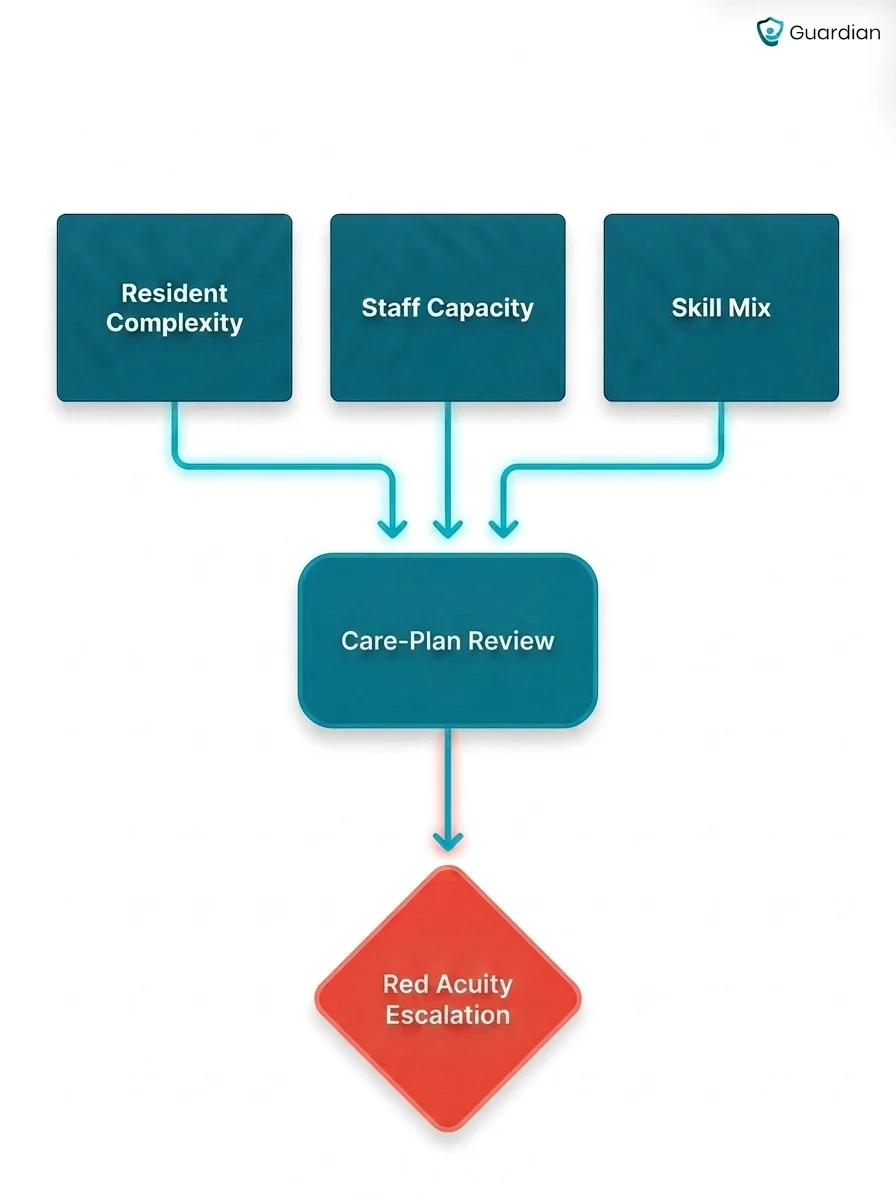
Red acuity escalation, a red-flag status raised when resident needs outrun staff capacity, turns that mismatch into an action point:
Resident complexity has outgrown the current support plan.
Staff capacity is too tight for the shift.
Skill mix no longer fits the support being delivered.
Staffing, scheduling, and training
A safe rota matches resident demand with enough staff and the right skills on every shift.
Hand-built rotas fail at the points managers handle during live operations:
Input errors leave a shift short.
Last-minute dropouts create gaps with no slack.
Manual updates pull managers away from residents and staff.
Digital staffing tools cut the administrative time spent building and adjusting rotas, and real-time visibility lets managers respond to a shortage before it lands on residents.
Safe coverage depends on workload.
Managers need to see how stretched staff are while the shift runs, then move support before the shortage affects care.
Red acuity escalation flags the moments when resident complexity exceeds current capacity or skill mix. Daily or weekly record audits then feed the same picture, so managers can reallocate people immediately instead of at the next review.
Facilities, safety, and documentation
Building safety depends on current records as much as the maintenance work itself.
Safe premises depend on records that stay current during the day:
Maintenance: preventative tasks and digital work orders.
Incidents: records captured close to the moment.
Assessments: facility policies and risk checks for residents and staff.
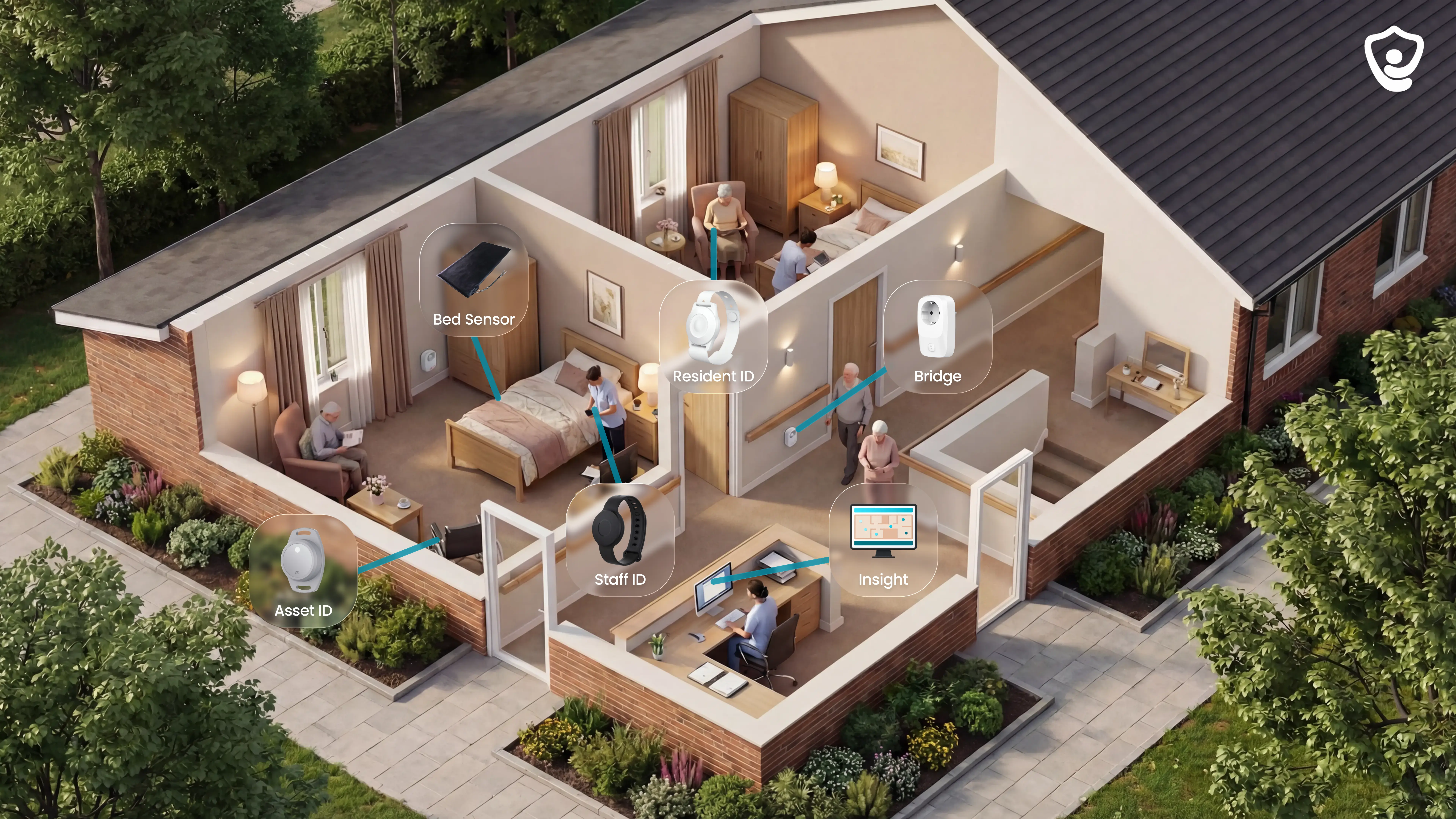
See the building live. Guardian links each sensor to a specific room or bed on a digitized floor plan.
Background reporting writes the evidence trail automatically. Incident records, visit history and shift notes do not wait for next-day reconstruction.
Administrators can keep routine movement quiet and escalate exceptions:
Rule set: out of bed for more than 15 minutes at night.
Context: active alerts show where the resident is and why staff are being notified.
Destination: alerts reach the device staff already use.
Guardian sends alerts through the web portal to staff devices already in use. Bed sensors track in-bed and out-of-bed status plus routine drift over time, all without cameras.
Approach | Typical method | Live monitored method |
|---|---|---|
Facilities tracking | Preventative maintenance and work orders | Room- and bed-linked sensor events on a floor plan |
Documentation | Manual or next-day reconstruction | Automated background incident, visit, and shift records |
Dining, housekeeping, activities, and family communication
Daily service routines are visible when they slip. Clear updates show designated relatives when a concern has been detected.
Automatic visit reporting records the essentials of a room visit:
Arrival: when the caregiver reached the resident's room.
Previous location: where the caregiver had been before the visit.
Duration: how long the caregiver stayed.
End time: when the visit finished.
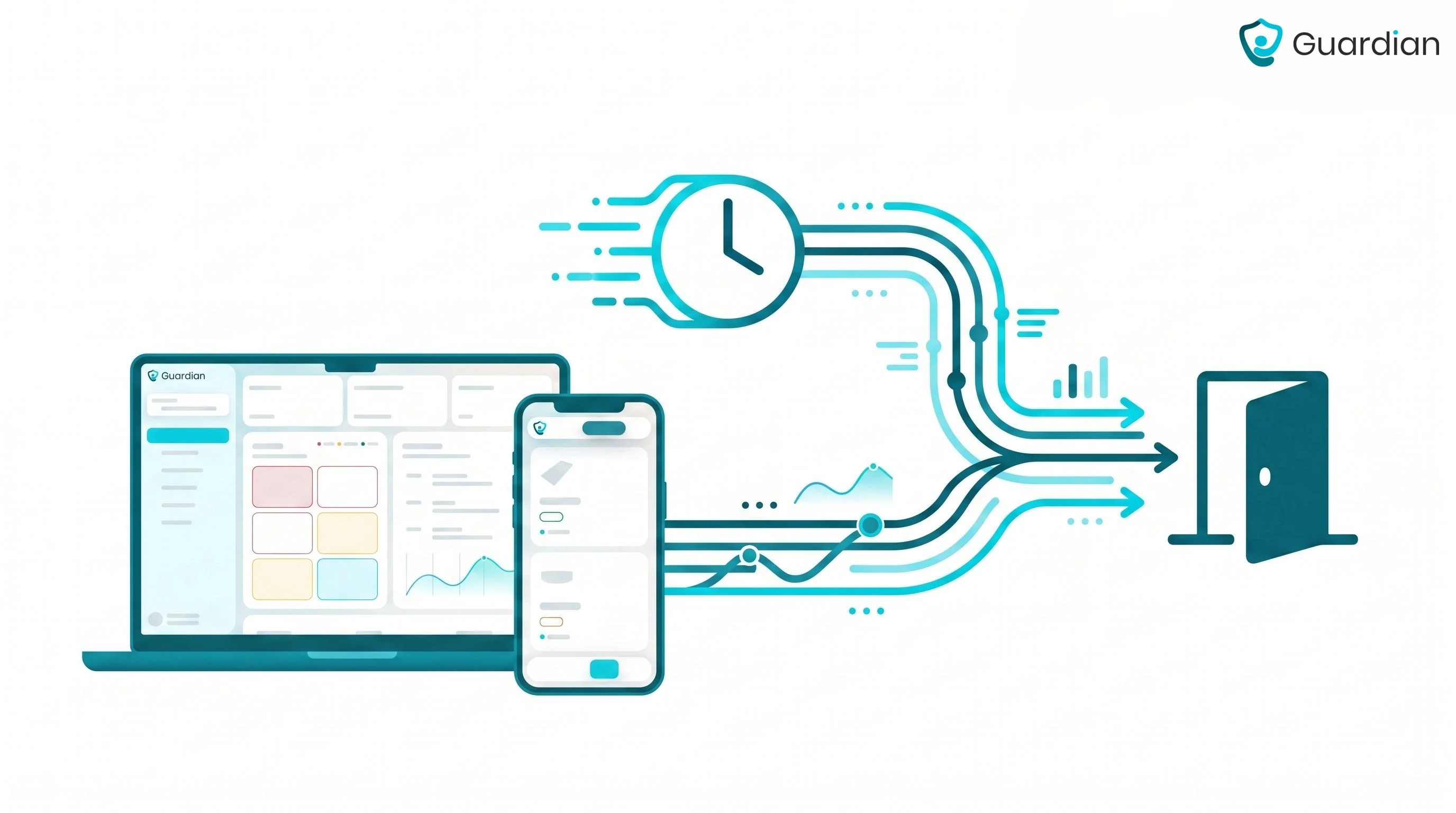
Guardian adds concern-based communication without cameras:
Family updates: designated relatives are notified when Guardian detects a potential safety or health concern.
Routine signals: motion and door sensors track patterns and flag anomalies.
Who owns what in daily operations
Every daily task needs a named owner before the shift begins. Without that owner, small misses turn into operational blind spots.
Routine work should be visible before a shift starts. Housekeeping covers cleaning, maintenance covers repairs, and kitchen teams cover food and beverage service.
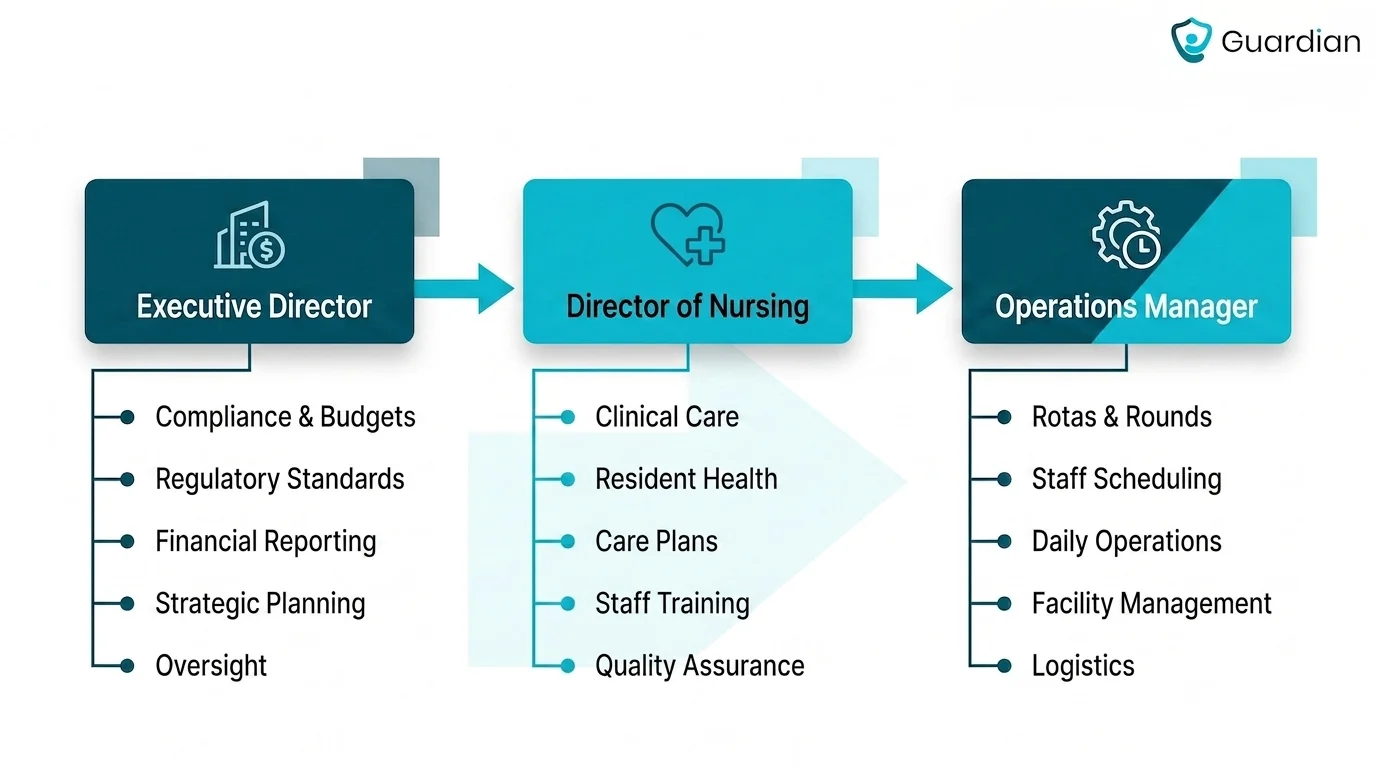
Three leadership roles close the gaps between departments.
Executive Director or Administrator: Holds final accountability for compliance, staffing, budgets, admissions, serious incidents, and family or regulator liaison.
Director of Nursing: Leads clinical care across nursing supervision, care planning, medicines, quality improvement, and emergency protocols.
Operations Manager: Runs the rota, daily rounds, maintenance follow-up, resident engagement, complaints, and emergency response.
Behind every rota and checklist, staff need each resident's baseline vital signs and usual behaviors documented. That record helps any caregiver spot a change from normal.
When a fall, medicine error, or safeguarding concern breaks the routine, ownership becomes shared. The attending nurse may leave medication rounds to assess the resident and coordinate with families or physicians.
Post-fall ownership crosses several roles.
Nursing: assess injury risk and decide whether equipment needs to change.
Leadership: notify families, physicians, or regulators when escalation is needed.
Team learning: record medicine errors and near misses, then share lessons across the organization.
Good governance looks for the same trail through clear responsibilities, incident learning, audit processes, and a speak-up culture.
Operations area | Typical owner |
|---|---|
Resident monitoring and documentation | Care staff and nursing leads |
Cleaning and room readiness | Housekeeping |
Repairs and equipment issues | Maintenance |
Meals and beverage service | Kitchen and dining staff |
Falls and medication incidents | Shared escalation across care, clinical, and leadership roles |
Operating cadence from daily to annual
Some risks need attention before the next handover. Other risks only surface when managers look beyond the current shift.
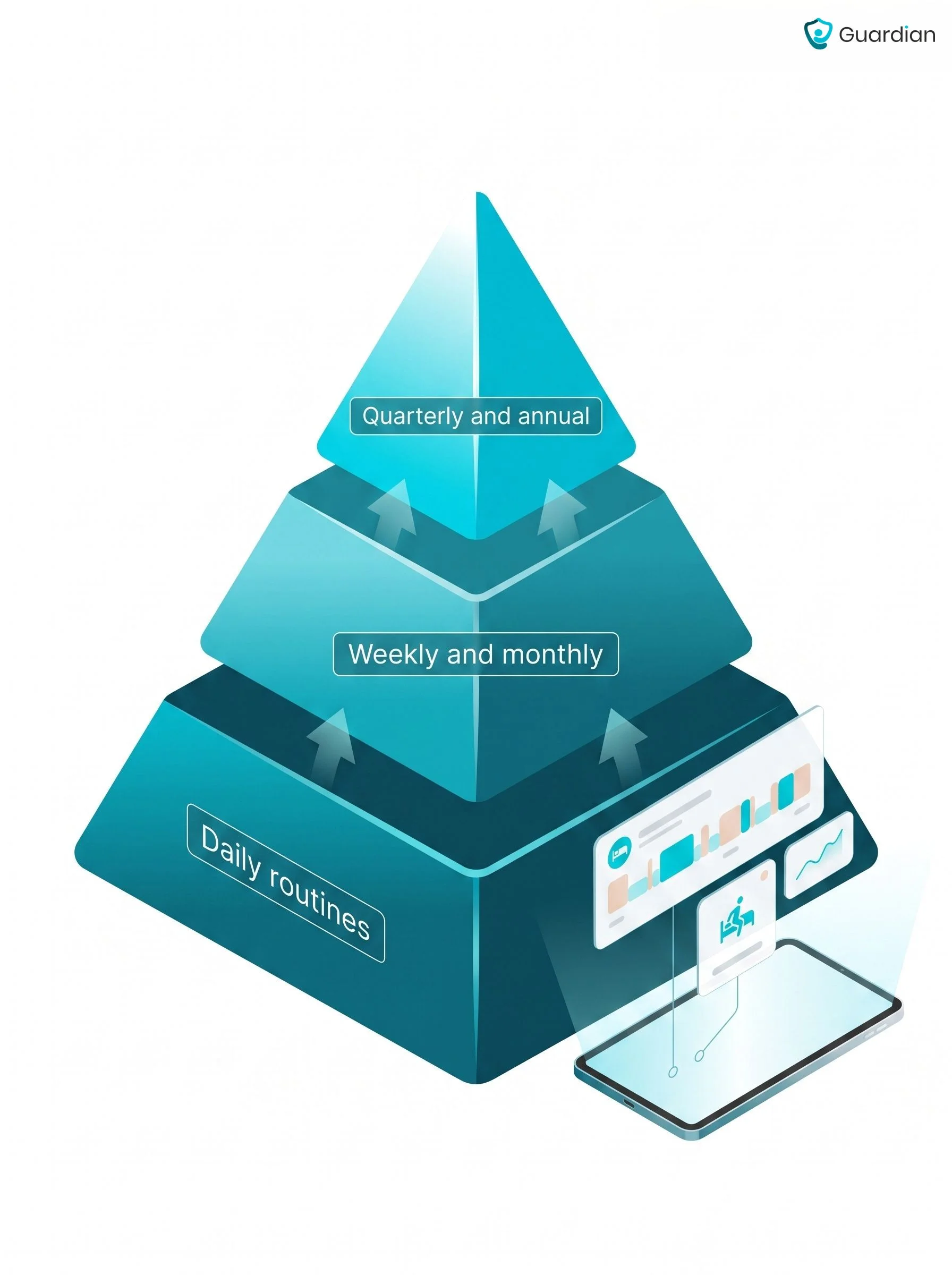
Use the cadence to separate three kinds of work.
Daily: care delivery, documentation, meals, cleaning, and handover checks.
Weekly and monthly: preventive checks, rota review, KPI review, and repair follow-up.
Quarterly and annual: risk review, equipment servicing, policy refreshes, and compliance planning.
Daily routines
Handover pressure creates the daily blind spot. Missed checks become hard to reconstruct once the next shift starts.
Daily work splits into resident support and safe-care controls.
Resident support: cleaning, laundry, bed linen, meals, grocery help, and errands.
Safe care: risk assessments, equipment checks, infection control, and timely care planning under core safety standards.
Daily incidents stay consistent when they follow a set pathway rather than the judgment of whoever is on shift. A fall starts with immediate injury assessment, including checks for head trauma or fractures.
The same pathway then reviews medication and the environment afterward, so the next fall is less likely than the last.
For facilities upgrading their incident response workflows, the facility-grade fall-alert systems roundup compares platforms that can automatically trigger these assessment pathways.
Weekly and monthly routines
Recurring reviews catch the gaps that a single shift cannot see. The work belongs on a calendar before missed checks become resident-facing problems.
Preventive work moves onto a weekly or monthly schedule when a check protects residents but does not need same-day action.
Put recurring checks on named calendars.
Care equipment: routine checks and maintenance follow-up.
Rotas: planned review before gaps become last-minute dropouts.
Repairs: open issues carried to the next accountable owner.
Safe-care standards require regular maintenance of care equipment, which anchors those recurring slots.
Managers also review whether the rota held, where care was delayed, and which repairs stayed open. Digital staffing tools reduce rota admin and the instability caused by manual errors or last-minute dropouts.
Color-coded KPI dashboards keep recurring risks visible between audits.
Falls
Pressure ulcers
Infection outbreaks
Adverse events
Medication errors
The dashboard view gives managers a running benchmark instead of a once-a-year snapshot.
Quarterly and annual routines
Longer cycles give managers time to inspect patterns that daily handovers can hide. The calendar forces reviews, audits, maintenance, and planning before pressure turns those tasks into afterthoughts.
At quarterly review, managers look for patterns across incidents, care plans, and risk assessments. Safe-care standards require each resident to have a risk assessment and timely care plan, so review time cannot depend on memory.
Medicine incident learning should move through the same review cycle.
Record: every error and near miss.
Review: trends at quarterly leadership level.
Act: assign corrective actions and share lessons across the organization.
Once-a-year work still needs a named date. Scheduled preventative maintenance protects facility assets and keeps staff equipment working.
Safe-care standards require regular equipment maintenance and infection control, which supports an annual schedule for formal equipment checks and policy refreshes.
Falls remain a constant operating risk in care homes. Structured prevention review gives that risk a fixed calendar slot instead of relying on memory.
Use each fall pathway to feed prevention planning.
Assessment: post-fall injury findings.
Medication review: medicine factors that may raise risk.
Environment review: room or equipment changes that reduce repeat incidents.
Cadence | Typical focus |
|---|---|
Quarterly | Risk reviews, care plan reviews, incident trend checks |
Annual | Preventative maintenance, equipment checks, policy and compliance refreshes |
How to measure whether operations are working
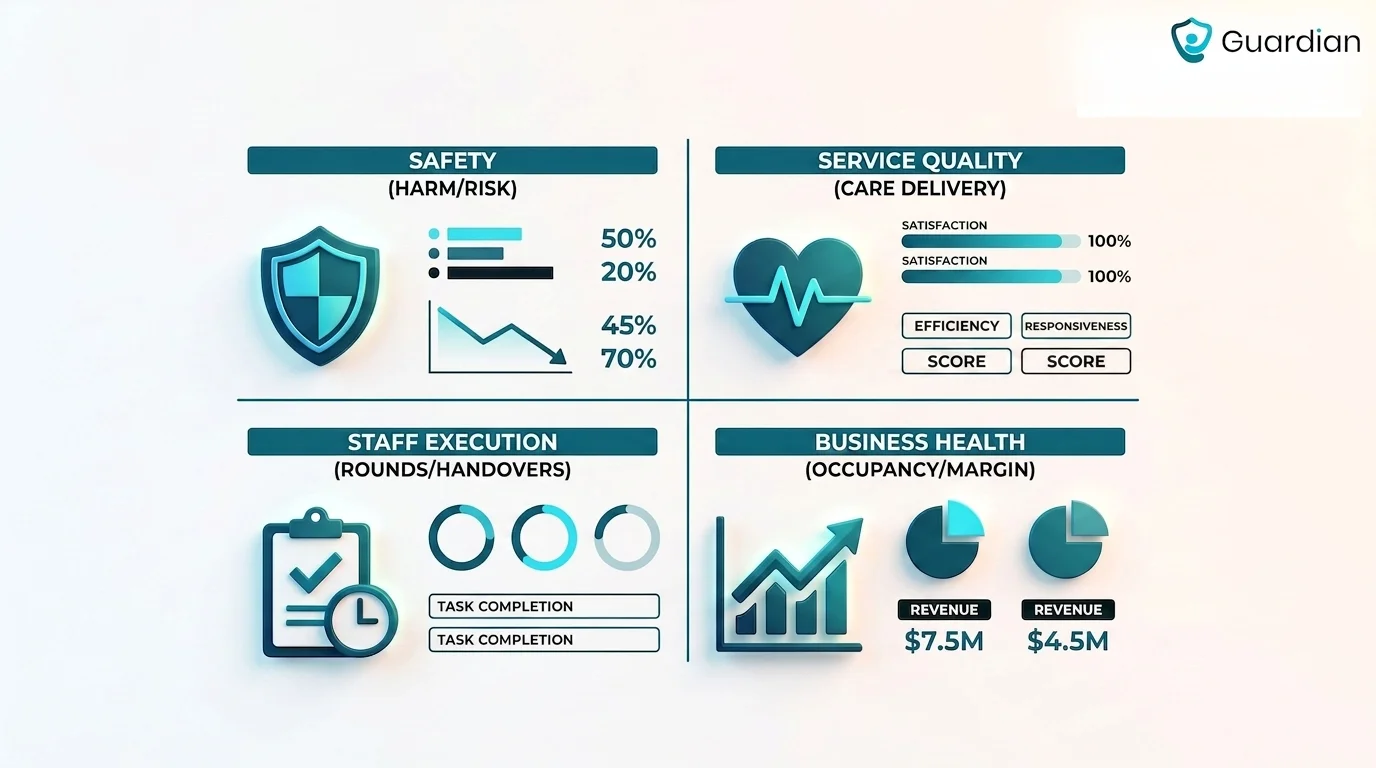
Measure operations with a balanced scorecard, not one headline KPI. The scorecard should show whether care is safe, consistent, staffed, and financially sustainable.
Safety should sit near the top of the dashboard because harm shows up there first. Use the same definitions every week so the trend is clear.
Read the next group of indicators as one scorecard:
Safety: resident harm and clinical risk.
Service quality: resident experience and care delivery.
Staff execution: rounds, handovers, and documentation.
Business health: occupancy, margin, and avoidable waste.
Treat audit pass rates and task completion as trend lines against your starting point. Watch night and weekend shifts separately because a weekly average can hide missed work.
Compare staffing exceptions with your historical average. A sudden change in missed rounds or overtime points to staffing, training, or handover problems.
Read financial measures against resident dependency and medical complexity. A high-acuity home should not be judged against a lower-need home.
Measurement area | What to track | Why it matters |
|---|---|---|
Safety | Falls, medication errors, pressure ulcers, infections, adverse events | Shows whether residents are protected from avoidable harm |
Service quality | Resident surveys, reviews, task completion, audit scores | Shows whether promised care is delivered consistently |
Staff execution | On-time completion, exceptions, documentation accuracy | Shows whether routines happen as planned across shifts |
Business health | Occupancy, profitability, financial stability, efficiency waste | Shows whether the operation is sustainable, not just busy |
Where operations usually break down
Operations usually break down when staff lose the timeline of a task. Paper notes and vague alerts turn routine care into delayed action.
After a fall, paper notes and memory can leave managers rebuilding the timeline the next morning. That delay makes the record less useful during the shift.
Scheduled rounds become hard to verify when oversight depends on manual tracking. Managers see a ticked box, but not whether the round happened at the right time.
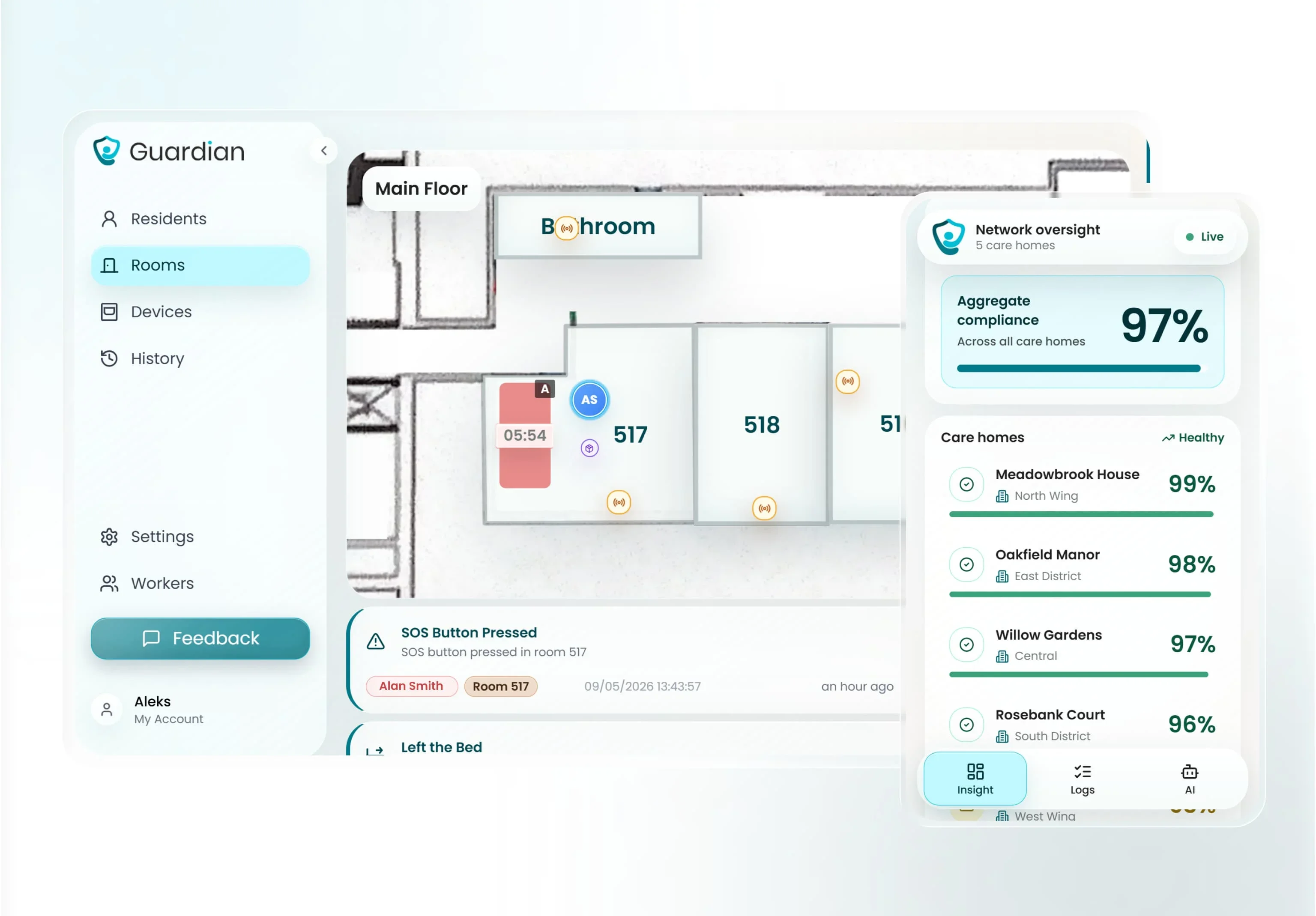
Alerts fail when staff need to decode them before moving.
Location missing: staff know something happened, but not which room needs them.
Resident context missing: the alert does not explain who is involved or why the event matters.
Escalation route missing: urgent events can sit on an app screen unless the workflow also triggers a phone call.
Guardian reduces that blind spot by tying facility alerts to map-based location context. SOS events can also trigger automated phone calls, giving urgent alerts another route beyond an app screen or SMS.
A single incident can pull a whole shift off schedule. After a fall, the attending nurse may need to pause medicines while the resident, family, and physician are contacted.
The incident then creates extra work that hides other risks:
Recording: medicine-related events need errors and near misses documented.
Learning: managers need a way to share lessons across the organization.
Alert noise: frequent low-priority alarms make urgent signals easier to miss.
Common breakdown point | Operational effect |
|---|---|
Manual notes and fragmented records | Missed rounds, unclear documentation, after-the-fact reconstruction |
Vague or passive alerts | Slower response because staff must interpret or notice the alert |
Single incidents in stretched shifts | Medication delays, disrupted routines, extra reporting burden |
Too many non-critical alarms | Staff desensitization and missed critical events |
To address vague signaling and alarm fatigue, the smart caregiver alert platforms breakdown compares modern options that deliver room-level context directly to staff.
What to fix first when visibility is poor
Fix poor visibility by centralizing operational data into one live system, then digitizing alerts, workflows, and reporting so every team works from the same current picture.
Start with one current operating view. The care team needs building data and live care activity in a unified senior monitoring platform, instead of reconciling separate records by hand.
Floor-plan context: Guardian links each sensor to a specific room or bed during setup, then shows active alerts alongside connected staff and assets on the digitized map.
Prompted night rounds: automated visit reporting records when caregivers arrived at each room and how long each visit lasted, so rounds can be directed to rooms with a current alert or inactivity signal.
Nurse-call context: alerts reach caregivers' phones with the resident's name and live location.
Automatic records: background reporting creates the visit and shift-time record, including incident details when an event occurs.
Dashboards and alerts come next. Use KPI status as the exception list for each shift.
Green: routine activity is on track.
Amber: clinical risk needs review, such as pressure-ulcer risk or infection outbreak signals.
Red: safe-staffing tools flag when resident acuity outruns capacity or skill mix.
Event review: fall reports and adverse events stay visible after handover.
After setup, the dashboard should show every sensor and connected device in active status. From there, custom alerts can be built around daily routines or inactivity, for example no refrigerator opening or no movement for a set period.
First fix | Why it comes first | Operational result |
|---|---|---|
Centralize fragmented data | Departments and building information sit in separate systems | One shared source of truth |
Digitize room, bed, and alert context | Staff need exact location, not verbal reconstruction | Faster response and less guesswork |
Automate reporting and escalation | Manual follow-up creates delays and blind spots | Live oversight plus audit trail |
Assisted living operates through a daily rhythm where resident care and building operations have to line up.
Every shift has to keep four lanes moving together:
Resident services: personal care, meals, and daily assistance
Operations support: staffing, documentation, and scheduling
Physical environment: maintenance, accessibility, and life-safety checks
Communication: family updates and resident changes
The hard part is timing. A repair in the wrong corridor can disrupt care rounds, mealtimes, or activities even when the maintenance work is routine.
Safety and compliance run through repeatable checks:
Risk assessments: completed for each resident under care regulations
Equipment: maintained before faults become care risks
Infection control: built into daily routines and records
Care planning: updated before transfers or changing needs
Medicine incidents need immediate action, clear recording, and shared learning. Post-fall response follows the same discipline: assess injury, review medication and environment, then use lifting equipment or escalate medically.
Assisted living combines housing with personal care and day-to-day support.
The care plan decides the exact support. One resident may need help dressing and eating; another may only need medication reminders and meal support.
The service package extends across the building:
Meals and dining: food service and mealtime support
Housekeeping and laundry: room cleaning, linens, and personal laundry
Activities: social programs and daily engagement
Property upkeep: repairs, safety checks, and accessible spaces
Assisted living regulation sets the guardrails for resident care, staffing, safety, documentation, medication practice, and building compliance.
In the US, assisted living rules are set mainly at state level. Facilities are licensed and inspected by state health or social service agencies, so operating requirements change by jurisdiction.
Assisted living oversight differs from nursing homes, where federal Medicare and Medicaid Requirements of Participation are enforced by CMS.
Current scale: CDC/NCHS NPALS puts residential care at about 30,600 communities and about 1 million residents in 2022.
Operating comparison: assisted living is spread across roughly twice as many licensed sites as nursing homes, so state variation matters in daily management.
For managers, regulation shows up as work that must be done, recorded, and reviewed before an inspection:
Life safety: keep fire suppression, emergency lighting, egress routes, and ADA accessibility inspection-ready.
Care and infection control: keep risk assessments, equipment maintenance, and care plans tied to each resident.
Medication and incidents: log incidents and near misses, act immediately, and report serious cases through the required route.
Fines, citations, and license suspension are the backstop. The daily aim is to make resident safety visible while care is happening.

Author
Aleks Timm
Aleks Timm leads Guardian and builds privacy-first operations technology for care homes and home care providers. Teams get location-aware alerts they can act on, clearer situational awareness, and measured insight into how care work actually runs.
Read MoreRecommended reads
Keep reading
Remote patient monitoring: a complete guide
Remote patient monitoring: the complete guide to sensors, benefits, and buying tips for safer care homes and better resident...
Read more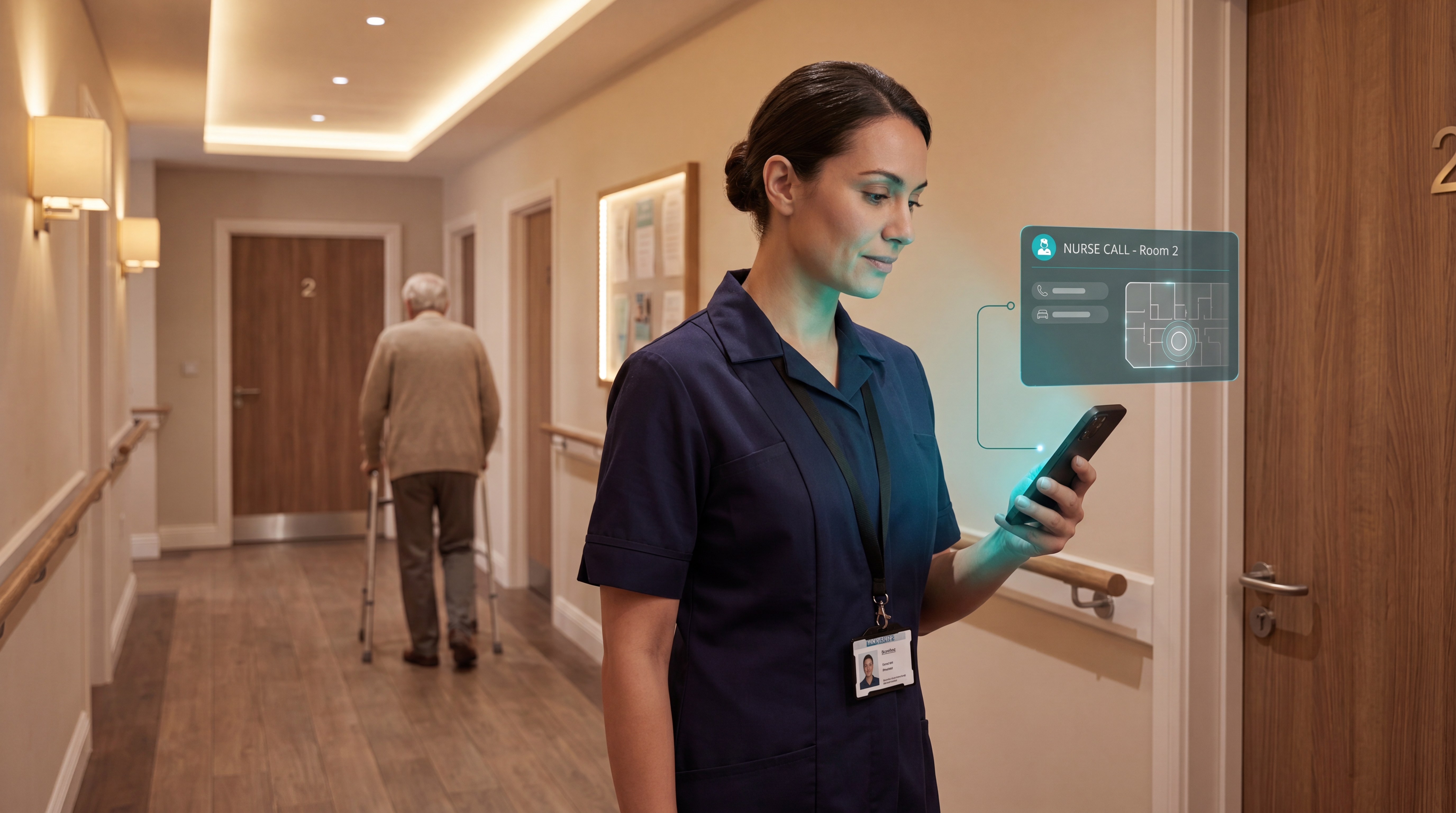
Smart Nurse Call Systems for Care Homes and Home Care Providers
Smart nurse call systems for care homes and home care providers: compare features, improve response times, and choose the right...
Read more
WiFi nurse call system guide for care homes
WiFi nurse call systems explained: alerts, clean records, and no wiring—compare options and choose the right setup for your care...
Read more