

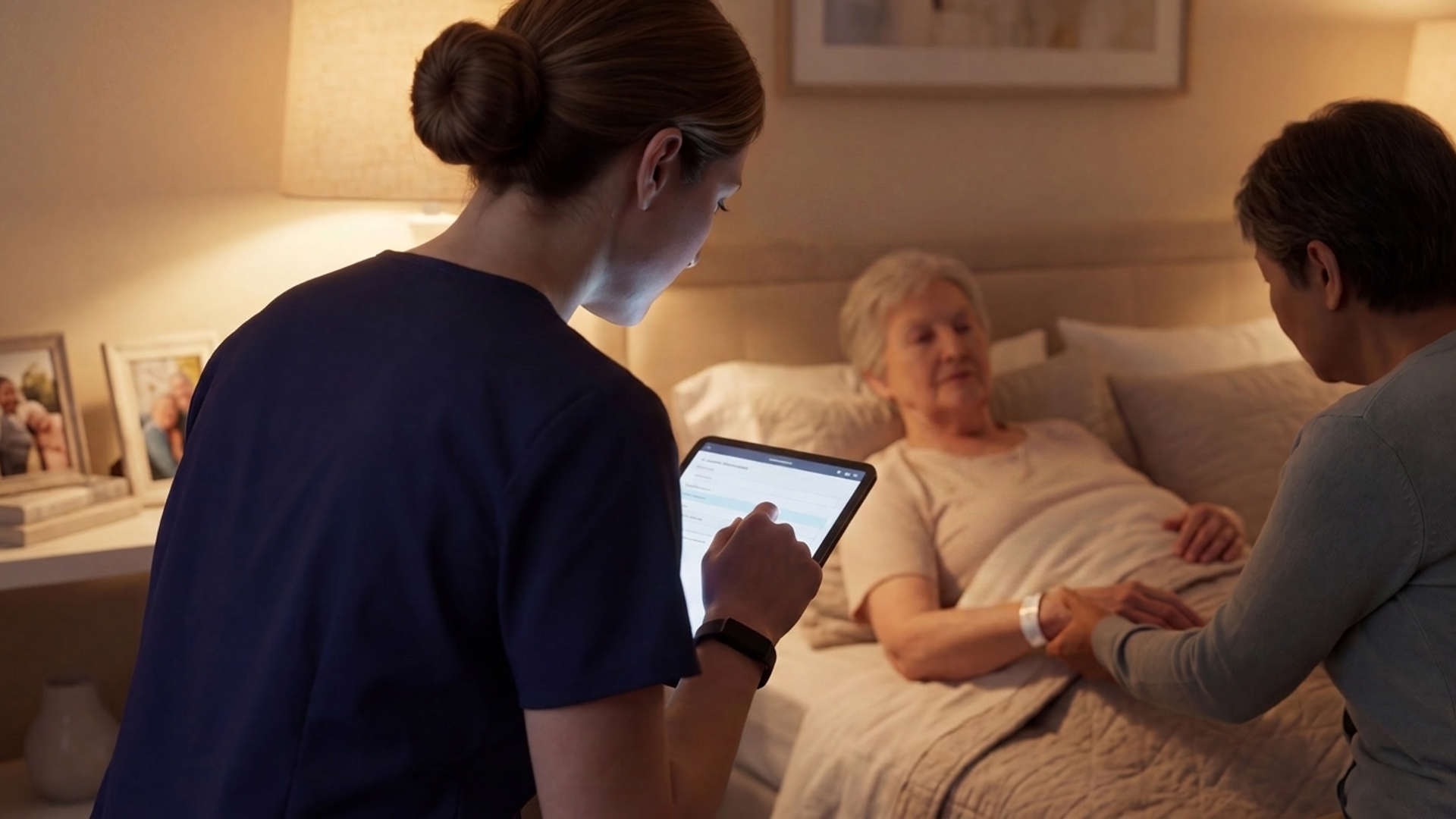
Post-Fall Protocol in Nursing Homes: A Step-by-Step Guide
In this article
When a resident falls, check immediate safety and injury risk before moving them. Follow the nursing home or care home’s approved clinical, emergency, and reporting procedures throughout.
Assessment, escalation, observations, notifications, and records may overlap once immediate care begins. Clear ownership prevents details and follow-up actions from being lost between shifts.
This guide starts with one pre-shift readiness check, then follows the resident from immediate response through recovery and review. Adapt every step to local law, clinical guidance, and facility policy.
Post-fall protocol scope
A post-fall protocol is the facility’s written process for responding after a resident falls. This example uses ISTUMBLE for immediate assessment and RESTORE2 for deterioration monitoring and communication.
Some services use NEWS2 for physiological scoring. The facility’s approved pathway always takes precedence.
Use this ten-step sequence as a quick reference. Steps 5 to 7 may run in parallel once immediate assessment and escalation are underway:
Prepare roles and records: At shift start, assign ownership and confirm baseline records, escalation routes, and required equipment.
Respond and make safe: Call for help, check immediate safety, and avoid moving the resident until injury risk has been assessed.
Assess and escalate: Apply the approved assessment pathway and seek clinical or emergency help when required.
Move safely: Support movement only after assessment confirms the appropriate method.
Notify the right people: Inform the shift lead, clinician, representative, or external service as local policy requires.
Document the fall: Record critical facts promptly and complete required records before responsibility transfers.
Start serial observations: Follow the observation schedule and escalation thresholds set by the local pathway and clinician.
Investigate the fall: Preserve evidence immediately, then complete the formal review within the facility’s required timeframe.
Revise the care plan: Apply urgent safeguards, update the risk assessment and care plan, and confirm ownership.
Support recovery: Reassess mobility, monitor delayed concerns, and review progress with the multidisciplinary team.
Treat unwitnessed falls and falls involving communication barriers, cognitive impairment, or unreliable symptom reporting as higher risk. Preserve the scene details, seek clinical advice, and follow the local pathway for enhanced observations and escalation.
1. Prepare roles and records
Complete this readiness check at the start of each shift, before any fall occurs. Assign a lead and confirm staff can find each resident’s baseline records and escalation route.
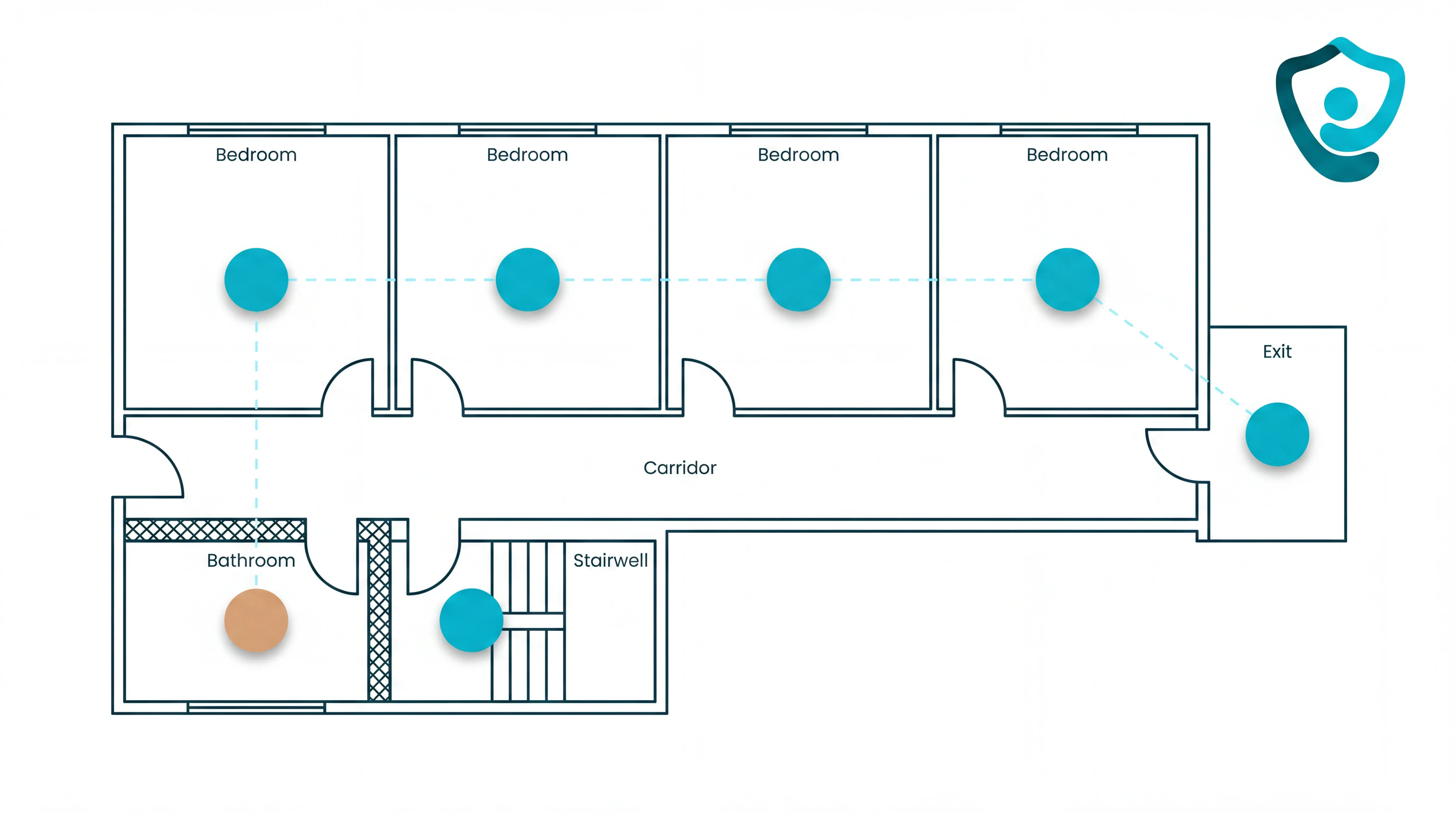
Where digital monitoring forms part of the facility’s fall-response plan, the readiness check should cover alerts, location mapping, and event records. Guardian supports that operational layer while staff retain every clinical decision.
Start with the checks every shift needs, then complete the monitoring checks used in your facility:
Assign clinical ownership: Name the shift lead and backup responsible for applying the post-fall protocol.
Check baseline records: Confirm each resident’s baseline observations and escalation route are current and easy to find.
Test required equipment: Confirm call systems and approved response equipment are ready for use.
Check monitoring devices: Where used, confirm sensor health and match each device to the correct resident.
Confirm room mapping: Link each monitored bed and room to the correct location on the digital floor plan.
Route alerts: Send alerts to designated staff devices, with a backup route for missed notifications.
Tune thresholds: Set resident-specific rules, such as prolonged night-time bed absence, under the care plan.
Monitoring supports the home's clinical protocol and professional judgement. It does not replace either.
Accurate resident, location, and event details make a post-fall response easier to verify. Guardian is a camera-free platform for professional care settings that sends mapped alerts can reach existing staff devices with the resident, location, event, and response times recorded for later review.
2. Respond and make safe
Make the resident safe before documentation or routine notifications. Immediate care, assessment, and escalation take priority over preserving scene details.
Follow this order on arrival:
Summon help. Call the nurse or emergency response team immediately, based on the resident’s condition and your care home’s escalation policy.
Check airway, breathing, and circulation. Start basic life support within your training and local protocol when needed. Immediate care takes priority over forms.
Look for urgent warning signs. Check for severe bleeding, visible deformity, or FAST signs: facial weakness, arm weakness, and speech problems. Escalate without delaying at the bedside.
Prevent further harm while preserving the scene. Isolate spills, cords, or broken equipment that still pose danger. Move only what is necessary, and retain the original positions or details for later review.
Reassure the resident and keep them still. Do not lift or transfer them until the clinical assessment supports movement, unless remaining in place creates immediate danger.
Notify the shift lead. Give the resident’s location, current condition, urgent warning signs, and hazards found at the scene.
Make a brief time record. Note when the fall was discovered, who responded, when help was called, and any scene detail changed for safety. Complete the formal incident report after immediate care.
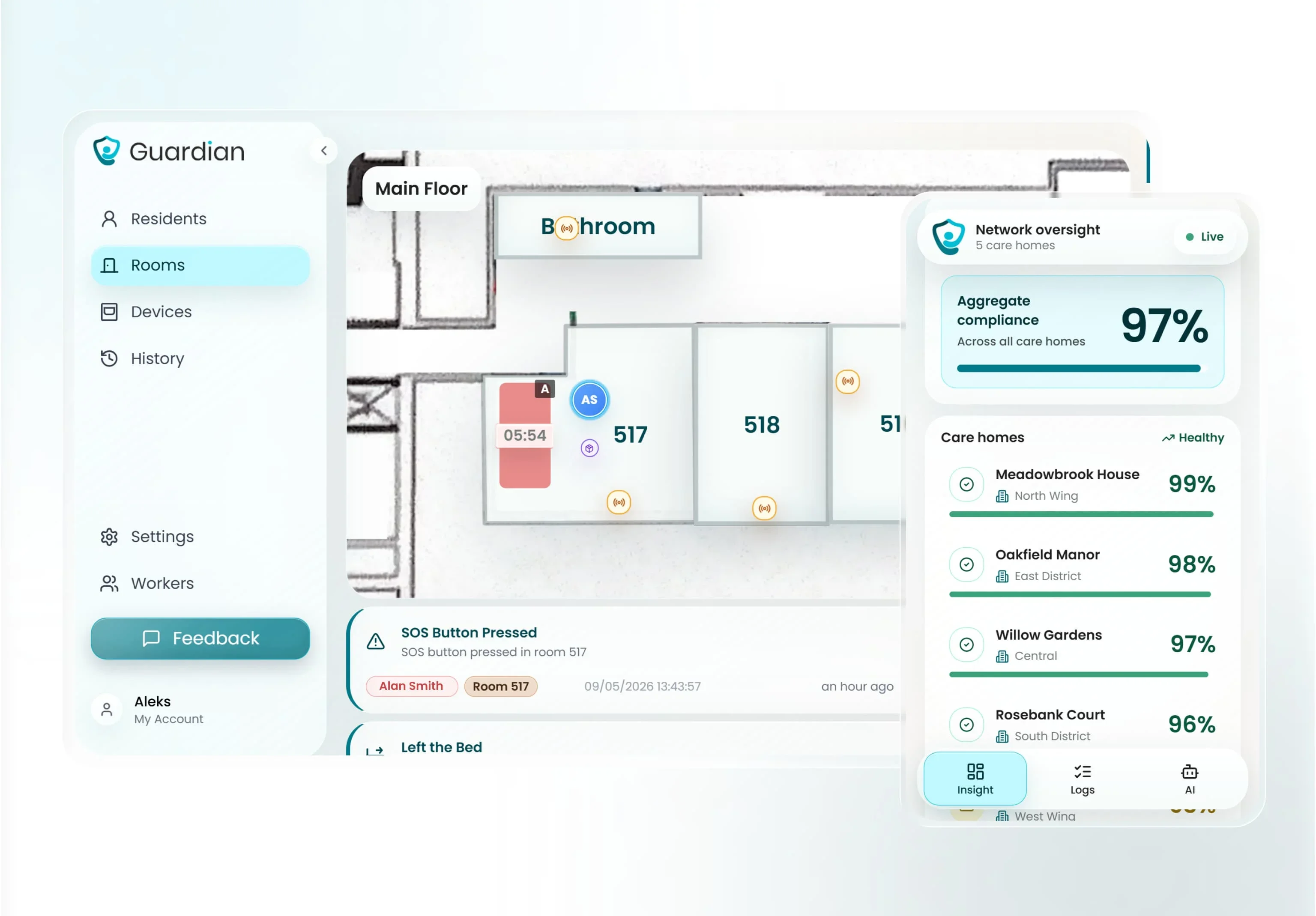
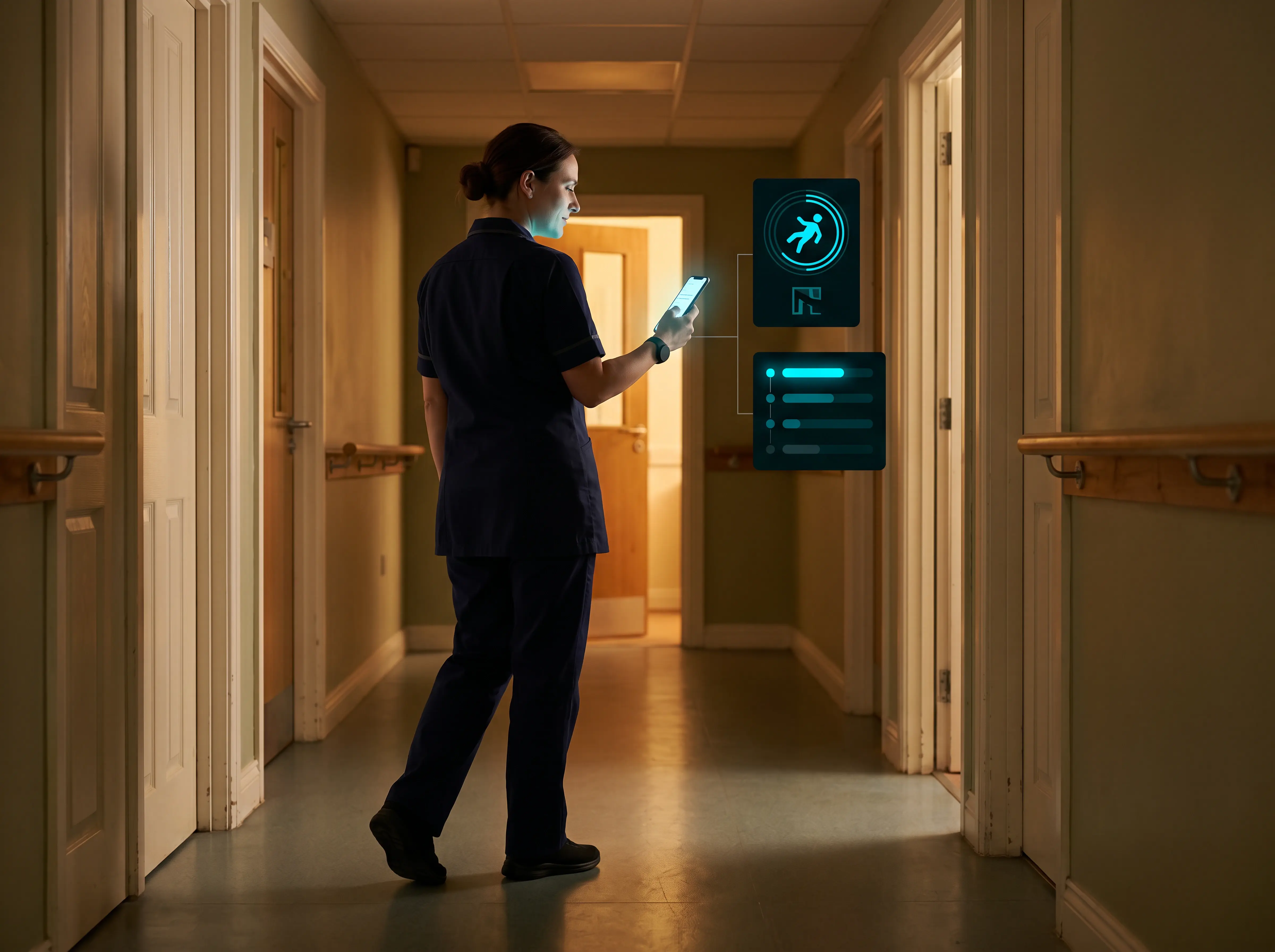
Guardian’s resident wristband can detect a fall through its built-in accelerometer, even when the resident cannot press the SOS button. The alert sends the resident’s identity and mapped room location to staff devices.
The same digitised floor plan links wristband fall and SOS alerts to the resident’s location. Bed, motion, and door sensors use the room mapping for their own configured events, so responders receive a specific location.
3. Assess and escalate
Assessment determines whether the resident needs emergency treatment or clinical review. Escalation follows the assessment findings and the care home’s local policy.
Use your organisation’s approved procedure, such as ISTUMBLE, while the resident remains on the floor. Trained staff should check airway and breathing, apply FAST, and complete the required head-to-toe assessment.
Check for pain, deformity, bleeding, and signs of head injury. Record the observations required by the approved pathway, compare them with baseline, and pass abnormal findings to the clinician responsible for escalation decisions.
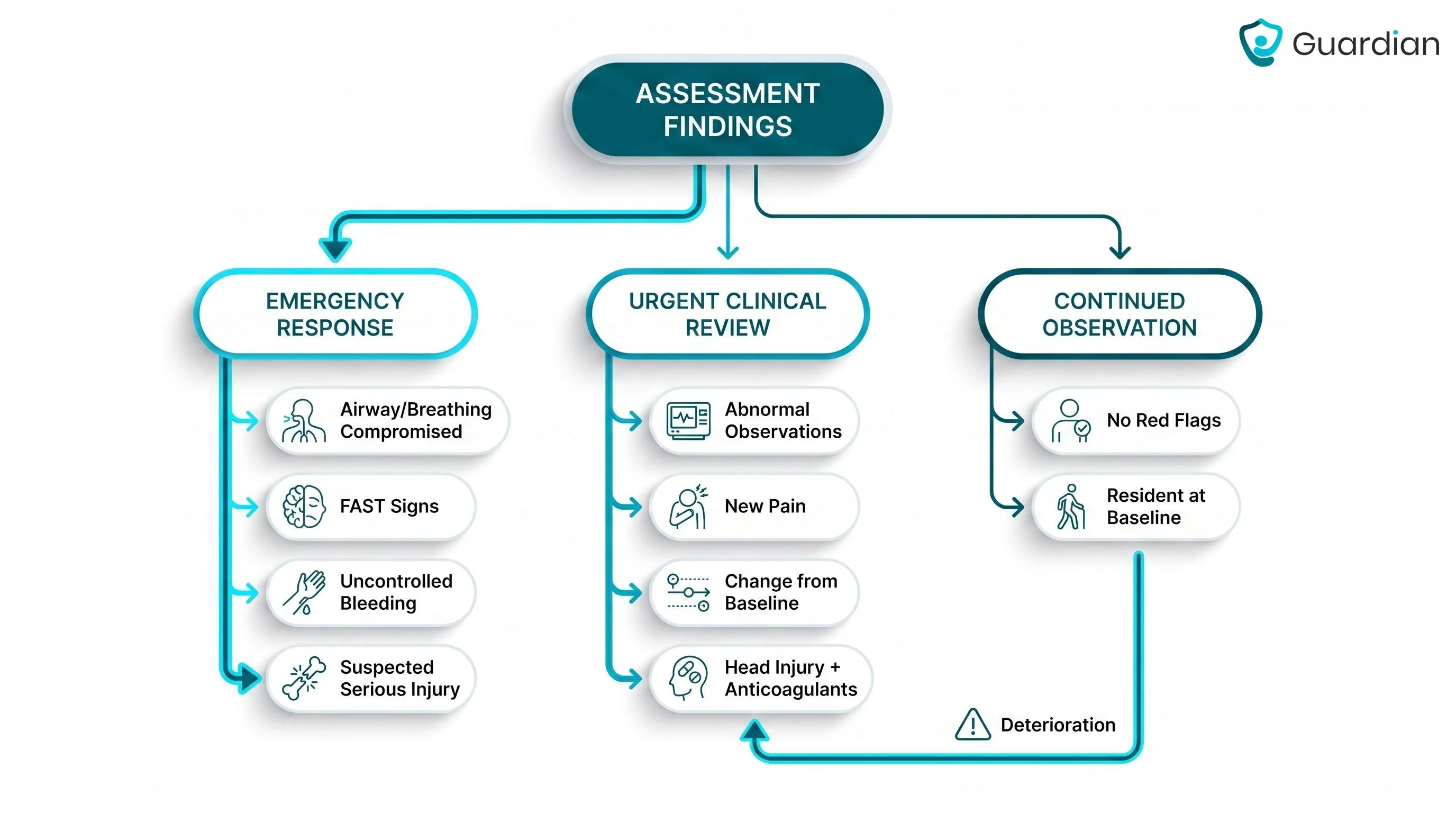
Route the findings through one of three paths:
Emergency response: Call emergency services for compromised airway or breathing, FAST signs, uncontrolled bleeding, or suspected serious injury.
Urgent clinical review: Escalate abnormal observations, new pain, or a change from baseline. Seek urgent clinical assessment after a possible head injury when the resident takes anticoagulants, following the applicable head-injury pathway.
Continued observation: Continue only when the assessment finds no red flags and the resident remains at their usual baseline. Escalate any deterioration.
Use RESTORE2 for deterioration recognition and communication, or NEWS2 where the service has adopted it for physiological scoring. Escalate changes from baseline even when a generic score is below a threshold; local policy takes precedence.
4. Move the resident safely
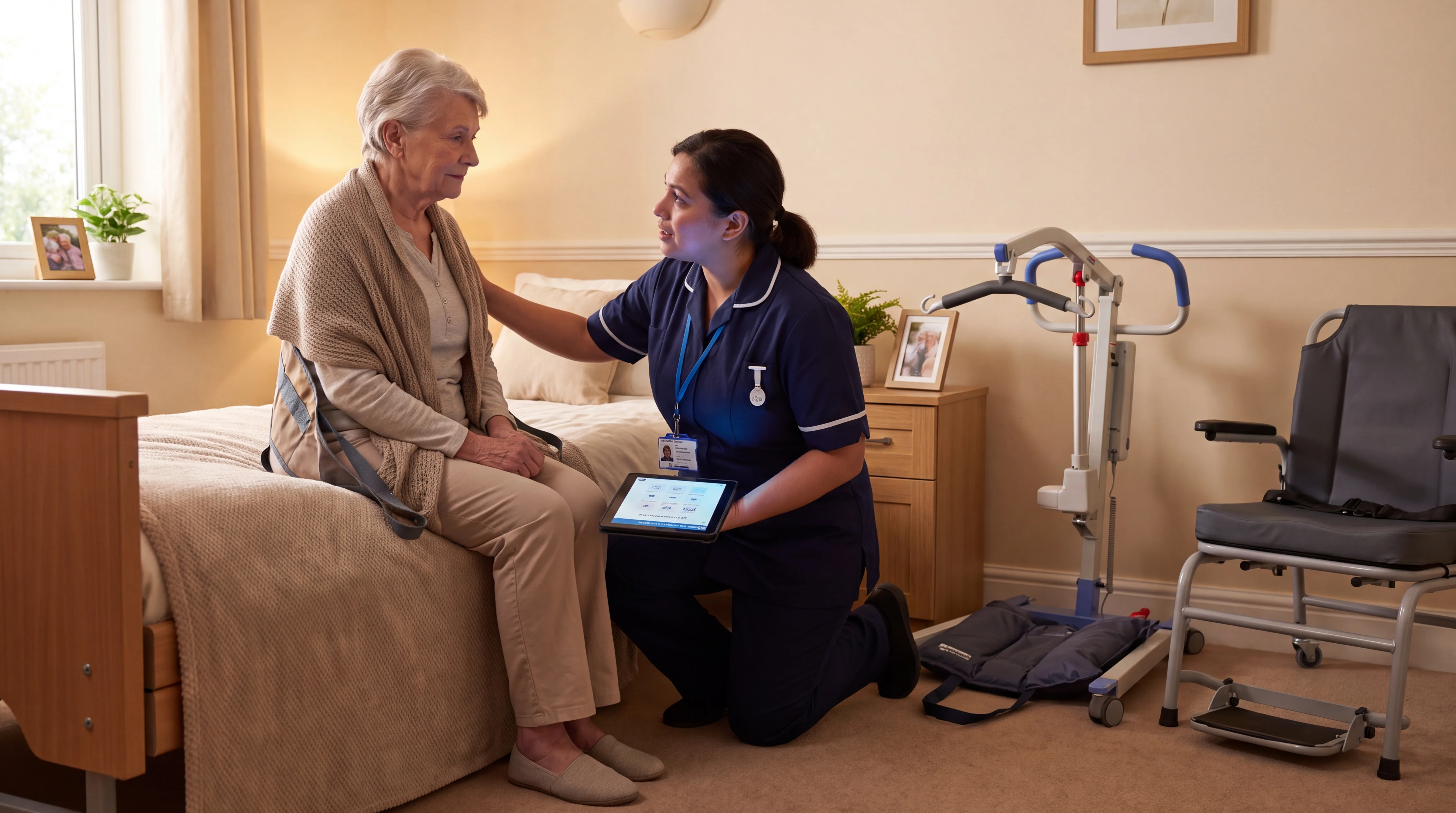
Move a resident only when the assessment confirms that movement is safe, using approved equipment and trained staff. If injury remains possible, keep the resident in position and escalate.
Do not move
Keep the resident on the floor when Step 3 identifies a red flag or the possibility of injury remains uncertain. Call for emergency help and follow the clinical escalation pathway.
Keep the resident warm and supported with blankets or pillows, without changing the position of a suspected injury. Stay with them, explain what is happening, and continue the required checks.
If assessment clears movement
Never attempt an unassisted manual lift from the floor. Select approved floor-recovery equipment under the facility's moving and handling policy, such as:
A mobile floor hoist
An inflatable lifting cushion
A lifting chair
Use the number of trained staff required by the resident’s handling assessment, facility policy, and equipment instructions. Before lifting, confirm the safe working load and check that the sling size and fit suit the resident.
Follow the manufacturer’s transfer sequence. Assign one staff member to communicate with the resident while the team monitors comfort and position throughout the lift.
After transfer to a supportive bed or chair:
Recheck pain, dizziness, alertness, and comfort
Repeat observations required by the post-fall protocol
Check the resident's position and skin around sling contact points
Stop and escalate any new or worsening symptom
5. Notify the right people
Once immediate safety actions begin, notify the shift lead. Contact a clinician or emergency services when the escalation policy requires it, then notify the designated representative after urgent clinical calls are complete.
Use the facility’s approved communication route. Give the resident and location, what happened, current condition, observations, action taken, and the help required.
Recipient | Trigger | Timing | Information to share |
|---|---|---|---|
Shift lead | Every fall | Immediately after immediate safety actions begin | Resident, location, witnessed or unwitnessed fall, current condition, observations taken, and action already started |
Emergency services or clinician | Emergency signs, suspected serious injury, or another threshold in the clinical escalation policy | Emergency services at once when required, using the local number, such as 999 in the UK or 911 in the US; otherwise contact the appropriate clinician within the policy timeframe | Current condition, injury concerns, consciousness, vital signs available, relevant medicines, and immediate care given |
Designated representative | The resident’s care plan, consent record, or facility policy requires notification | Promptly after the resident is stable and urgent clinical calls are complete | Known facts, current condition, care provided, clinical advice received, and the next planned update |
Risk lead or regulator | The event meets an internal threshold or an external reporting rule that applies in the facility’s jurisdiction | Alert the risk lead promptly; submit an external report within the deadline set by the applicable rule | Factual event summary, injury or transfer status, immediate safeguards, and contact details for follow-up |
Use the facility’s approved communication route for the designated representative. Regulatory thresholds and deadlines vary by jurisdiction, so staff should follow the facility’s reporting policy for that jurisdiction rather than treating every fall as externally reportable.
6. Document before shift end
Record critical scene facts as soon as practicable, without delaying care. Complete the required incident and clinical records before responsibility transfers, or hand over any unfinished action to a named person.
Record at the scene
Exact discovery time: Enter the time the resident was found, separately from any alert timestamp.
Room conditions: Describe the scene as found, including lighting, a wet floor, displaced furniture, or disturbed bedding.
First responder: Record the name and role of the first staff member at the scene.
Resident position: Note the resident's position and location before movement, unless immediate danger requires action.
Immediate hazards: Record hazards factually without deciding why the fall happened.
Capture these details once immediate care permits, before activity changes the room or the sequence becomes harder to reconstruct.
Complete before handover
Incident mechanism: Record the observed or reported sequence and attribute any account to its source.
Objective findings: Enter assessment findings and any change from the resident's baseline.
Actions taken: Document immediate care, treatment, and who carried out each action.
Escalation: Record who was contacted, when, and what instructions were received.
Transfer method: State how the resident was moved or transferred and which staff assisted.
Notifications: Log contact with the clinician, manager, family, or representative as required by facility policy.
Observation plan: Specify the monitoring to continue after handover, including responsibility and frequency.
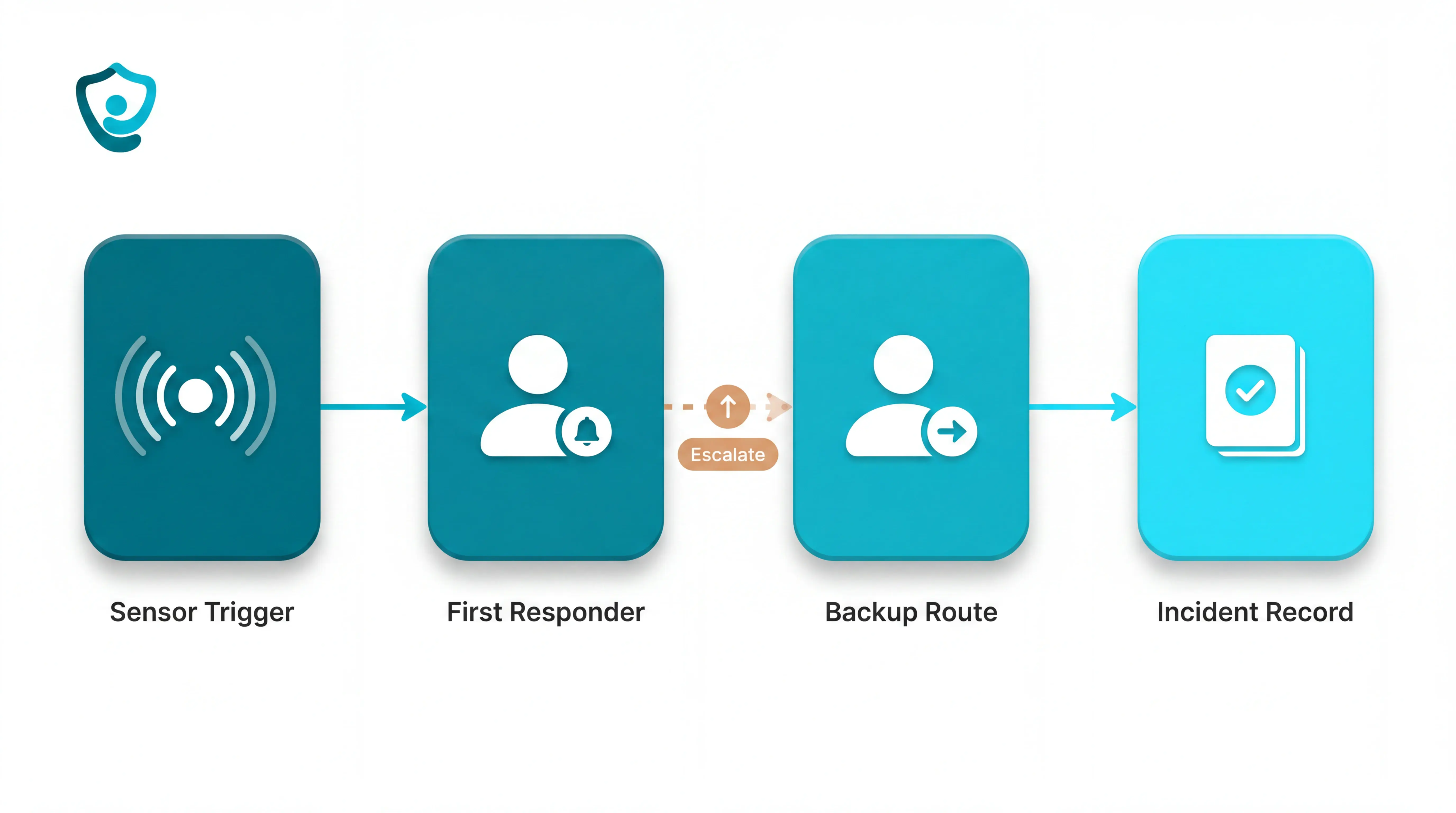
Guardian retains configured event, location, alert, and response timestamps. Each facility can tailor acknowledgement, escalation, attendance, and other recorded stages to its response protocol.
Staff still enter clinical judgment, assessment findings, treatment notes, and the observation plan in the facility record.
7. Start serial observations
Start serial observations when the local pathway or clinician requires them. For suspected head injury, complete neurological checks at the intervals specified by the approved head-injury procedure.
Set the observation frequency from the local post-fall pathway and clinician instructions. Record each result against the resident's baseline, including any escalation.
Parameter | Frequency or source | Escalation sign |
|---|---|---|
Overall frequency | Higher-frequency pathway for unwitnessed falls or communication barriers | Deterioration or unclear baseline |
Vital signs | Every scheduled observation | Outside resident-specific parameters or worsening trend |
Neurological status | Structured schedule after suspected head injury | Reduced consciousness, new confusion, weakness, or vomiting |
Pain | Every scheduled observation | Increasing or new focal pain |
Mobility | Each shift and before unsupported activity | New transfer, weight-bearing, or walking difficulty |
Postural blood pressure | When clinically indicated | Symptoms or readings outside prescribed parameters |
Guardian can add coverage between scheduled in-person rounds:
Track bed exits: Bed sensors record in-bed and out-of-bed status, while configurable delays can flag a prolonged exit without placing cameras in residents' rooms.
Watch activity patterns: Motion sensors track activity patterns in rooms, hallways, and common areas. Staff can review changes or unexpected movement alongside direct checks and the resident’s usual routine.
Tune alert rules: Set time windows and delay thresholds around the resident's routine to reduce noise; sensor alerts supplement direct vital sign, neurological, pain, and mobility observations.
8. Investigate the fall
Preserve scene details, records, witness names, and equipment status as soon as immediate care allows. Complete the formal review within the facility’s required timeframe, with named actions, owners, deadlines, and unresolved questions.
Compare factual accounts with available records and separate confirmed findings from uncertainty. Apply any urgent interim safeguard at once, then carry longer-term changes into the care-plan review.
Clinical factors
Resident condition: Review the resident's condition against their usual baseline, including symptoms and recent health changes. Check whether medicines may have contributed.
Preceding activity: Examine what the resident was doing before the fall. Compare it with their usual routine and any near miss.
Clinical follow-up: Confirm that concerns identified after the incident were escalated and flag any risk assessment that needs reconsideration during the care-plan review.
Environment
Immediate conditions: Check the immediate area for hazards and whether the resident could reach the call system.
Equipment: Confirm that the required equipment and footwear were suitable, available and used correctly.
Location pattern: Check whether earlier falls or near misses occurred in the same room, route, doorway, or bathroom.
Staffing and workflow
Cover and allocation: Review the rota and staff allocation at the time. Identify the staff member responsible for the resident and any interruption to planned cover.
Planned care: Compare the resident's support plan with the care delivered before the fall, including required assistance for transfers or toileting.
Workload and interruptions: Identify any delay or unclear escalation responsibility that affected the response.
Build one chronology: Align resident and staff accounts with available call-bell, observation, access, alert, acknowledgement, attendance, and escalation times.
Record unresolved differences: Note conflicts or missing evidence, then seek corroboration rather than forcing one account.
Look backwards: Review activity before discovery, including near misses and unusual movement, because the last routine check alone may not explain the fall.
Monitoring-system review
Device status: Confirm that the relevant sensor or wearable was active and working at the time of the incident.
Resident assignment: Check that the device and alert rules were assigned to the correct resident.
Alert delivery: Establish who received the alert and when staff acknowledged it and attended.
Rule performance: Review thresholds and prioritisation. Identify alerts that were suppressed or escalated late, and review movement before the fall that should have prompted a notification.
Connected records: Check connected records where they add a timestamp or explain a gap in the chronology.
Monitoring implications: Record assignments, thresholds, escalation paths, or monitoring needs for review in Step 9 without prescribing the final intervention here.
Use Guardian’s configured event and response timestamps to test the incident chronology against clinical evidence and staff accounts. Record any gap or uncertainty before reaching a conclusion.
9. Revise the care plan
Apply urgent interim safeguards as soon as a risk is identified. After the investigation, revise the care plan so approved changes match the resident’s current needs and remain clear across shifts.
Use this change-control checklist to turn each finding into a recorded, assigned intervention:
Medication: Ask an authorized clinician to review medicines that could have contributed to the fall, then record the decision.
Mobility and footwear: Reassess mobility support and footwear against the resident's current abilities and routines.
Environment and toileting: Remove any identified room hazard. Adjust the environment or toileting support when the resident's pattern shows a need.
Physiotherapy and bed setup: Refer for physiotherapy assessment when indicated. Set the bed configuration to support familiar, safer movement.
Supervision: Specify when closer support is needed without applying blanket restrictions. Preserve the resident's choice and independence.
Sensor rules: Set sensor rules around the resident's actual movement pattern. Keep monitoring within the clinical plan rather than treating it as a separate intervention.
Handover and ownership: Record every change, name the person responsible, and confirm that the staff implementing it have received and understood the instruction.
Review date: Name the reviewer, set the date, and state what outcome will show whether risk has reduced without limiting independence.
10. Support recovery and follow-up
Supporting recovery involves guided physical reconditioning, addressing fear of falling, monitoring for delayed complications, and conducting multidisciplinary follow-up reviews.
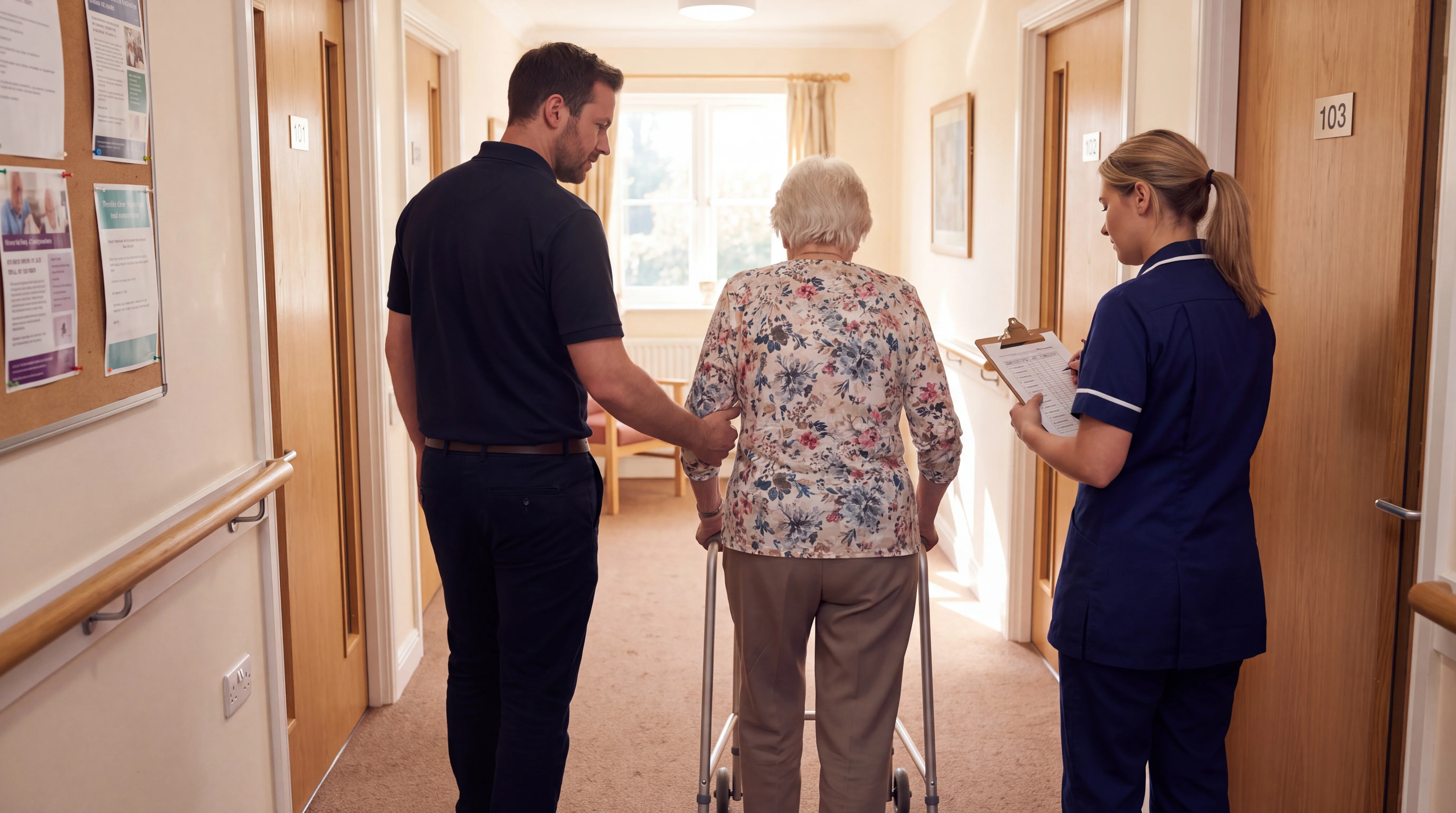
Review mobility and equipment. The named clinical lead should reassess transfers, walking, and usual independence within the locally required timeframe. Record changes and seek physiotherapy input when indicated.
Recondition through supervised movement. Agree a graded activity plan the resident can complete safely, increasing movement as tolerated. Support rather than take over, so the resident retains independence.
Rebuild confidence. Ask whether fear of falling is limiting movement. Set achievable mobility goals with familiar staff where possible, without encouraging avoidable immobility.
Maintain follow-up. Record delayed pain or functional decline and seek clinical review. The named lead should reconvene the multidisciplinary team when required and share authorised updates with the representative.
Close the protocol. Confirm the incident and clinical records, observation plan, notifications, chronology, interim safeguards, care-plan changes, owners, and review date are complete.
Reliable post-fall monitoring
Guardian supports post-fall review without replacing clinical assessment or professional judgement. It links mapped alerts with staff response times, giving care teams a clear timeline to evaluate.
During a pilot, use that record to measure alert-to-attendance time and test the workflow with your own care data.
Report every fall internally at once and complete the required record before responsibility transfers. External reporting depends on the event and the rules that apply in the facility’s jurisdiction.
In U.S. Medicare- or Medicaid-certified nursing facilities, the deadlines in 42 CFR §483.12 apply to alleged abuse, neglect, exploitation, or mistreatment, not every fall. Reportable allegations involving serious bodily injury have a two-hour deadline; other covered allegations have a 24-hour deadline.
Yes. Document every fall, the resident’s initial findings, and the follow-up plan even when no injury is apparent.
Record visible injury, pain, movement, neurological status, comparison with baseline, and the named observation plan. Follow the detailed documentation steps above.
Respect an informed refusal from a resident with decision-making capacity. Explain the risks and alternatives, but follow the emergency pathway if immediate intervention is legally and clinically justified.
Offer less intrusive checks for breathing difficulty, deformity, or pain cues. Notify the clinician and authorised representative when required.
Record the capacity assessment, explanation, refusal, notifications, and agreed checks. Continue authorised observations and escalate deterioration under CMS guidance, AHRQ guidance, and local policy.
Treat an unwitnessed fall as higher risk. Preserve available evidence, complete the approved assessment, seek clinical advice, and follow the enhanced observation and escalation pathway.

Author
Aleks Timm
Aleks Timm leads Guardian and builds privacy-first operations technology for care homes and home care providers. Teams get location-aware alerts they can act on, clearer situational awareness, and measured insight into how care work actually runs.
Read MoreRecommended reads
Keep reading
Wireless Patient Monitoring Systems for Care Homes
A complete guide to wireless patient monitoring systems, connected sensors, alert logic, care-home deployment, privacy, and...
Read more
Remote patient monitoring: a complete guide
Remote patient monitoring: the complete guide to sensors, benefits, and buying tips for safer care homes and better resident...
Read more
Patient bed alarms for elderly & hospital care
Patient bed alarms help prevent falls in elderly and hospital care. Compare alarm types, choose the right sensor, and protect...
Read more