


Incident Reporting Procedures: A 5-Step Guide for Care Settings
In this article
Incident reporting procedures begin by making people safe, then preserving facts, escalating concerns, and recording what happened.
This guide gives care homes, home care teams, and other professional care settings a five-step process. External duties vary by jurisdiction, so use it alongside your organisation's approved policy.
What counts as a reportable incident?
An incident may require an internal record, urgent clinical or safeguarding escalation, an external statutory notification, or more than one of these actions.
Record events and hazards that meet your organisation's internal threshold, even when no harm occurred. A separate legal or regulatory threshold determines whether an external body must be notified.
A missed round, medication near miss, or unexplained injury may therefore need an internal report without automatically becoming a statutory notification.
Use your local incident policy to confirm the reporting threshold, who owns the report, and when it must be submitted.
Common incident categories and examples
Classify the event by what happened, rather than by the outcome alone:
Health and medical: a medical emergency, sudden change in condition, medication error, or missed dose
Injury: a fall, burn, skin tear, manual-handling injury, or other harm to a resident, worker, or visitor
Care delivery: a missed round, short visit, unassisted transfer, or night-time bed exit that reveals a missed check or care-plan deviation
Safeguarding: suspected abuse, neglect, unexplained injury, financial exploitation, unsafe restraint, or another concern requiring the approved safeguarding route
Operational and facility reports cover events that interrupt safe care or expose the service to risk:
Operational: incomplete handovers, missed assignments, record failures, property damage, or a formal complaint linked to service delivery
Security: unauthorised access, a missing resident, threatening behaviour, or loss of confidential records
Equipment: a faulty hoist, failed bed sensor, damaged call button, or device malfunction during care
Environmental: a wet floor, blocked exit, unsafe temperature, exposed wiring, or hazardous substance release
One event can fit more than one category. A failed bed sensor during a night-time bed exit, for example, may be both an equipment incident and a care-delivery incident under local policy.
Near misses and hazards: report these too
A near miss is an event that caused no harm but could have harmed a person, disrupted care, or exposed the failure of a safety control.
Near-miss examples include:
A worker steadies a resident who loses balance during an unassisted transfer
Staff catch a medication prepared for the wrong resident before administration
A resident starts to slip on a wet floor but regains balance
A hoist brake fails during setup, before the resident is lifted
Record enough detail to identify where the control failed, even though the event ended without injury. Repeated near misses can reveal the same weakness across shifts or locations.
The distinction depends on whether you found a condition or witnessed an event:
Hazard: an ongoing source of risk, such as a wet floor, blocked exit, or faulty call button.
Near miss: a specific event that nearly caused harm, such as a slip without a fall or a transfer stopped after equipment failure.
Follow your local policy for who records or removes the hazard, who reviews the near miss, and the required timing for each action.
The incident reporting procedure, step by step
The procedure follows five steps: make the situation safe, notify the right people, preserve relevant evidence, record the facts, and submit the report through authorised channels.
Containment and clinical notification come before documentation because an active hazard can cause further harm, while an injured person may need immediate treatment. Start the report once people are safe and essential care is covered.
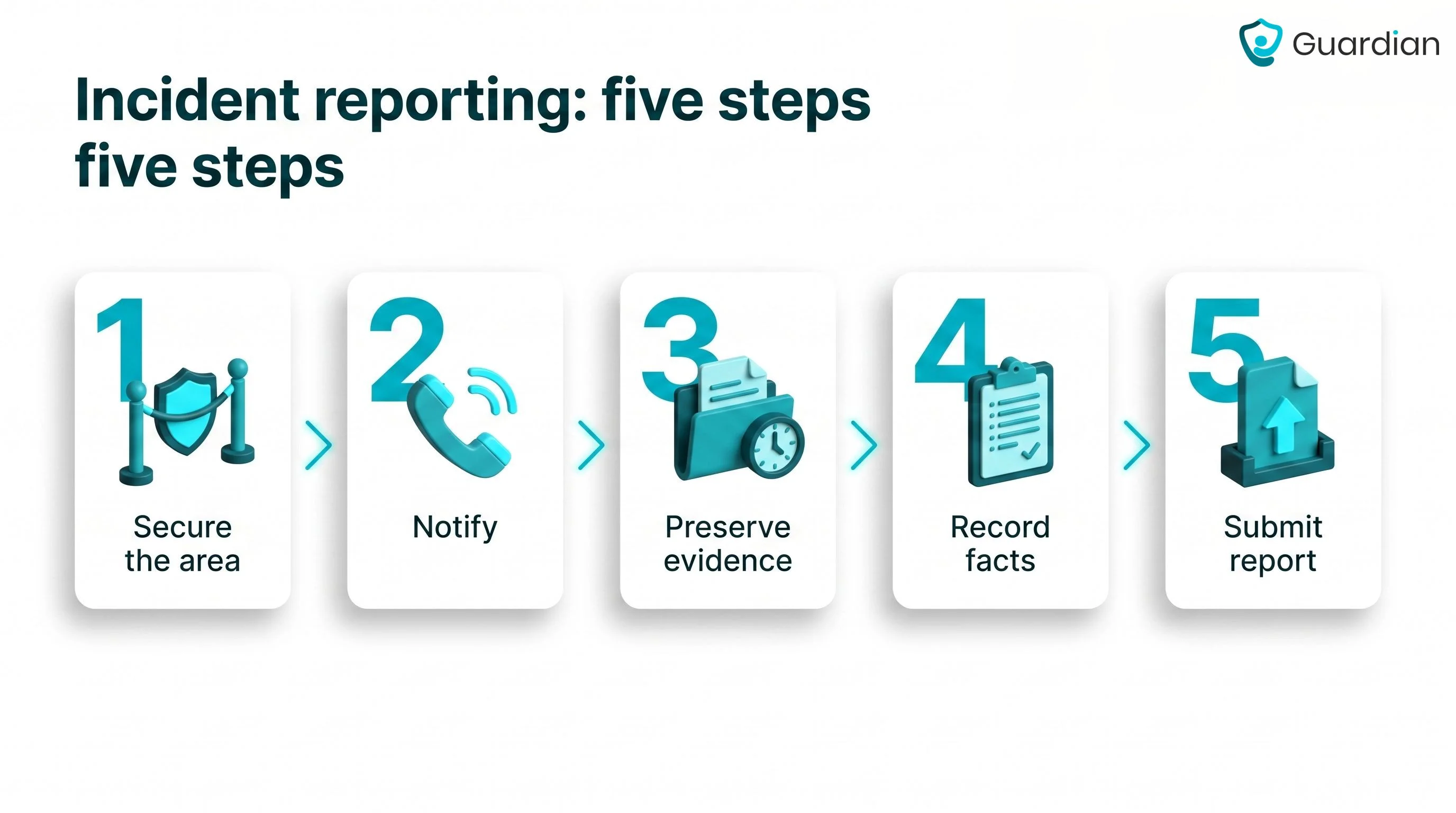
1. Respond to danger and secure the area
Check the scene for active hazards, provide emergency first aid or call emergency services, and isolate the area to prevent further harm.
Use this order to keep one incident from causing a second care delay:
Make the resident safe. Check for immediate danger and follow the approved clinical or post-fall protocol within your training. Move the person only as that protocol or emergency conditions require.
Get clinical help. Contact the appropriate clinician or emergency service when the injury needs assessment or urgent treatment.
Follow the approved local route. Use your organisation's emergency and post-fall protocol. In England, the HCPA pathway is one example of a falls pathway using 999, 111, and local response services.
Contain the hazard. Stop the source where safe, then block access with barriers or warning signs. For a digital incident, isolate the affected system and use the approved offline process.
Protect care continuity. Notify the shift lead and reassign medication rounds or essential checks so the incident response does not delay care elsewhere.
2. Notify the right person or team
Notify your immediate supervisor, designated safety lead, or emergency services depending on the incident's immediate severity level.
Use the incident’s current severity to decide who acts first.
Use this escalation route:
Immediate danger: Call local emergency services. In the UK, use 999 for a life-threatening event or red-flag injury, then follow the setting’s emergency protocol.
Urgent deterioration: Contact urgent clinical support under the local escalation policy. The pathway may require urgent clinician review or emergency services.
Stable, lower-risk incident: Notify the supervisor or on-call lead promptly and arrange the response required by local policy.
Safeguarding or medicine concern: Use the required direct safeguarding route and seek clinical advice immediately for a medicine error. Follow CQC medicine guidance in England.
Use your organisation's approved structured handover format. SBARD is one example; its final Decision step confirms the instruction, owner, and review time:
Situation: State what happened, the exact time and location, and the person’s current condition.
Background: Give the relevant history or circumstances needed for an immediate decision.
Assessment: Describe observed signs, changes and immediate risks.
Recommendation: State the action already taken and the decision or support you need.
Decision: Repeat back the instruction, who owns the next action and when review is due.
UK pathways are jurisdiction examples. Apply the emergency, safeguarding and clinical escalation rules for your location and organisation.
Do not wait for managerial approval where policy or law requires direct safeguarding or emergency escalation. Notify management once the immediate route is active.
3. Preserve evidence and identify witnesses
Preserve the evidence needed for a fair review. The amount depends on the incident's severity, complexity, and likelihood of dispute.
For every incident, capture the available core evidence:
Time and place: Record the exact time and precise location.
People: Identify those involved, witnesses, and anyone who arrived immediately afterwards.
Immediate actions: Record care, containment, escalation, and relevant equipment or alert status.
Available records: Secure relevant care notes, access logs, device data, or other records before routine deletion.
For a serious, disputed, or externally reportable incident, preserve additional material when permitted:
Scene and equipment: Photograph relevant conditions and record equipment settings before reset or repair, unless safety requires immediate action.
Separate accounts: Take individual witness statements before group discussion shapes recollection.
Controlled handling: Record exports and handovers, keep original files where possible, and restrict access to the approved incident file.
4. Record the facts, not conclusions
Recording facts means documenting observable events, exact times, direct statements, and physical conditions without speculating on causes, fault, or intent.
For example, a sample entry could read: “The resident was seated on the floor beside the bed at 07:10; the walking frame was against the opposite wall.” Avoid conclusions such as “The resident fell because they were careless.”
Use quotation marks for a witness’s own words: “I heard a call, then found the resident by the bed.” Identify the speaker and record when the account was given.
Describe the scene precisely:
Lighting: which lights were on and whether visibility was restricted
Floor: dry, wet, uneven, or obstructed
Objects: the position of furniture, mobility aids, footwear, and call devices
Equipment: displayed readings, alarm status, and device settings
Premature blame narrows the review around one person’s presumed mistake. A neutral account leaves room to examine staffing, equipment, environment, and procedure as possible contributing factors.
Objective records support open review and accountability under requirements such as CQC Regulation 12, which covers safe care and treatment.
5. Submit the report through the right channel
Submit the completed report through the channel required by your organisation’s policy and the law in your jurisdiction. The route depends on the incident’s severity and any external notification duty.
Use this routing framework:
Routine internal entry: log the report in the approved internal record and route it to the role named in your policy.
Urgent escalation: use the designated phone or clinical escalation route when the incident needs prompt senior or clinical review, then complete the written entry.
Direct external notification: notify the regulator, safeguarding authority, police, insurer, or other body when the applicable rules require direct reporting.
Follow the deadline stated in your policy and the relevant regulator’s current requirements. A single submission deadline does not apply to every incident or jurisdiction.
Keep the submission reference or case number with the incident record. Record the channel and confirmation received, then start the approved escalation process if confirmation does not arrive.
What to include in an incident report
Start with the facts that identify what happened, who was involved, and what staff did next. Add incident-specific clinical or technical details after that.
Universal fields every report needs
Record these fields for every incident report:
Event details: Date, exact time, precise location, and incident category.
People and roles: Full names and each person's role in the event or response.
Chronology: Observable events and direct quotes in time order.
Immediate actions: First aid, clinical escalation, containment, and care-continuity steps.
Notifications: Person contacted, time, method, advice, and response.
Evidence: Witness details, available records, photographs, and preserved items.
Reporter: Full name, role, contact details, and submission time.
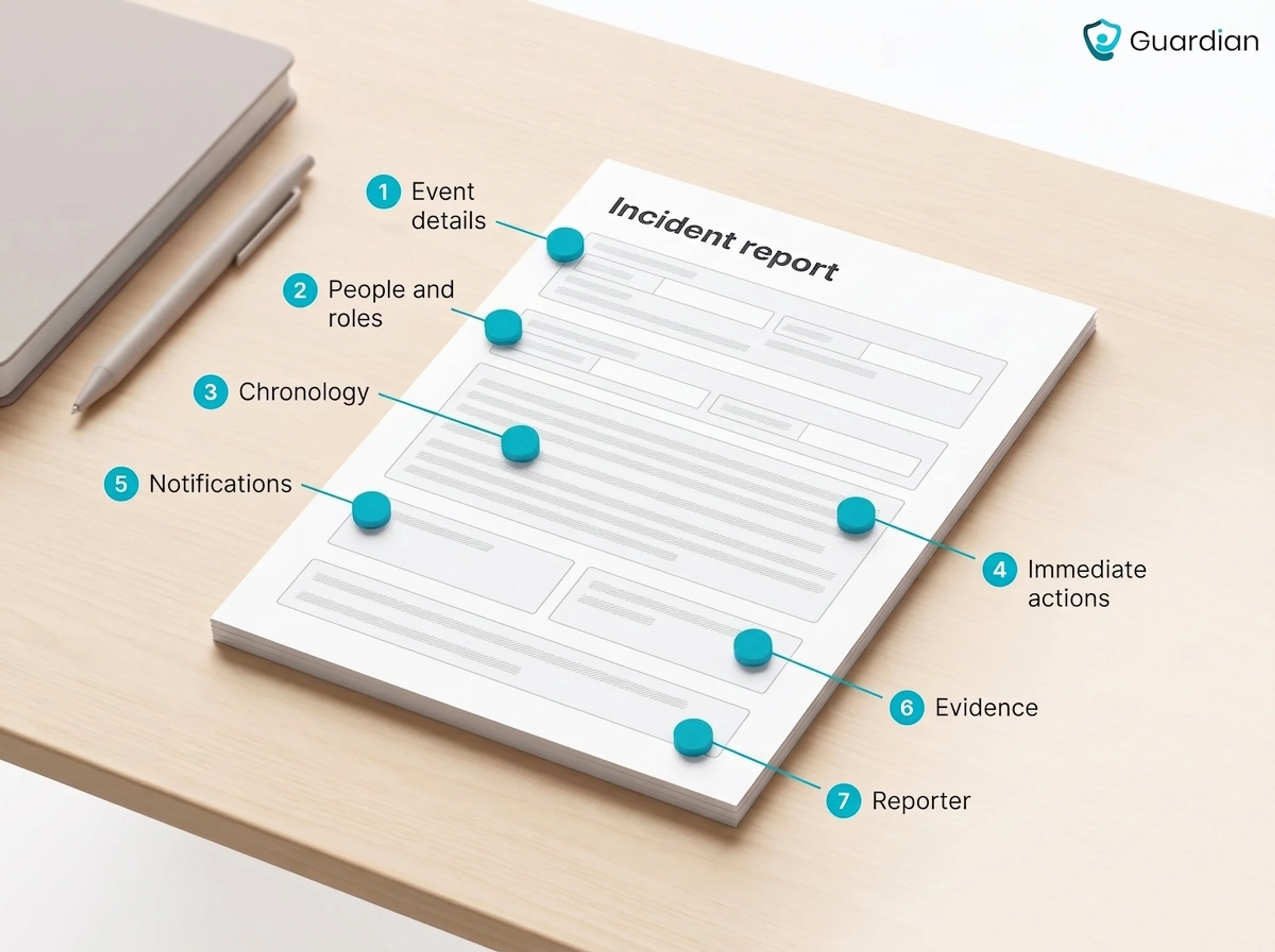
Record what you saw or what someone told you. Label direct quotes clearly, and do not guess at fault or cause.
Follow your organisation's reporting route and notification thresholds. Local law and clinical policy may set extra requirements.
Extra details by incident type
Some incidents need extra details to support safe follow-up and review. Use the fields that match the event.
Add the fields that apply:
Fall: Position found, possible head impact, observed injuries, post-fall checks, moving equipment, and environmental factors.
Deterioration: Baseline, observed changes, vital signs, approved assessment score, escalation times, clinical advice, and response.
Medication error: Medicine, strength, prescribed dose, route, due time, what was given or omitted, checks, advice, and corrective action.
Near miss: Event sequence, failed control or precursor behaviour, people exposed, how harm was prevented, and controls added.
Care context: Relevant care-plan instructions, staffing or assignment context, and whether scheduled care continued elsewhere.
Device context: Sensor, alarm, call-button, or equipment status at the time.
Further notifications: Family, advocate, safeguarding, insurer, or regulator contacts where required.
Use any extra fields required by your approved local form. Follow local law, clinical policy, and organisational procedure for external reporting or clinical escalation.
Who is responsible at each stage?
Assign each handoff clearly: who makes the situation safe, raises the report, chooses the escalation route, investigates, verifies corrective action, and authorises closure.
Write down each handoff. Staff need to know who takes over, who can escalate, and who confirms the work is complete.
Frontline employee or witness: Give immediate aid when safe, reduce further danger, notify the supervisor, and give a factual account without assigning blame.
Supervisor or team lead: Coordinate care, manage the immediate area, route the report correctly, and complete the initial review.
Safety or risk lead: Run the formal review, arrange specialist or external referral where required, and track corrective actions to completion.
Director or oversight committee: Approve resources and policy changes, confirm corrective actions are complete, and authorise case closure.
Name a primary owner and deputy for every role.
State who can approve escalation, corrective action, and closure when senior staff are unavailable.
Severity and escalation: when to go beyond the normal channel
Use the normal reporting route for non-urgent records. Escalate immediately when someone faces life-threatening harm, uncontrolled danger, or rapid deterioration.
Internal, specialist, and external reporting
Choose the route by the immediate risk and the reporting duty that applies. Protect people first, then contact the right internal, specialist, or external lead.
Immediate emergency response: For life-threatening injury, uncontrolled danger, or rapid deterioration, contact local emergency services and prevent further harm.
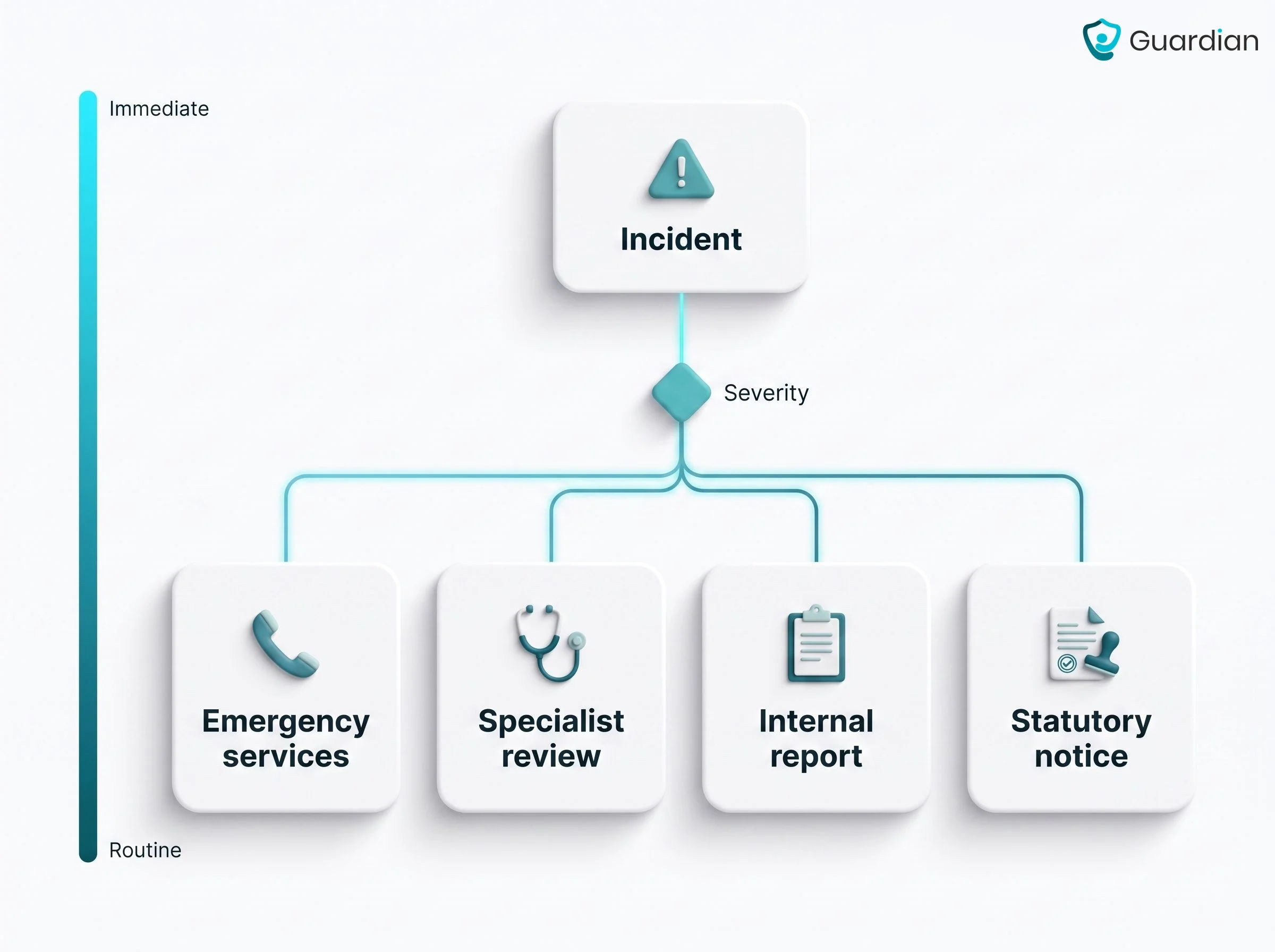
Urgent specialist review: For a clinical concern needing prompt assessment, contact the designated clinician or approved specialist pathway.
Routine internal reporting: For a managed event or near miss, notify the named supervisor through the approved channel.
Statutory notification: For an event covered by local law, route the formal submission through the accountable regulatory lead.
RESTORE2 is one example of a deterioration pathway for organisations that have adopted it. Follow the organisation's approved scoring and escalation instructions rather than applying a universal threshold.
CQC notification duties are one example for registered providers in England where the relevant regulations apply. Each policy should name the accountable role, regulator, contact route, and deadline for every jurisdiction in which the organisation operates.
What happens after you submit a report?
The report moves from triage to investigation and follow-up. Urgent risks are escalated straight away.
The manager or safety lead checks the report within the timeframe set by policy, then assigns its severity, investigation route, and owner. Urgent risks remain subject to immediate escalation.
Triage and classify. The manager or safety lead checks the report, assigns a severity level, and sets the investigation and escalation route.
Review the evidence. Investigators examine the available records and physical evidence, then speak to each witness separately so accounts remain independent.
Identify root causes. The review looks beyond individual error to find process gaps, environmental hazards, or unclear responsibilities that allowed the incident to happen.
Implement corrective and preventive action. A named owner fixes the immediate cause and addresses wider risks through changed procedures, environmental controls, or staff training.
Communicate and complete notifications. The responsible lead shares findings with those affected and relevant staff, then submits external notifications where law or policy requires.
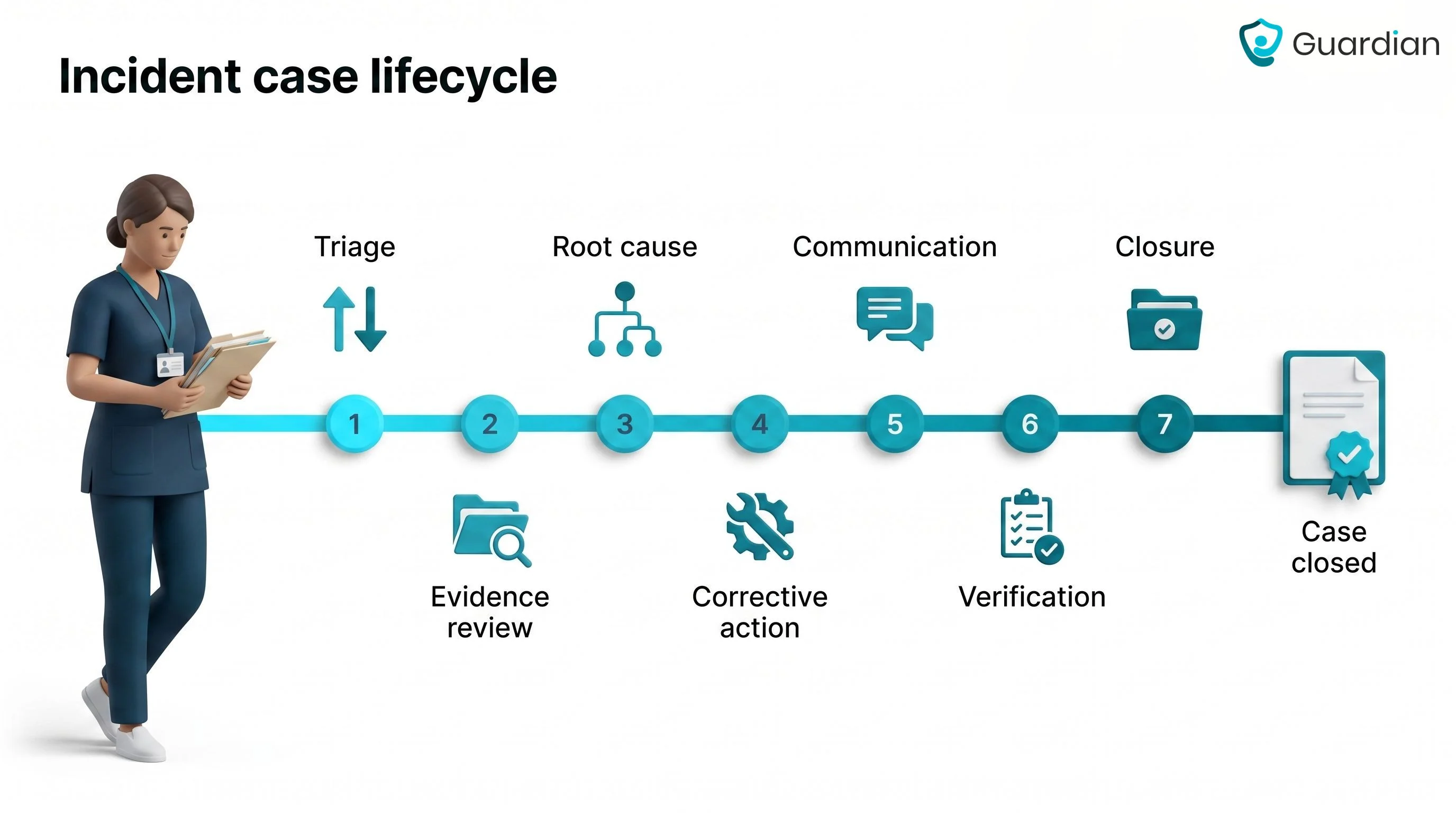
How to know a case is actually closed
A case closes only when a named lead verifies that required actions and notifications are complete, then records evidence that the controls work during routine practice.
Before archiving, check the evidence rather than assuming an action is complete because it was scheduled:
Actions implemented: Corrective and preventive actions are complete, with evidence attached to the case record.
Procedures and training updated: Affected procedures, guidance, and training materials reflect the investigation findings, and relevant staff have received the update.
Filings completed: Required notifications to regulators or other external bodies are submitted and logged.
Controls checked: A follow-up check confirms the controls work during normal shifts; health or environmental reviews are complete where relevant.
Communication recorded: The final outcome and any continuing precautions have been shared with the people who need to know.
Closure approved: A named manager or safety lead reviews the evidence, approves closure, and records the decision.
Are incident reports confidential, and do they go on your record?
Incident reports are controlled records. Access, storage, retention, and lawful disclosure depend on the record type, local law, and organisational policy.
Limit access to authorised roles with a genuine need to know. Record only information relevant to the incident and store it in an approved system with appropriate privacy controls.
Personnel-file treatment should follow written policy and local employment law:
Routine cases: Keep the report in the safety, safeguarding, or risk-management archive.
Formal action: Add relevant findings to personnel records when verified misconduct, serious negligence, or a policy breach triggers discipline.
Near misses: Under a just-culture approach, separate learning from performance action unless the review verifies misconduct or another disciplinary issue.
Confidentiality limits access, but it does not prevent lawful disclosure. Regulators, inspectors, insurers, courts, police, or safeguarding authorities may be entitled to receive the record.
Use the approved legal basis and share only what each recipient needs, unless a legal duty, court order, or investigation requires broader disclosure.
Why incident reporting procedures still fail in practice
Procedures fail when forms take too long, staff wait for approval, near misses feel burdensome, or reporters never hear what changed.
Form friction: Long forms and high click-depth delay filing and pull staff away from direct duties. Fix: shorten forms and capture essential facts immediately.
Delayed reporting: Writing from memory at shift end can lose the exact time, room conditions, device state, and first response. Fix: capture core facts as soon as immediate care is covered.
Approval bottlenecks: Staff who wait for a manager before submitting can miss safeguarding or statutory deadlines and leave hazards open. Fix: define which reports go directly to the designated channel, with review after submission.
Near-miss underreporting: A no-harm event may demand the same paperwork as an injury. Fix: provide a short near-miss route that records the hazard and immediate action.
Blame and missing feedback: Fear of blame suppresses reporting, while silence after submission makes the process feel pointless. Fix: separate learning from discipline, acknowledge every report, and tell staff what changed.
No action owner: Corrective work stalls when nobody owns the deadline. Fix: assign one named owner and deputy for every action.
Premature closure: Scheduling a fix is mistaken for completing it. Fix: close the case only after a named lead verifies the control in routine practice.
Why manual reporting still misses what live monitoring catches
Manual reporting can capture injuries, hazards, near misses, and reconstructed events. Its limits come from what staff observe, remember, retrieve, and enter after the event.
Reconstructing a shift turns the incident timeline into a manual matching exercise across care notes and handovers. A time-stamped sensor record supplies the missing sequence before staff write the incident report.
Manual records: Depend on observations, witness accounts, available evidence, and timely data entry.
Live records: Create timestamps for configured events within sensor coverage, including events that staff did not witness directly.
Guardian is one care-specific example. The wireless, camera-free platform combines four signal types in one live operational view:
Bed sensors record exits and changes in night-time routines.
Movement sensors capture room-level activity without filming residents.
Door sensors log room exits or entry into monitored areas.
Wearables detect falls or SOS presses and send room-level location.
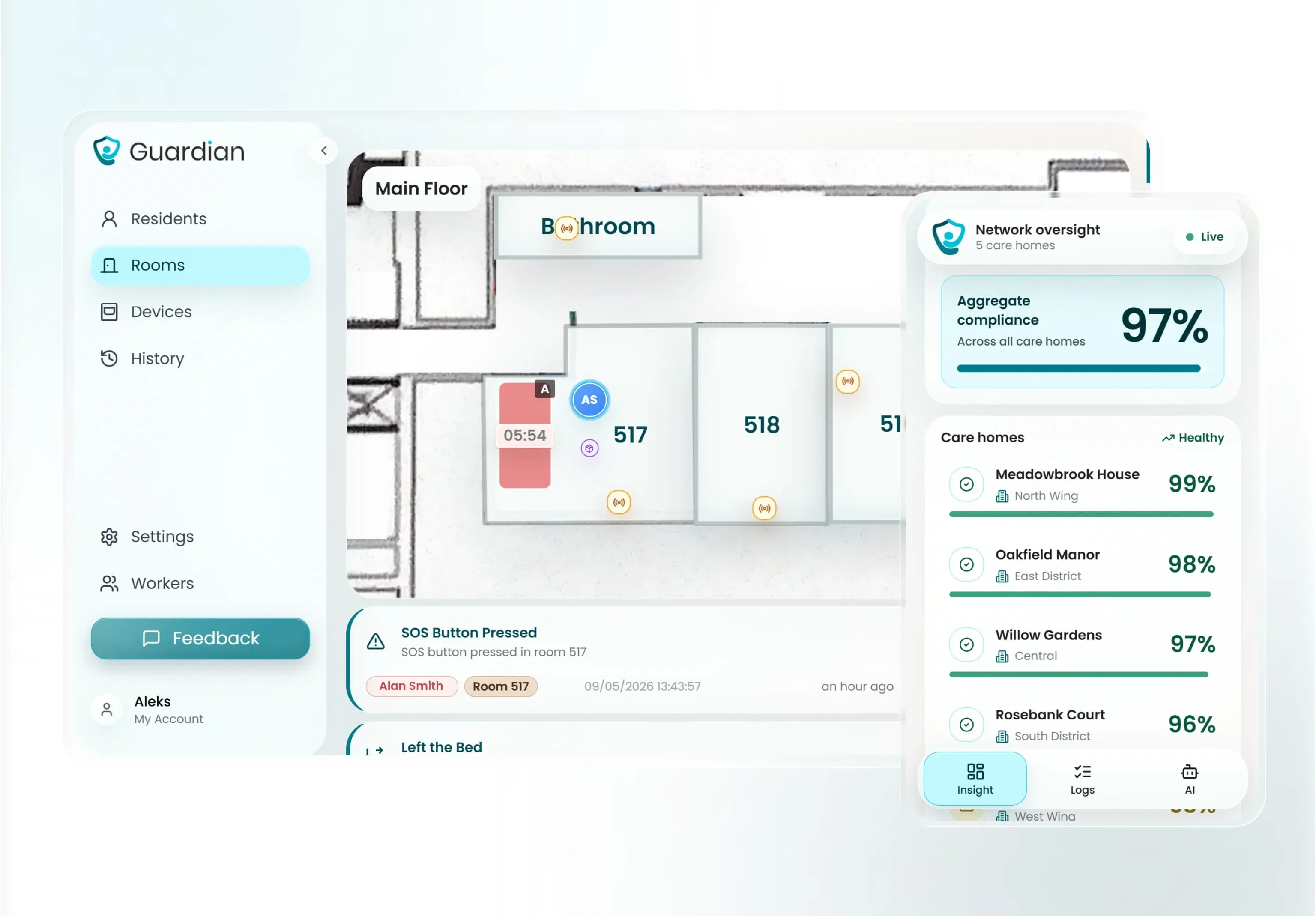
Guardian records configured events within its coverage and applies agreed alert rules. A prolonged bed exit can trigger a location-aware alert with the resident's name and room, while routine activity remains in the timeline.
Live records do not replace staff observations, clinical assessment, safeguarding judgement, or the formal incident report. They provide timestamps and context that support faster response and a clearer review.
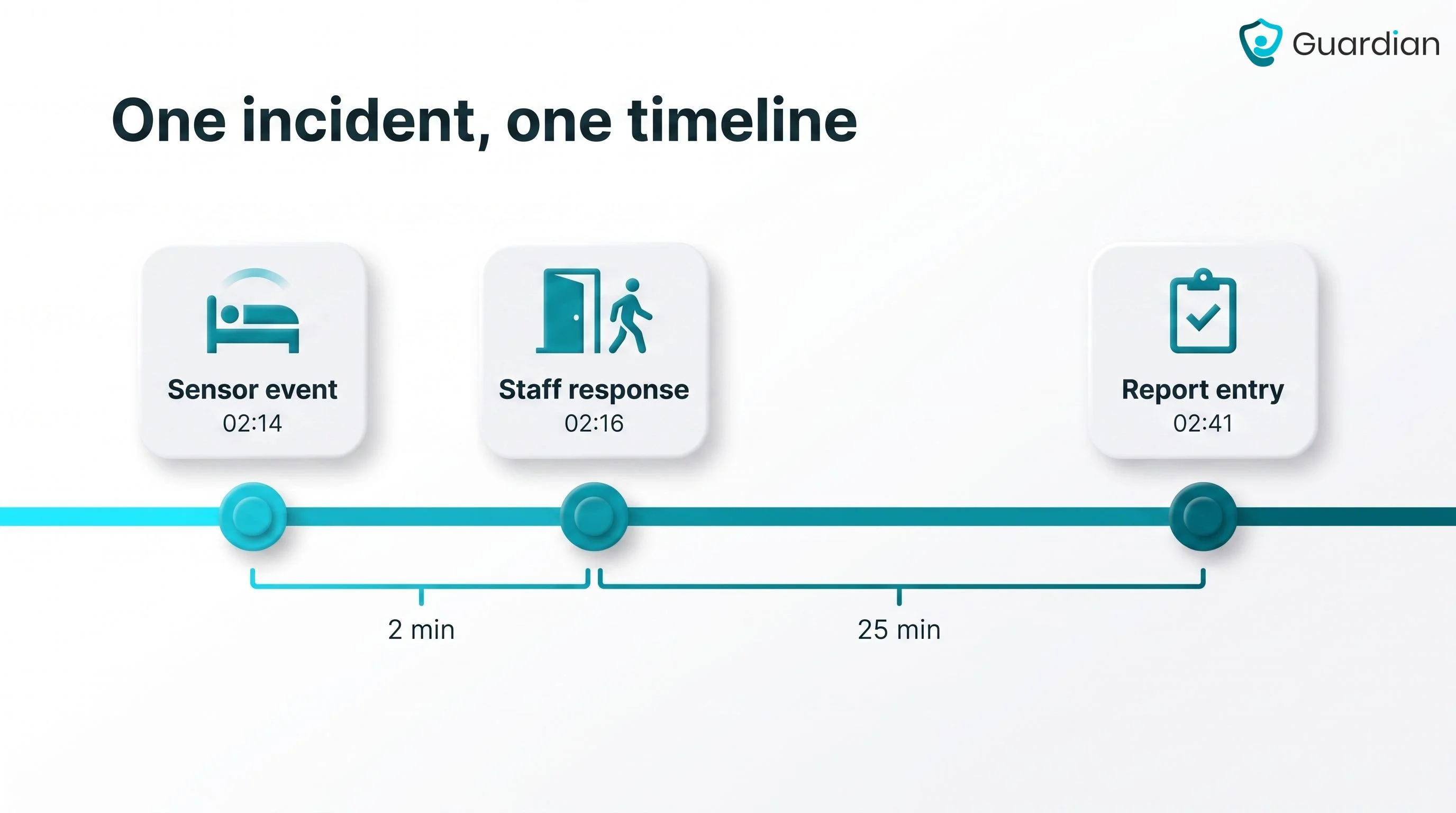
Move from incident reconstruction to live visibility with Guardian
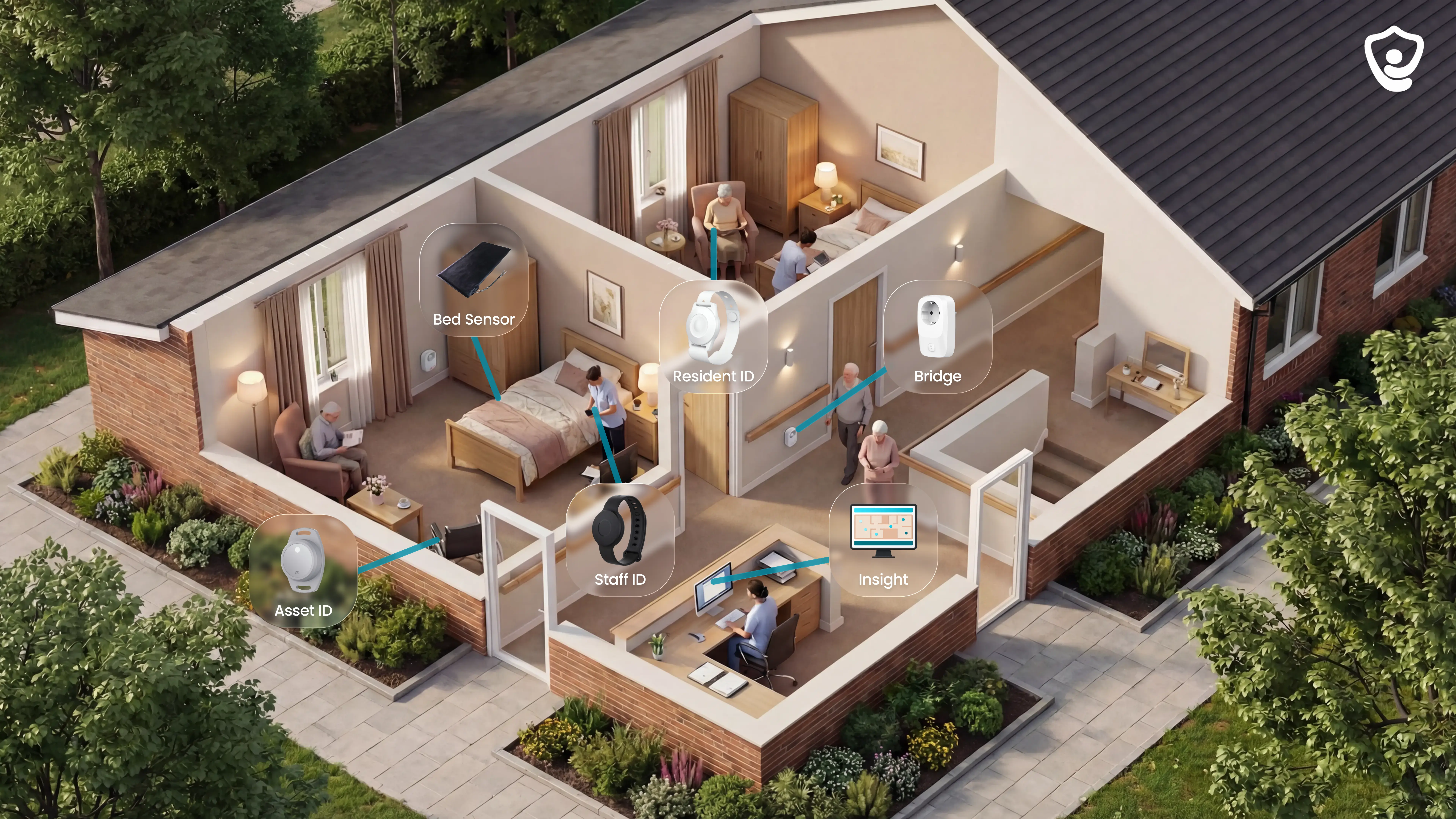
Guardian gives care homes, home care providers, specialist care services, and mental-health teams a live, camera-free view of events across a facility or fleet.
Wearables, bed and movement sensors, door sensors, vehicle trackers, and asset trackers feed Guardian Insight. Configured alerts reach staff devices with the person and room or map location, while timestamps remain available for review.
A 6-8 week pilot maps your workflows and configures selected use cases in one ward, home, or team. Your team then measures event records, response times, alert handling, and staff feedback.
The pilot ends with an impact and ROI report plus a rollout recommendation. Use your own data to decide what to scale.
There is no universal deadline. Escalate immediate danger or safeguarding concerns at once, complete the internal record within your policy's timeframe, and meet any separate external deadline. For alleged violations in US CMS-certified nursing facilities, 42 CFR § 483.12 requires reporting to the facility administrator and other officials immediately, within 2 hours when serious bodily injury is involved or within 24 hours otherwise. In England, CQC Regulation 18 requires specified incidents to be notified without delay.
You can raise an internal concern anonymously when the organisation's reporting channel permits it. Formal external notifications must still be made by the provider or responsible person identified by the applicable rules. Give the time, location, people involved, and event sequence because anonymity can limit follow-up questions.
An incident report covers an unplanned event, hazard, or near miss. An accident report covers an event that caused injury, illness, or property damage, so every accident is an incident but not every incident is an accident. Organisations sometimes use these terms differently, so follow the definitions on the approved form and policy.
Retention depends on the jurisdiction, record type, organisational schedule, and any legal hold. Do not apply the rule for one record type to every incident file. For example, OSHA injury and illness records are kept for five years after the calendar year they cover, while RIDDOR Regulation 12 requires covered records to be kept for at least three years. Investigation, claim, safeguarding, and litigation files may follow different schedules.

Author
Aleks Timm
Aleks Timm leads Guardian and builds privacy-first operations technology for care homes and home care providers. Teams get location-aware alerts they can act on, clearer situational awareness, and measured insight into how care work actually runs.
Read MoreRecommended reads
Keep reading
How to install a nurse call system: a step-by-step guide
How to install a nurse call system with less disruption: plan devices, wiring, testing, and handover step by step for a smoother...
Read more
Smart Nurse Call Systems for Care Homes and Home Care Providers
Smart nurse call systems for care homes and home care providers: compare features, improve response times, and choose the right...
Read more
Remote patient monitoring: a complete guide
Remote patient monitoring: the complete guide to sensors, benefits, and buying tips for safer care homes and better resident...
Read more