

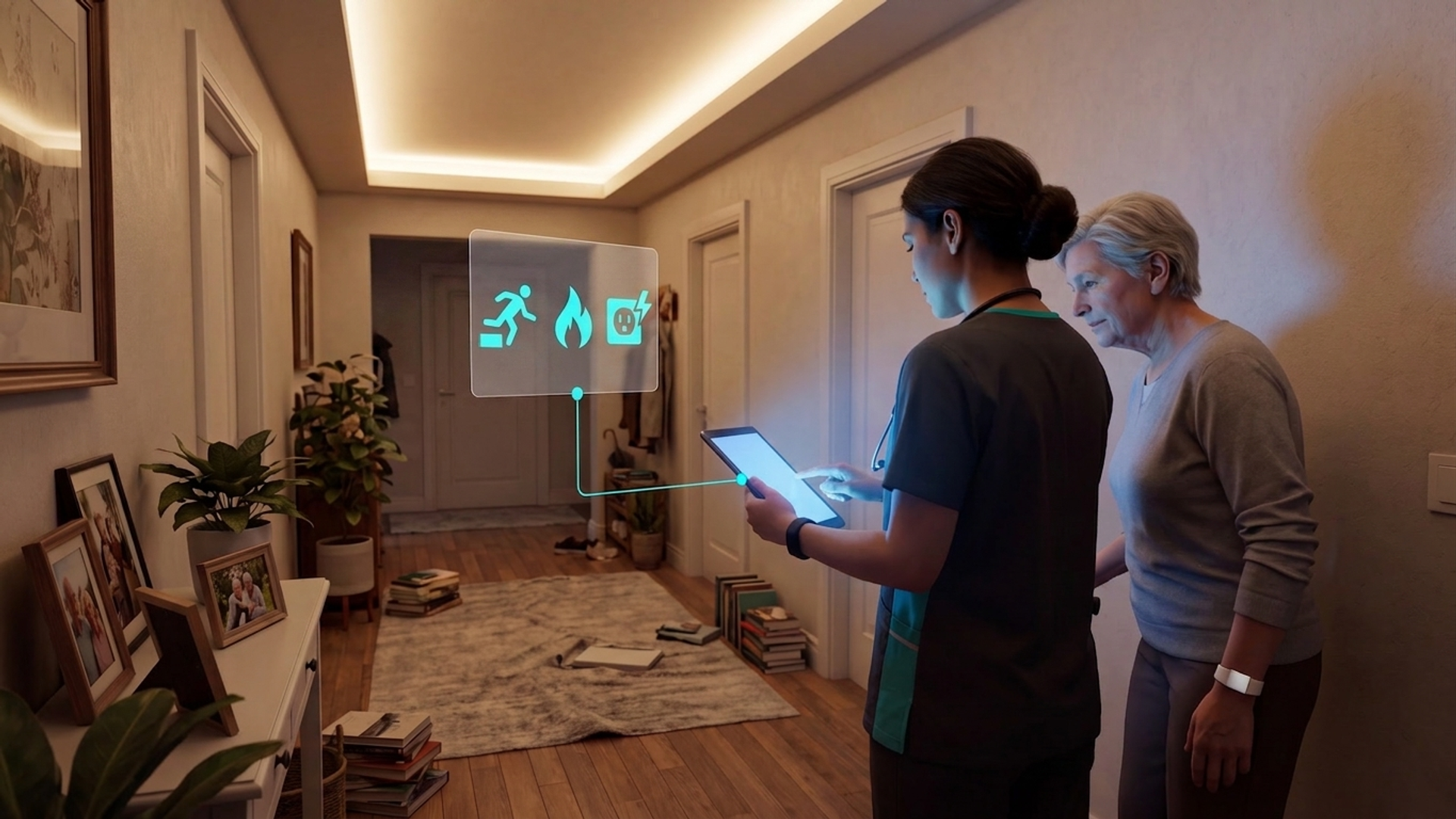
Home Safety Assessment: Find Hazards Before They Cause Harm
In this article
A person gets up overnight. The route from bed to bathroom can expose poor lighting, loose rugs, clutter, or furniture that narrows the path.
Family caregivers can use the physical and daily-function checks in a private home. Care managers, home care operations leads, and professional assessors can use the same findings to assign owners, priorities, and review dates.
Guardian is a wireless, camera-free safety and operations platform for care homes, home care providers, and specialist care settings. It connects sensors, wearables, location-aware alerts, and operational records.
Use this guide for screening and documentation, not to replace clinical or property assessment. Follow the existing care plan, never remove required support to test a movement, and stop when an immediate or uncertain hazard needs a qualified professional.
What a Home Safety Assessment Covers
A home safety assessment checks the living space and the care routine around it.
Use the four domains together. A clear route still leaves risk when support is unavailable or an emergency alert has no response plan; record each finding with an owner, priority, and review date.
Physical hazards: Inspect stairs, porches, hallways, bathrooms, bedrooms, kitchens, and living areas for trip risks, poor lighting, blocked routes, unsafe surfaces, and missing handrails or grab bars.
Functional routines: Observe transfers, standing, walking, steps, self-care, meal preparation, medication routines, and overnight movement to identify where the person needs support.
Emergency readiness: Check smoke and carbon monoxide alarms, electrical safety, emergency contacts, and the plan for responding to a fall, fire, or sudden change in health.
Support workflows: Review caregiver availability, handovers, communication routes, and escalation responsibilities so everyone knows who should respond and how concerns are recorded.
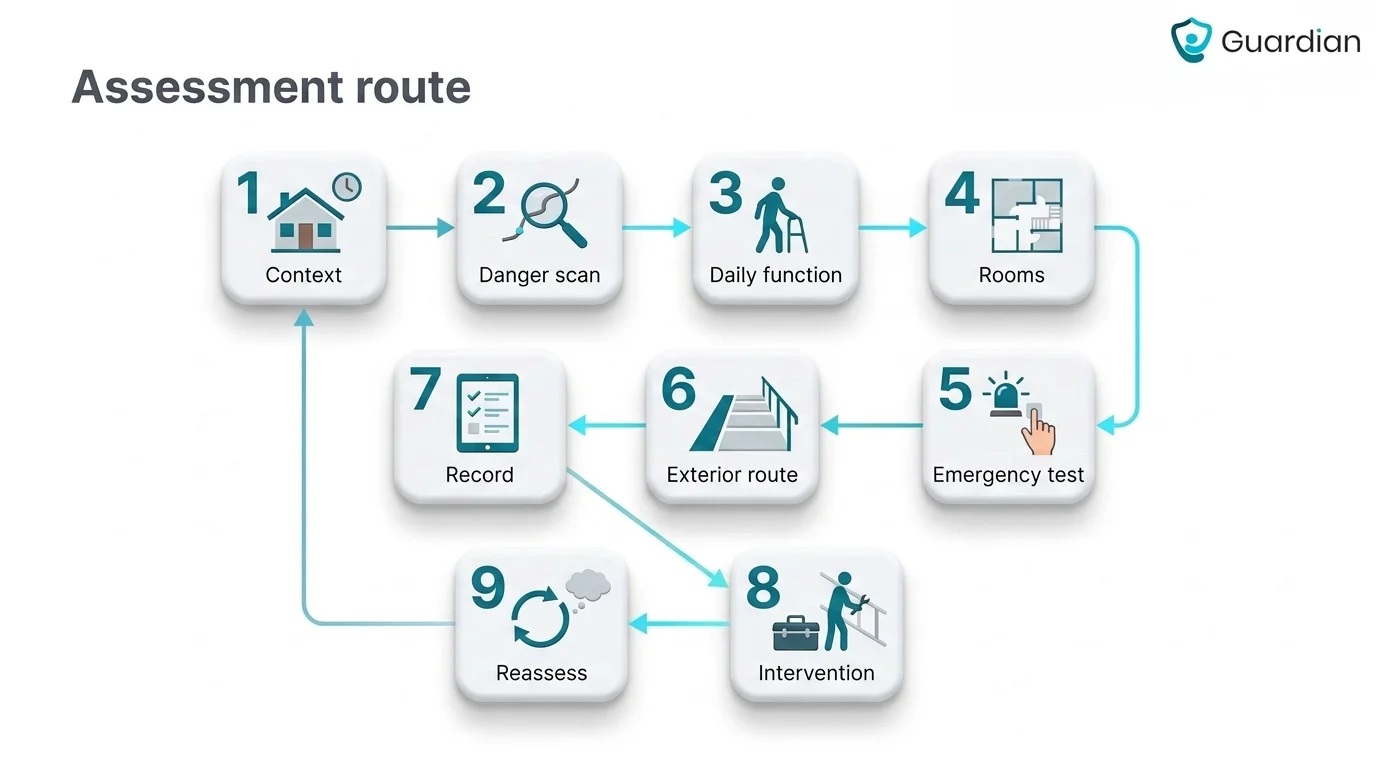
1. Set the Assessment Context
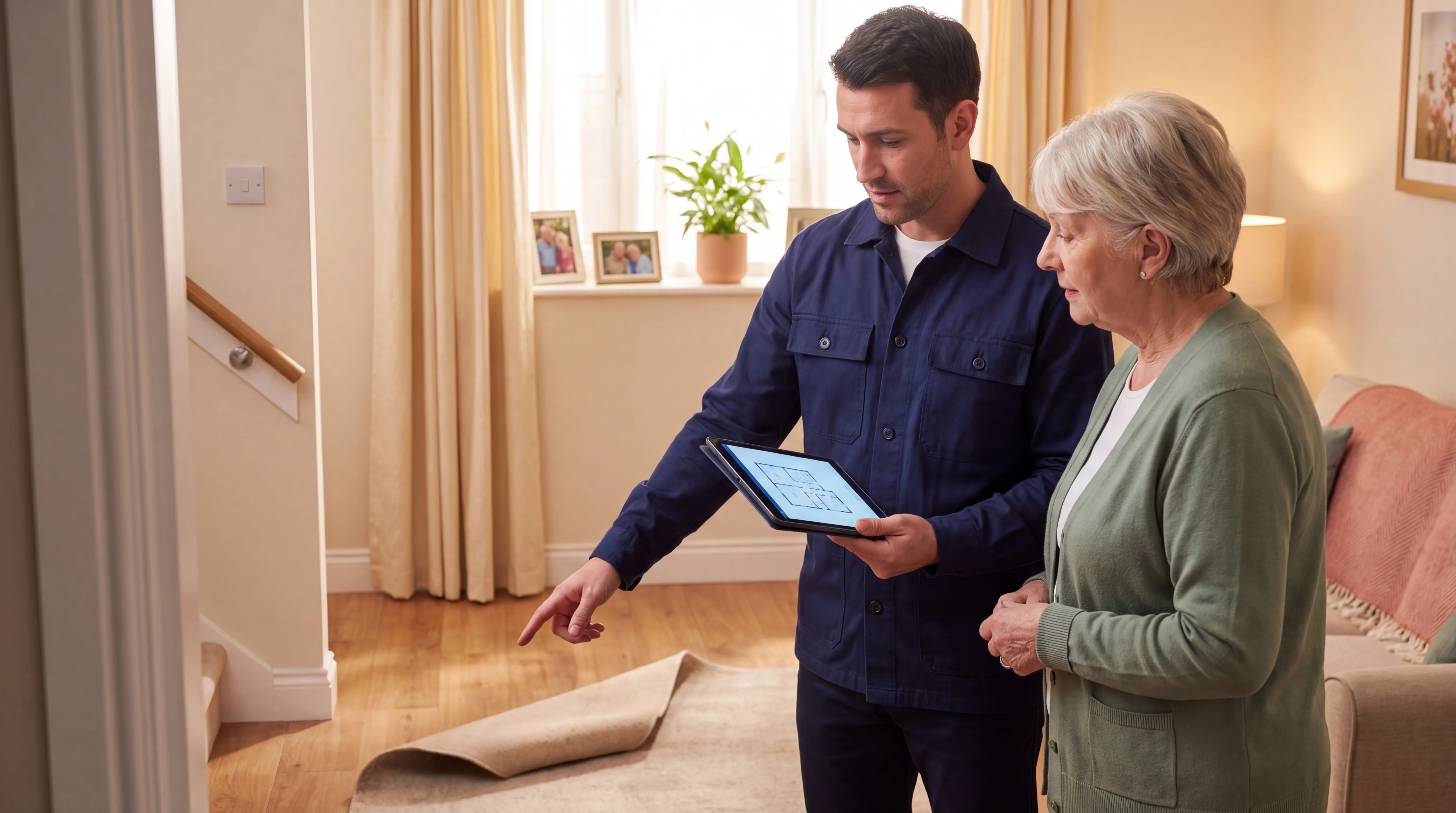
Before inspecting the space, document the person's physical, cognitive, and daily support needs. In managed care, add caregiver routines and named responsibilities; in a private home, record who is available and when.
Record the resident baseline
Use the care plan and the person's account to establish what is normal; add staff observations when records differ. A narrow route carries different risk for an independent walker than for someone using a frame.
Mobility: Record the distance, in metres, the resident walks without hands-on help. Note whether fatigue, pain, or a mobility aid changes the result.
Transfers: Record the support and staffing already required by the care plan or qualified assessment, then name the movement, such as bed-to-chair or chair-to-toilet. Refer any uncertainty for reassessment.
Cognition: Record a screening result where one exists, then state whether the resident follows a one-step instruction and calls for help.
Medication routine: List administration times that may coincide with changes in alertness or balance, then ask the appropriate clinician to review suspected medication effects.
Support needs: State whether routine care requires supervision or hands-on help.
Choose the assessment mode
Choose the assessment mode to match the decision and the access available. Direct professional judgement is needed when risk is high or uncertain.
In-person assessment: use for high-acuity residents, recent incidents, unclear transfer ability, or decisions that require direct observation and measurement.
Guided video assessment: Use when access is delayed and a caregiver can follow a structured walkthrough. Obtain consent, protect privacy, and use an approved secure service.
AI photo or video screening: Use only as a supplement for human review. Obtain consent, use secure storage, and never treat visual screening as a substitute for clinical or housing assessment.
Formal tools: In the UK, local authorities use the Housing Health and Safety Rating System (HHSRS) to assess property hazards. Elsewhere, use a current official self-screening or professional tool recognised in the relevant jurisdiction.
Common mistake: Recommend a home change only after linking it to a specific risk, such as an unstable transfer or unreliable help-seeking.
Set the workflow baseline
Record the workflow baseline before steps 2 to 6 examine specific hazards. Use logs, handovers, and staff interviews to establish current performance.
Alert response: Record minutes from alert to staff arrival, including delayed responses by shift.
Incident locations: Map each recorded incident or near miss to a room, route, or transfer point.
Reporting effort: Record the minutes staff spend documenting and reviewing each incident.
Caregiver capacity: Record the named responder for each shift and whether that person can leave current duties.
2. Scan for Immediate Danger
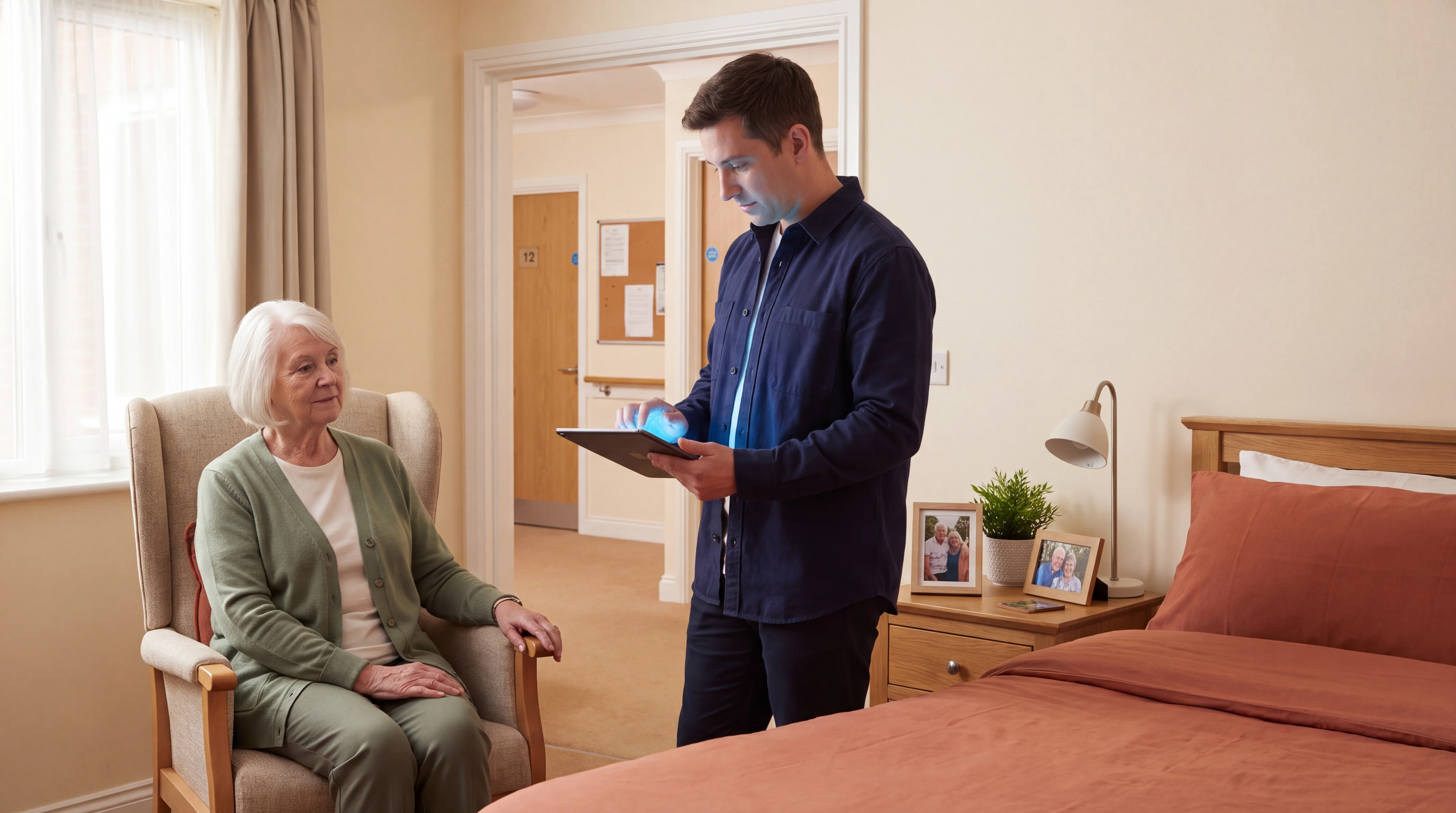
This is a stop-and-secure check for hazards that could cause harm before the walkthrough begins. Fire, gas, and electrical hazards take priority because they can make the home unsafe to remain in.
Fire and utility threats
Leave the property and call emergency services for smoke, flames, a suspected gas leak, sparking wiring, or an appliance that cannot be made safe. Do not operate a gas or electrical control when doing so may expose anyone to harm.
Blocked routes and unstable structures
Clear objects that stop an exit door opening fully or block the main route out of the home.
Prevent access to loose stair rails, broken thresholds, or damaged flooring until the hazard is repaired.
Emergency communication
Keep a large-print contact sheet within reach beside the landline or main seating area. Include emergency services, utility emergency numbers, a primary caregiver, and a backup contact.
Write the escalation order beside the contacts. Follow the organisation's emergency protocol where one applies; otherwise call emergency services for active danger, then the primary and backup contacts for urgent support.
Check that a working phone or call device is reachable without crossing the unsafe area.
Continue the full walkthrough only after each active danger is removed or isolated and responsibility for the next action is assigned.
3. Observe Daily Function
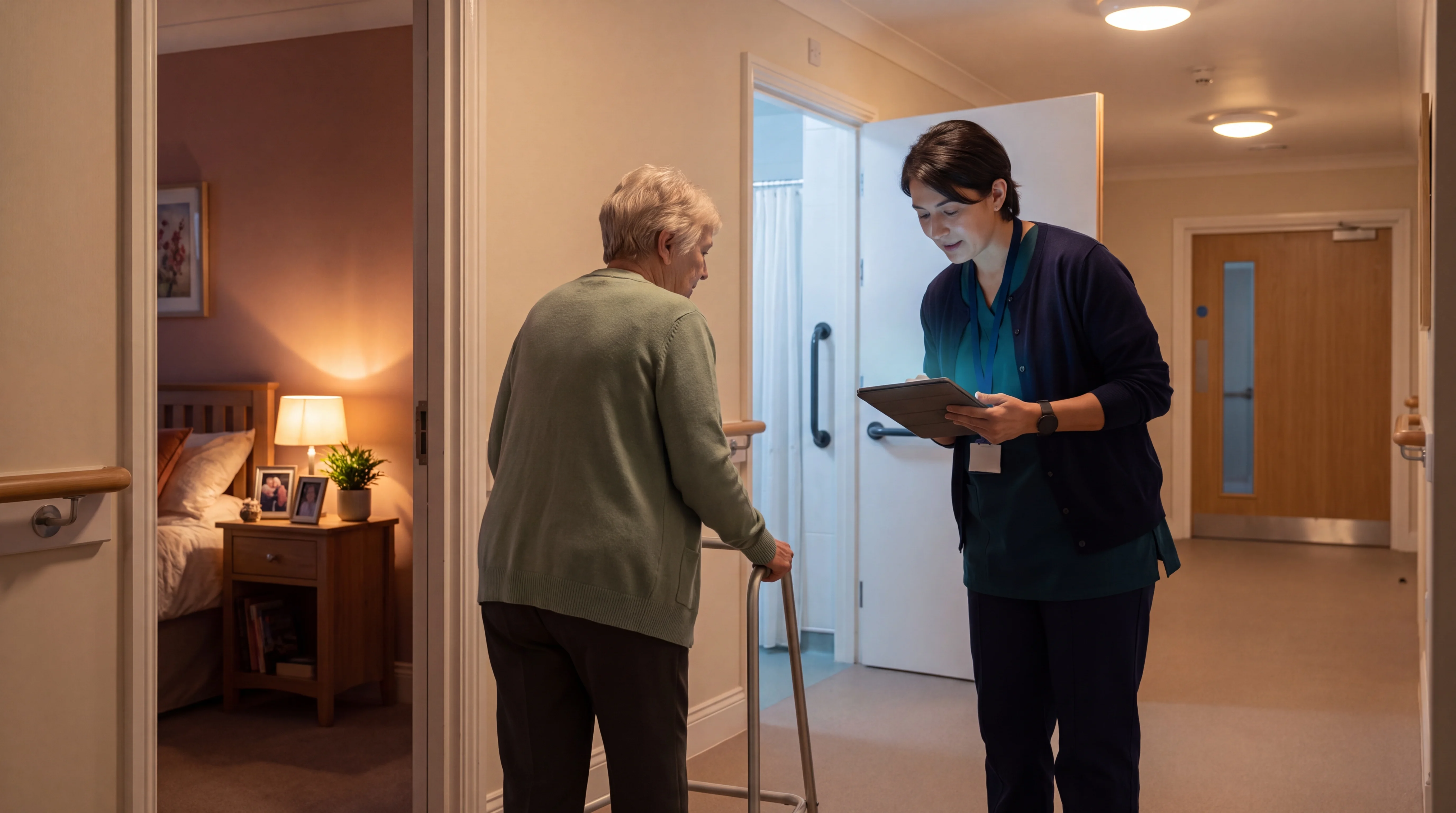
Observe how the person completes ordinary routines. An overnight bed-to-bathroom journey can expose risks that isolated daytime checks miss, but direct observation is appropriate only when the movement is already routine and safe.
Safety note: Keep the support required by the care plan. Do not create darkness, fatigue, urgency, or divided attention; simulate the route when direct observation would add avoidable risk.
Observe the bed exit. Watch how the person sits up, orients themselves, places both feet, and rises with the required support.
Follow the route to the bathroom. Move at the person's usual pace and note hesitation, furniture used for support, poor lighting, and tight turns.
Observe the bathroom turn. Check balance while the person changes direction and manages clothing, using simulation if both hands cannot be occupied safely.
Watch the toilet transfer. Observe the approach, controlled lowering, rising, grab-rail use, and the support specified in the care plan.
Follow the return to bed. Note whether fatigue affects the route, turning, or final transfer without deliberately tiring the person.
Repeat the observation during a daytime routine. Watch meal preparation, eating, chair transfers, or medication handling as a complete routine rather than isolated tests.
Check stair use only when safe and relevant. Observe the person's normal method and required support. Do not ask them to carry an item solely for the assessment.
Between visits, camera-free sensors can flag changes in bed exits, room motion, and door activity. Treat each signal as a prompt for a human check, not proof of what happened.
4. Inspect Every Room
Inspect the spaces and routes the person uses each day. Check the overnight bed-to-bathroom journey separately because lighting and support can differ after dark.
Common mistake: Clearing obvious clutter while leaving the usual route tight or poorly lit. Follow the full path at walking pace and verify clearance against local requirements and the mobility aid used.
Bedroom and bathroom: Check that weight-bearing grab bars are rated and securely installed for their intended use. Do not rely on a suction-cup bar for body weight unless its manufacturer and a qualified assessor confirm that use.
Kitchen and common areas: Store daily-use items between waist and shoulder height to avoid step stools and deep bending. Test chairs and sofas for firm, stable support, then confirm appliance and lighting controls are reachable without stretching across hot or wet surfaces.
Moisture and mold: Record water stains, dampness, or visible mold. Correct the moisture source and use a qualified local professional when the source, extent, or remediation method is uncertain.
Other environmental hazards: Arrange targeted radon, lead, or asbestos assessment only when the building, location, materials, or local requirements indicate a credible concern.
5. Test Emergency Systems and Response
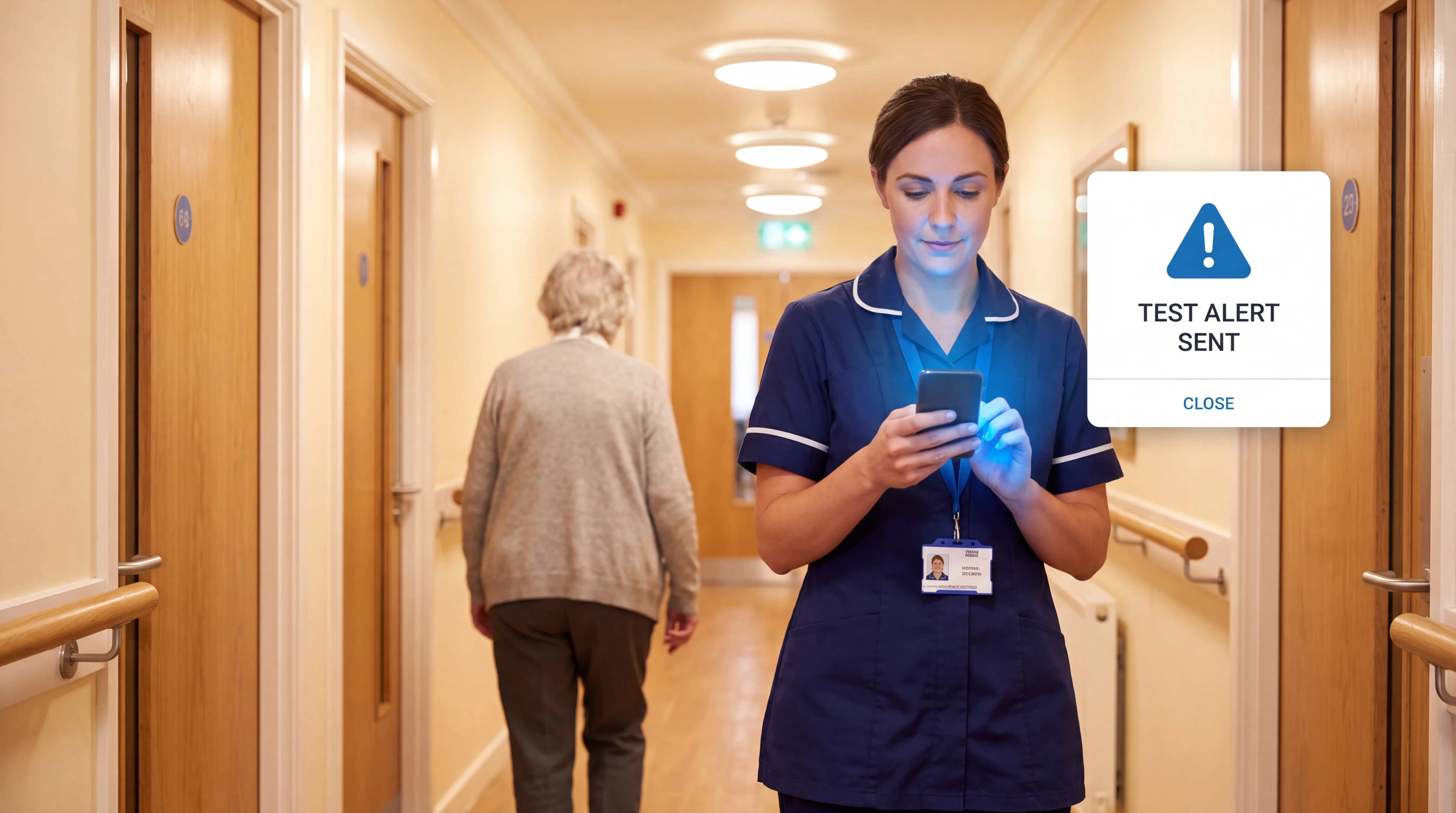
Inspect each emergency system physically and record whether it works, where it is, and who receives the alert. Treat any device that cannot complete its test as a finding to fix.
Use this emergency-readiness checklist:
Smoke and carbon monoxide alarms: Follow the manufacturer's test schedule and local requirements. The test control checks the circuit and sounder, not sensor accuracy; record any fault or low-battery signal.
Utility shutoffs: Locate the main water valve, gas shutoff, and electrical panel; make sure each is accessible and clearly labelled.
Backup power: Follow the equipment and care-plan requirements for critical medical or communication devices, then check charging status and fault indicators.
Emergency lighting: Activate the test mode and confirm that stairs and main exit routes remain lit during a power loss.
Emergency documents: Keep current contact details and essential medical information together in a visible, accessible location.
Flashlights: Switch each flashlight on and check that spare batteries are available.
Alert devices: Run a two-person test from each normal living area. Confirm the expected recipient, correct location, acknowledgement, and escalation route.
A manual SOS button is a single point of failure when a person cannot reach or press it. Unconsciousness, immobilisation, cognitive impairment, or a slow fall can interrupt the alert.
Automatic fall detection and passive sensors can add a second alert path for events such as a bed exit or unusual movement. Match the device and its coverage to assessed needs and the home layout.
6. Inspect Exterior Routes and Security
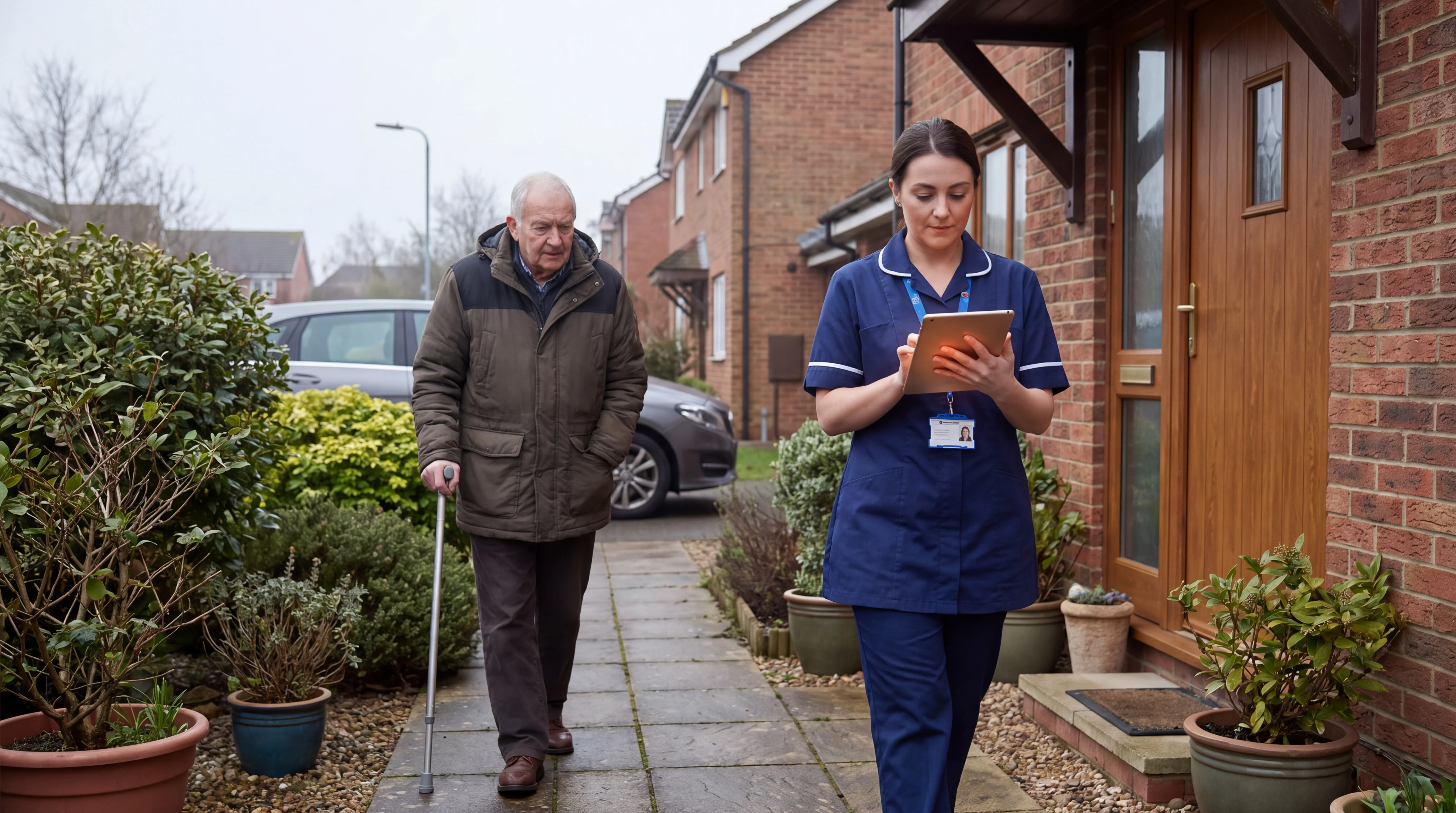
Inspect each exterior route from the building to the arrival point, including shared entrances and vehicle pickup areas. Check the route in the weather and lighting conditions people normally encounter.
Pro tip: Check routes in daylight and after dark only when conditions are safe. Use existing records, photographs, or staff observations when rain, snow, or ice would make a live walkthrough unsafe.
Check the exterior in the conditions people actually encounter:
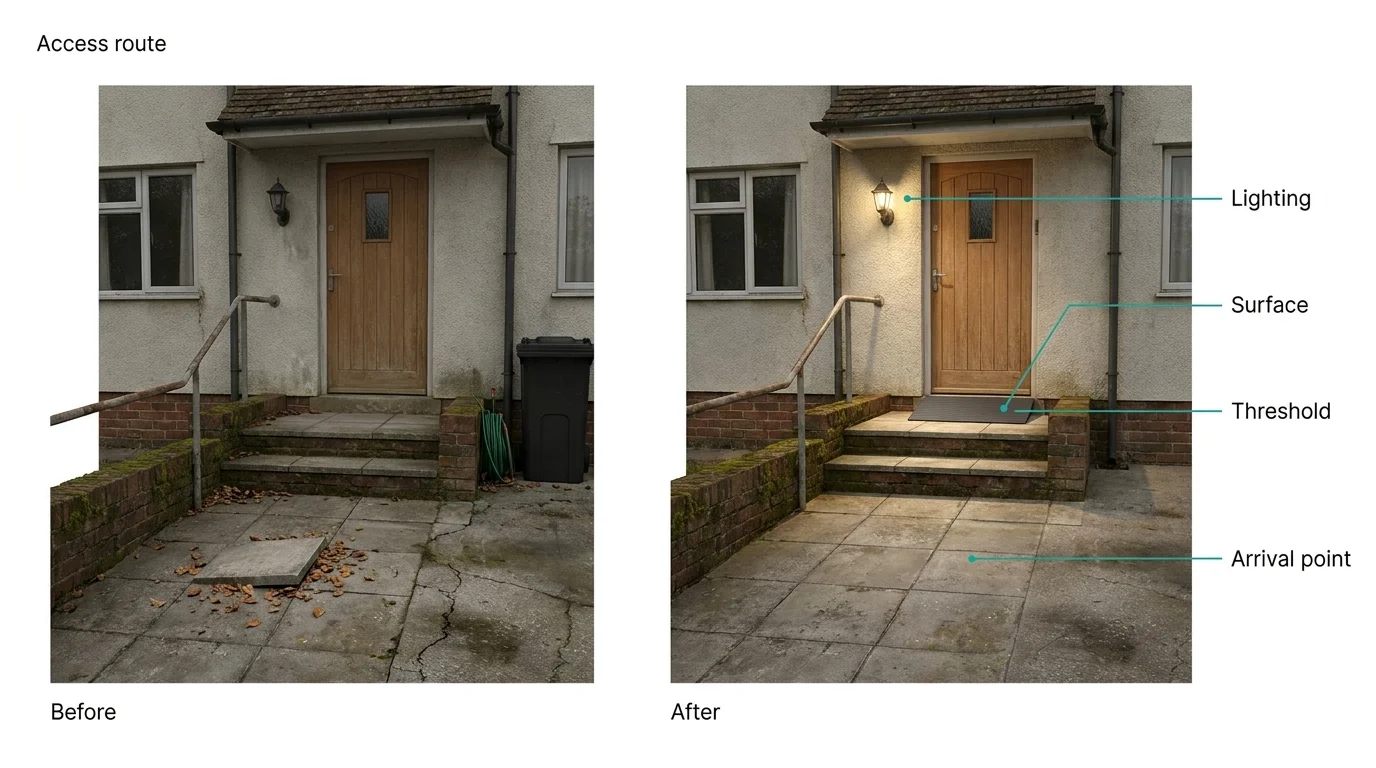
Walking surfaces: Mark cracks, loose pavers, potholes, unstable gravel, and uneven settlement that could catch a foot, cane, walker, or wheelchair.
Drainage and debris: Clear leaves, cords, boards, ice, standing water, and overgrown plants; repair holes and redirect runoff that crosses the route.
Lighting: Confirm paths, steps, parking areas, and entry doors have direct illumination without deep shadows or glare.
Stairs and handrails: Test each rail for movement and check that steps are even, visible, and free of loose edging.
Ramps: Confirm the ramp is stable, unobstructed, and suitable for the mobility aid used, with safe transitions at both ends.
Thresholds: Check door tracks, mats, lips, and level changes that could stop wheels or cause a trip.
Doors and access: Make sure exterior doors open easily, locks work, and staff or responders can enter without avoidable delay.
Arrival point: Provide a level, well-lit place for the person to wait while a vehicle, caregiver, or staff member approaches.
When leaving the property is a credible risk, document who checks nearby routes and contacts the responsible advocate, care coordinator, or emergency services. For GPS use, record consent, privacy controls, charging ownership, monitoring responsibility, and escalation steps.
7. Record and Prioritize Findings
A useful finding record lets any caregiver see the hazard, the current control, and the next action without relying on memory. Set priority by the potential harm and the person's ability to recover or call for help.
Common mistake: Treating a finding as low priority because it has not yet caused harm. Recurrent exposure and an inability to summon help move a risk up the queue.
Use three action priorities:
Do now: Act immediately when serious harm is possible, exposure is current or recurring, and the person cannot recover or summon help reliably.
Do soon: Set an owner and due date for a credible risk that has temporary controls in place but still needs correction.
Monitor: Keep an ongoing log for an emerging or lower-immediacy risk, with a clear trigger for reassessment if frequency, exposure, or support needs change.
Status: Track each action as open, in progress, or verified and closed. Close it only after the change is checked and record ongoing monitoring when the risk can return.
A loose rug may be closed after removal. Repeated unobserved overnight exits belong higher in the record because the person may need help before recovering safely.
Record the same fields for every finding:
Finding details: unique ID, date, time, room or location, and assessor
Person and observation: resident or client, routine involved, and what was seen or reported
Risk rating: severity, likelihood or recurrence, exposure, and ability to recover or call for help
Action plan: action priority, immediate control, required change, responsible person, due date, and status
Review: scheduled review date, reassessment trigger, and notes from ongoing checks
Closure: completion date, person who verified the change, evidence, and outcome
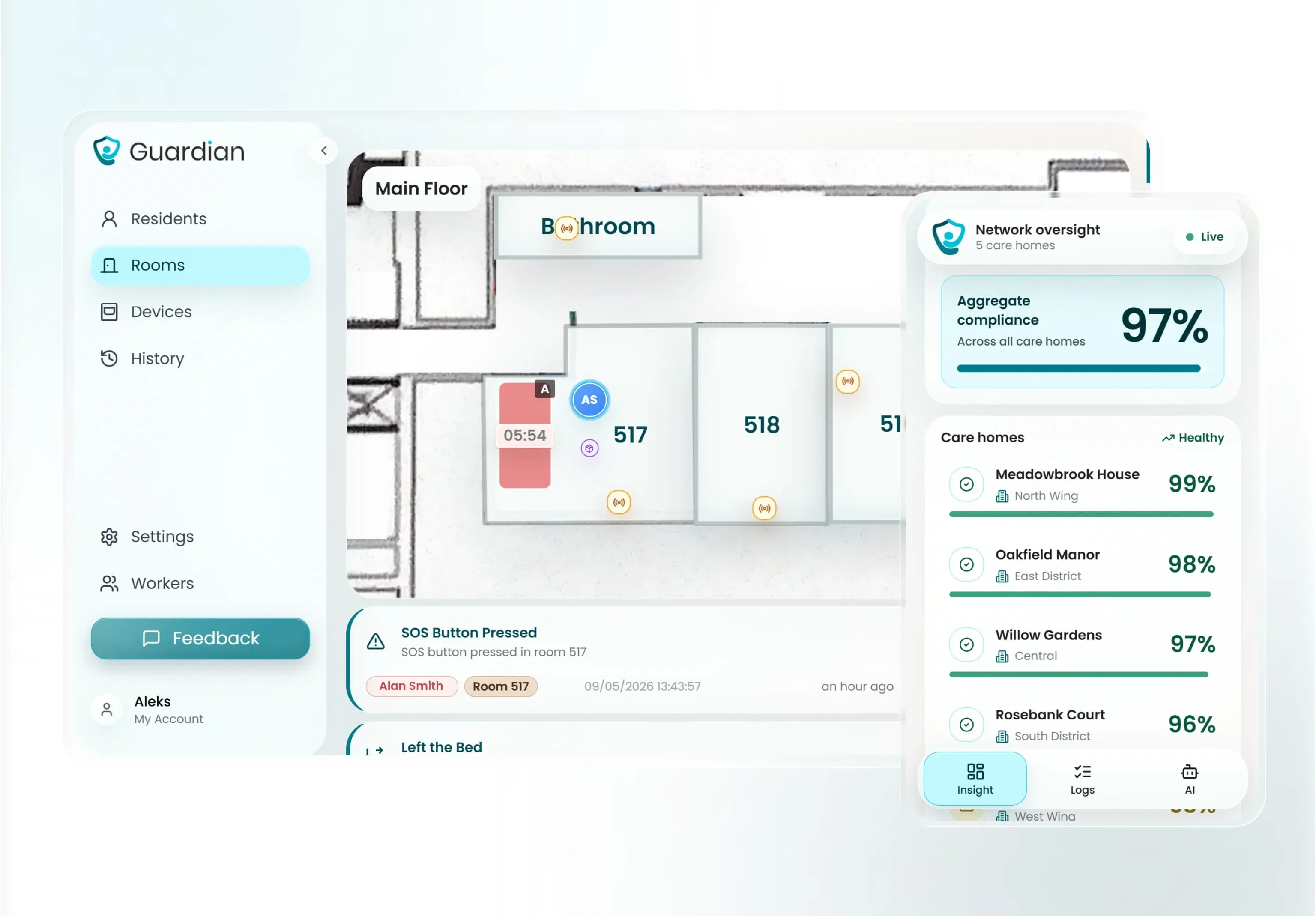
Guardian can link a detected event and staff acknowledgement to the relevant room or routine, giving the care team a usable operational record.
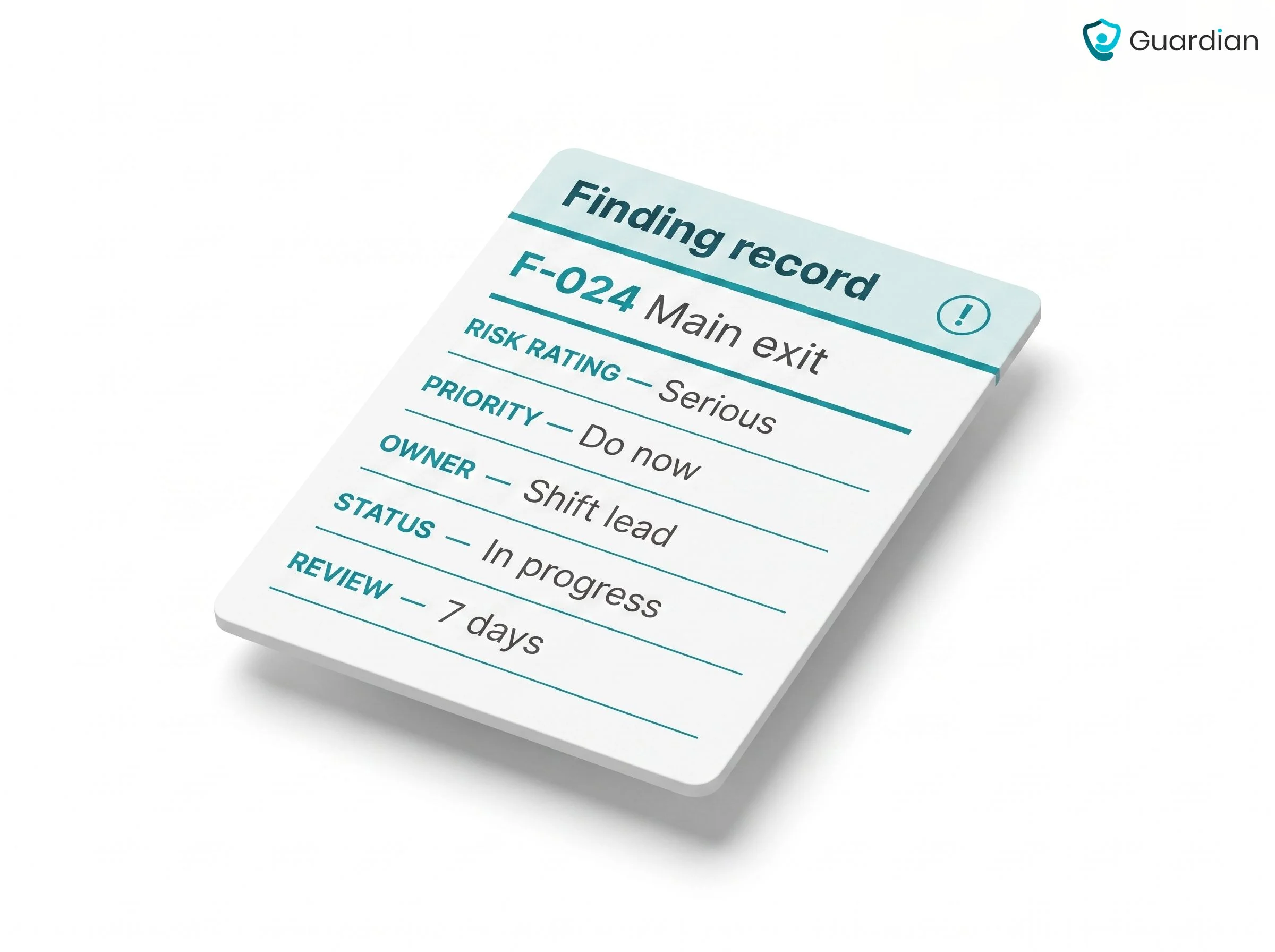
Example record
Finding: Example F-024, [date and time], main exit; stored equipment prevents the door from opening fully.
Risk rating: Serious potential harm, recurring exposure, and limited ability to use the alternative exit.
Action: Do now. Assign the shift lead to clear the route and prevent new storage before the next round.
Review and closure: Verify that the door opens fully, record the check, and close the action only after the route remains clear.
8. Match Each Hazard to the Least Intrusive Intervention
Match each hazard and support need to the least intrusive intervention that addresses it. Start with the environment or care routine, then add monitoring when the risk can develop between visits or checks.
Environmental change: Clear routes, secure loose coverings, or improve lighting when the hazard comes from the physical setup.
Installed adaptation: Use a qualified installer or assessor for changes involving transfers, bathing, stairs, ramps, or access.
Targeted monitoring: Consider camera-free sensors when exits, room activity, or routine changes require a prompt between visits.
For professional care providers, Guardian can support the monitoring layer after the assessment identifies a clear use case. Workflow mapping defines the risk, response owner, and route before sensors are assigned to rooms and routines:
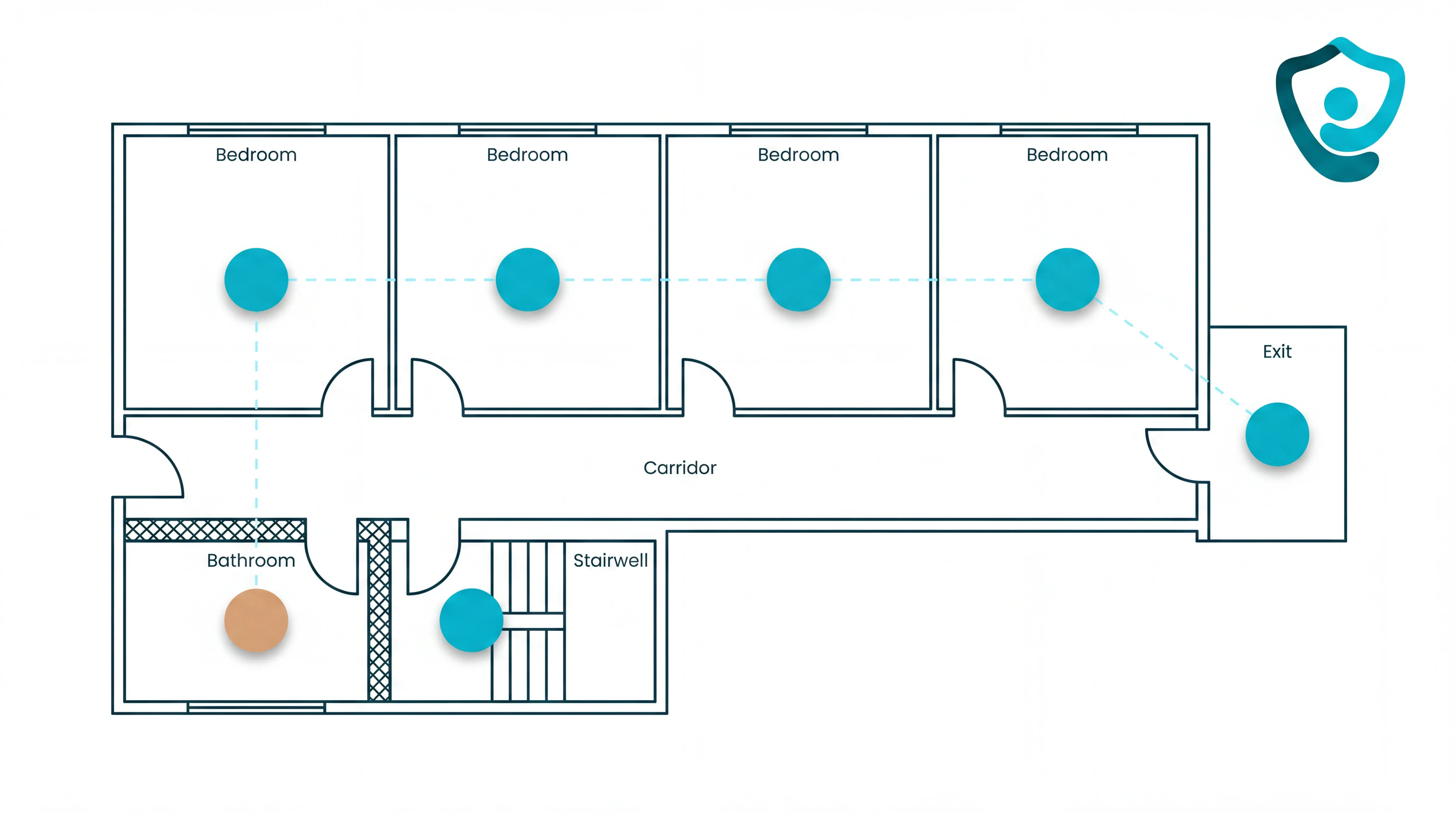
Guardian maps camera-free sensors to the rooms and routines identified in the assessment, while wearables remain optional. Alerts reach staff on existing phones, tablets, or nurse-station screens with the relevant location.
Bed exits: Use a passive bed sensor when unassisted overnight movement creates a fall risk.
Movement or exit risk: Place motion and door sensors along the relevant route. An event shows activity or an opening, not the person's intent or what happened next.
Fridge activity: Use a fridge sensor when opening patterns should prompt a caregiver check-in. The pattern does not establish that the person has eaten.
Cooking: Add a stove sensor when unattended appliance use is the identified hazard. A stove sensor supports a defined control; it does not replace the care plan.
Active help requests: Use passive sensors when a person may not reliably press or wear a device. Keep a wearable or call button when the person can and will use it.
9. Reassess After Changes
Reassess the setting after an event or change that may alter risk. Use the findings to update the hazard record, care plan, visit timing, and alert rules.
Start an immediate review after:
A fall or near miss that exposes a new hazard or ineffective control
A medication change or illness that may affect alertness, continence, strength, or mobility
A change in balance or cognition noticed by the resident, family, or care team
New equipment such as a walking aid, bed rail, commode, or transfer aid
Altered caregiver support including new visit times, reduced family help, or a change of provider
Repeated routine deviation such as more overnight movement, changed kitchen activity, or longer inactivity; use the care plan to decide whether review is immediate or scheduled
Use sensor events as prompts, then confirm what happened through human observation and care records.
Sensor prompt: Use a detected bed exit, door opening, or room-activity change to trigger a caregiver review.
Human confirmation: Confirm changed fridge or mealtime activity with the person or caregiver; an opening event does not prove food intake.
Human confirmation: Record transfer difficulty from caregiver observation and care notes, not from an assumed sensor measurement.
Human confirmation: Assess pain, illness, wellbeing, and the reason for a routine change through observation and appropriate professional review.
Review cycle: Name who reviews the pattern, who updates the care plan, and who verifies the change rather than waiting for the next scheduled assessment.
Record the change: Add the event, observed pattern, affected room, and current control to the hazard record.
Revise the response: Update the care plan and any equipment or environmental change needed for the identified risk.
Adjust support: Move visits or checks toward periods when the record shows greater need, including repeated overnight bed exits.
Tune the alerts: Set a person-specific threshold and escalation route. Review the rule after false or low-value alerts and adjust it against the care plan.
Limits of Self-Assessment
Self-assessment can find visible hazards and inform practical fixes, but it is screening rather than clinical assessment, environmental inspection, or diagnosis. It records current conditions, not every risk that develops between visits.
A walkthrough captures one moment. It can miss gradual decline in daily routines and near misses such as a brief loss of balance or an unassisted bed exit.
Monitoring reveals patterns, not causes. Ongoing monitoring can flag activity changes and near misses between assessments, but it cannot remove hazards or diagnose the reason for a change.
Escalate complex risks. Use an appropriately licensed occupational or physical therapist for functional, cognitive, gait, or transfer concerns. Use qualified local professionals for structural, electrical, gas, mold, radon, lead, asbestos, or carbon monoxide concerns.
Track Changing Risks Between Assessments
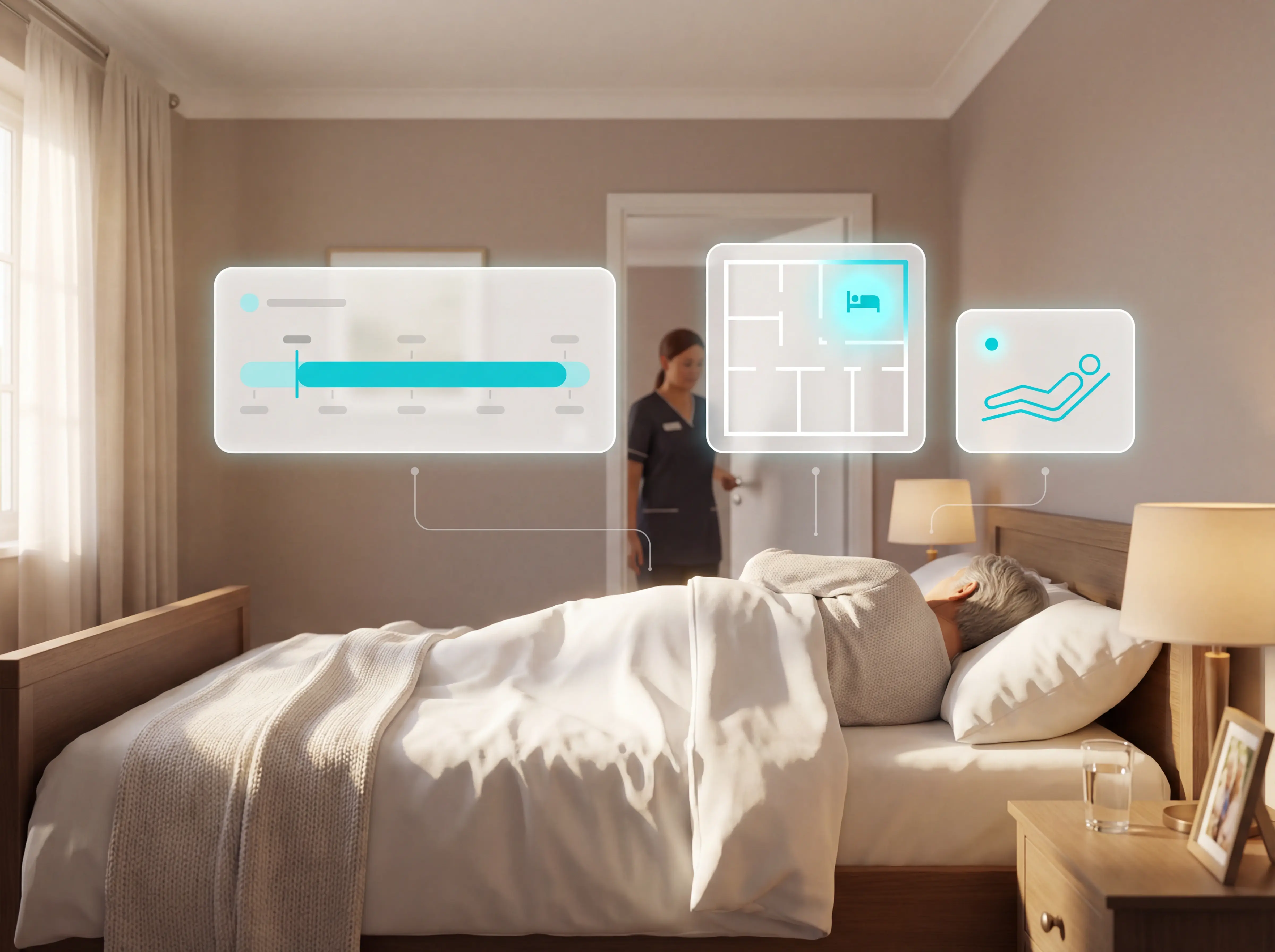
Risk can shift between scheduled reviews. Ongoing signals give staff a prompt to check what happened, record the result, and update the care plan or setting when needed.
Guardian connects camera-free monitoring to staff alerts and clean operational records across care homes, home care teams, and specialist care settings.
The cost varies by evaluator, visit scope, location, and insurance coverage. Ask for a written estimate and check local coverage before booking. This fee is separate from Guardian's scope-based B2B pilot for professional care providers.
A family caregiver can screen for obvious hazards. Use an occupational therapist for daily function, a physical therapist for mobility and balance, an appropriately qualified adaptation specialist for modifications, and a local environmental professional for building hazards.
There is no universal timeframe. The home's size, the number of routes and systems checked, mobility observation, records review, and the complexity of identified hazards all affect the visit length.
Local ageing services, veteran services, public health teams, or social-care programmes may fund an assessment. Availability, eligibility, and in-home access vary, so check the relevant local service before booking.
Repeat the assessment after a fall or near miss, a change in mobility, cognition, medication, illness, equipment, caregiver support, or a recurring routine deviation. Use the care plan and professional advice to set any scheduled reviews.
Prepare the current care plan, medication list, incident and near-miss records, mobility aids, emergency contacts, and any alert or visit logs. Note the routes and routines that cause concern so the assessor can observe them safely.

Author
Aleks Timm
Aleks Timm leads Guardian and builds privacy-first operations technology for care homes and home care providers. Teams get location-aware alerts they can act on, clearer situational awareness, and measured insight into how care work actually runs.
Read MoreRecommended reads
Keep reading
Patient bed alarms for elderly & hospital care
Patient bed alarms help prevent falls in elderly and hospital care. Compare alarm types, choose the right sensor, and protect...
Read more
Smart Nurse Call Systems for Care Homes and Home Care Providers
Smart nurse call systems for care homes and home care providers: compare features, improve response times, and choose the right...
Read more
Nurse call button systems for care homes and hospitals
Nurse call button systems for care homes and hospitals: compare smart alerts, sensors, and response tracking to improve safety and...
Read more