

Fall Prevention Program in Home Care: A 7-Step Workflow
In this article
A fall prevention program turns client safety into a repeatable workflow across scheduled visits and the hours between them. This guide covers seven prevention steps, immediate fall response, role assignment, proven approaches, and between-visit monitoring.
What is a fall prevention program in home care?
A fall prevention program in home care is an ongoing, individual plan for identifying and reducing an older adult’s fall risk at home.
Each client’s written care plan should cover:
Agreed support: records the assistance needed and who is responsible.
Routine review: repeats risk screening and home hazard checks on a set schedule.
Targeted care: coordinates strength and balance work with a physical therapist, plus medication review with a nurse and prescriber.
Reassessment: updates the plan after a fall or health change.
Between-visit awareness: monitoring can flag bed exits or unusual inactivity for review, where appropriate and agreed in the care plan.
Delivery is shared between aides and family caregivers. Nurses and therapists contribute clinical assessment or treatment when the care plan requires it.
Home care vs. home health care: who does what
Home care is non-medical help with daily tasks. Home health care can include skilled nursing, physical, occupational, and speech-language therapy, medical social services, and home health aide services.
The distinction is practical:
Home care: clients or families can usually arrange non-medical support directly. Aides observe changes, support safer transfers, clear hazards, and follow the care plan.
Home health care: skilled services begin under an authorized, documented plan of care from an eligible medical provider. Nurses and therapists assess fall risk, treat mobility problems, and coordinate medication concerns.
Job titles vary: “home health aide” can describe a Medicare home-health role, while some states use overlapping titles for non-medical home care workers.
Both services can run at the same time. An aide can handle daily supervision while a nurse or therapist manages scheduled clinical care.
What causes falls at home?
Falls at home often result from interacting physical, environmental, medication, and behavioral factors. A single risk may be manageable until another factor makes an ordinary movement less stable.
Physical factors: Muscle weakness, gait changes, poor balance, impaired vision, arthritis, and Parkinson's disease can make standing, turning, or recovering from a misstep harder.
Environmental factors: Loose rugs, clutter, dim lighting, slippery bathroom floors, missing grab bars, and stairs without secure railings create points where instability becomes a fall.
Medication factors: Sedatives and blood pressure medicines can cause dizziness or drowsiness, especially when standing up or walking soon after a dose.
Behavioral factors: Avoiding stairs, rooms, or regular activity after a scare reduces movement and can gradually weaken strength and balance.
The risks compound. Poor balance becomes more dangerous in a dim hallway, while medication-related dizziness raises the chance that a loose rug or slippery floor will cause a fall.
The fear-of-falling cycle
The fear-of-falling cycle is a loop in which fear reduces movement, inactivity weakens strength and balance, and higher fall risk reinforces fear. The CDC STEADI resources place mobility, balance, and modifiable risks within the same screen-assess-intervene process.
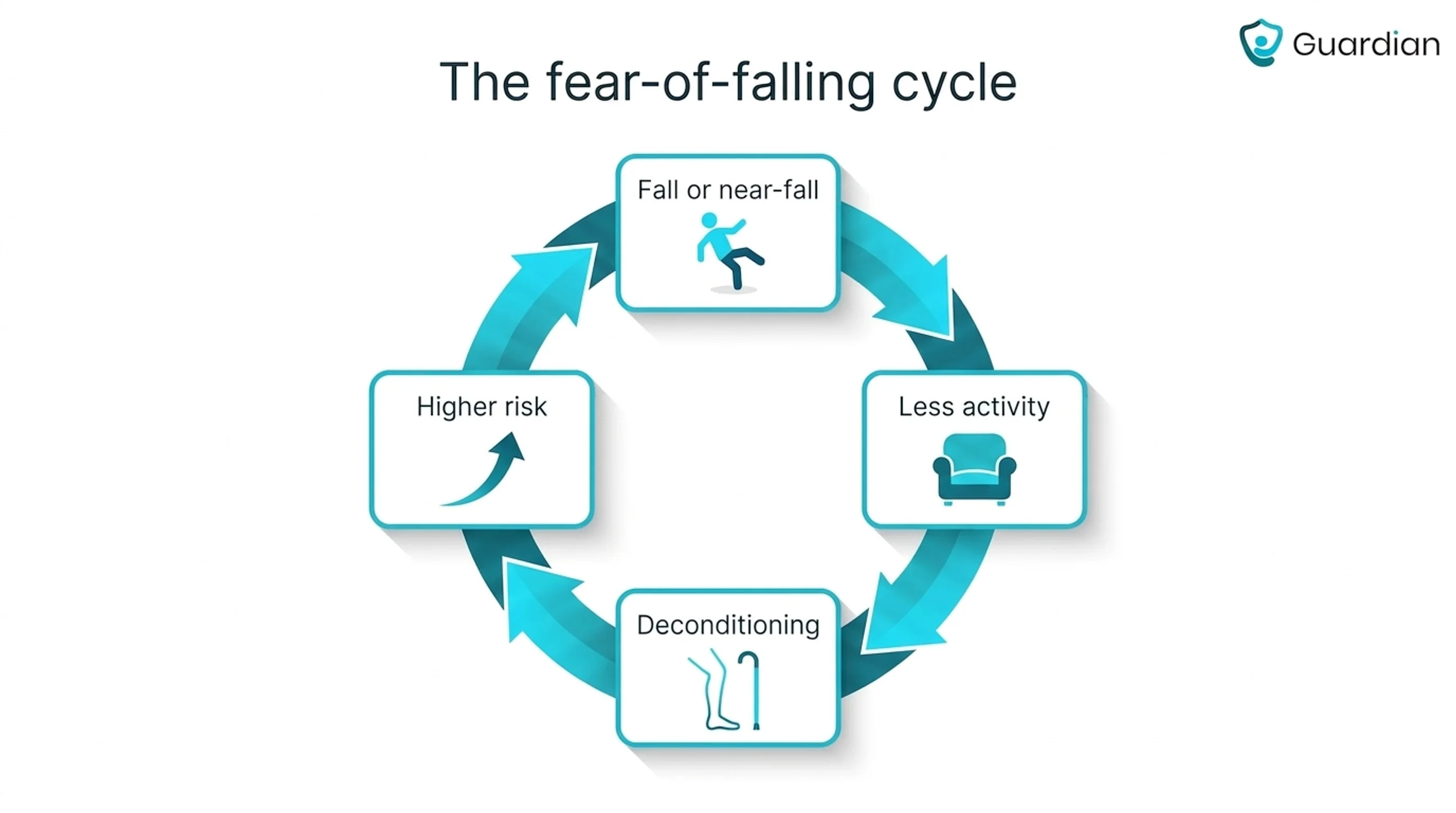
A fall or near-fall creates fear. Everyday movements such as bathing, using stairs, or walking between rooms begin to feel unsafe.
Fear leads to avoidance. The person limits movement, stays in fewer parts of the home, or withdraws from social activity.
Inactivity causes deconditioning. Muscles weaken, balance declines, and routine movement requires more effort.
Higher fall risk deepens the fear. Another stumble or loss of confidence restarts the cycle with tighter limits on activity.
Left unaddressed, the cycle can narrow daily life and reduce independence. Later assessment and program selection should address both the underlying fall risks and the fear that keeps the person inactive.
The 7-step home care fall prevention workflow
A home care fall prevention workflow uses seven repeatable steps to identify risk and keep the care plan current. It covers screening, assessment, prioritization, intervention, monitoring, reassessment, and fall response.
Clinical decisions usually sit with nurses and therapists. In structured in-home programs, an occupational therapist may assess the person’s routines and home environment.
Home care aides and family caregivers handle the day-to-day observations: a new stumble, slower transfers, dizziness after medication, or a rug that has shifted. They record and pass those changes to the clinical lead.
Repeat the workflow after a fall or a change in health, medication, mobility, or the home. Scheduled reviews matter too; evidence-based programs build follow-up into the process so the plan stays tied to current risk.
1. Screen for fall risk
Use a brief, validated screen to identify who needs a deeper assessment. The CDC STEADI algorithm covers fall history, unsteadiness, concern about falling, and functional assessment.
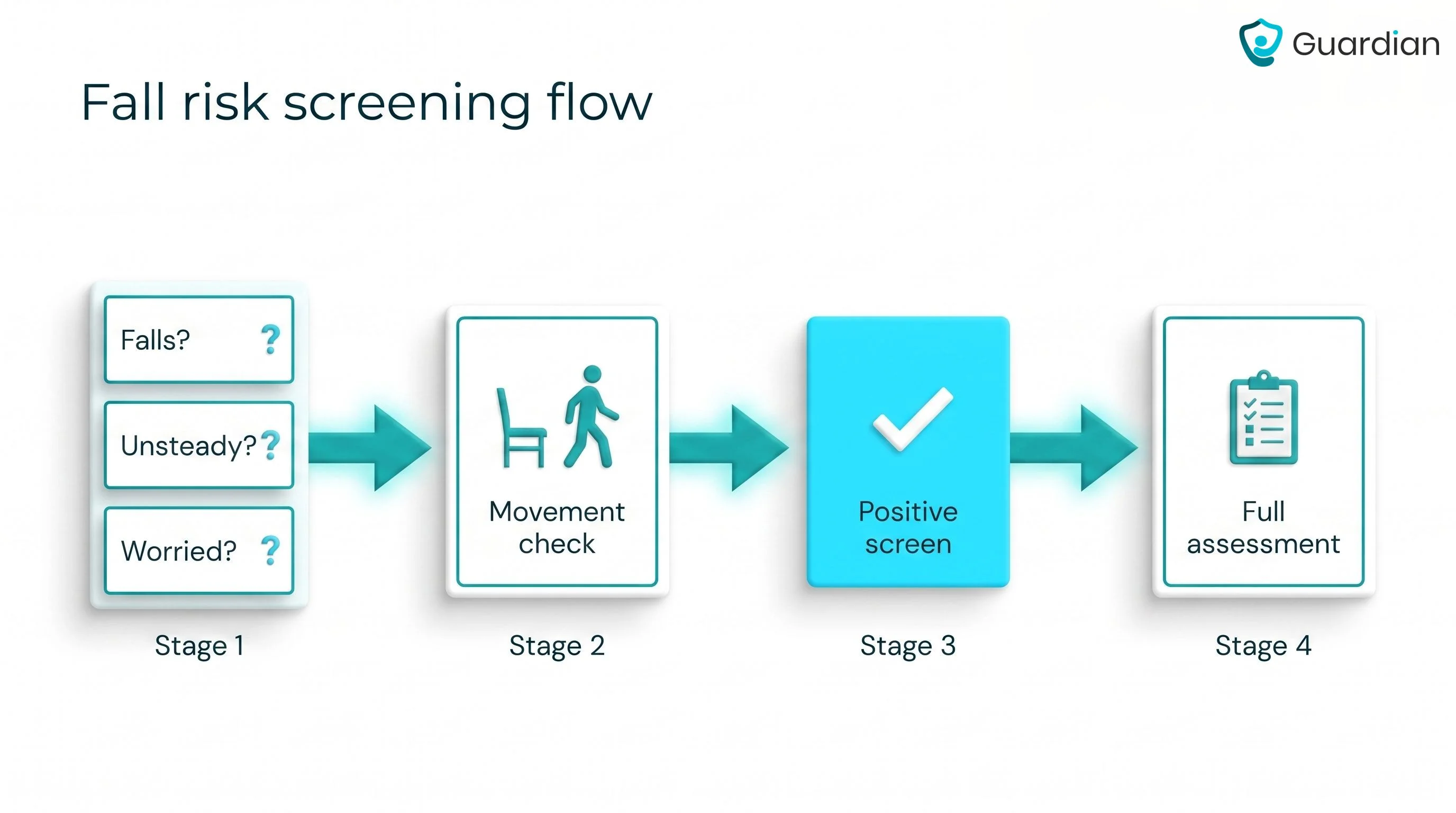
Start with three plain questions:
Falls: Have you fallen in the past year?
Unsteadiness: Do you feel unsteady while standing or walking?
Fear: Do you worry about falling?
Add the movement check specified by your agency's validated tool. A trained clinician may use a test such as Timed Up and Go, following its instructions and stopping rules.
An intake nurse or care coordinator can include screening in the first visit. Use the staff training and assessment process specified by the screening tool.
A fall, reported unsteadiness, fear of falling, or concerning movement check counts as a positive screen. Pass the result to the nurse, physical therapist, or occupational therapist responsible for the full assessment.
2. Assess contributing risks
The full assessment examines physical function, home hazards, medications, and behavior that may combine to cause a client's falls. Licensed clinicians conduct formal mobility, cognitive, and medication assessments.
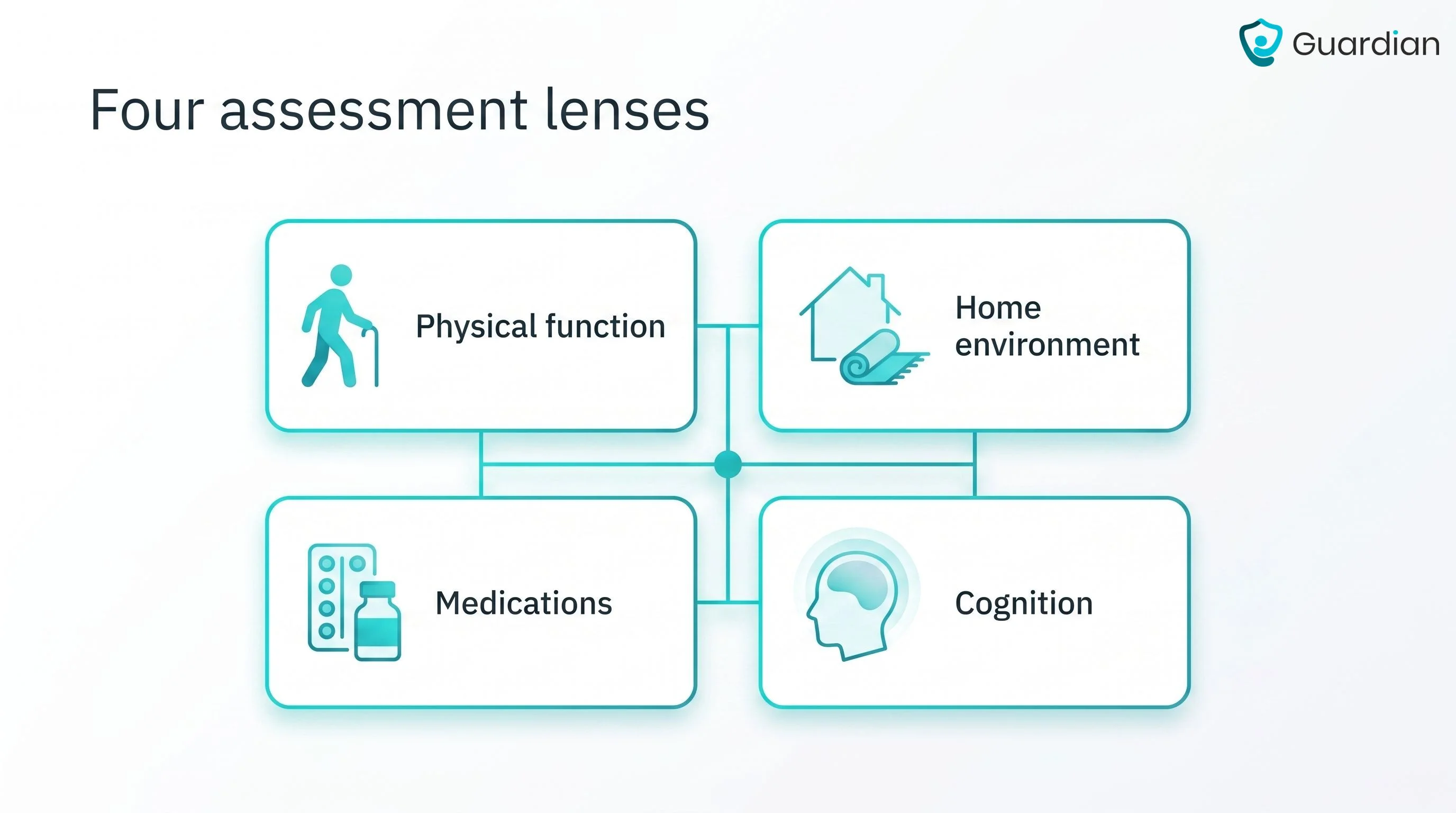
Use four lenses to turn the positive screen into a person-specific assessment:
Physical function: Record observable changes in standing, walking, turning, transfers, bathing, and dressing. A licensed clinician assesses balance, strength, pain, and mobility-device needs.
Home environment: Walk the routes the person uses, especially between the bed, bathroom, kitchen, and entrance. Note lighting, floor surfaces, steps, clutter, handholds, and moving hazards such as pets.
Medications: Ask a nurse, pharmacist, or prescriber to review prescription and over-the-counter medicines, recent changes, and symptoms such as dizziness, drowsiness, or light-headedness.
Cognition and judgment: Record observable changes, such as forgetting a mobility aid or no longer following familiar safety instructions. Refer concerns for clinical assessment.
Write each finding as an observable situation. “Unsteady when turning toward the toilet at night” gives the care team more to work with than “poor balance.”
3. Prioritize the risks that matter most
Prioritize risks by weighing the potential harm from a fall against how practical each risk is to change. Put low-cost changes that can be completed immediately on the active list alongside the risk with the greatest potential severity.
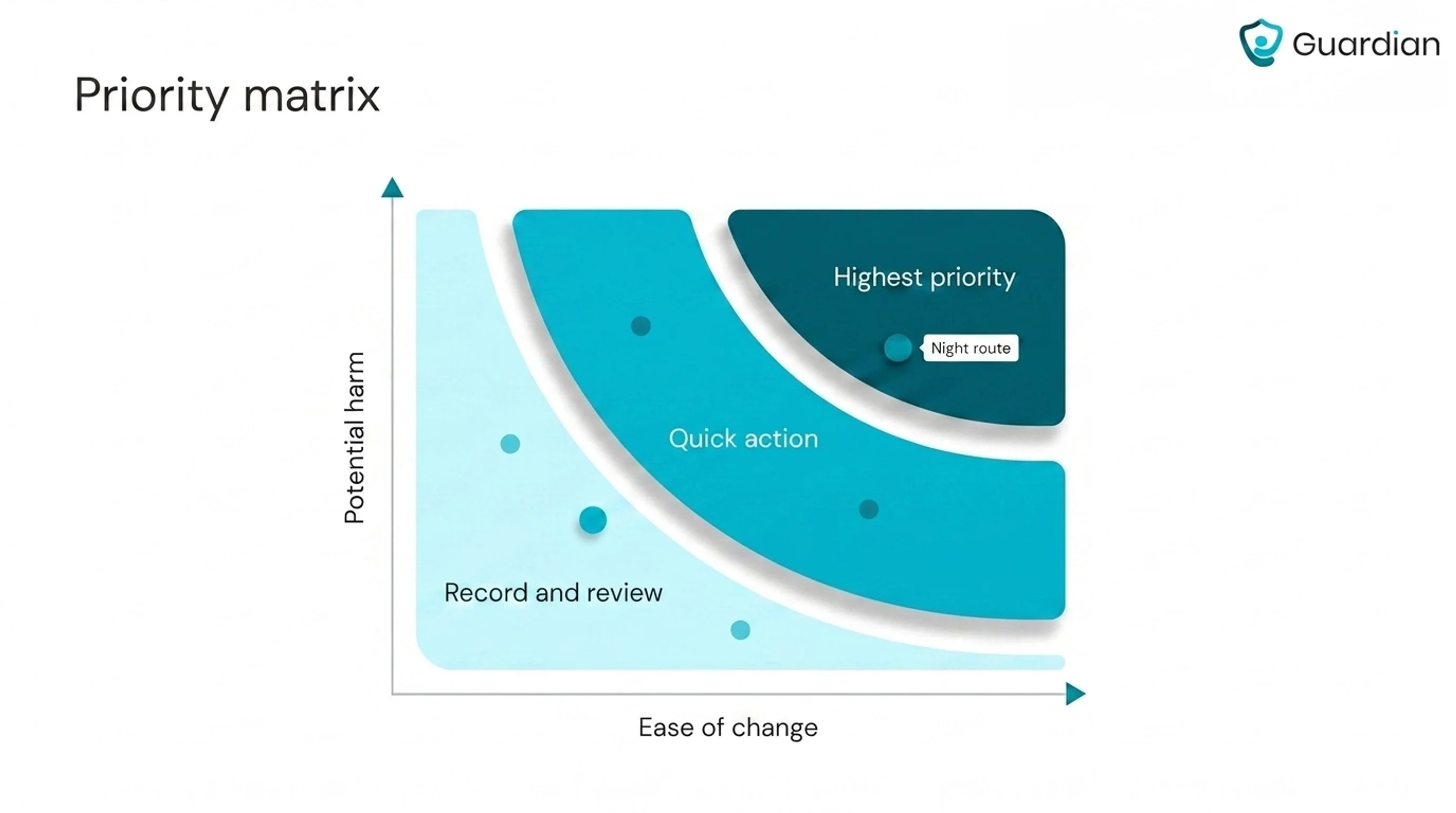
Use three practical priority bands. A numerical score is unnecessary for this operational decision.
Highest priority: severe potential harm, frequent exposure, or interacting risks.
Quick action: a risk that can be reduced soon and creates repeated exposure.
Record for reassessment: a less pressing risk, a change that is not practical yet, or a finding that needs more information.
Frequency changes the order. A hazard on a nightly bathroom route can outrank a similar hazard in a room the person rarely enters.
Look at interacting risks together. Poor balance on a dim route is a higher priority than either finding considered alone, while a previous fracture raises concern about the consequences of another fall.
Keep the active list short enough for the client, family, and care team to follow. Start with the most serious risk and practical changes that reduce repeated exposure.
Keep every lower-priority risk in the assessment record. Revisit the list at the planned reassessment and after a fall, medication change, illness, or change in mobility.
4. Match interventions to each risk
Match each prioritized risk to the professional and action that can change it. Use layered interventions when risks overlap.
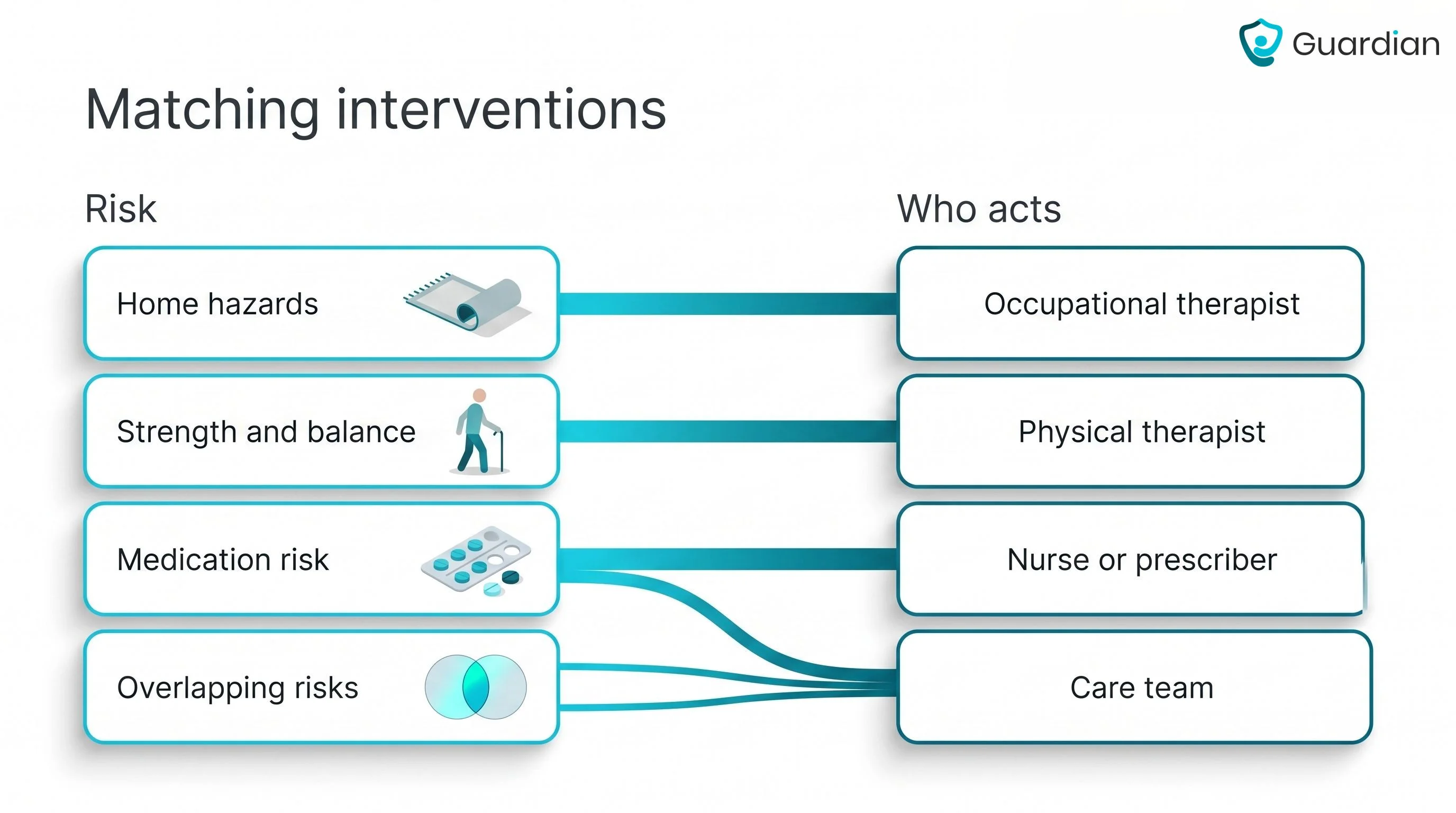
Environmental hazards: an occupational therapist recommends home or task changes; record what changed.
Weak strength or balance: a physical therapist designs and progresses exercise; record the plan and support required.
Medication-related risk: a qualified clinician reviews medicines; record decisions and observed effects.
Overlapping risks: the coordinated care team assigns owners across one shared plan.
5. Document and monitor
The care record should show the current risk level, agreed actions, named responsibilities, and events observed between reviews.
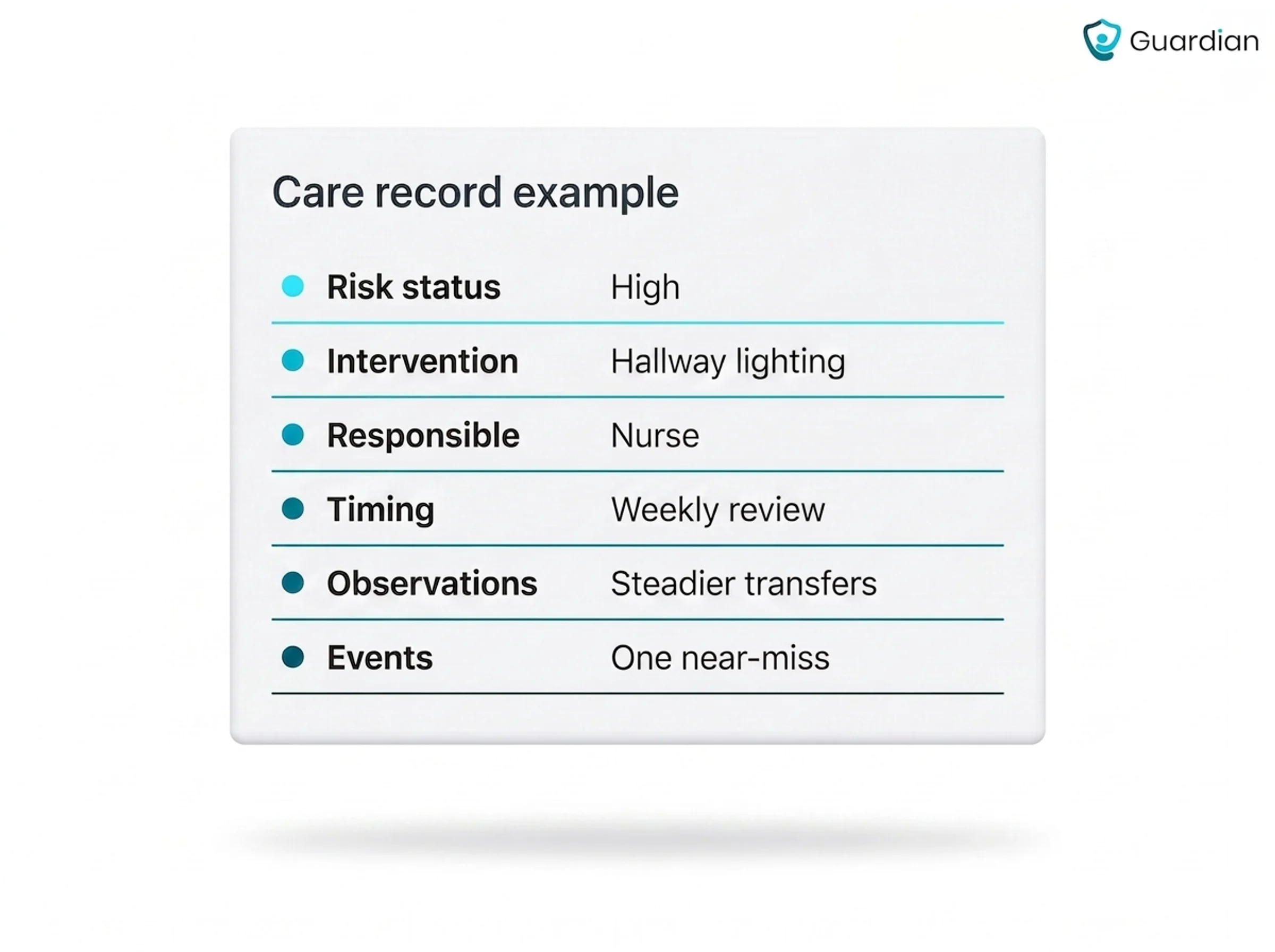
The care record needs enough detail for the next caregiver or clinician to understand the plan:
Risk status: current level and prioritized factors.
Intervention: agreed action and intended outcome.
Responsibility: named person who will arrange or deliver the action.
Timing: start date, frequency, and next scheduled review.
Observations: participation, changes in function, and barriers.
Events: falls and near-misses, with time, place, activity, and response.
Scheduled reviews only capture what staff, the client, or family observed. Between contacts, remote monitoring can add time-stamped records of inactivity, bed exits, or routine changes that a visit may miss.
Use remote records alongside scheduled contact and professional judgment, never as a substitute for either.
Near-misses reveal repeat risk before injury, such as frequent unassisted standing or loss of balance during transfers. Recording the context gives the next scheduled review a pattern to examine.
6. Reassess after any change
A fall, medication change, worsening mobility, or change at home triggers a fresh fall-risk screen and risk-factor assessment.
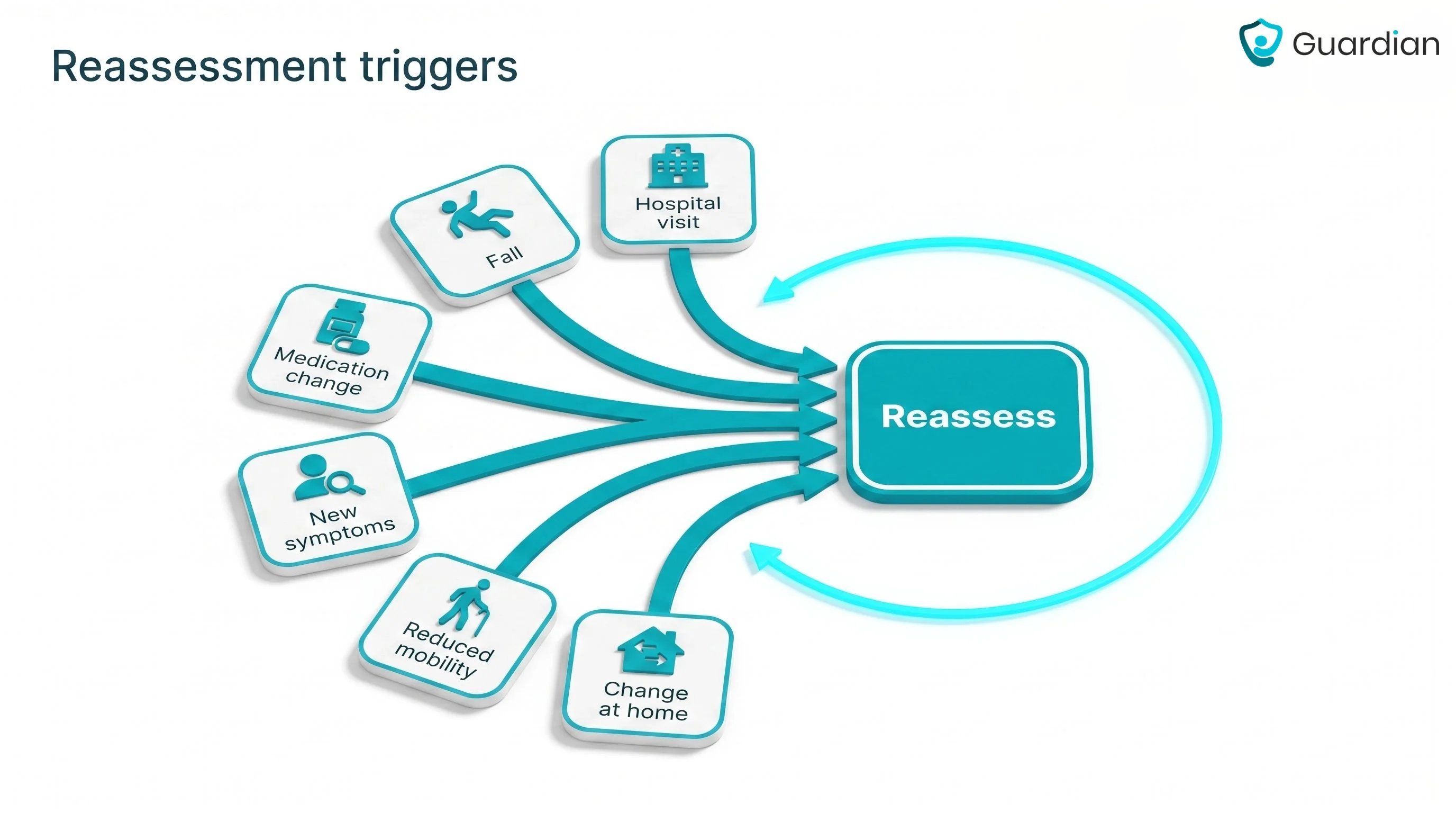
Repeat the screen and assessment after any of these changes, following the CDC STEADI screen-assess-intervene process:
Hospital visit or new diagnosis: health status may have changed.
Medication change: balance, alertness, or blood pressure may be affected.
Dizziness, weakness, or confusion: new symptoms can change fall risk.
Reduced mobility: walking, transfers, or routine activity may no longer be safe.
Change at home: equipment, furniture, or care routines may alter risk.
Daily monitoring records what caregivers observe from visit to visit. Formal reassessment repeats the screen and risk-factor review from steps 1 and 2 after a trigger, then adjusts interventions to the person's current risk.
Without that reset, the care plan can remain tied to an earlier level of mobility or health.
7. Respond to a fall and update the plan
After a fall, check for injury, escalate care at the required level, document the event, and update the prevention plan before routine care resumes.
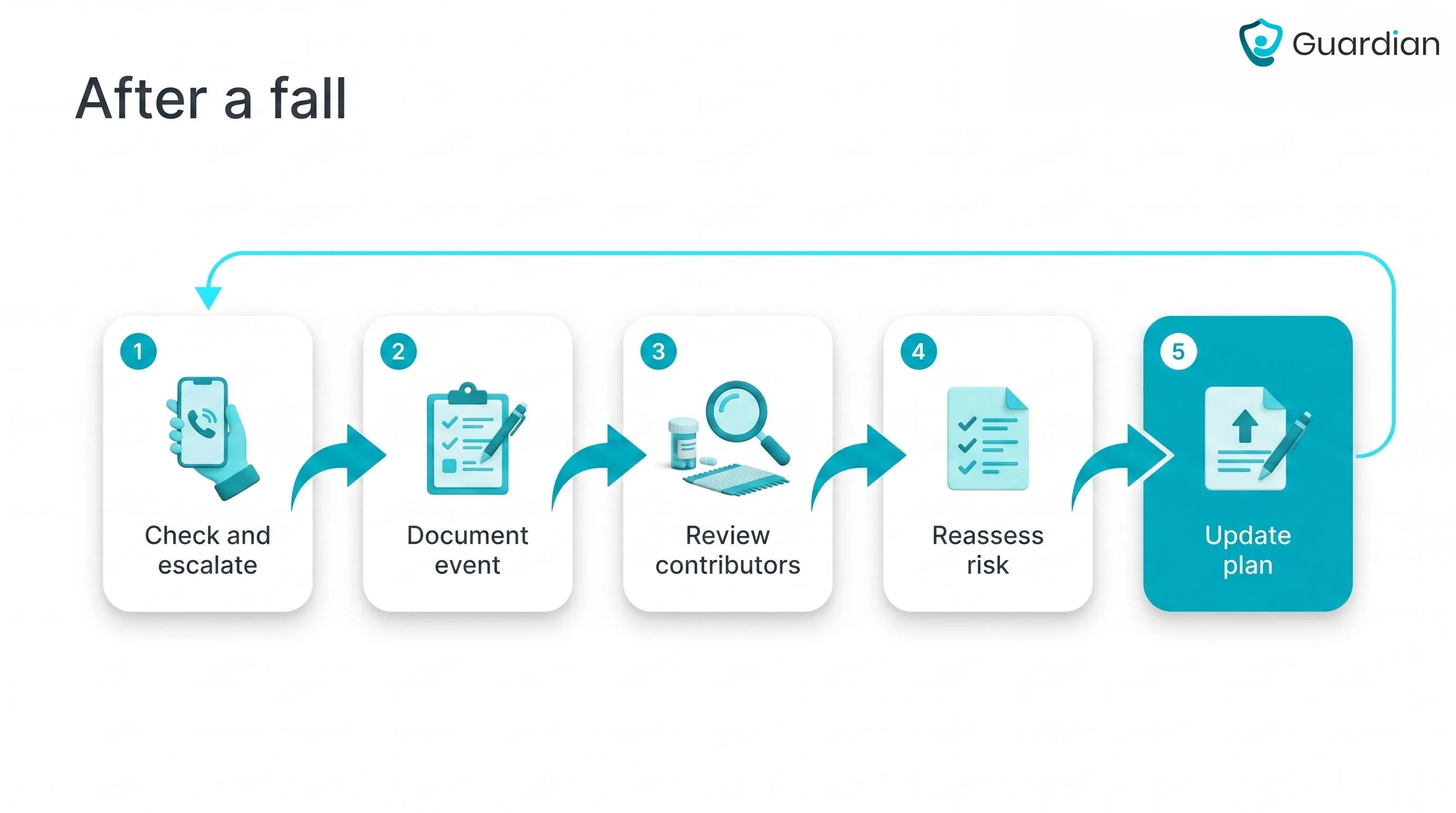
Check and escalate. Follow the agency's emergency procedure. Do not move the person when serious injury is suspected unless emergency instructions require it.
Document the event. Record the time, place, activity, observed signs, response, notifications, and outcome.
Review likely contributors. Refer medication concerns to the appropriate clinician and inspect the environment or equipment involved.
Reassess fall risk. Repeat the screen and relevant parts of the clinical assessment after immediate needs are addressed.
Update the plan. Record the agreed changes, named owners, and next review date before routine care resumes.
What to do immediately after a fall
Respond to a fall in five steps: check the person, avoid unsafe movement, escalate urgent concerns, monitor as directed, then document and notify.
Check responsiveness and breathing. Call the local emergency number for unresponsiveness, abnormal or absent breathing, or another immediate threat to life. Follow the dispatcher's instructions and the agency's emergency procedure.
Avoid unsafe movement. Ask about pain and note visible bleeding, a reported head impact, or an obvious deformity. Do not lift the person when serious injury is suspected.
Escalate according to the signs. Call the local emergency number for stroke signs, uncontrolled bleeding, seizure, loss of consciousness, or suspected head, neck, back, or hip injury. Route non-emergency concerns according to the care plan.
Monitor as directed. Follow observations or checks ordered by the responding clinician and report any deterioration immediately.
Document and notify. Record the fall, observed signs, actions, and outcome. Notify the care team and family or representative according to the care plan.
Who handles what: aides, nurses, PTs, and family
Fall prevention works when each person has a defined responsibility and reports changes quickly. Clinical decisions stay with licensed professionals.
Home care aide: notices observable changes, keeps the immediate environment safer, follows the care plan, and reports falls or concerns promptly.
Nurse: conducts clinical assessment, reviews health and medication-related risks, updates the care plan, and coordinates escalation.
Physical therapist: assesses gait and transfers, designs and progresses exercise, and recommends mobility equipment.
Family or representative: shares changes, supports clinician-approved routines, and keeps the care team informed.
Fall prevention approaches by need
Choose a fall prevention program according to the main barrier to safe movement at home:
Home hazards and daily function: start with an occupational therapy assessment.
Strength and balance: use a program focused on physical ability.
Fear of falling: use an approach that rebuilds confidence and safe participation.
For home hazards and daily function
A home hazard and functional program is an in-home assessment by an occupational therapist that identifies environmental risks and modifies the home to support safer daily activity.
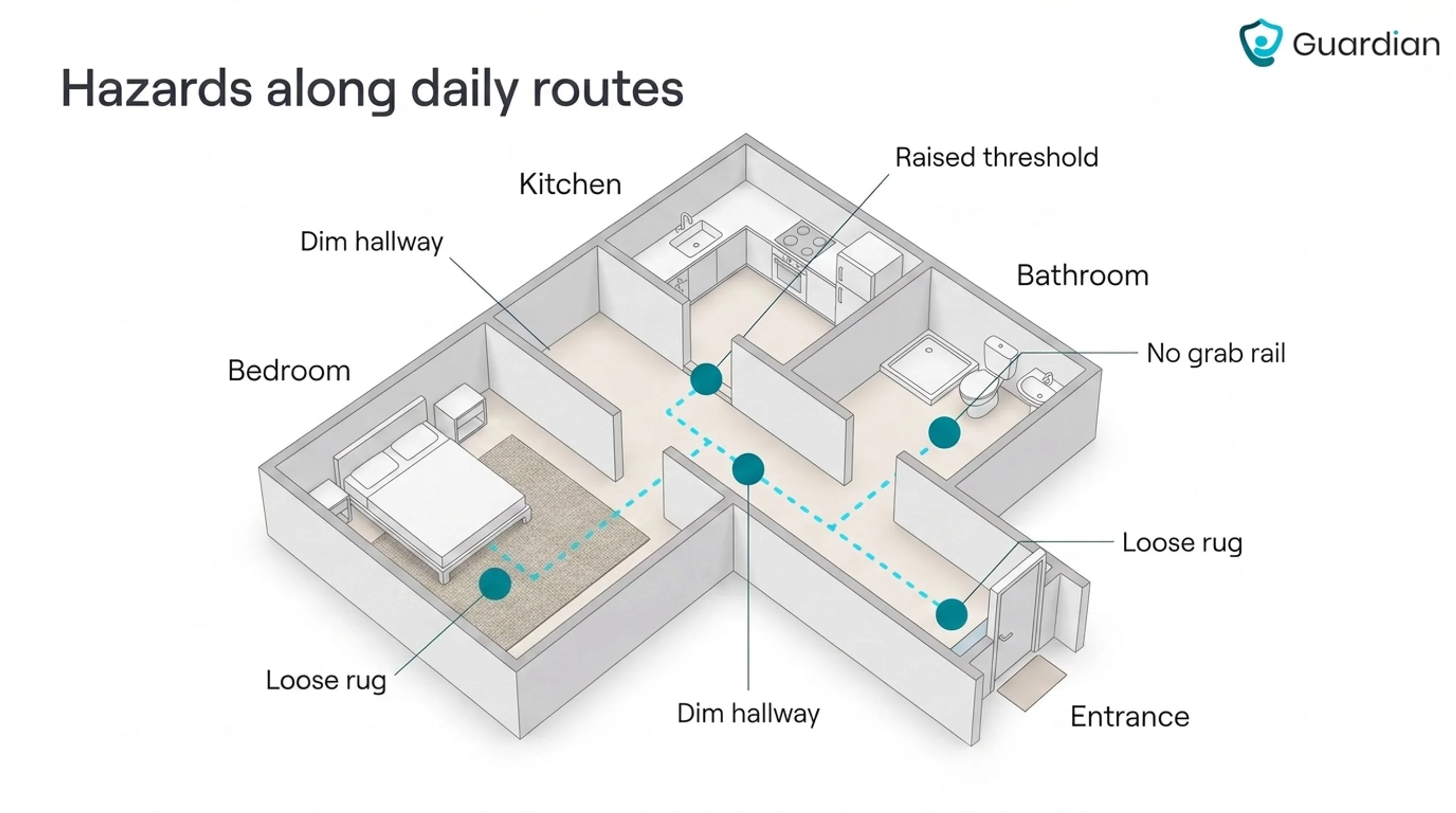
The occupational therapist watches the person move through familiar rooms and complete everyday tasks. Recommendations are based on the client's routine rather than a room-by-room inspection alone.
The home assessment checklist covers:
Routes and surfaces: lighting, loose flooring, thresholds, stairs, and furniture that narrows a walking path.
Transfers: getting in and out of bed, rising from a chair, and reaching the toilet safely.
Bathroom use: access to the shower or bath, support points, and the placement of everyday items.
Daily tasks: dressing, preparing food, carrying laundry, and reaching stored items without climbing or overreaching.
Mobility devices: whether a cane or walker fits the person, stays within reach, and clears doorways and furniture.
Small changes should solve the risk observed during a task. The occupational therapist might change furniture placement, recommend a support rail, or suggest help with a task the person cannot complete safely alone.
Arrange another assessment after:
A fall, illness, or surgery
A change in walking or transfer ability
A new cane, walker, or other mobility device
A move or substantial change to the home layout
For strength and balance
Strength and balance programs use planned exercises to address muscle weakness and unsteady gait. Tai Ji Quan: Moving for Better Balance and the Otago Exercise Program differ mainly in where and how the exercises are delivered.
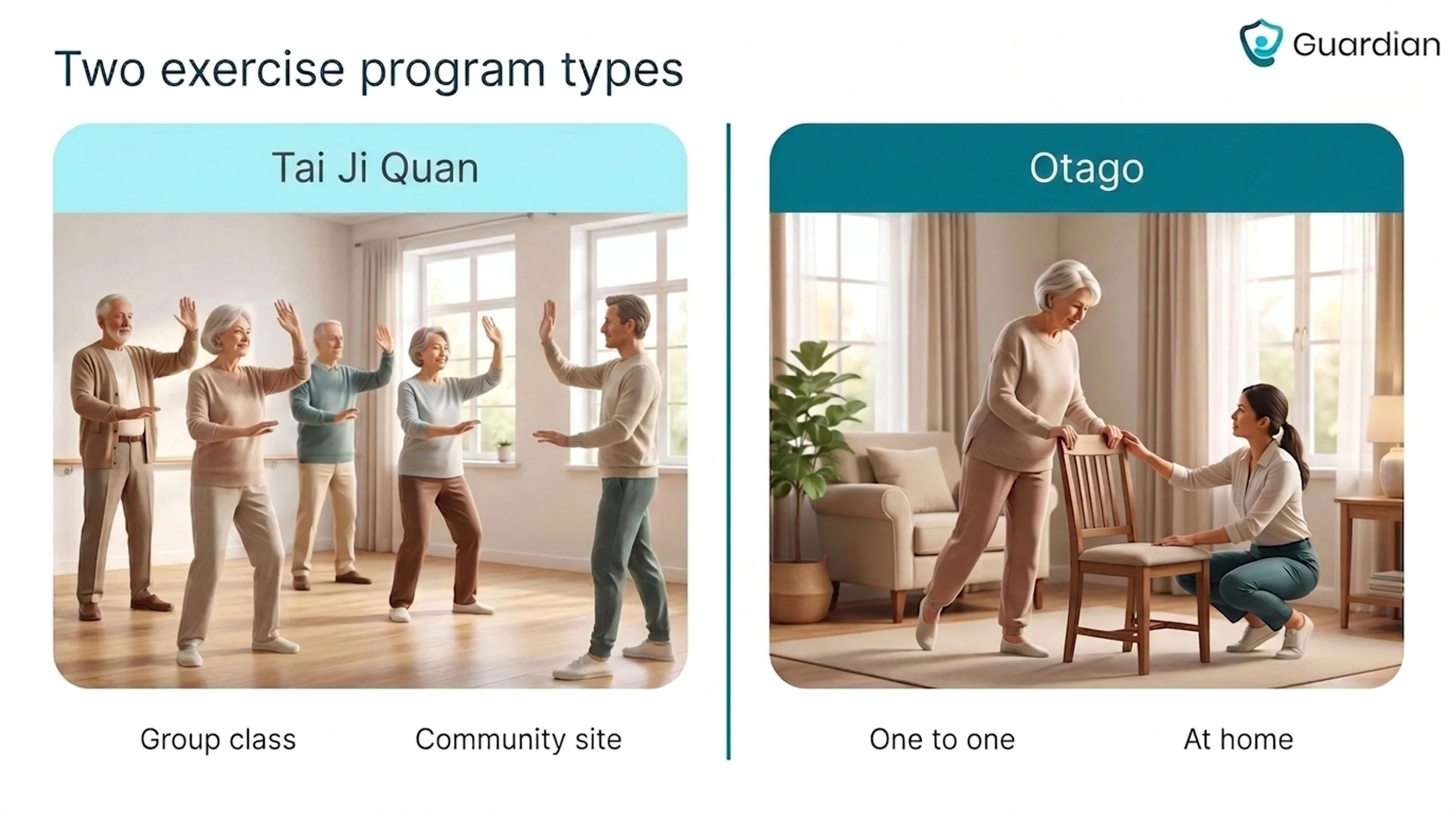
Tai Ji Quan: Moving for Better Balance: group classes at senior or community sites, led by a program instructor and centered on slow movements, weight shifting, and lower-body control.
Otago Exercise Program: one-to-one sessions, often at home, with individualized leg strengthening, balance retraining, and a walking plan.
The NCOA program summary lists Tai Ji Quan: Moving for Better Balance as a 24-week course, usually with two 60-minute classes each week. Otago is individualized around the person's mobility and prescribed exercise plan.
A home care aide may reinforce clinician instructions during a visit. The care plan must authorize that support; home care aides do not design or lead exercise sessions.
The care manager can coordinate suitable exercise and supervision with the client's clinician. Local senior or community centers can confirm available programs and referral routes.
For fear of falling and confidence
A Matter of Balance is an eight-week group program for older adults who have reduced activity because they fear falling. It rebuilds confidence and participation gradually.
The program works through four connected areas:
Reframing fear: Participants learn to view fall risk as something they can address rather than an inevitable part of aging.
Setting realistic goals: Each person chooses manageable activity goals and increases movement step by step.
Building physical capacity: Strength and balance exercises support a safer return to activity.
Reducing hazards: Participants identify home changes that can lower everyday fall risks.
Gradual activity matters because avoidance can reduce strength and balance, making everyday movement feel less secure. Small goals give participants a structured way to resume activity without jumping straight back to a demanding routine.
A Matter of Balance is usually delivered through senior or community centers, not one-to-one home care visits. The care manager or family can ask local centers about availability; the home care agency does not need to coordinate enrollment unless that role is in the care plan.
What if a client resists help?
Start with the smallest safety change the client will accept, and connect it to the routine they want to keep. Resistance may protect pride, independence, or familiar routines.
Start with their priorities. Ask which routines or activities matter most, then connect fall prevention to keeping those parts of daily life.
Offer meaningful choices. Let the client choose between two reasonable options, such as when support arrives or which safety change happens first.
Propose a reversible trial. Agree on a review point before starting, so the change has a clear opportunity for adjustment.
If the client still refuses, record the decision, pause, and revisit the smallest change later. Follow the care plan and seek urgent professional help when there is immediate danger.
What a home care team can't watch for around the clock
Scheduled home care visits cannot provide around-the-clock visibility. Even reliable carers leave legitimate blind spots between check-ins, when a change in safety or routine can develop without a witness.
The warning sign may be a break from an ordinary pattern rather than an obvious emergency:
Prolonged inactivity: no movement during a normally active part of the day
Unusual bed exits: getting up at an unexpected time or remaining out of bed
Changed movement: fewer trips between rooms or a new pattern of restlessness
Missed fridge use: no sign of preparing food or collecting a drink
A possible unwitnessed event: prolonged inactivity or a broken routine can prompt a check when the client cannot reach a phone or pendant.
Camera-free bed, motion, door, and fridge sensors can record routine changes. A configured rule then sends the relevant event to the named caregiver or contact for review.

Passive, camera-free monitoring compares activity with the client's usual routine. It can flag inactivity, a bed exit, or missed fridge use for review, but a routine-change alert does not by itself confirm a fall.
Monitoring still depends on a response plan. The care plan must state who receives each alert, what action follows, and how an unacknowledged alert is escalated.
Between visits, Guardian tells you what actually happened
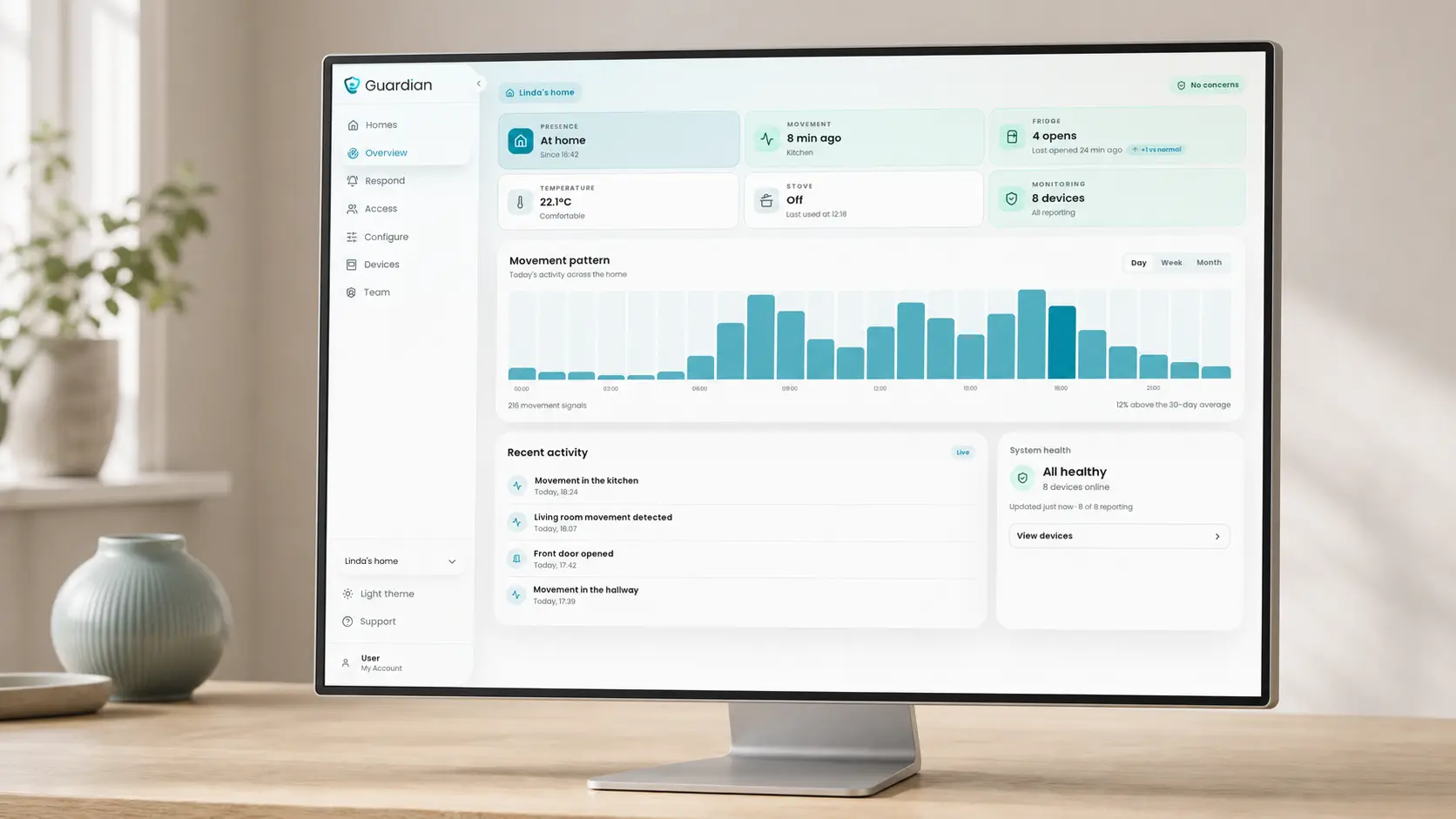
Guardian fills the gap between scheduled visits with camera-free activity records, configured alerts, and automatic visit data. Guardian Insight brings clients, caregivers, vehicles, alerts, and records into one live view for the home care team.
Guardian uses passive sensors to record signals that show whether a routine is continuing or changing:
Motion: room-level activity and periods of inactivity
Bed: getting into or out of bed, including night-time exits
Doors: movement into or out of monitored areas
Fridge and stove: everyday appliance use that can indicate a change in routine
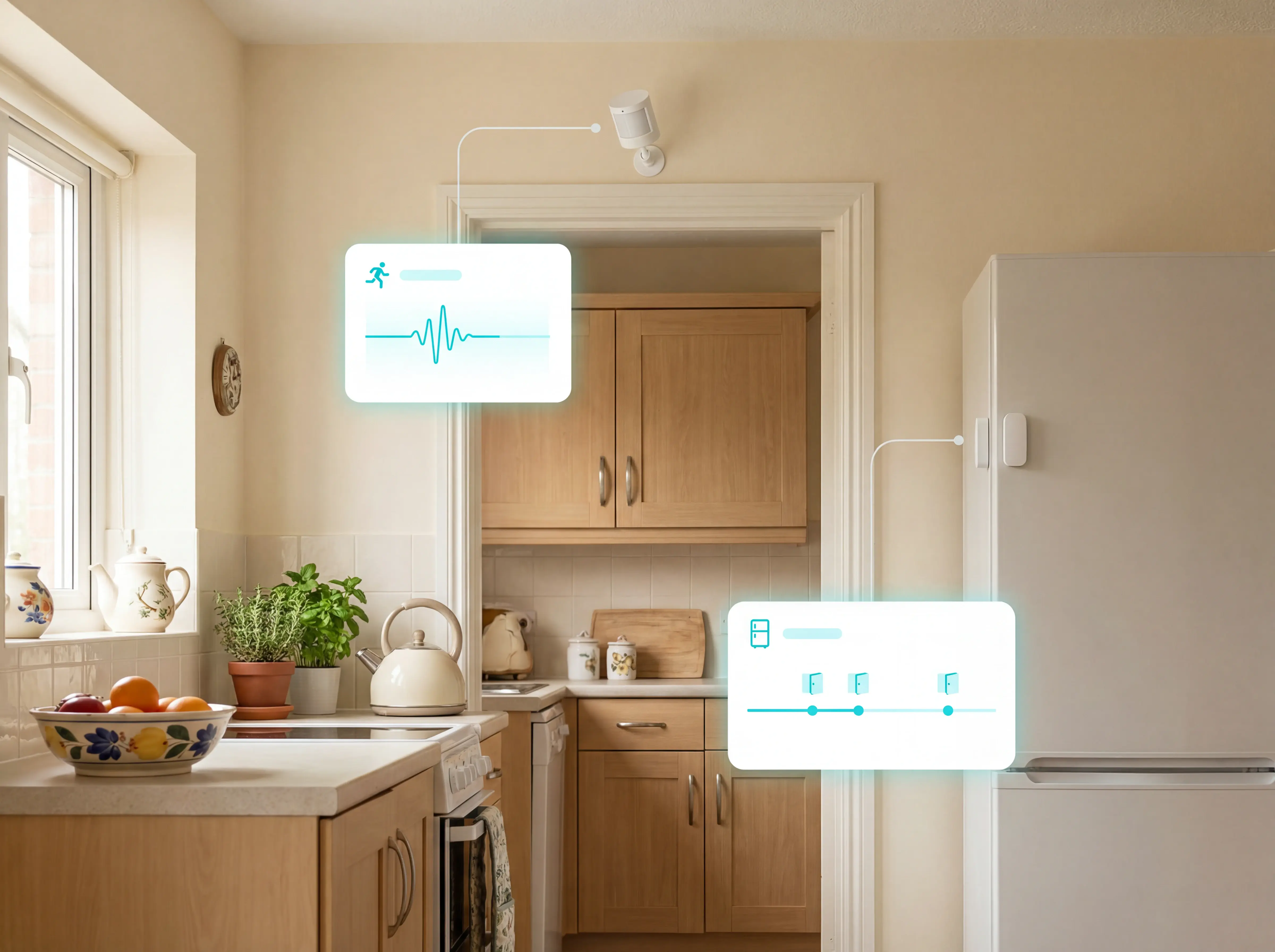
Clients do not need to press a button or wear a device for passive monitoring to work. Radar and infrared sensors detect events without cameras, while GPS safety watches and other wearables can support clients when appropriate.
Guardian turns those signals into rules for each client and workflow. A team can set thresholds for inactivity or a nighttime bed exit, so normal movement stays in the record while a defined concern triggers an alert.
Once a rule is triggered, Guardian sends the alert to the named staff member or contact on their existing device. They see the event and available location context, then follow the agency's response and escalation process.
A continuous record between visits
The event remains in Guardian's activity record after the alert is handled. Guardian Insight also brings caregiver visits and vehicle activity into the same view, helping managers verify service and review follow-up at the next check-in.
Guardian is wireless, so a pilot can focus on selected clients, visits, vehicles, sensors, and alerts without a cabling project. The pilot maps the workflow, configures the relevant rules, and measures what changes in daily operations.
Prove the impact in your care setting
Run Guardian for 6 to 8 weeks with one home care team or selected care setting. The report summarizes response times, visit records, alert data, and staff feedback, then assesses ROI and recommends whether to roll out.
In the US, coverage depends on the plan, medical necessity, provider eligibility, and authorization rules. Physical therapy or skilled home health may be covered, while durable medical equipment and home modifications such as grab bars or lighting follow separate rules. Confirm the order or authorization, network, copay, deductible, and equipment coverage before services begin.
Start with same-day changes: clear regular walking paths, remove or secure loose rugs, move cables, and turn on lights between the bed and bathroom. Next, add nightlights, secure handrails, fit nonslip surfaces, and arrange clinically recommended grab bars. Ask a clinician to review dizziness, medication effects, weakness, or changed walking.
A treating clinician or physical therapist should match strength and balance work to the person's mobility, health conditions, and supervision needs. Otago and Tai Ji Quan: Moving for Better Balance are established examples, but their delivery differs. Home care aides follow the written plan rather than designing or progressing exercises.
There is no universal timetable. Environmental changes can happen immediately, while exercise and confidence programs require sustained participation. Record changes in transfers, walking, adherence, and near misses, then reassess after a fall, health change, medication change, or other trigger.

Author
Aleks Timm
Aleks Timm leads Guardian and builds privacy-first operations technology for care homes and home care providers. Teams get location-aware alerts they can act on, clearer situational awareness, and measured insight into how care work actually runs.
Read MoreRecommended reads
Keep reading
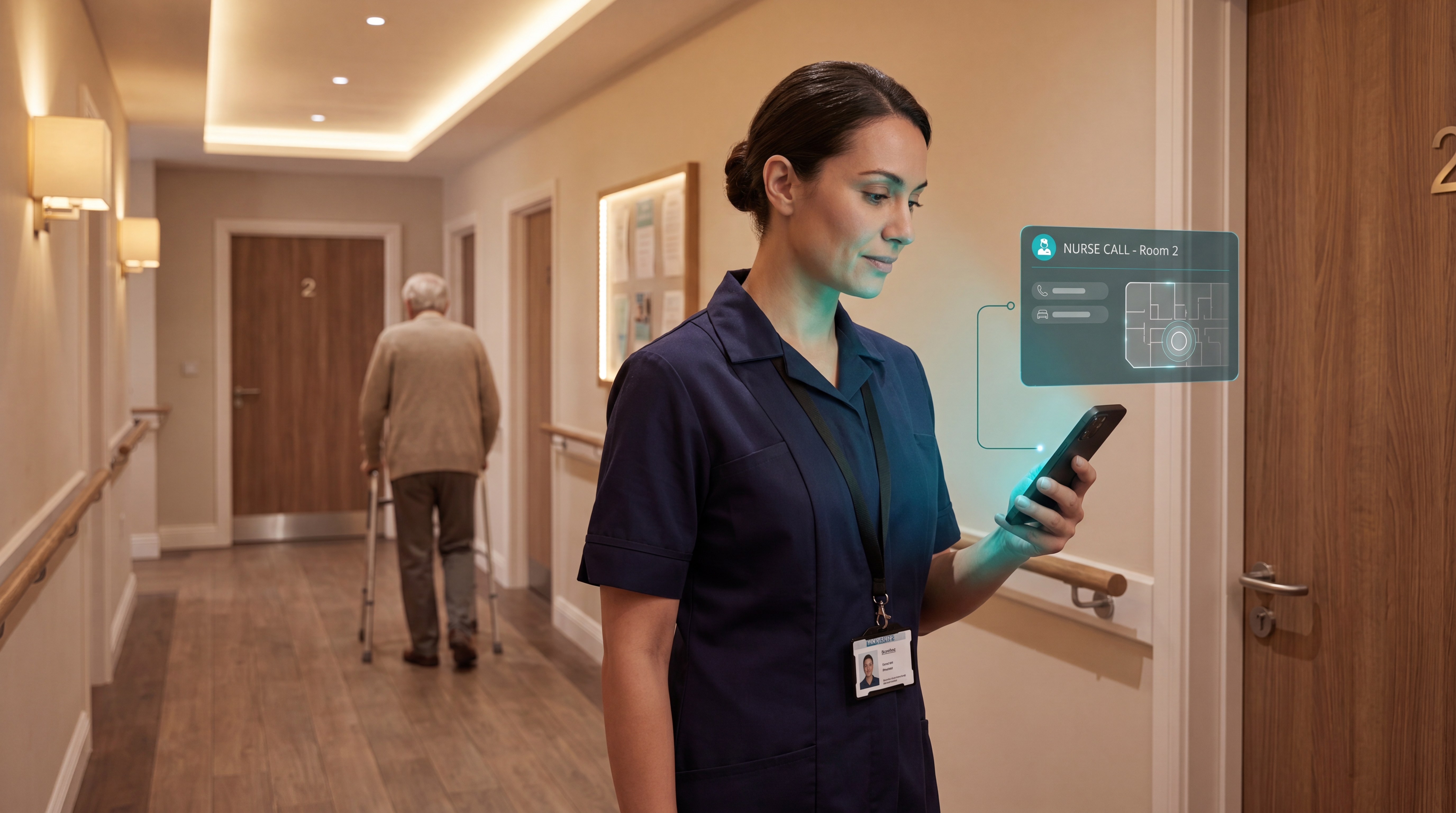
Smart Nurse Call Systems for Care Homes and Home Care Providers
Smart nurse call systems for care homes and home care providers: compare features, improve response times, and choose the right...
Read more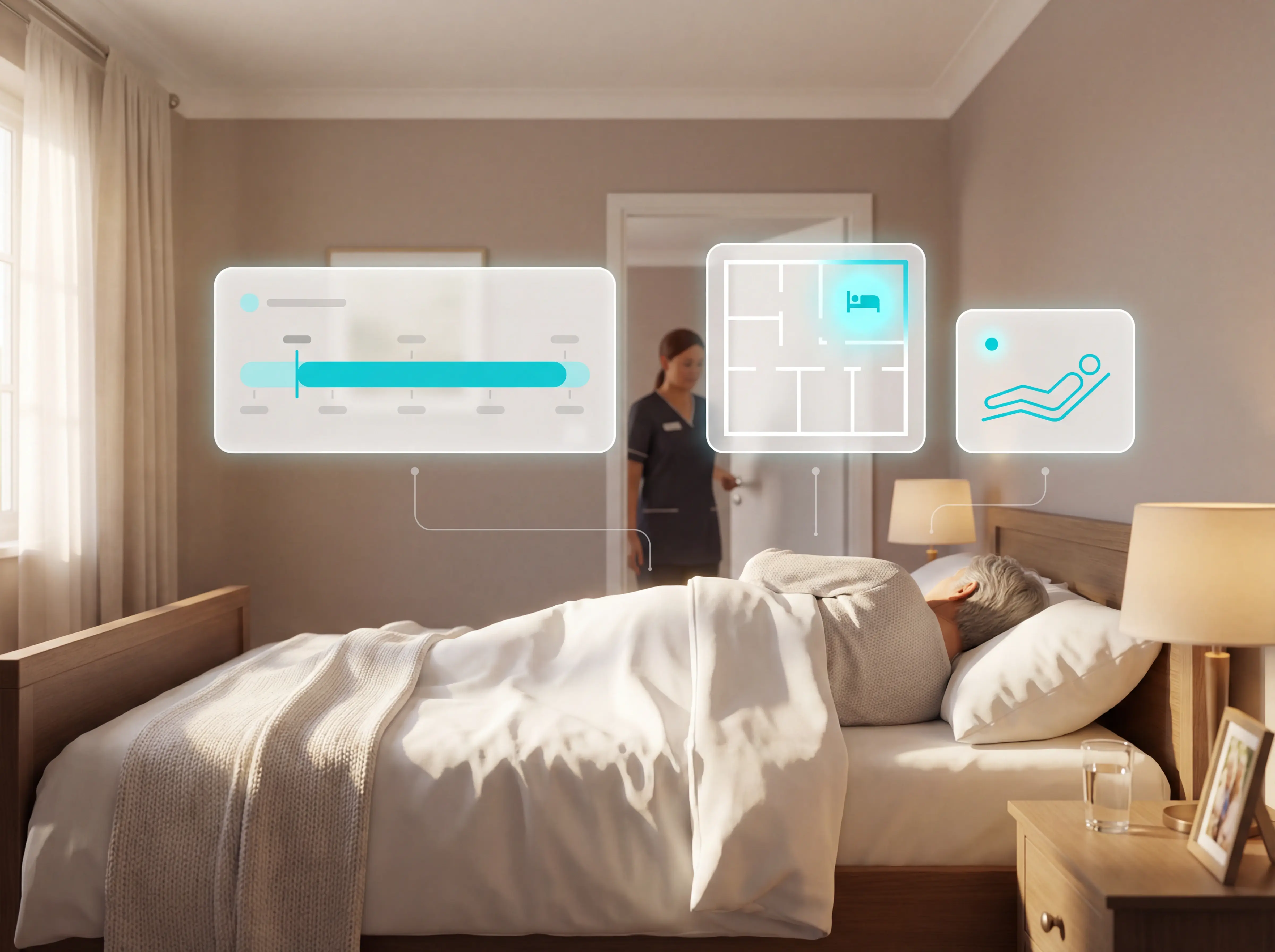
Patient bed alarms for elderly & hospital care
Patient bed alarms help prevent falls in elderly and hospital care. Compare alarm types, choose the right sensor, and protect...
Read more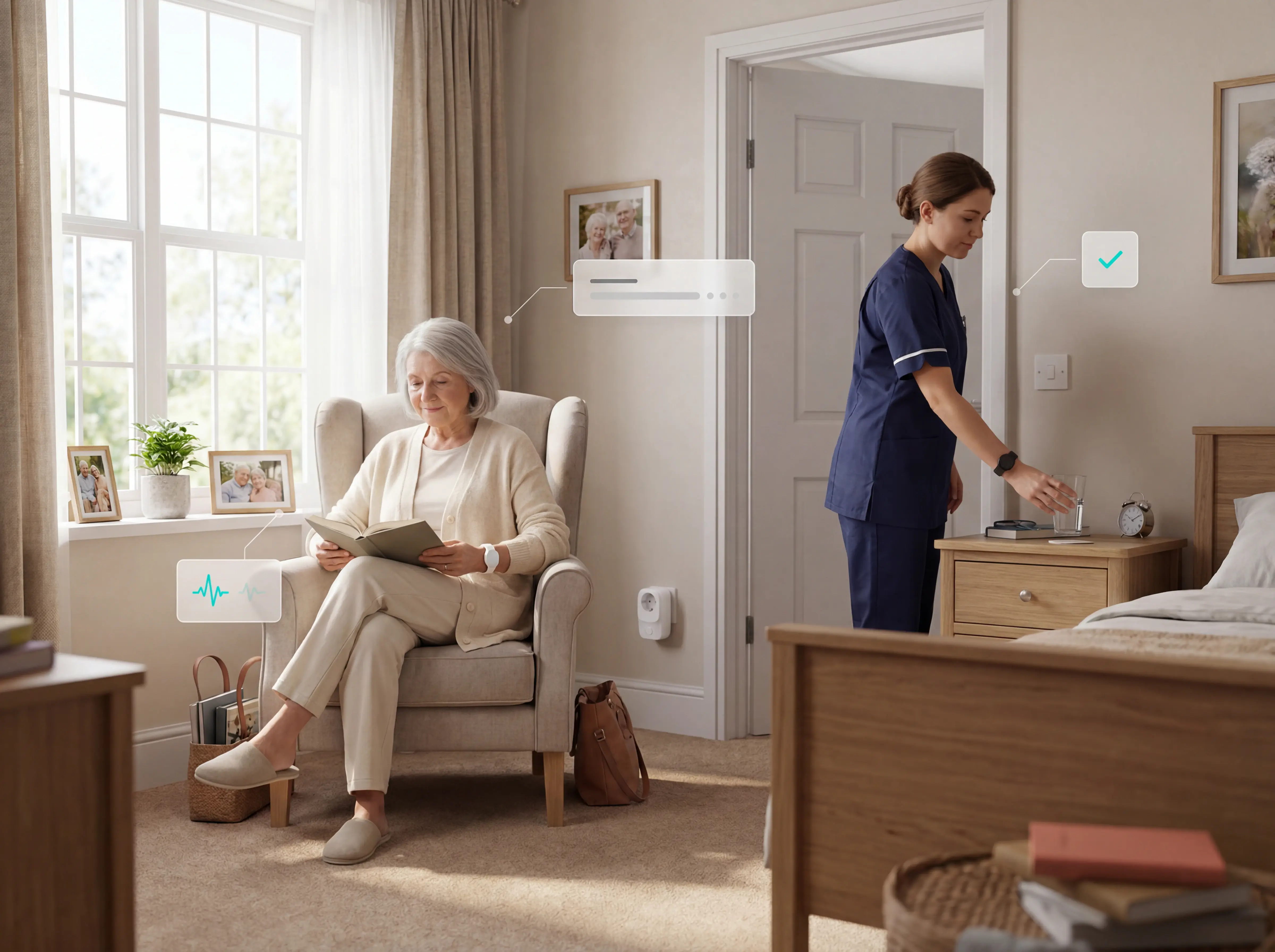
Remote patient monitoring: a complete guide
Remote patient monitoring: the complete guide to sensors, benefits, and buying tips for safer care homes and better resident...
Read more