

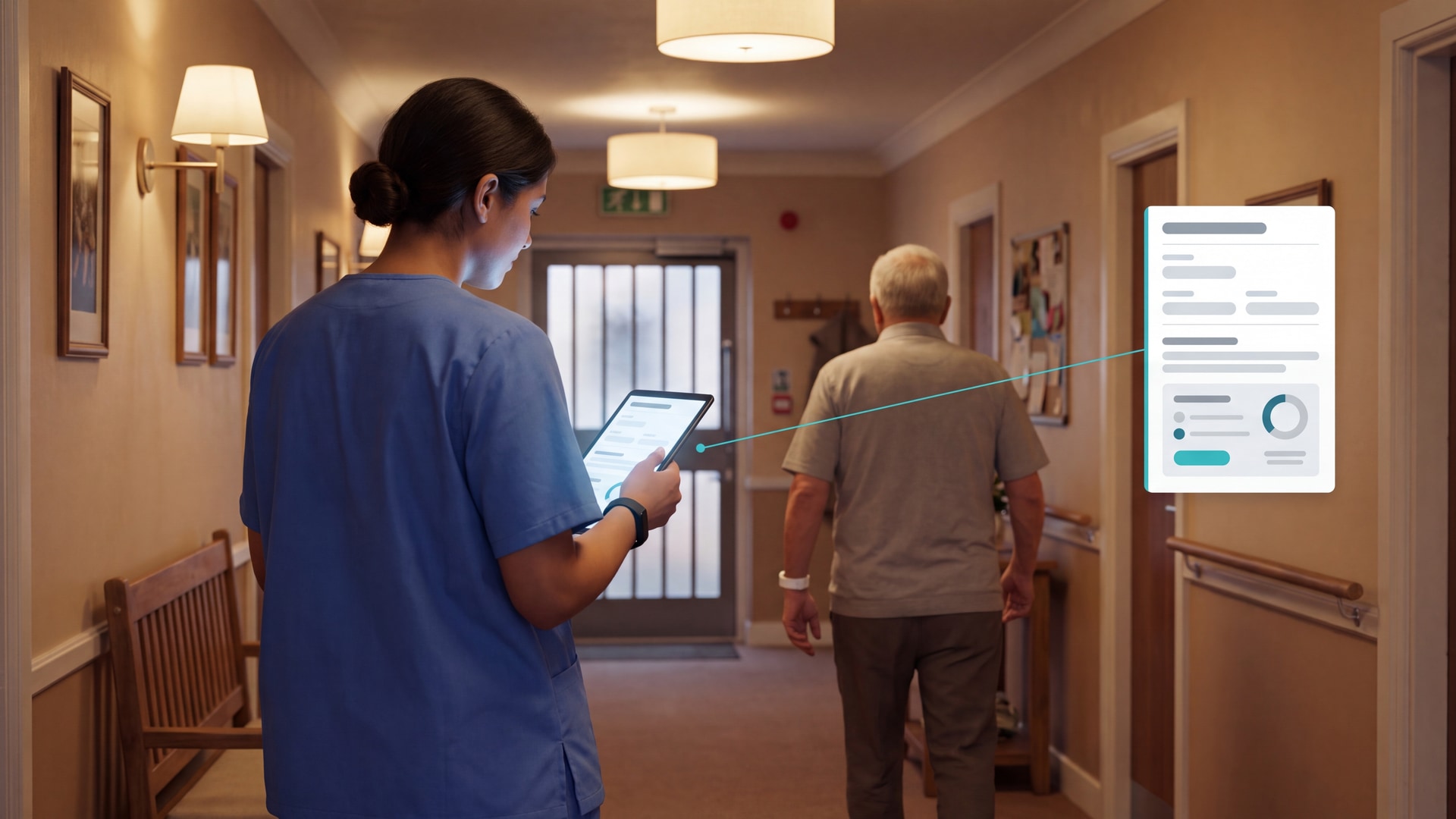
Elopement Risk Assessment: Set Clear Safeguards
In this article
An elopement assessment earns its place when staff can act on it during the next shift. The record should identify the resident’s exit risk and the safeguard that changes care.
An assessment filed without an action plan leaves staff guessing at the door. For a resident who repeatedly approaches a service exit, record the route and a clear supervision instruction for handover.
This guide shows care teams how to assess elopement risk, turn findings into safeguards, document handover instructions, and respond after an attempted departure.
What is an elopement risk assessment?
An elopement risk assessment is a structured care or clinical assessment of whether a person may leave an agreed safe boundary and face harm.
Staff review safety awareness and the resident’s ability to leave. Departure history and current supervision needs inform the monitoring instructions recorded in the care plan.
Elopement vs. wandering, AMA, and other departures
Elopement is a departure beyond an agreed safe boundary that triggers the organisation's safeguarding response. Wandering occurs within that boundary, while an AMA departure follows the applicable informed-decision process.
Use documented facts and the applicable legal framework. Capacity is decision-specific, and a diagnosis, safety concern, or legal status does not automatically authorise staff to restrict movement.
Event | Capacity or intent | Authorisation | Operational response |
|---|---|---|---|
Wandering within a safe area | Intent may be unclear; assess capacity individually | Remains inside the agreed safe boundary | Observe patterns; redirect when safety requires |
Elopement beyond an authorised boundary | Exit may be purposeful or disoriented | Crosses a boundary without authorisation | Start the elopement procedure and search |
Informed AMA departure | Person understands relevant risks and chooses departure | Leaves against advice through the applicable process | Explain risks; document assessment and decision |
Authorised leave | Capacity assessed; an escort may provide support | Leave is approved and recorded in advance | Sign out; confirm escort and return plan |
How elopement risk differs by care setting
Elopement risk changes across care settings because exit routes and supervision arrangements change.
Memory care: Test door-seeking history and how the resident responds to controlled access, especially where tailgating is possible.
Assisted living: Check orientation and the resident’s ability to return independently through open exits, grounds, or visitor traffic.
Skilled nursing or high-acuity residential care: Assess mobility and response to cues during periods of hands-on care.
Acute care: Reassess current orientation and intent to leave when illness or treatment causes episodic confusion.
Behavioural health: Document stated intent and current mental state around unit doors, escorted movement, and grounds access.
Use the terms required by local law and organisational policy. Whatever the label, record the observed risk, the agreed boundary, and the safeguard staff must use.
When to complete or repeat an elopement risk assessment
Complete an elopement risk assessment during admission and transfer. Repeat it after an event or change that affects the resident’s ability or intent to leave safely.
Repeat the assessment after these six triggers:
Admission or transfer: Complete the assessment during intake for a new resident or after transfer between units or services.
Care-plan review: Reassess at each care-plan review required by your organisation.
Acute cognitive or clinical change: Reassess after delirium, new confusion, or a physical change that affects safe movement.
Medication change: Review risk when a medication change affects orientation, alertness, or mobility.
Attempted exit or near miss: Reassess promptly after exit-seeking, an attempted elopement, or a near miss.
Environmental change: Reassess after a move or when an access point changes.
Admission or transfer: Assess during the required intake process for a new admission or transfer between settings, units, or services.
Scheduled care-plan review: Reassess at each review required by policy. A quarterly review is appropriate only where local policy sets that schedule.
Acute cognitive or clinical change: Reassess after new confusion, delirium, psychiatric symptoms, or a change in physical condition that may affect safe movement.
Relevant medication change: Review risk when a medication starts, stops, or changes in a way that affects orientation, alertness, or movement.
Attempted exit or near miss: Reassess promptly after exit-seeking, an attempted elopement, or a near miss rather than waiting for the next scheduled review.
Environmental or room change: Reassess after a room, unit, or floor move, or when access points, door hardware, or outdoor areas change.
Common mistake: Waiting for the next scheduled review after a resident tries to leave. An attempted exit requires a prompt reassessment and a revised handover plan.
The authorised assessor varies by setting and jurisdiction. Involve an appropriate clinician when cognition, medication, psychiatric state, or acute illness may be affecting the person's behaviour.
What to look for: core risk factors and assessment domains
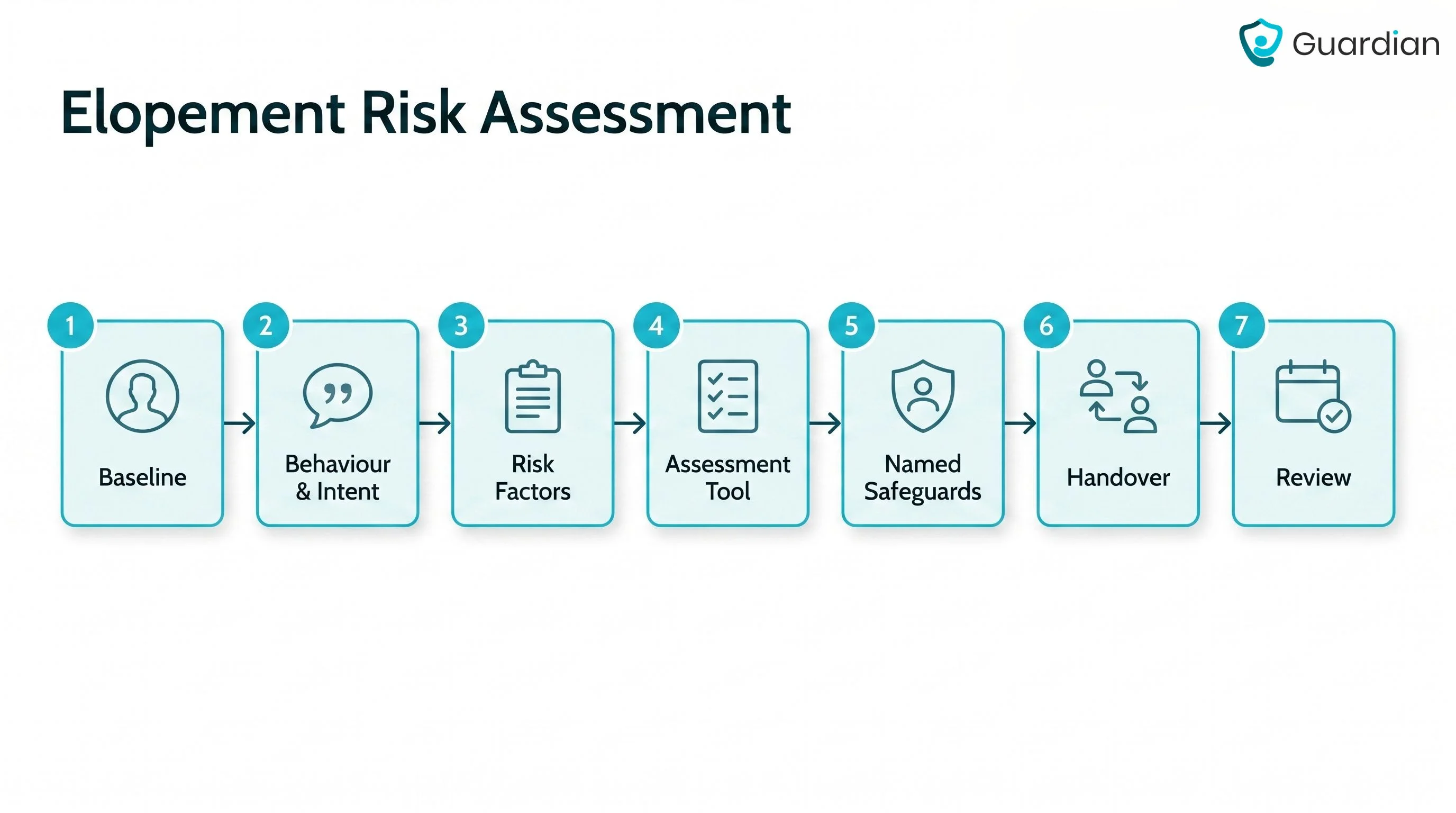
A structured assessment tests intent, ability to leave, and the safeguards already in place. Use this operational workflow alongside the approved assessment tool, not as a replacement for it.
Establish the person's usual baseline.
Record current behaviour and stated intent.
Review cognition, clinical change, mobility, and exit access.
Identify routes, times, locations, and triggers.
Apply the approved assessment tool as written.
Match each finding to a named safeguard.
Set handover, observation, and review instructions.
History, behavior, and intent to watch for
Start with previous events, current words, exit-focused behaviour, time and location patterns, and changes from baseline. The Alzheimer’s Association’s wandering guidance supports a person-centred response.
Previous events: Review documented elopement attempts, wandering episodes, goal-directed walking, and exit-seeking during earlier admissions or transitions.
Goal-directed words: Record statements such as “I need to go home,” “I’m late for work,” or “My family is waiting” in the resident’s own words.
Exit-focused actions: Note door-handle testing, packing belongings, waiting near exits, or following others through secured doors.
Time-linked patterns: Look for agitation, pacing, or exit-seeking around late afternoon, shift changes, meals, visits, or another repeatable trigger.
Change from baseline: Separate a new or escalating pattern from a long-standing routine, preference, or way of communicating.
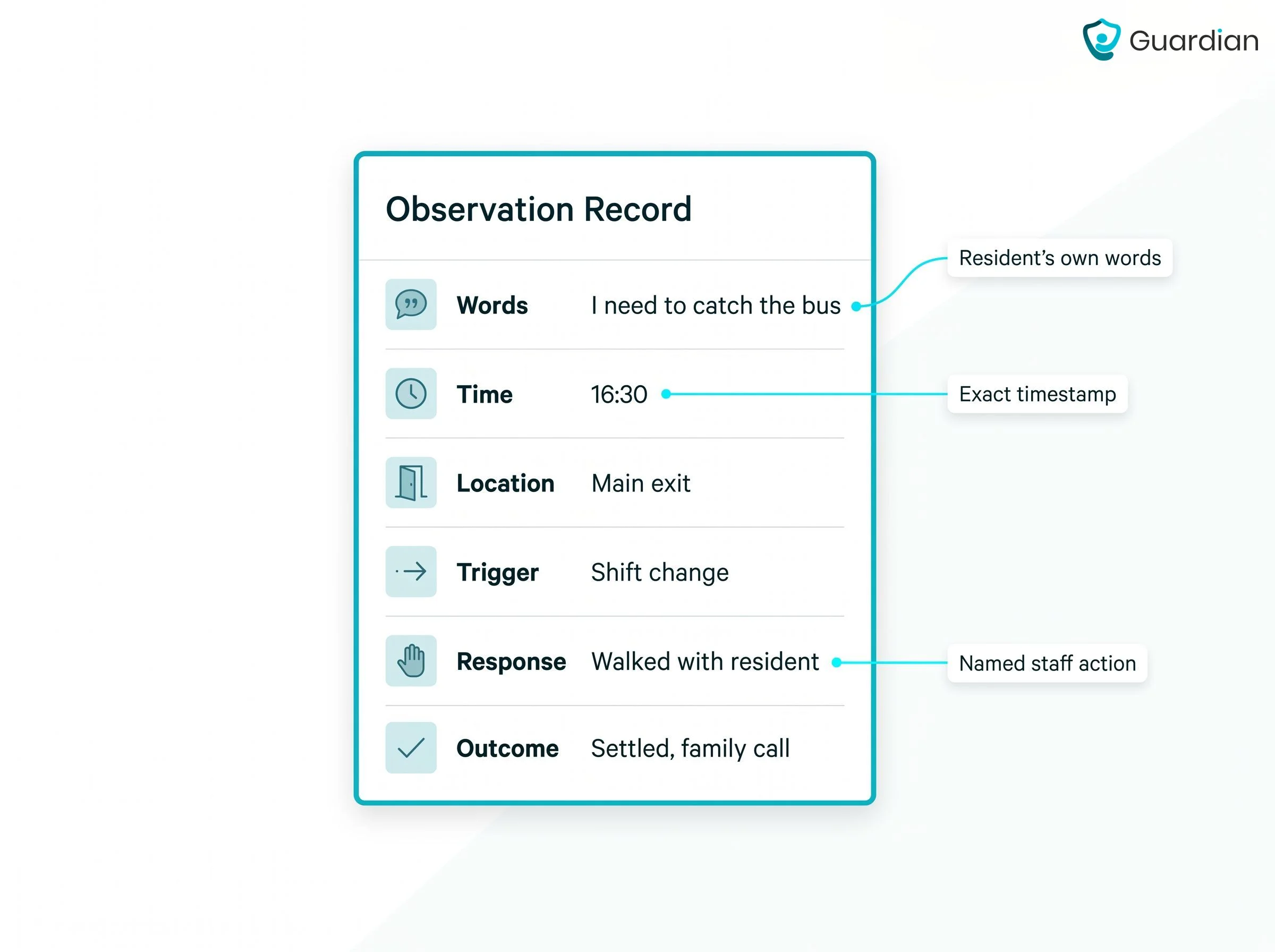
Observation protocol: In the approved record, capture the exact words or action, time, location, trigger, response, and outcome. *Example: “I need to catch the bus” at 16:30 near the main exit, settled after a call with family.*
Cognitive, medical, and mobility factors
Risk rises when a resident is disoriented and can move independently towards an exit. A sudden medical or medication-related change can make that pattern more urgent.
Orientation and judgment: Check whether the resident recognizes the setting and can judge hazards beyond the exit, using their usual cognition as the comparison.
Acute cognitive or psychiatric change: Escalate sudden confusion, hallucinations, marked fear, or another abrupt psychiatric symptom through the facility’s clinical protocol.
Medication effects: Review recent starts, stops, dose changes, or missed doses when restlessness, sedation, impulsivity, or movement patterns change from baseline.
Medical causes: Check for pain, acute illness, delirium, withdrawal, or another clinical change that coincides with uncharacteristic exit-seeking.
Mobility and exit operation: Observe whether the resident can reach an exit, operate door hardware or access controls, and move beyond the doorway without assistance.
How to interpret assessment findings
Interpret findings by deciding whether the resident’s current behaviour has changed from baseline and whether the present safeguards cover that risk.
Use the risk tiers defined by the validated tool. Do not create informal low, moderate, or high cutoffs at the bedside.
Apply the selected tool as written. Use the correct version, timeframe, wording, and scoring instructions. Record each finding before applying the decision rules approved by your organisation.
Compare findings with the resident’s baseline. Check whether exit-seeking, pacing near doors, or boundary testing is new, more frequent, or linked to the immediate circumstances.
Test current safeguards against the observed risk. Decide whether the resident can reach an exit between staff contacts. If the answer is yes, revise the care plan and handover before the next shift.
Each tool answers a different question. A score is evidence for a care-plan decision, not the decision itself.
RAWS-LTC: Measures wandering behaviour. Follow the instrument's scoring instructions rather than treating its score as an elopement tier.
CMAI: Records the frequency of 29 agitated behaviours. Pair it with an exit-risk assessment when departure risk is the concern.
CMS MDS Section E: Records behaviour relevant to care planning. Use the current item set and guidance; it does not create a universal elopement-risk tier.
A score outside the expected range may still reflect the person's baseline. Record the behaviour and what has changed before deciding whether safeguards need revision.
Ambiguous exit-seeking and near misses need prompt clinical review. Use temporary, proportionate safeguards while the team clarifies the circumstances; ambiguity alone does not create a universal high-risk label.
Matching findings to interventions and prevention steps
Turn each finding into a proportionate response that addresses the resident’s observed risk and the route they may take towards an exit.
Document why each control fits the resident’s pattern and name the staff member who must act on it. Set observation frequency around the observed risk window; a generic 15-minute schedule is not a plan.
Use person-centred, proportionate, and least-restrictive controls permitted by local law and policy. Distinguish event monitoring and direct supervision from restrictions that require consent, legal authority, or formal review.
Finding | Immediate care-plan response | Environmental or workflow control | Review trigger |
|---|---|---|---|
Active exit intent | Stay with the resident, respond to the stated need, and escalate according to the resident's current level of risk. Record the words, behaviour, redirection, and agreed observation level in the care plan. | Where feasible, use a room away from perimeter exits. Give the next shift a named handover; an immediate door or restricted-zone alert can provide backup between rounds. | Review after every attempt, exit-seeking episode, or redirection, and whenever the resident expresses a new destination or reason for leaving. |
Disorientation with independent mobility | Support safe movement while checking orientation and unmet needs. Record the routes, places, or people the resident appears to seek. | Keep familiar routes well lit and free from avoidable hazards. Clear signs, staff awareness, and optional camera-free door or motion sensing can flag movement towards an exit without filming the resident. | Review when mobility, orientation, usual route, sleep pattern, or ability to follow prompts changes. |
Time-linked patterns | Record when exit-seeking occurs and what happens beforehand. Plan support before the recurring risk window rather than waiting for the behaviour to begin. | Align staffing, activities, and shift handover with the identified pattern. Configure alerts by resident, location, or time window so routine movement does not create avoidable noise. | Review when the pattern repeats, shifts to another time, or follows a change in routine, health, or medication. |
Acute clinical change | Treat a sudden change from baseline as a clinical concern. Follow local escalation procedures, increase supervision when clinically indicated, and update the care plan with the onset and observed change. | Reduce avoidable stimulation, keep the resident accompanied in higher-risk areas, and make the change explicit at handover. | Review immediately after assessment, after treatment or medication changes, and whenever cognition or behaviour changes again. |
Prior attempt or near miss | Raise the recorded risk level as clinically appropriate and revise the plan after the event. Include where the resident went, what interrupted the attempt, and what staff response worked. | Treat exit-seeking and successful redirection as near misses. Check the route and access point, correct the failed control, and hand over the revised response before the next shift. | Review after every recurrence, control failure, delayed response, or new route towards an exit. |
Guardian is a camera-free, wireless safety and operations platform for care settings. Its door and motion alerts can support an assessed care plan without setting clinical risk or supervision levels.
Guardian records configured events as they happen, helping staff respond between rounds without replacing direct care or clinical judgment. See how Guardian supports care settings.
Documenting and communicating elopement risk
A usable elopement record turns assessment findings into clear instructions for every staff member.
The care plan, handover, and near-miss log must show what to watch and what action is expected.
Care-plan record
Assessment findings and baseline: Record the current risk level and the resident’s usual movement, routines, communication, cognition, and support needs.
Observed behaviour: Describe what staff saw or heard in neutral terms, such as “walked to the main exit and pressed the release button.”
History and triggers: Note previous exit attempts, known destinations, time patterns, environmental cues, distress, and people or routines linked to exit-seeking.
Controls and rationale: Name each agreed control, the finding it addresses, when it applies, and any restriction or consent consideration.
Identification: Include approved identification details and a current photograph in the resident record. Limit display and sharing to staff with a care role.
Review and escalation: State the next review date and the route for reporting new behaviour, a near miss, or a change in clinical risk.
Ownership: Name the role responsible for maintaining the plan and the role authorised to approve changes.
Shift handover
Handover protects the resident when responsibility changes. Use SBARD to make the current concern, agreed action, and accountable role unmistakable.
Situation: State the immediate concern and what has changed since the previous handover.
Background: Give the relevant history, baseline, triggers, and current care-plan controls.
Assessment: Describe the latest observed behaviour and the staff member’s current risk judgement.
Recommendation: State what the incoming shift must continue, change, or observe. Brief any staff member who may supervise the resident or work near an exit.
Decision: Confirm the agreed action, responsible role, and review point. Share approved recognition details with reception when that role may affect the response.
Observation or near-miss log
A near miss disappears when the record relies on memory. Capture the event as it unfolds so the next shift can act on facts, not recollection.
Time and place: Enter the exact date, time, and location of the observation.
Action: Record the resident’s words and actions in neutral language, including direction of travel or interaction with an exit.
Staff response: State what staff did, who responded, and when the response began.
Outcome: Record where the resident remained or returned, their presentation, and any immediate support provided.
Care-plan follow-up: Note whether the event matches the known baseline or requires a care-plan review.
Escalation and ownership: Record who was informed, the route used, the responsible follow-up role, and any agreed review date.
Responding to an attempted or actual elopement
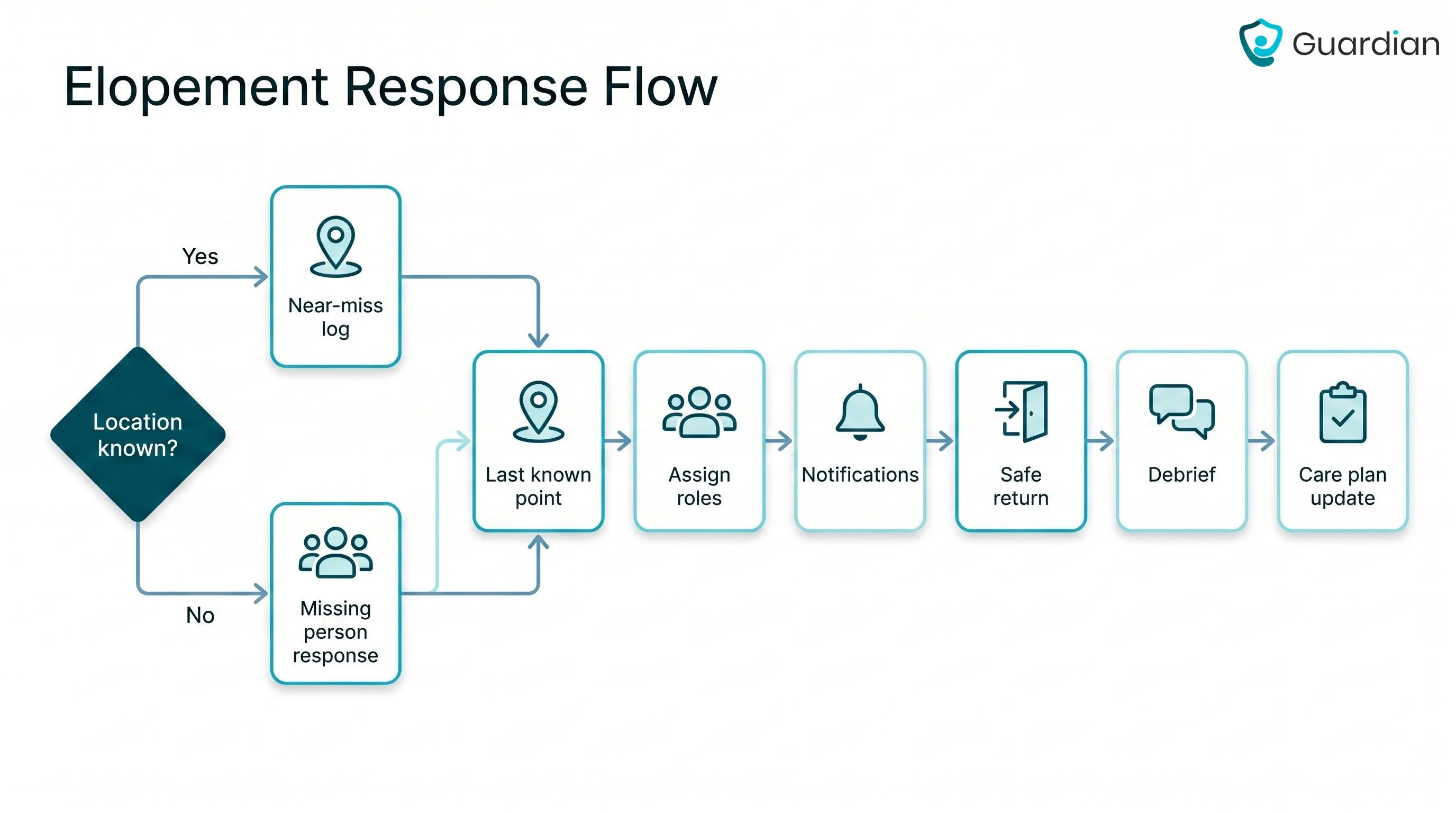
Start by establishing whether the person's location is known. A redirected attempt is a near miss; an unknown location requires the approved missing-person response.
Speed depends on preparation. Staff should know who leads the search before an alarm or concern arises.
Activate and classify the response. Treat a redirected attempted exit as a near miss. If the person’s location is unknown, activate the full missing-person response without delay.
Confirm the last known point. Establish where and when the person was last seen, then determine their likely direction of travel and any immediate medical risk.
Assign clear roles. Name one incident lead. Keep search duties separate from exit control and routine resident care.
Use live location information. Immediate door or perimeter alerts can shorten the gap between crossing and staff awareness. Floor-map location helps direct responders to the correct exit or zone.
Make the required notifications. For a confirmed missing-person event, contact emergency services and notify family, clinical, regulatory, and management parties as required by local law and facility policy.
Support the person on return. Approach calmly, assess immediate health needs, and return the person to a safe setting with appropriate supervision. Preserve dignity and avoid blame.
Debrief and update the plan. Debrief promptly to identify the trigger and any failed safeguard. Update the risk assessment, then communicate revised safeguards to the relevant team.
Auditing whether your elopement prevention process works
An elopement prevention process works only when records show that staff follow the plan and safeguards perform under pressure.
Audit against a fixed scorecard, using operational records and direct observation as evidence.
Common mistake: counting only confirmed elopements. Near misses, drills, and routine control checks show whether safeguards work before a resident goes missing.
Use five checks to test the process:
Event records: Were exit attempts recorded, and did findings lead to a care-plan change when needed?
Alert response: Did staff reach the correct area promptly after an alert or drill?
Handover: Did the incoming team receive the current risk and agreed safeguards?
Drills and devices: Did assigned roles work, and were door or sensor faults closed?
Recognition and patterns: Could staff identify the resident quickly, and do events repeat by location or time?
Name an owner for each check. Keep the evidence source and review date beside it.
When a check fails, record the gap, assign an owner and completion date, re-test the control, and close the action only when the evidence shows it works.
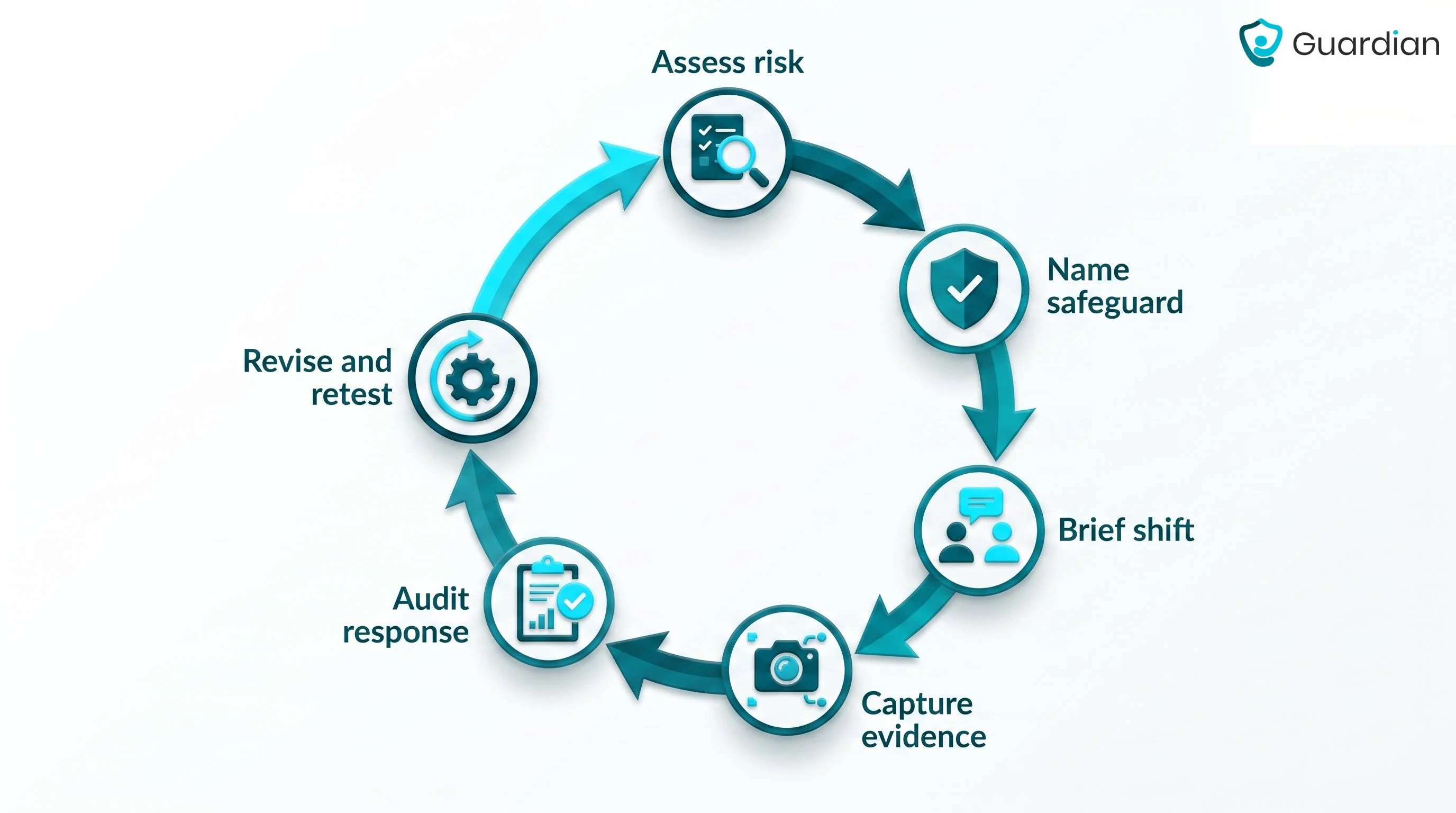
Every measure needs a visible review date. Tie it to the resident's current risk assessment and equipment instructions, then make overdue checks visible to the safety committee.
Keep applicable disclosure, incident-investigation, and reporting records together. The audit trail should show the decisions made, the corrective action assigned, and evidence of completion.
Pilot metrics need enough context to be interpreted.
Scope: Name the ward or care team, observation period, and included residents, events, or drills.
Method: State the recorded result and how it was calculated.
Baseline: Record the comparison period used before the pilot or change.
Definitions: Define the alert and the start and end points for response time.
Exceptions: Record excluded events and device downtime.
Review: Name the owner and the date results will be reviewed.
Where paper checklists and manual tracking still fall short
Paper checklists record what staff see during scheduled rounds. Exit-seeking can occur between rounds, leaving no event record until the next observation.
Recording: Staff notes capture clinical context and the resident's condition; sensors record configured exit/restricted-area and bed events.
Timing: A sensor event is time-stamped when it occurs between rounds, rather than when a later checklist entry is completed.
Near misses: Exit-seeking, pacing, and redirection still need staff interpretation, but configured events create a record when activity occurs outside a round.
Handover: Event records reduce the need to reconstruct a shift from notes, while care notes retain the clinical decision-making.
Privacy: Camera-free sensors record defined activity and location events instead of video.
Guardian maps each configured exit or restricted area to a digital floor plan. The time-stamped event record supports response review, handover, and audit alongside clinical notes.
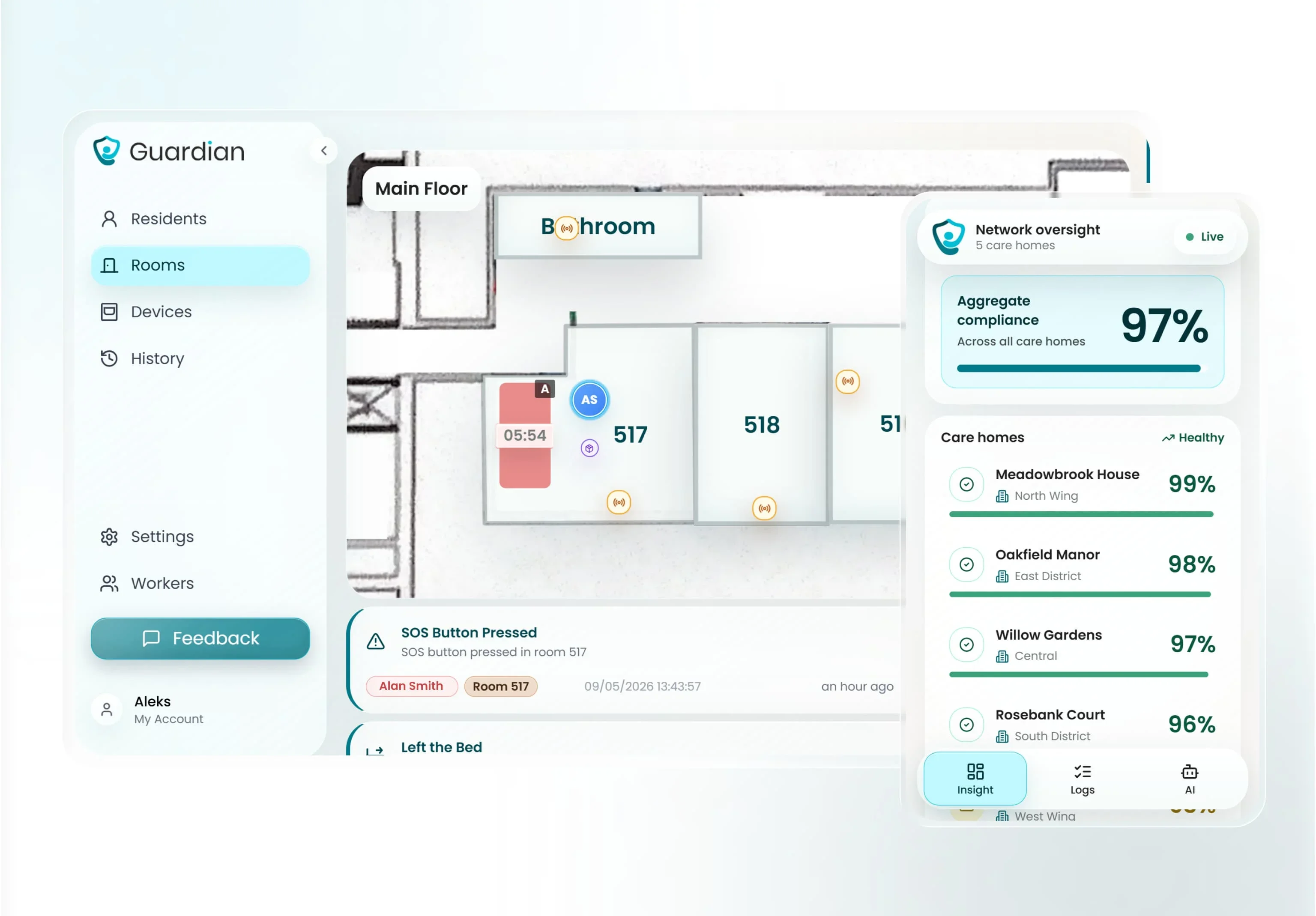
Real-time exit alerts back up your elopement risk process with Guardian
Guardian supports care homes, residential and specialist care, mental health services, and relevant home care workflows. It records configured exit events between rounds while staff retain every clinical and safeguarding decision.
A configured door or restricted-area event is mapped to the relevant floor-plan location. Guardian then sends the event details to staff devices and keeps a record for handover, review, and audit.
Each alert sent to staff devices contains:
Room number
Bed or resident ID
Alert type
Timestamp
Elopement risk can come from a resident’s behavior, clinical condition, mobility, or care environment. No single factor determines risk, so assess the current pattern and context.
Prior events: Previous wandering or elopement attempts documented in the care record, a risk factor discussed by Aud (2004).
Exit preparation: Testing doors or packing personal belongings.
Disorientation with mobility: Confusion alongside the ability to walk or use a mobility aid independently.
Acute change: A sudden change in cognition or behavior from the person’s usual baseline.
Admission or transfer: Unfamiliar surroundings after a move between care settings can increase elopement risk.
Operational gaps: An incomplete handover or busy entrances during shift changes and visiting periods.
In the United States, ICD-10-CM code Z91.83 means “wandering in diseases classified elsewhere.” It is an additional code used with the underlying disorder, not a standalone measure of elopement risk.
Under the CMS guidelines, sequence the underlying disorder first and report Z91.83 as an additional code. Coding and reporting outside the United States follow local rules.
Yes. Mental health assessment weighs cognition alongside intent and current clinical state. Use the assessment process required by the service’s legal framework and regulator.
Assess these factors:
Intentional absconding: stated plans, previous attempts, or efforts to evade observation
Legal status: voluntary or involuntary admission and any authorised leave conditions
Acute clinical state: psychosis, self-harm risk, or substance-related needs
Treatment engagement: refusal of care, conflict about admission, or disengagement from the care plan
Dynamic triggers: distressing news, a change in observation level, or access to an exit
There is no universal interval for elopement drills. Set the schedule through the facility’s documented risk review, while following applicable regulation and regulator guidance.
Rotate scenarios: include day, night, and weekend staffing so each shift practises its role
Respond to incidents: add a drill when an attempted or actual elopement exposes a response gap
Re-test changed controls: consider an extra drill after major process, access, or perimeter changes
Account for staffing changes: add practice after major turnover or role changes when the risk review supports it

Author
Aleks Timm
Aleks Timm leads Guardian and builds privacy-first operations technology for care homes and home care providers. Teams get location-aware alerts they can act on, clearer situational awareness, and measured insight into how care work actually runs.
Read MoreRecommended reads
Keep reading

Bed exit alarm systems for fall prevention
Bed exit alarm systems for fall prevention help care homes spot risk faster, reduce falls, and improve response with smarter alerts...
Read more
Wireless Patient Monitoring Systems for Care Homes
A complete guide to wireless patient monitoring systems, connected sensors, alert logic, care-home deployment, privacy, and...
Read more
Patient bed alarms for elderly & hospital care
Patient bed alarms help prevent falls in elderly and hospital care. Compare alarm types, choose the right sensor, and protect...
Read more