

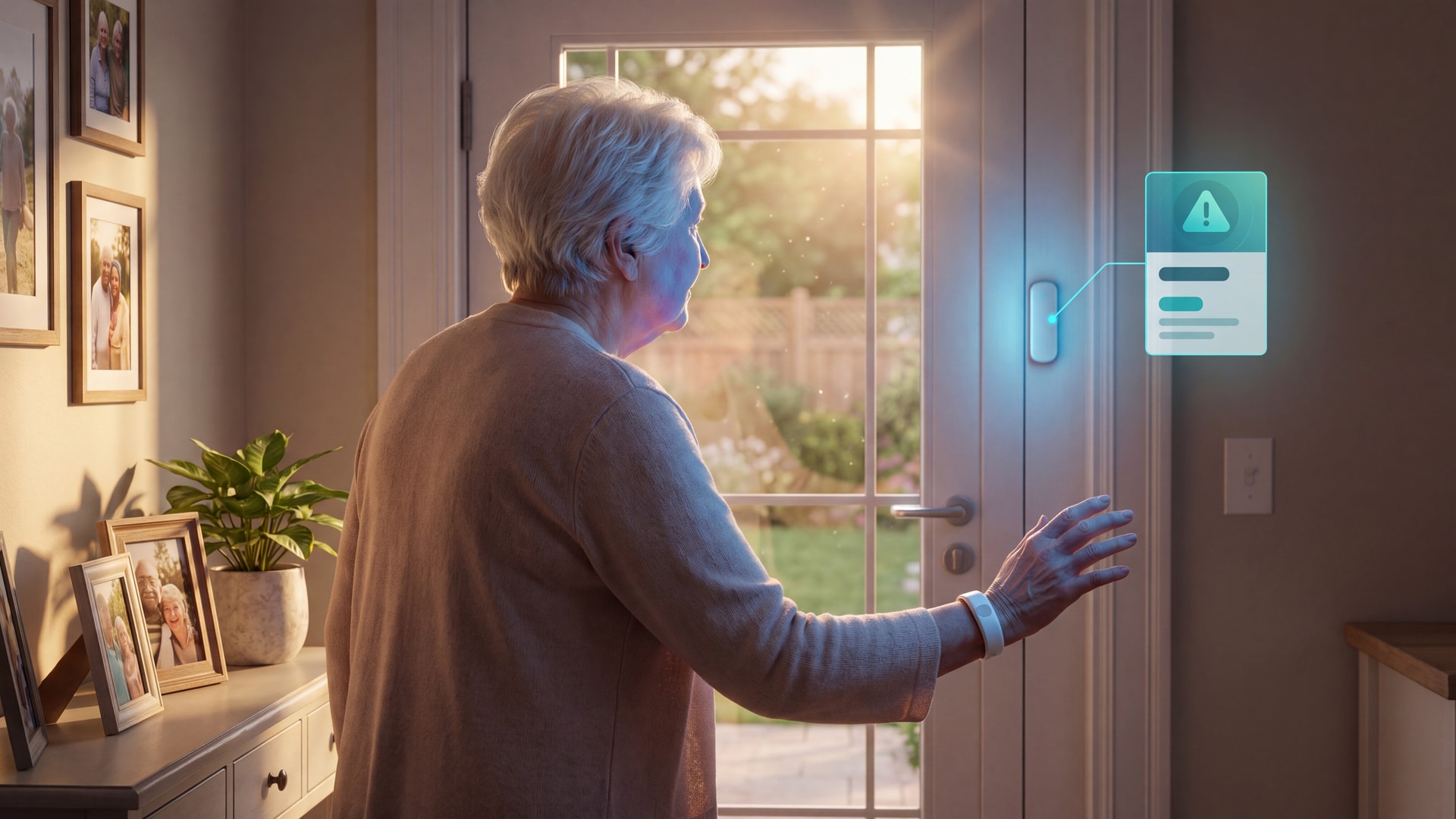
Elopement prevention in nursing homes: act before a resident reaches the exit
In this article
Elopement prevention in nursing homes starts well before a resident reaches an exit. Care teams need to recognize changing risk and exit-seeking behavior early enough to intervene calmly.
A door alarm only confirms that someone has reached the perimeter. Without clear location context and dependable monitoring, the alert may arrive too late or leave staff searching.
The practical goal is a current care plan, clear shift ownership, reliable alerts, and a tested response when a resident cannot be located.
What counts as elopement in a nursing home?
Elopement occurs when a resident leaves a safe area or facility without the supervision required by their documented plan, creating a safety risk. It is a departure event, not a label for wandering within a safe area.
Situation | Physical boundary | Classification |
|---|---|---|
Supervised movement | Approved unit or secured courtyard | Wandering |
Unsupervised crossing | Designated unit or courtyard | Elopement |
Unsupervised during transfer | Parking or transfer area | Elopement |
Capable, authorized exit | Boundary allowed by care plan | Authorized departure |
Decision-making capacity is specific to the decision and circumstances. Whether a departure is authorized depends on the resident's rights, documented care plan, required supervision, and applicable law.
Who is at higher risk of elopement, and what are the warning signs?
A prior elopement attempt, repeated exit-seeking, or a new change in mental state calls for prompt assessment. Dementia can raise wandering risk, but movement within a safe area is not itself elopement.
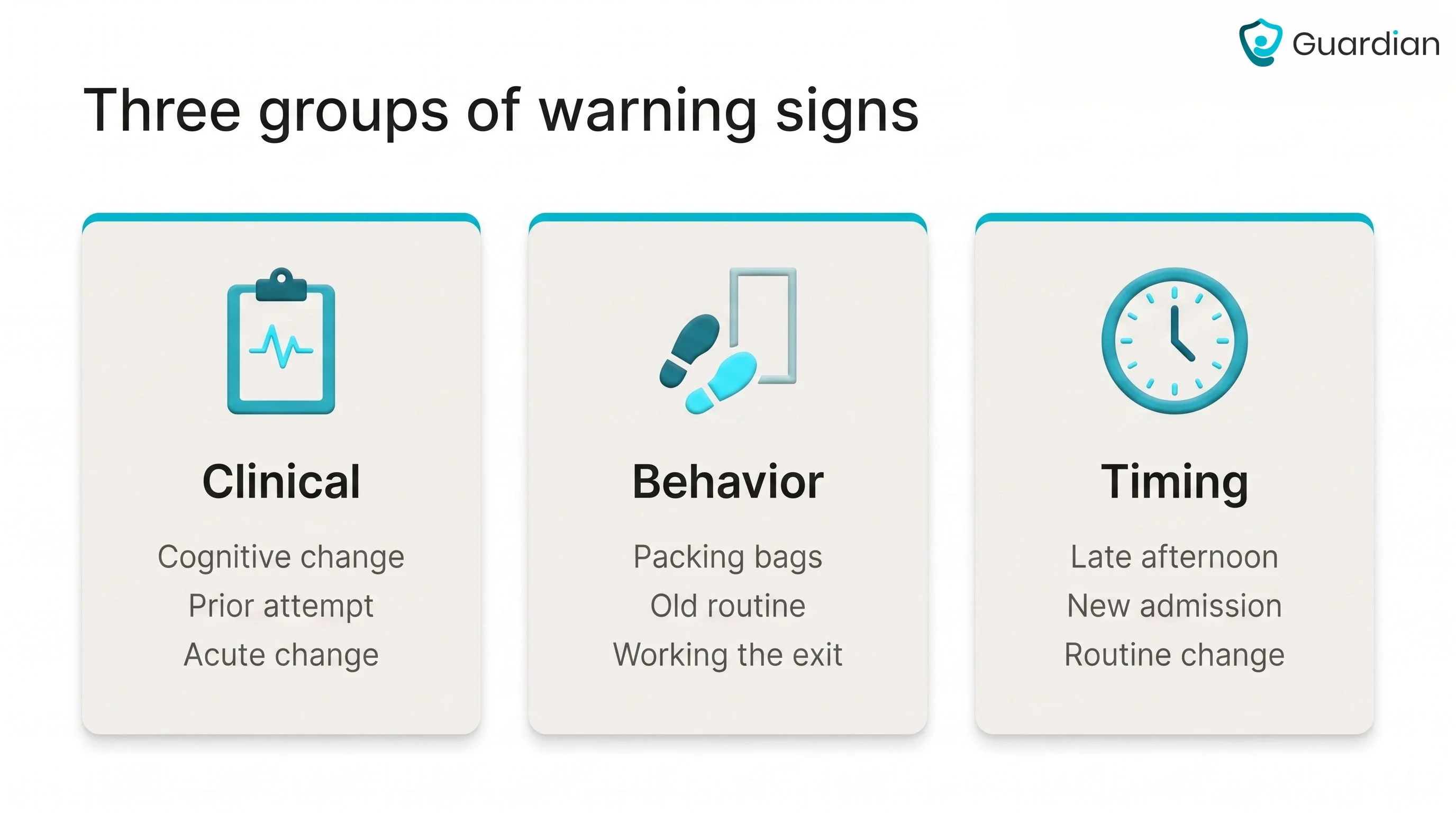
Clinical factors
Cognitive impairment: Alzheimer’s disease and other dementias can be associated with wandering. Assess whether the resident’s movement includes exit-seeking or a need to leave the safe area.
Previous incidents: Treat a documented elopement attempt or pattern of unassisted wandering as important baseline information.
Acute clinical change: Reassess new exit-seeking alongside withdrawal, psychosis, delirium, medication changes, or another sudden change in mental state.
Observable behavior
Packing to leave: Bags filled with clothes or personal belongings can indicate preparation to depart.
Following an old routine: A resident may prepare for work or to go home because the obligation feels current.
Working the exit: Repeated pacing near doors, testing handles, or waiting in an entry vestibule warrants prompt attention.
Timing and environmental changes
Late afternoon or early evening: Watch for a change in confusion or exit-seeking as daylight fades.
Early admission period: A recent arrival may search for home or another familiar place while getting used to a new room and routines.
Routine disruption: Look for a change after medication adjustments or during long, unstructured periods with little daytime engagement.
A single behavior does not prove an intention to elope. Compare it with the resident's usual pattern and current circumstances.
Speak with the resident, check immediate needs, document the change, and reassess the care plan when the behavior is new or escalating.
The elopement prevention framework, step by step
An elopement prevention framework connects individual risk assessment, person-centered interventions, shift ownership, reliable alerts, and review after incidents or near misses.
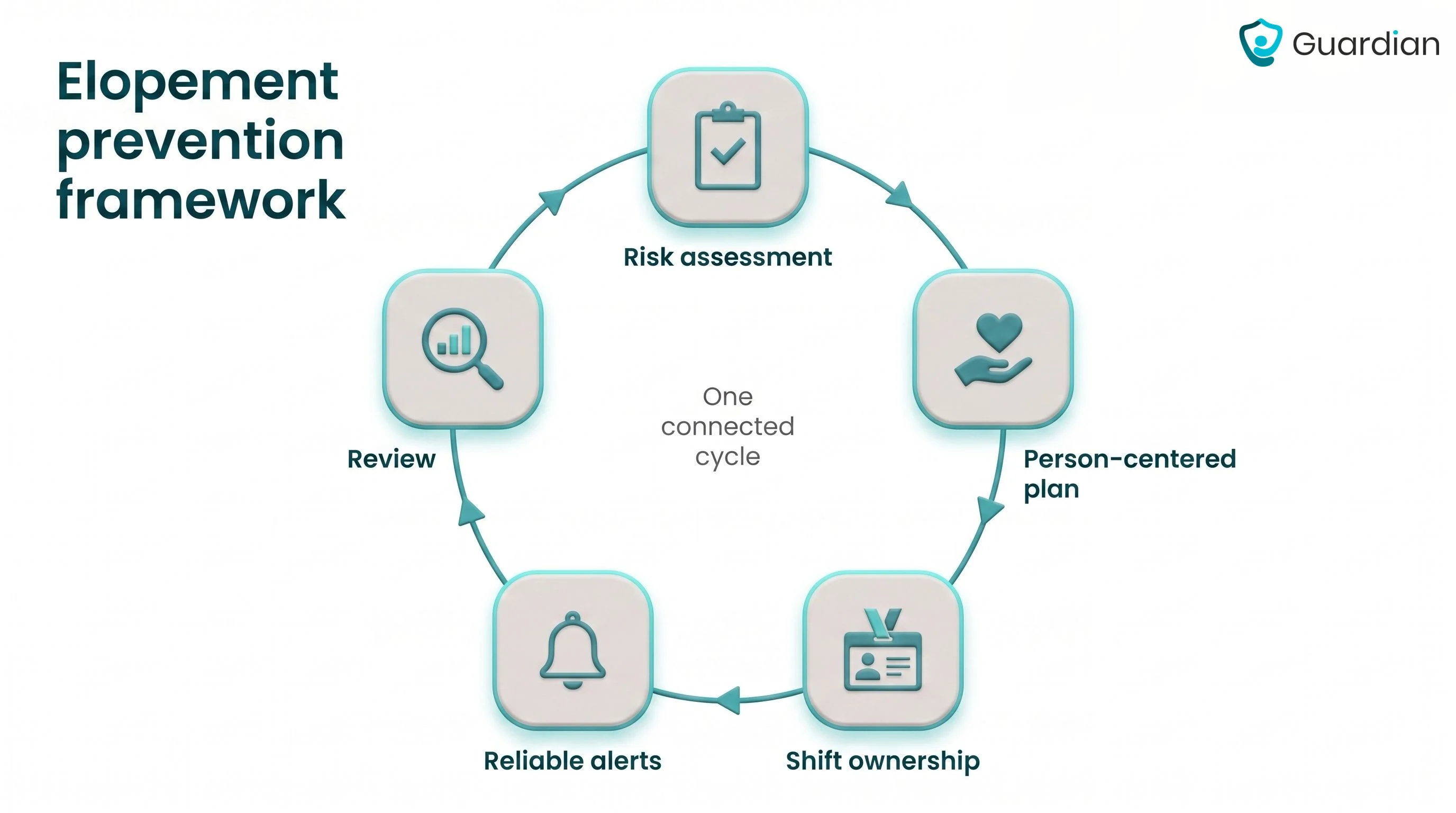
The nurse responsible for the care plan coordinates input from nursing, activities, dietary staff, and other relevant disciplines. Complete scheduled reviews, but reassess immediately when risk, behavior, health, medication, or surroundings change.
Assess risk on admission, and reassess after these triggers
Elopement risk assessment starts on admission. The responsible nurse updates it after clinical, behavioral, or environmental changes, while the interdisciplinary team updates the related care plan.
Use the same approved screening tool at each review so the record shows changes over time:
Admission: Complete a formal risk screen and record any known wandering or elopement history, along with the resident's current orientation.
Scheduled care-plan review: Repeat the screen at each interval required by facility policy, even when no incident has occurred.
Medication or cognition change: Reassess after a medication change, acute delirium, or worsening cognitive impairment.
Transfer or relocation: Reassess after any room, unit, or care-setting move because unfamiliar surroundings can change exit-seeking behavior.
Major life event: Reassess after bereavement or a major change in family contact, routine, or familiar caregivers.
Near miss: Record repeated approaches to exits, following visitors, and unusual movement toward restricted areas. Where appropriate and available, camera-free monitoring can add time-stamped movement patterns to staff observations.
Match interventions to the reason a resident is exit-seeking
Match each intervention to the physical, emotional, environmental, or cognitive reason behind the resident's exit-seeking behavior.
The same doorway behavior can have different causes. Use the resident's words, routines, and immediate needs to choose a response.
Pain or discomfort: Check pain cues, reposition the resident, and follow the clinical plan.
Toileting urgency: Offer discreet help and keep the bathroom route clear.
Hunger or thirst: Offer a familiar snack or drink within the dietary plan.
Boredom or confinement: Provide a purposeful task, supervised walk, or preferred activity.
Late-day confusion: Keep the evening routine calm, familiar, and predictable.
Searching for someone or somewhere: Validate the concern, use life-story cues, then guide the resident toward a familiar activity.
Care-plan flow: observed exit-seeking → check the likely driver → use the agreed response → record what worked → assign it at handoff → align any alert rule with the plan.
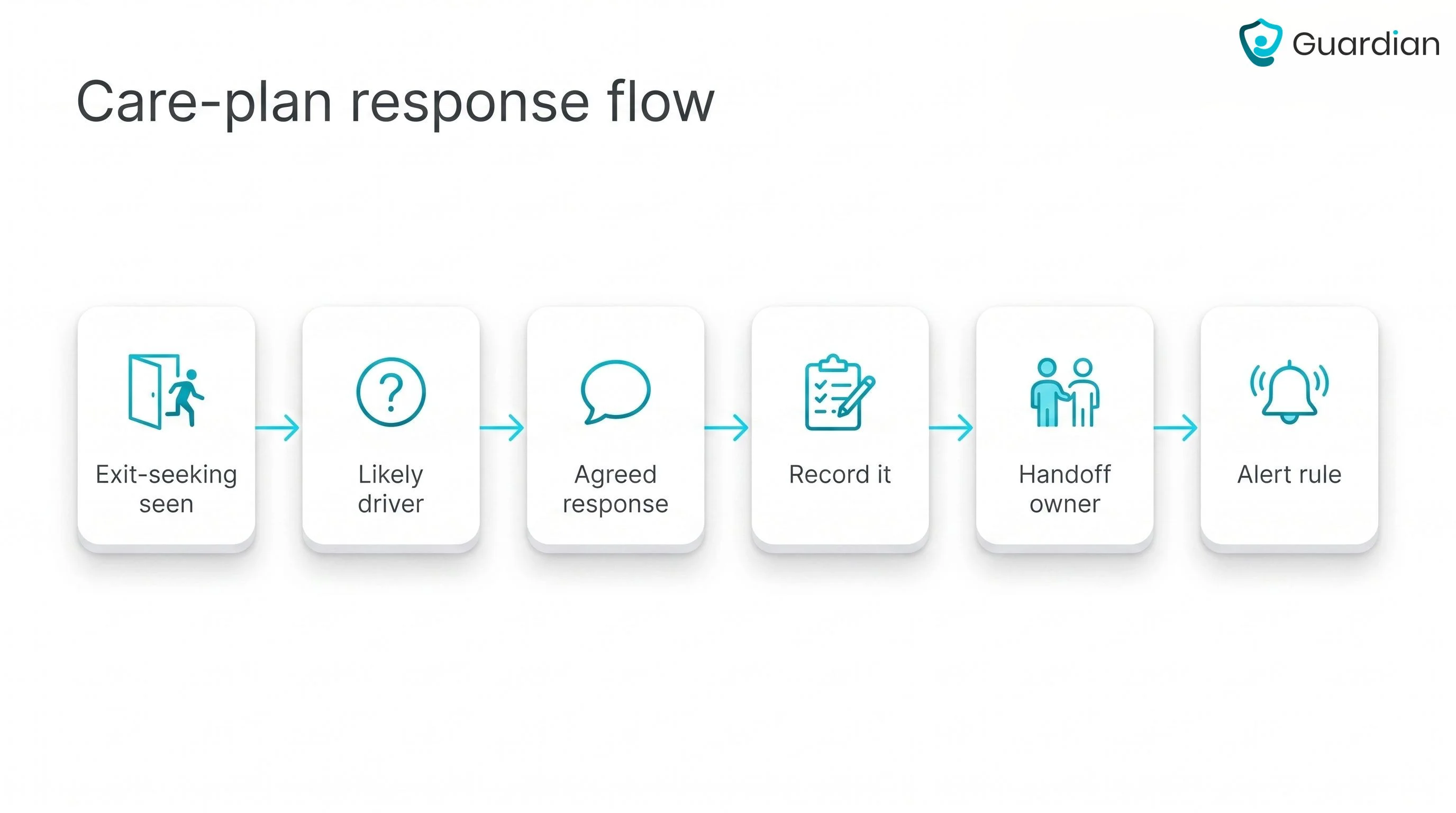
For example, a resident who heads to the lobby at their former work time may settle with acknowledgment and a supervised walk. Record the trigger, response, responsible role, and time it works best.
Put the care plan into daily rounds and shift handoffs
Put the individualized elopement plan into daily rounds, verbal handoffs, assigned checks, and alert workflows.
The shift lead assigns a named owner for each planned check, response, and active alert. Ownership can sit with different staff members, but every action must have one accountable person.
Include these details in every shift handoff:
Recent behavior: the latest exit-seeking attempt, direction of travel, and stated destination
Baseline changes: new confusion, agitation, sleep disruption, or distress
Medication changes: new prescriptions or dose changes that the incoming nurse must review
Current supervision: observation level, planned checks, and the staff member responsible
Proven responses: words, activities, people, or routines that helped the resident settle
Active alerts: resident-specific door, motion, or restricted-zone rules that staff must acknowledge
Rounds verify what background alerts cannot confirm on their own: the resident's wellbeing, the current location, and whether an exit needs staff action.
Locate the resident: confirm where the resident is and whether the location matches the care plan.
Check exits: confirm relevant doors are in the expected state and no resident is waiting nearby without support.
Close the loop: record the check, any departure from routine, and the response taken.
Use alerts between rounds: configured door and motion rules notify staff of relevant movement while routine checks continue.
Set facility protocol so an exit alert remains open until a named staff member confirms the resident's location and records the outcome. Guardian supports care-home teams with location-aware alerts.
Making door alarms and tracking devices reliable, not just installed
Reliable door alarms and tracking devices need physical testing and a tested response path.
1. Walk every detection path
Physically walk through room entrances and perimeter doors, then confirm each event reaches the staff device used on shift. Open doors slowly and at normal pace to expose coverage gaps.
Inspect every door contact for alignment, damage, loose fixings, or obstructions. Maintenance records results and retest dates; the care lead confirms alerts reach the right workflow.
Set the test schedule from facility policy and manufacturer guidance. Review it when a door or room layout changes.
2. Verify location and routing
Map every device to the exact room, doorway, or perimeter exit on the digital floor plan. The floor plan should show the location staff receive with an alert, as illustrated below.
Route door alerts to staff who can respond in that area and on that shift.
Motion sensors: In privacy-sensitive living areas, motion sensors can be a better choice than cameras because they notify staff of movement without recording footage.
Routing: The care lead approves routes and movement filters; the system administrator applies them. Retest whenever local routines or configuration changes.
3. Check batteries, backup power, and spares
Guardian is a wireless, camera-free monitoring platform for nursing homes, care homes, home care providers, and other care settings. Where deployed, its system-health view helps staff check supported device status and battery levels before a sensor or wearable goes offline.
Test backup power for alert and network equipment according to the outage plan and manufacturer instructions.
Keep a labeled spare kit:
Contacts and sensors
Batteries and chargers
Wearable hardware
Maintenance owns power and hardware checks. A named manager maintains the inventory log.
Use battery-health data and manufacturer guidance to set intervals. Align those intervals with the outage plan.
4. Escalate unacknowledged alerts
Define who receives an exit alert first, who receives it next, and who takes command when nobody acknowledges it. Send notifications to the mobile devices staff use during rounds, rather than relying on a fixed nurse station.
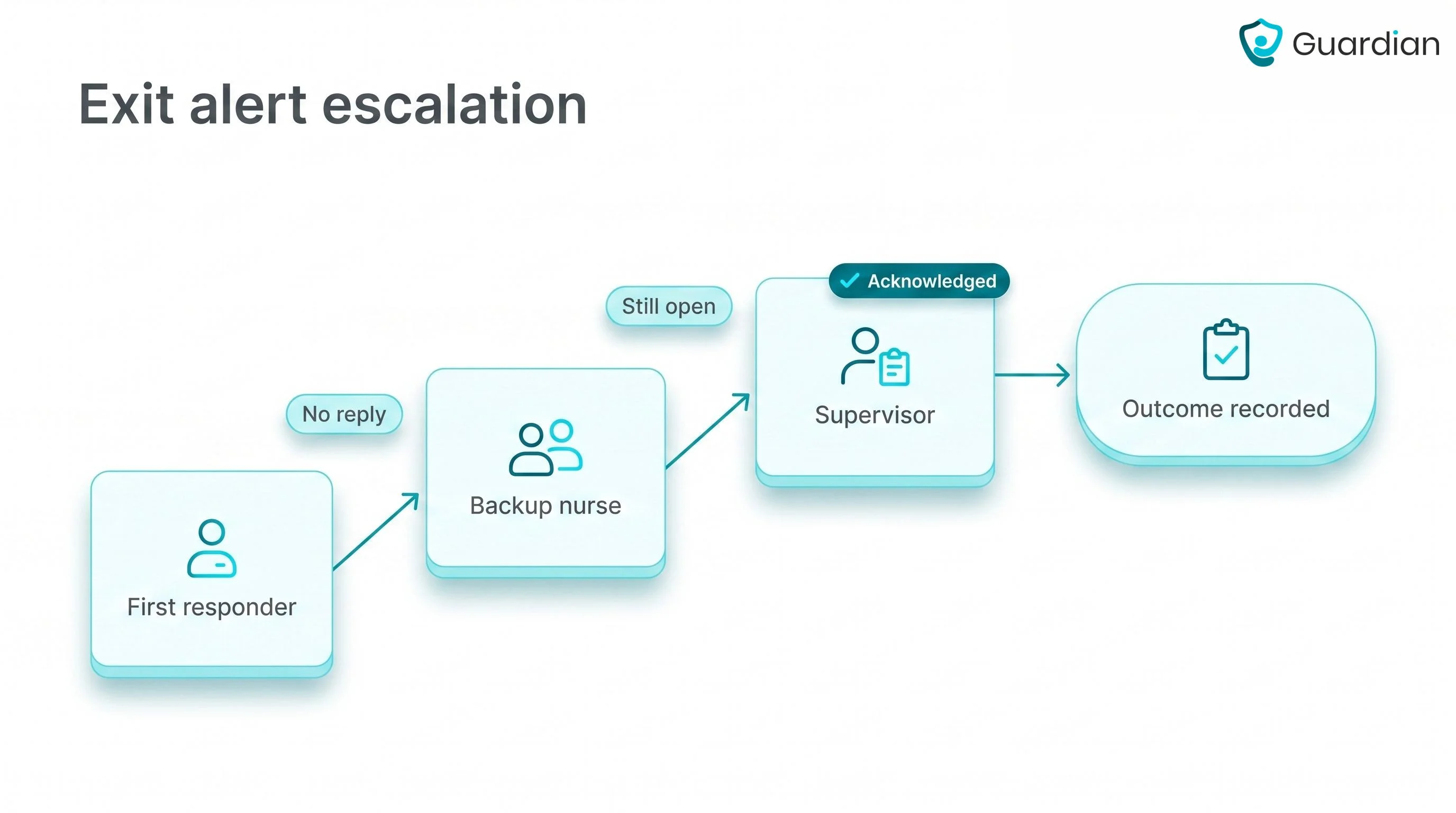
Test every escalation handoff and record receipt, acknowledgement, and response. The nurse supervisor or safeguarding lead maintains the path and named backups for each shift.
Review the escalation path after drills or near misses, and whenever staffing or policy changes. Follow the facility's documented test schedule.
High-risk times and transitions to watch closely
High-risk times require a defined staffing and monitoring control, not only a note in the risk assessment.
Build these windows into the care plan, assign a responsible role, and confirm the control at handoff.
Admission and the first days: A published case review found that 45% of reviewed elopement cases occurred within 48 hours of admission. The admitting nurse records known cues, sets observation from assessed need, and reviews the plan at handoff.
Late afternoon, evening, and familiar routine times: A named caregiver starts the agreed activity or check before the usual trigger and records whether it worked.
Shift changes, visits, and deliveries: The shift lead assigns resident observation and entrance oversight while door traffic and staff handoff overlap.
Overnight and early morning: The night lead aligns checks with the resident's assessed pattern, keeps bathroom routes clear, and reports unusual movement at morning handoff.
What to do if a resident is missing
Activate the missing-resident protocol at once: confirm the last sighting, alert the incident lead, monitor exits, protect other residents, and preserve approved emergency egress while the facility search begins.
Incident search map key: mark the last confirmed location, assign named search zones, mark each cleared area, show monitored exits, and record reported sightings at the command point.
Call emergency services immediately when the resident's condition, weather, location, or other circumstances create urgent risk. Make other external notifications according to facility policy and applicable reporting rules.
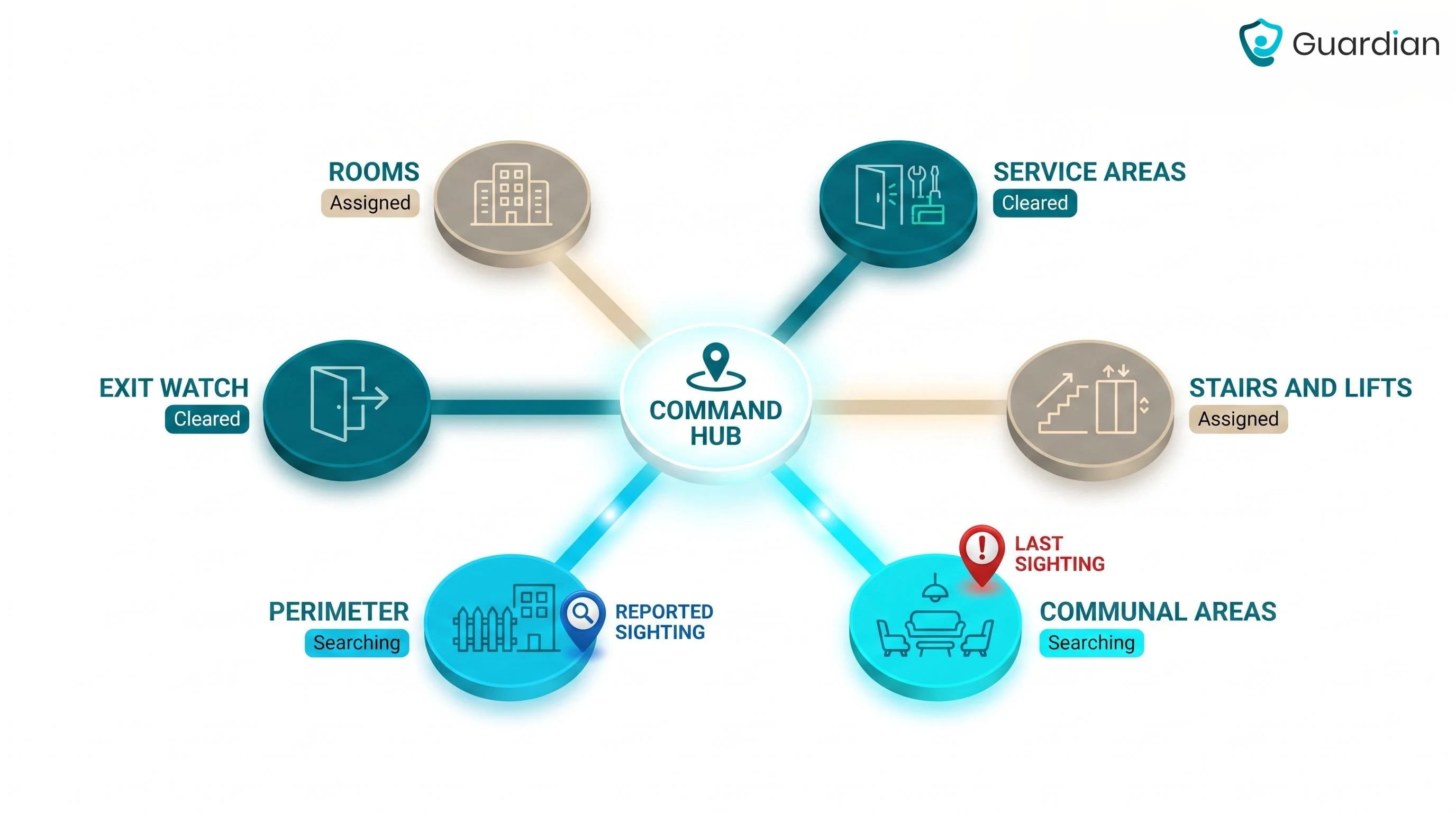
Activate the facility alert. Announce the predefined missing-resident code, notify the unit supervisor and administration, protect remaining residents, and record the time and last confirmed sighting.
Assign search zones. Give named staff responsibility for rooms, bathrooms, utility rooms, closets, stairwells, communal areas, lifts, and every exit. Searchers report each cleared zone to the incident lead.
Search the perimeter. Check exit doors, gardens, parking areas, outbuildings, nearby paths, and roads. Review available access-control or camera records without pulling assigned staff from the physical search.
Escalate externally. Call emergency services immediately when the resident faces urgent risk. Make other notifications under facility policy, including security and the attending clinician where applicable.
Brief law enforcement. Provide a recent photograph, physical and clothing description, cognitive and clinical baseline, mobility needs, last known location, likely destinations, and urgent medication or communication needs.
Keep command centralized. The incident lead tracks searched areas, calls, sightings, and staff deployment, then coordinates any transition to law-enforcement-led activity. Update the resident's representative according to policy.
Assess the resident after recovery. Licensed nursing staff check vital signs and assess for injury, exposure, dehydration, distress, and missed medication. Arrange emergency treatment when findings require it.
Close and document the incident. Update the family or representative, complete the incident report, preserve relevant records, and submit required notifications within applicable deadlines.
Reassess the care plan. Record the circumstances, revise supervision and response instructions, and brief the next shift before handoff.
Care-planning duties, resident rights, and state variation
Facilities must use individualized safety measures while protecting resident rights, dignity, and autonomy. Federal rules set a baseline, while state law, licensing, fire safety, and survey practice add setting-specific requirements.
Federal requirements create a baseline for Medicare- and Medicaid-certified nursing facilities. State law, licensing rules, and survey practice can impose additional duties for each care setting.
Area | What the facility should do |
|---|---|
Care planning | Under CMS F656 and F657, assess each resident's exit-seeking pattern and connect it to person-centered interventions. Revise the care plan after a significant change, incident, or near miss. |
Resident rights | Use the least restrictive intervention consistent with assessed risk. Before using an alarm or controlled exit, determine whether it limits movement or dignity, then follow the consent and review process required by applicable law. |
State and accreditation requirements | No nationwide rule sets the same lock, alarm, notification, or drill requirement for every setting. Confirm licensing rules, life-safety conditions for delayed-egress locks, and any applicable Joint Commission standards for the facility. |
Treat Guardian alerting and any magnetic delayed-egress lock as separate parts of the approved safety design. Qualified fire and life-safety professionals must review physical door controls before rollout.
Documentation exposure
Survey records should show the facility's decision trail:
Assessment: current elopement risk and care-plan rationale
Staff action: assigned interventions and handoff instructions
Safeguards: alarm tests, equipment checks, and maintenance records
Follow-up: incident response and corrective action
42 CFR § 483.70(i) requires nursing facilities to maintain clinical records. Complete records help surveyors and investigators reconstruct an incident, but they do not guarantee compliance or eliminate liability.
Verify before rollout
Ask qualified counsel or the relevant regulator to confirm current state law and survey guidance. Get the reporting window and drill requirement in writing for each licensed setting.
This checklist is operational guidance, not legal advice.
Reviewing near misses so the plan actually improves
Near-miss review is the systematic analysis of intercepted exit attempts to identify facility vulnerabilities and update care plans before actual elopements occur.
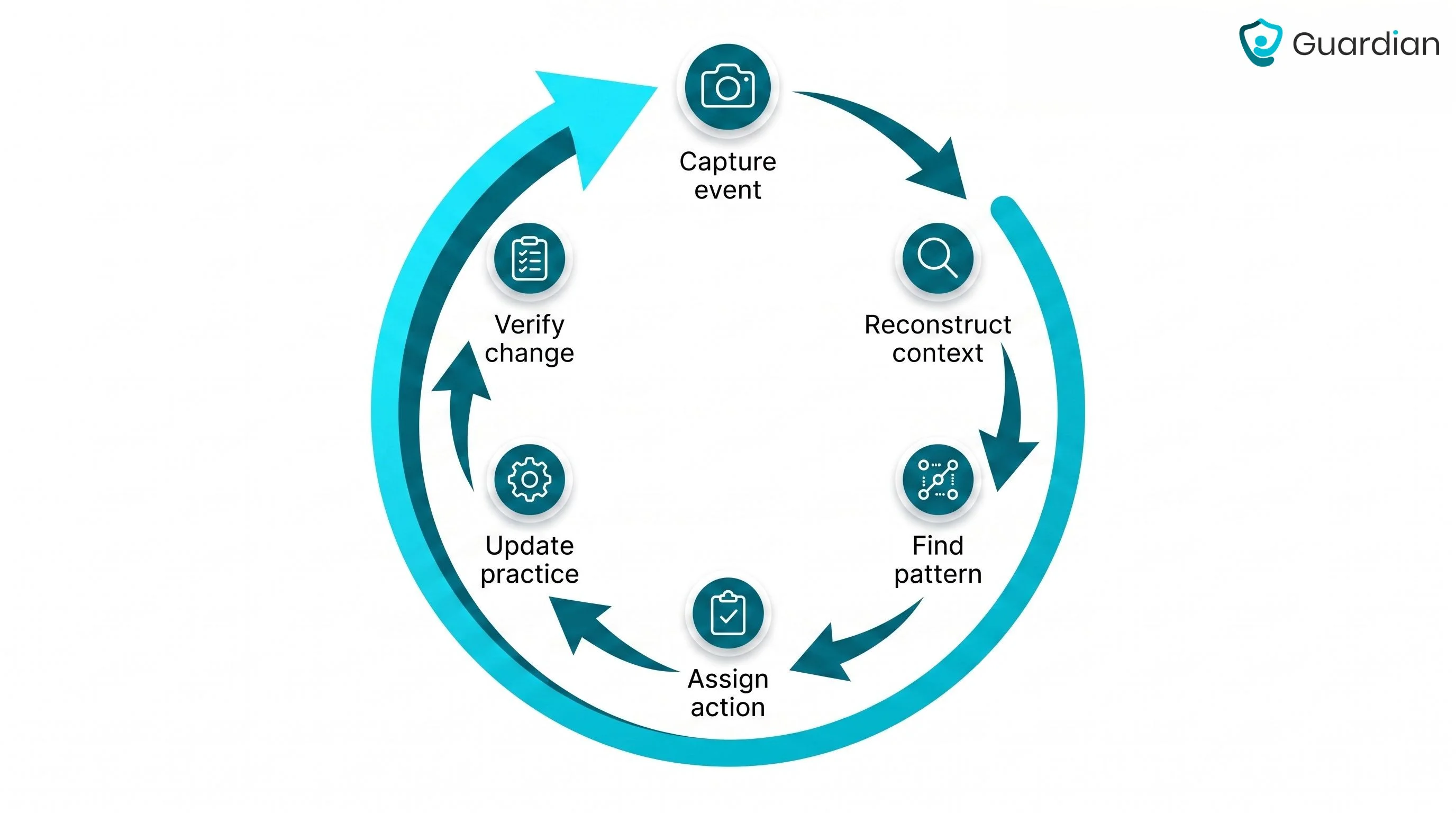
Capture the event. Record the observed trigger, route, staff response, and outcome. Where Guardian is deployed, its timestamped movement or boundary record can add map-linked time and location context.
Reconstruct the context. Check the care plan and what happened immediately beforehand. A resident approaching an exit after evening handoff may need an earlier toileting check or familiar activity.
Find the pattern. Compare records for repeat attempts after the same handoff or care routine, then check whether they occur on the same route.
Assign corrective action. Tie one practical change to the pattern, then give a named staff member responsibility and a due date.
Update daily practice. Put the revised intervention in the care plan and the immediate action in shift handoff. Adjust supported Guardian rules only when they align with the updated plan.
Verify the change. Reassess immediately after a new or escalating safety risk. Otherwise, review after the agreed period, check recurrence and response, then revise the action if needed.
Why exit alerts alone don't stop elopement: Guardian closes the gap
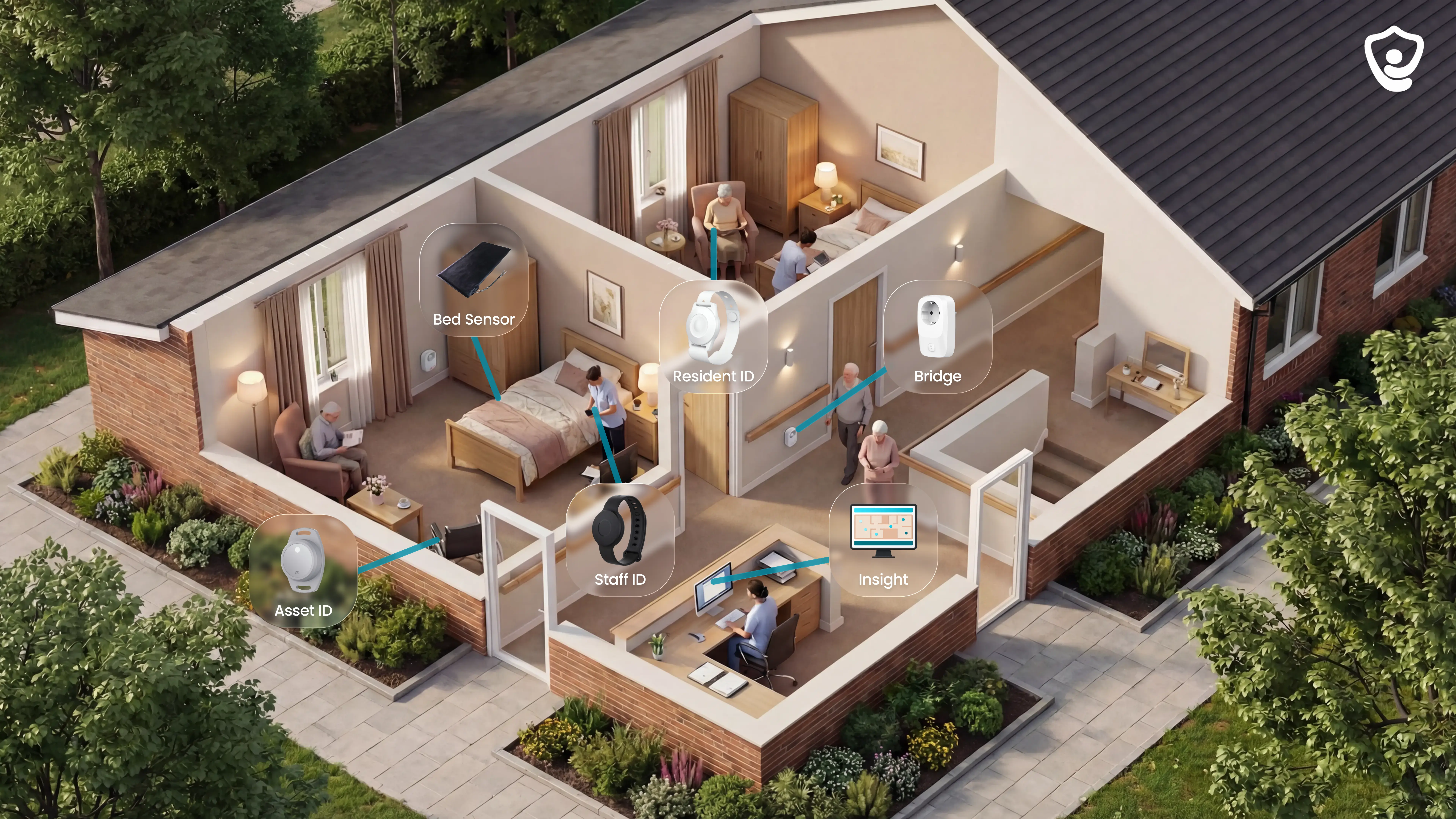
Guardian is a wireless, camera-free monitoring platform for care homes, nursing homes, home care providers, and other care settings. A basic exit alarm marks the doorway; Guardian adds live location and event context.
Guardian sends room-level, map-based context with supported alerts and shows residents and open events in one live view. Escalation rules route unacknowledged events to the next responsible person.
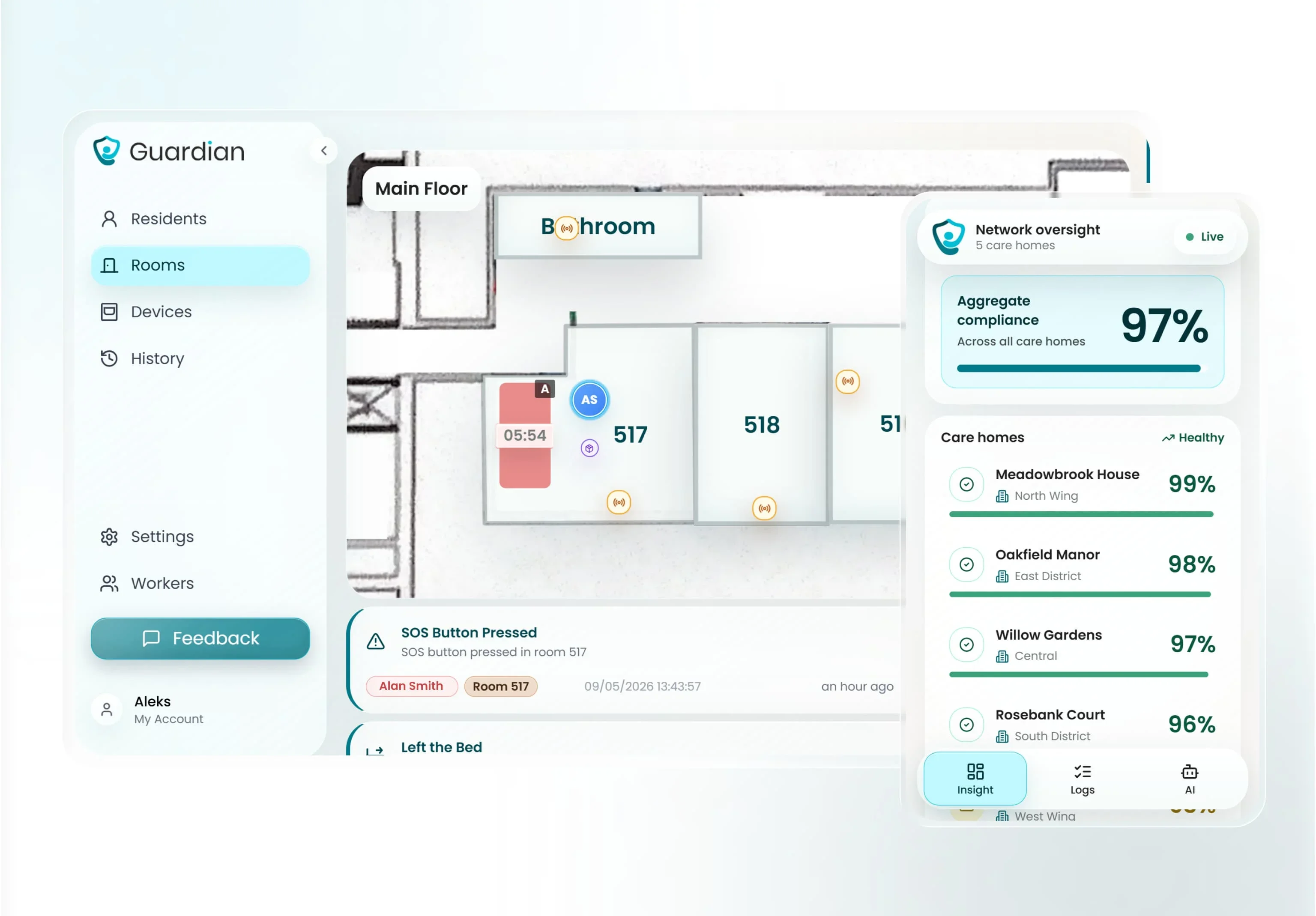
Passive door, bed, and motion sensors can support residents who cannot or will not wear a device. Automatic event records also give managers a clean basis for reviewing response.
Wandering is dementia-related locomotion within safe facility boundaries, while elopement occurs when a resident leaves a supervised area unnoticed or unauthorized. Wandering calls for assessment and an individualized care plan. After an elopement, CMS F689 may guide review of accident hazards, supervision, and assistance devices; other requirements depend on the facts.
A nursing home may face civil liability when state law establishes a duty, breach, causation, and harm after an elopement. CMS F689 addresses accident hazards, supervision, and assistance devices for covered facilities.
State law determines the legal standard and available damages. Records may be examined for:
Documented risk: admission assessments and later reassessments
Planned safeguards: care-plan instructions and exit-alarm checks
Staff response: actions taken after prior exit-seeking or alerts
There is no reliable nationwide nursing-home elopement prevalence rate. A published case review describes reviewed incidents, while wandering figures cannot be substituted because wandering can remain within supervised boundaries.
Facilities should track their own elopements, intercepted attempts, locations, and response times rather than treating a wandering estimate as a local incident rate.
Motion sensors are a privacy-preserving option for bedrooms and bathrooms, but they are only one layer. Door sensors identify openings, while bed sensors can detect getting up or a sustained out-of-bed state.
Camera use should follow resident consent, applicable law, and facility policy. Guardian's care-home system provides a camera-free setup for supported door, bed, motion, wearable, and location-aware alerts.

Author
Aleks Timm
Aleks Timm leads Guardian and builds privacy-first operations technology for care homes and home care providers. Teams get location-aware alerts they can act on, clearer situational awareness, and measured insight into how care work actually runs.
Read MoreRecommended reads
Keep reading
Remote patient monitoring: a complete guide
Remote patient monitoring: the complete guide to sensors, benefits, and buying tips for safer care homes and better resident...
Read more
Bed exit alarm systems for fall prevention
Bed exit alarm systems for fall prevention help care homes spot risk faster, reduce falls, and improve response with smarter alerts...
Read more
Smart Nurse Call Systems for Care Homes and Home Care Providers
Smart nurse call systems for care homes and home care providers: compare features, improve response times, and choose the right...
Read more