

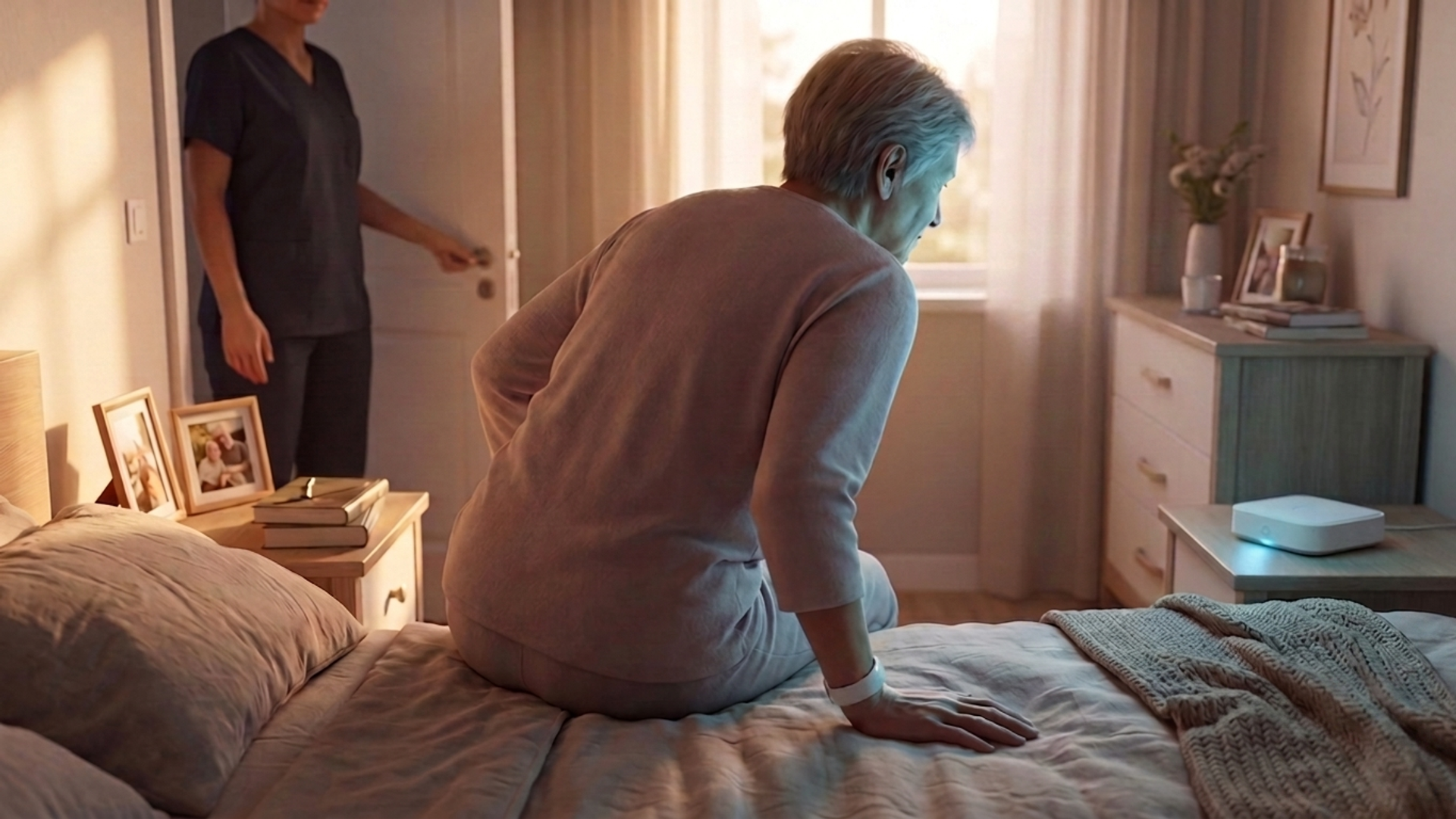
Do Bed Alarms Reduce Falls? What the Evidence Shows
In this article
Shorr and colleagues’ cluster-randomised trial found no reduction in falls or fall-related injuries after bed-alarm use increased. Bed alarms signal movement; they cannot prevent it.
For care managers, the question is whether staff receive enough warning and context to intervene. The practical answer combines selective alarms with risk assessment, care routines, and a reliable response process.
Do bed alarms reduce falls?
Evidence does not show that bed alarms alone reduce fall rates. They can alert staff when a high-risk resident attempts to move without help.
The alarm creates a response opportunity after movement begins. Staff still need enough context and time to reach the resident before an unsupported transfer becomes a fall.
Repeated non-critical alerts can slow recognition of the alert that matters. Bed alarms are therefore one input in an individual fall-risk plan, rather than the plan itself.
What a bed alarm does (and doesn't do)
Bed alarms alert staff when a resident shifts weight, moves, or leaves the bed. They do not physically support the resident or stop a fall.
Four points show what happens between movement detection and a care response:
Detection: A pressure pad or load-cell system registers weight change. A motion sensor may instead detect movement near the bed.
Notification: A local alarm sounds in the room, while a connected system sends a wireless alert to a designated caregiver or monitoring service.
Physical limit: The alarm cannot support a resident or stop a fall once balance is lost.
Clinical limit: The device cannot assess why movement is unsafe or decide what care the resident needs.
Staff can use the alert to decide whether a resident needs transfer assistance or a routine check. Mobility assessment and care planning remain clinical tasks.
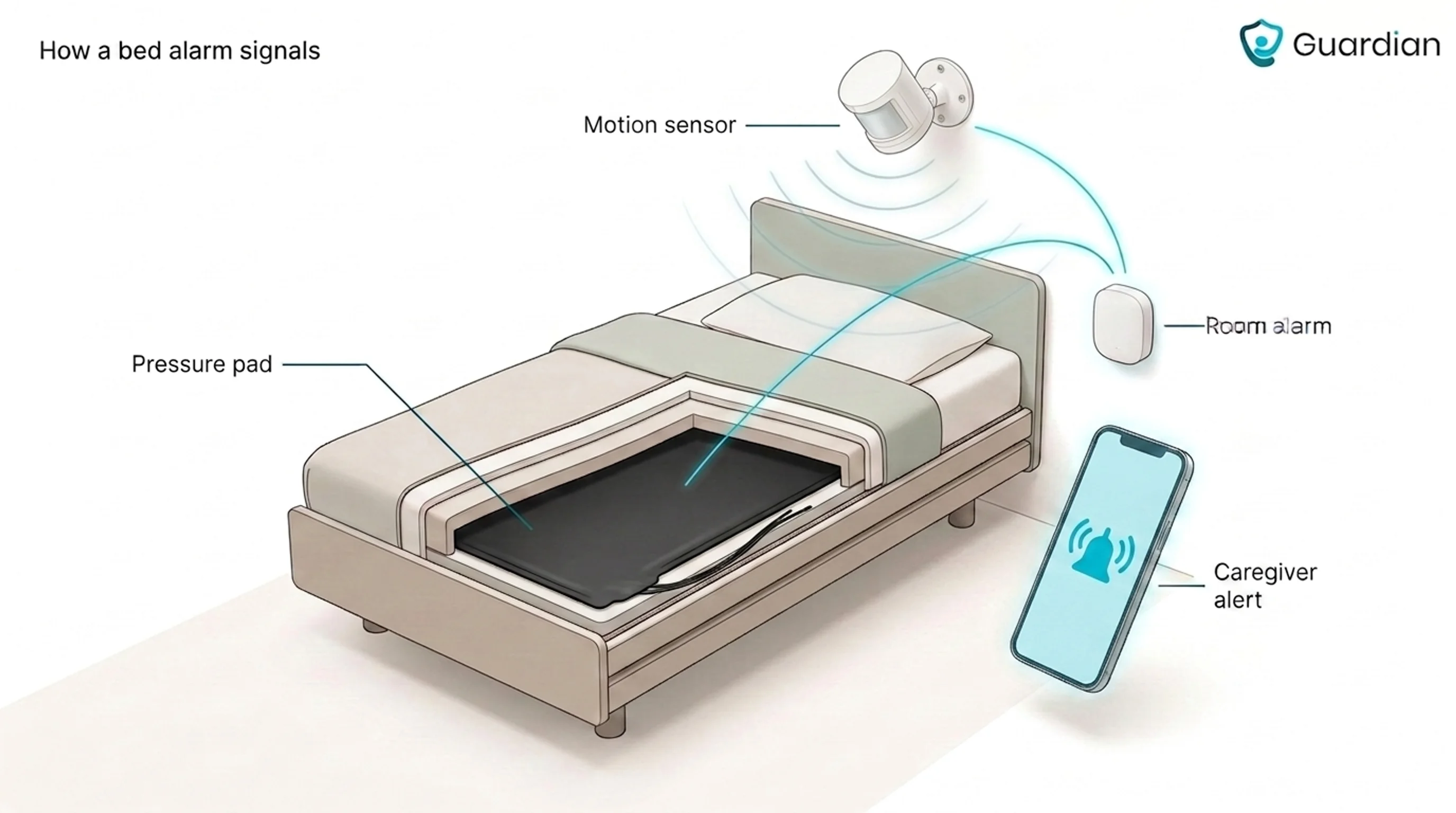
How an alarm could prevent a fall, and where the chain breaks
A bed alarm can create time for staff to intervene before a resident falls. That depends on detection, a clear alert, staff travel, and hands-on help all happening quickly enough.
Detection: A pressure pad registers a change in weight, or a motion sensor detects movement as the resident begins to leave the bed.
Transmission: The sensor triggers a local alarm or sends a wireless notification to nearby or designated care staff.
Staff travel: A caregiver identifies the bed, stops their current task, and crosses the ward or home to reach the resident.
Hands-on intervention: The caregiver assists the transfer or guides the resident back to a safe position before balance is lost.
The chain has three common operational weak points:
Poor calibration: Over-sensitive thresholds trigger alerts during ordinary repositioning; insensitive settings detect the exit too late.
Alert fatigue: Repeated non-critical alarms make staff more likely to respond slowly, mute notifications, or disable the device.
Distance: A bed-exit alarm reacts after movement starts, so a caregiver in a corridor or care station may arrive after the resident is already standing or falling.
What the research says about bed alarms and falls
The Shorr hospital trial found that promoting greater bed-alarm use did not reduce facility-wide falls or fall-related injuries.
The trial covered 27,672 inpatients across 16 nursing units in one urban community hospital. Intervention units received education, training and technical support to increase use of a standard bed-alarm system.
Alarm use increased, but fall rates, injurious falls and restraint use did not improve. This facility-wide result does not show that an alarm can never help one selected person, and the single-hospital setting limits wider conclusions.
Why hospital findings may not transfer directly to care homes and private homes
Hospitals, care homes, and private homes differ in who receives an alert, how far that person is from the bed, and whether other care tasks are competing for attention.
Notification routes vary by device. A local alarm depends on someone hearing it, a connected alarm can notify named staff, and remote monitoring may contact a caregiver elsewhere.
Shared care settings: Repositioning and brief pressure changes can produce repeated non-critical alerts. Staff may respond more slowly when the alarm provides no resident, room, or movement context.
Private homes and home care: Fewer devices can reduce background noise. An alert may reach a relative in another room instantly, yet the resident can already be standing before help arrives.
Sensitivity settings should therefore match the person’s movement pattern, and every notification should have a clear response route.
When a bed alarm may still help
A bed alarm may help a specific person during a defined period when an unnoticed exit creates immediate risk. Use one only with an individual risk, named responder, workable response route and review trigger.
Impaired safety awareness: Consider an alarm when dementia or delirium affects the person’s ability to remember instructions and they repeatedly try to transfer without assistance.
Temporary mobility change: Short-term monitoring may help after surgery, acute illness or a medication change. Review the need and settings when mobility, cognition or treatment changes.
Intermittent home supervision: An alarm can notify a family caregiver elsewhere in the home. It creates a response opportunity only when a named caregiver is present and able to act in time.
An unfamiliar room: After a move, reassess orientation and transfer ability, then check call-bell access and room setup in line with local policy.
Drawbacks: noise, false alarms, and alarm fatigue
Bed alarm drawbacks include intrusive noise, non-critical notifications from routine movement, occasional false detections and staff desensitisation known as alarm fatigue.
Non-critical and false alerts: Routine movement may correctly trigger a pressure alarm without requiring care. A false alert detects an event incorrectly; both types of noise can weaken trust and slow response.
Acoustic disruption: An in-room alarm can wake a sleeping resident or startle someone who is disoriented. A hurried attempt to stand creates another safety risk while staff are responding.
Match the rule to the risk: Use an immediate alert when the first unsupported transfer is dangerous. A delayed Guardian rule suits prolonged absence or unusual routine, not an urgent bed-exit risk.
The comparison below separates urgent transfer risk from longer-duration routine monitoring.
Alert setup | Trigger | Appropriate use | Main limit |
|---|---|---|---|
Immediate bed-exit alert | Movement or bed exit begins | The first unsupported transfer creates urgent risk | Routine repositioning may create non-critical alerts |
Prolonged-absence or routine-change alert | The person remains out of bed beyond a configured threshold | The concern is unusual activity rather than the first transfer | The delay is unsuitable for immediate fall risk |
What to pair a bed alarm with
A bed alarm belongs within a resident-specific falls plan. Pair it with routine, room, clinical, and monitoring controls that address why the resident may try to get up unsupported.
Routine controls
Plan checks around assessed need: Set check timing from the resident's risk, usual waking pattern and local policy so support reflects current need rather than a fixed universal interval.
Anticipate toileting: Use continence patterns and the resident’s normal routine to offer timely assistance before urgency prompts an unsupported bed exit.
Prepare before rest: Confirm the resident can call staff from bed and has the transfer equipment named in the care plan within reach.
Room controls
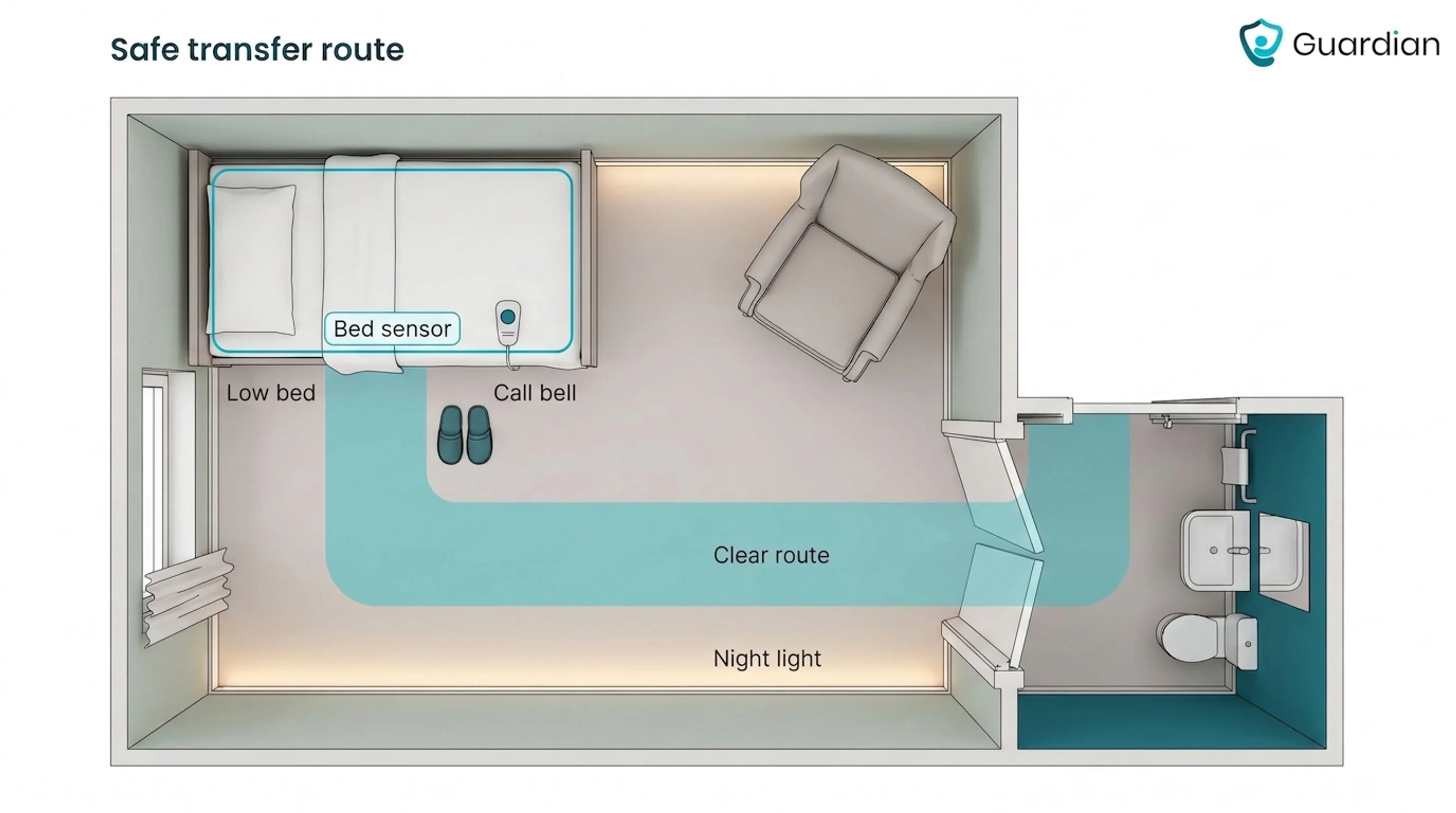
Clear the transfer route: Remove loose items and obstacles between the bed, chair, and bathroom so the resident has a direct path when standing or walking.
Adjust the immediate environment: Set the bed and chair for safer transfers, then use low-glare night lighting to improve visibility without disturbing sleep.
Clinical controls
Assess mobility and transfers: Use the organisation’s locally approved fall-risk assessment, then check how the resident stands, transfers and walks.
Review medication effects: Ask the prescriber or pharmacist to review medicines when dizziness, drowsiness or postural symptoms appear, because these effects can make an attempted transfer less stable.
Reassess after change: Review the plan after a fall, near miss, illness or change in function so controls continue to match the resident's current risk.
Monitoring controls
Tailor the alarm settings: Match sensitivity and alert thresholds to the resident’s movement pattern so routine repositioning does not create avoidable alarms.
Define the response route: Send alerts to a named on-duty role with the resident's location and an escalation path. Guardian can give staff the resident's room and bed context when an alert arrives.
Add passive monitoring where appropriate: Bed and motion sensors can extend coverage when a resident cannot use a call button, but multi-sensor monitoring remains one layer alongside direct care.
How to turn off or reset a bed alarm safely
Reach the resident before resetting a bed alarm. Assess immediate safety, then follow the resident's care plan and the device instructions.
Use the controls and sequence documented for the exact alarm model. Button functions, pause periods, sensor placement and indicators vary, so this guidance does not replace device-specific training or local policy.
Support the resident first. Stay beside them, assist their balance or position, and check for pain, injury, reduced responsiveness, or another acute change before touching the alarm controls.
Escalate possible harm. If injury or acute deterioration is possible, keep the resident supported and follow local clinical escalation or emergency-response policy. Silencing the alarm must not delay care.
Pause during assisted care. For a transfer or personal care, use the unit's manufacturer-specified pause or standby control. Keep the resident attended and follow the care plan throughout.
Avoid improvised deactivation. Do not disconnect cables, remove batteries, or guess a button sequence. Follow the device manual and local policy for temporary deactivation and reactivation.
Restore the sensor. Once the resident is safely positioned, replace the pad or sensor exactly as the manufacturer specifies, including its placement, orientation, and connections.
Rearm and test before leaving. Use the documented reset sequence, confirm the model-specific active indicator, and complete the manufacturer's test. If either check fails, follow the local equipment-fault and escalation policy.
Why a single alarm isn't a full fall-prevention plan
A safe reset restores the alarm for the next event, but it does not address every cause of a fall. Turn the detailed controls into one plan covering the person, environment and response workflow.
Person: Review mobility, cognition and medicines together; use transfer support, strength work or supervised toileting where assessment identifies a need.
Environment: Check lighting, walking routes, bed height and flooring so avoidable hazards are corrected before an alarm has to sound.
Response workflow: Assign alerts, plan assistance around toileting and transfers, then record events and review the plan after a fall, near miss or change in condition.
Beyond bed alarms: location-aware fall alerts and passive monitoring with Guardian
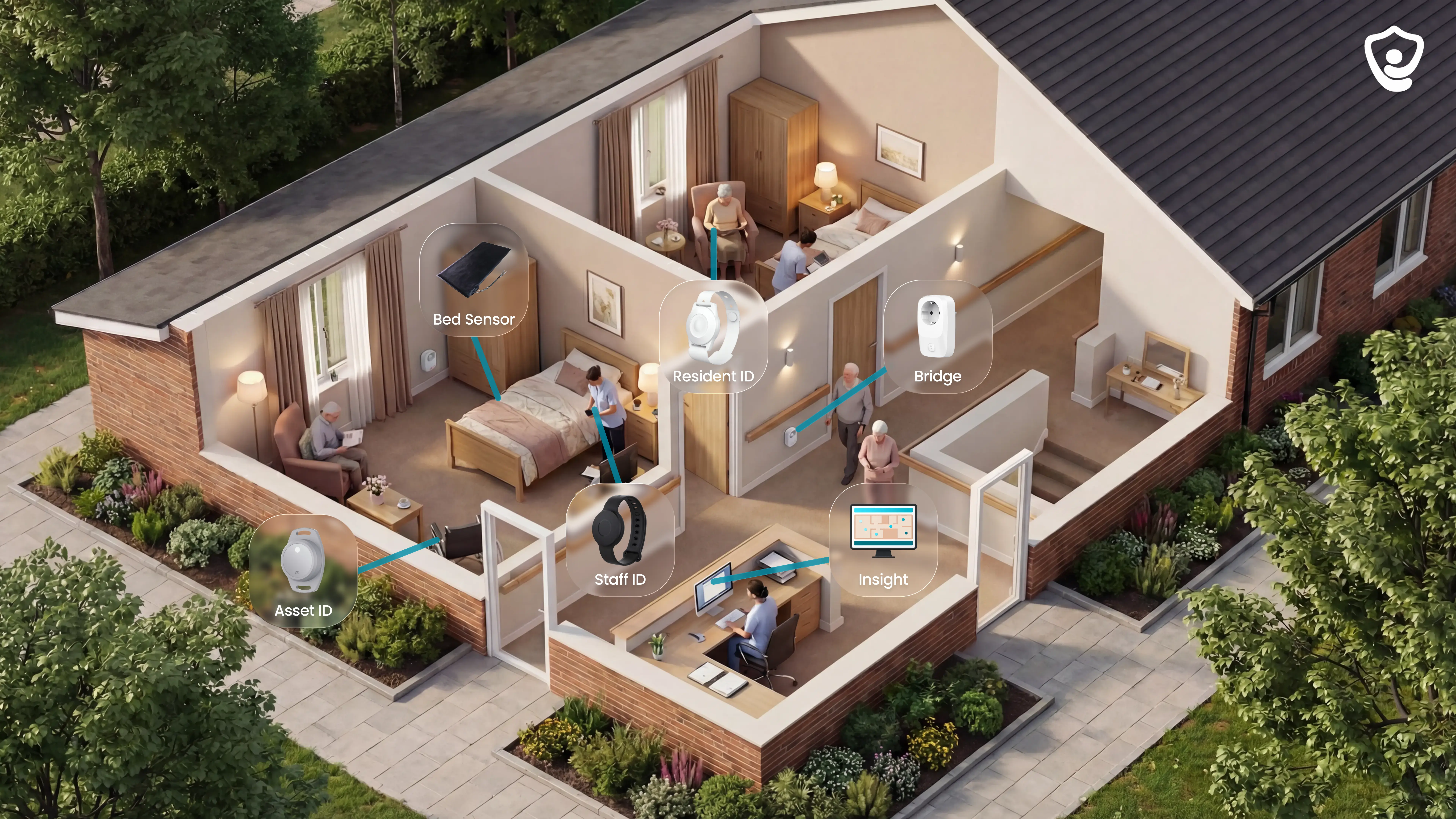
Guardian gives care homes, home care teams, specialist care and mental-health facilities a camera-free, wireless way to monitor safety events.
Fall-detection wristbands: Detect a fall event and send staff an alert with live location.
Bed sensors: Record bed activity, bed exits and changes in routine without requiring a button press.
Configurable rules: Set immediate notifications for urgent risks or thresholds for longer-duration activity.
Guardian Insight: Brings the person, location, alert and operational record into one live view.
During a 6–8 week pilot, measure response times, visibility and planning against your own baseline, then use the impact and ROI report to decide what to roll out.
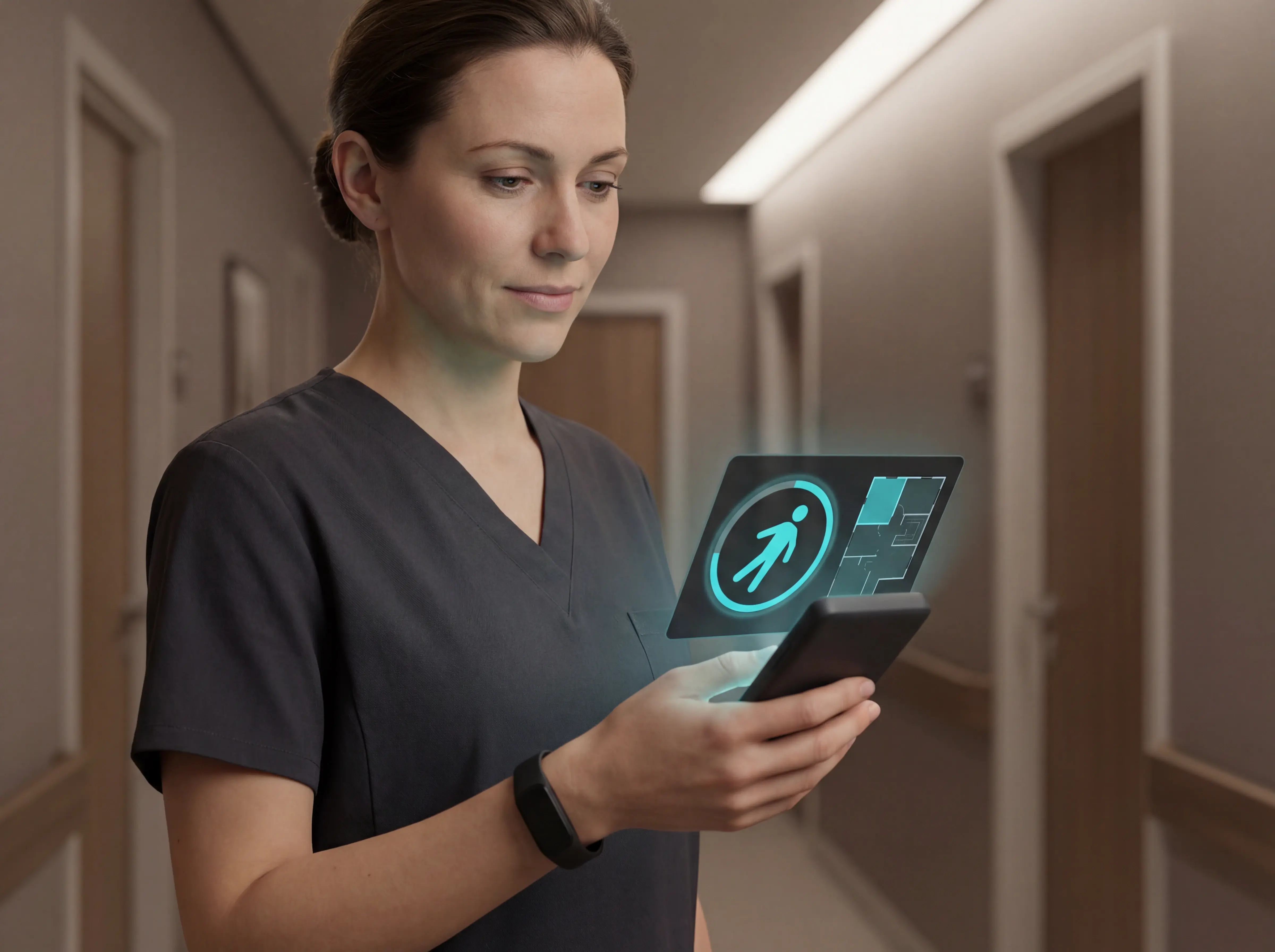
The Guardian fall-detection alert combines the resident and live-location context, helping the caregiver identify where to respond.
No. A bed alarm detects bed movement or exit, while a fall sensor detects a fall event or impact. They support different points in the response process and may be wearable or room-based.
Yes. A bed alarm can notify staff without the resident pressing a call bell. It still needs a timely caregiver response and should sit alongside the resident's care plan, not replace transfer support.
No. It can help staff decide when a resident may need attention, but it does not replace planned checks or hands-on care for comfort, continence, skin care and changes in condition.
Not inherently. Both can be camera-free, but they detect different activity and may route alerts differently. Residents and families should understand what the system collects, who receives alerts and whether the setup causes distress.

Author
Aleks Timm
Aleks Timm leads Guardian and builds privacy-first operations technology for care homes and home care providers. Teams get location-aware alerts they can act on, clearer situational awareness, and measured insight into how care work actually runs.
Read MoreRecommended reads
Keep reading
Patient bed alarms for elderly & hospital care
Patient bed alarms help prevent falls in elderly and hospital care. Compare alarm types, choose the right sensor, and protect...
Read more
Smart Nurse Call Systems for Care Homes and Home Care Providers
Smart nurse call systems for care homes and home care providers: compare features, improve response times, and choose the right...
Read more
Caregiver alert systems for care homes
Caregiver alert systems for care homes help staff respond faster with room-level alerts. Learn what to buy to prevent harm and save...
Read more