


Are bed alarms considered restraints?
In this article
Care teams often use “restraint” to describe different problems. A bed alarm, nearby equipment, and staff actions must be assessed separately.
Misclassification affects care planning, resident rights, documentation, and survey readiness. The key is to separate movement detection from equipment or actions that physically restrict movement.
This article explains the U.S. federal framework. State law, licensing rules, hospital policy, and private-home consent requirements may differ.
Are bed alarms considered restraints? The short answer
A conventional bed alarm is generally a monitoring device, not a physical restraint under federal rules, because it detects movement without physically preventing it.
The surrounding setup may still include a restraint. Bed rails, restrictive equipment, or staff physically preventing movement must be assessed separately.
Loud or indiscriminate alarm use can still disrupt sleep, cause distress, or reduce independence. Those effects require care-plan review even when the alarm is not a physical restraint.
What is a bed alarm and how does it work?
A bed-exit alarm detects movement or a person leaving the bed and alerts staff or another caregiver. Broader position-change alarms can also monitor transfers from a chair or movement beside the bed.
The sensor responds to weight, position, movement, or a released cord. Depending on the setup, it sounds locally or sends a silent alert through a nurse call or connected system.
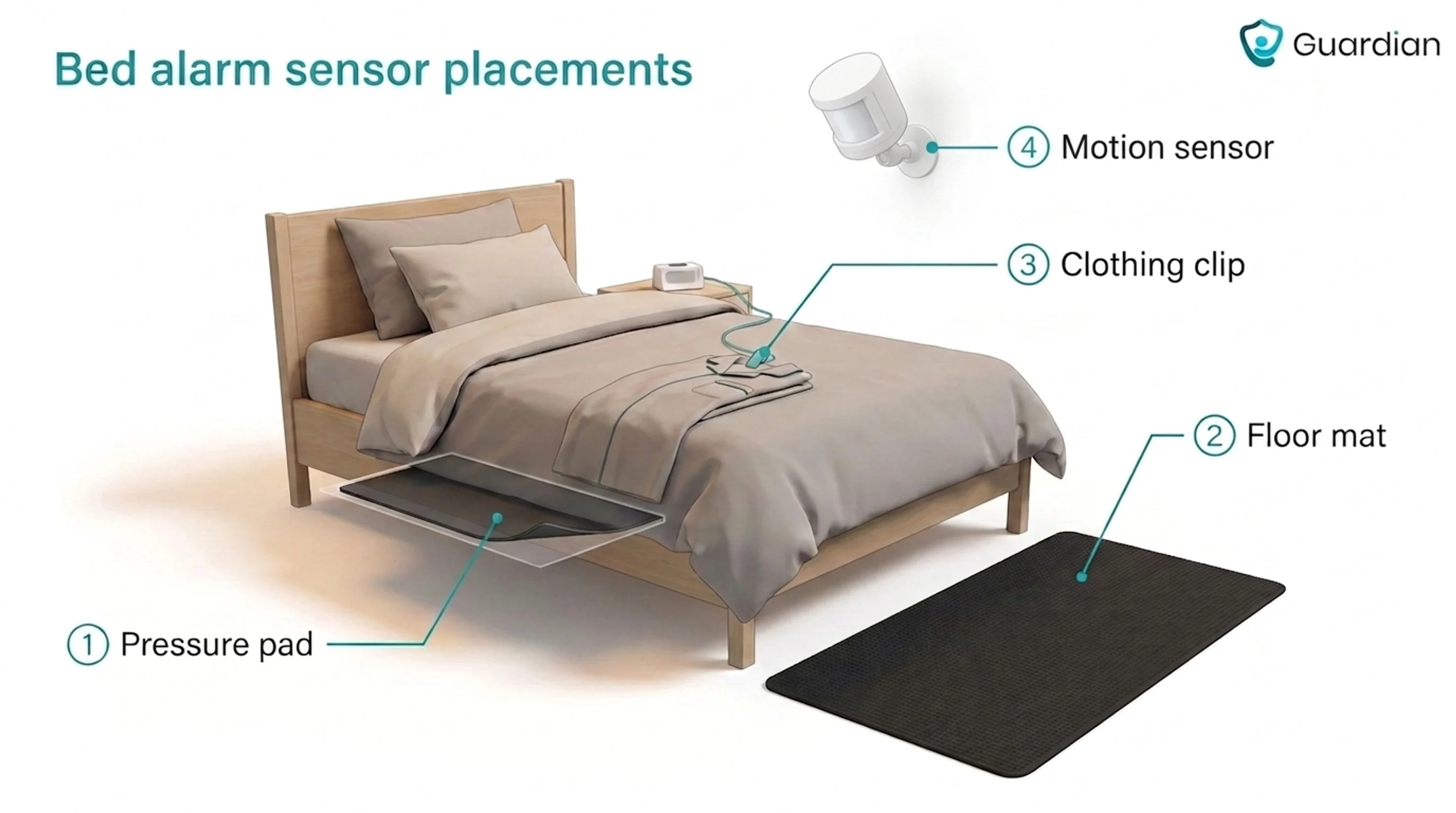
Common sensor types use different triggers and placements:
Pressure pads: Detect when weight shifts or lifts from a pad on the bed or beneath the mattress.
Motion sensors: Detect position changes without contact, often using infrared sensing near the bed.
Clothing clips: Attach to clothing and trigger a pull-cord alarm when the resident rises.
Floor mats: Register weight when the resident steps onto a mat beside the bed.
These devices create an opportunity to respond after movement starts. They do not physically stop a person from leaving the bed.
When is a bed alarm considered a restraint?
The alarm itself is usually not a physical restraint. The complete setup may include one if equipment, materials, or staff actions physically reduce movement or access to the body.
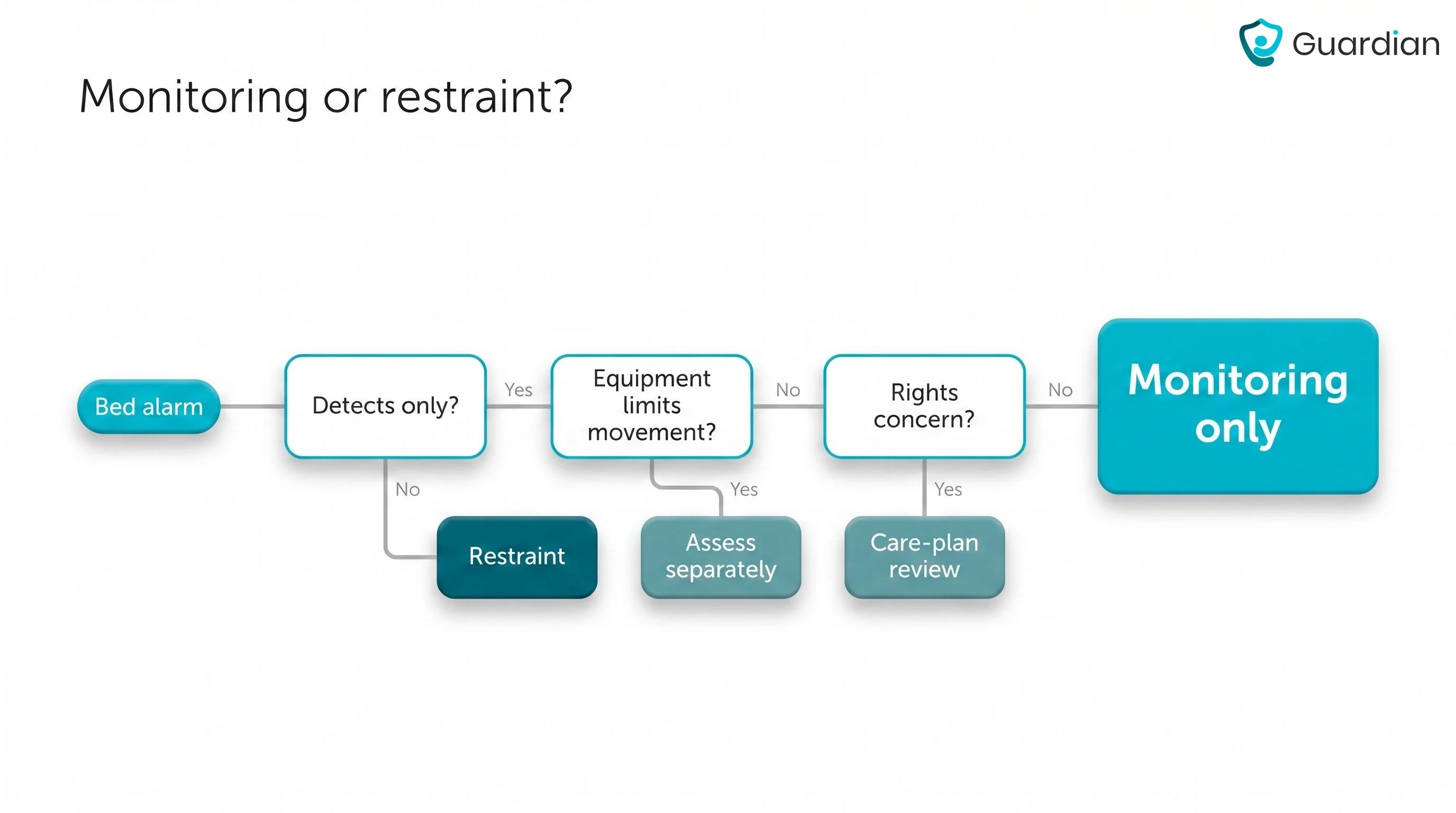
A quick test: what restricts movement?
Assess the alarm separately from the bed, nearby equipment, and staff response. Start by asking what, if anything, physically limits movement.
Review these four parts of the setup:
Equipment or materials: Does a rail, restrictive covering, or other item physically reduce movement or access to the body?
Ability to remove it: Can the person release or remove the item easily without help?
Staff action: Are staff physically preventing movement or overriding the person’s attempt to get up?
Alarm function: Does the sensor only detect movement and notify staff after movement begins?
Even without a physical restraint, review distress, sleep disruption, coercive instructions, and reduced independence. Reassess whenever the person’s response, alarm settings, equipment, or staff routine changes.
Examples: monitoring, restraint, and rights concerns
The same alarm can sit within very different care setups. Classify the alarm, any restrictive equipment, and the person’s experience separately.
Use the issue in the middle column to guide the required review:
Restraint-like setup | Monitoring-only setup |
|---|---|
A loud alarm startles the resident | A quiet alert goes to staff |
Staff tell the resident to wait | Staff assist without forbidding movement |
Every bed exit triggers intervention | Time-based rules flag defined risks |
The goal is controlling movement | The goal is observing changes |
Sensor use reduces independent choice | Camera-free sensing preserves privacy and choice |
Changing the alert sound does not reclassify restrictive equipment. Likewise, a non-restraining alarm may still be inappropriate if its effects conflict with the person’s care plan, dignity, or choices.
How the care setting changes the answer
Yes. Nursing homes, hospitals, assisted living settings, and home care operate under different legal frameworks. The provider type, certification status, state law, and facility policy all matter.
Nursing homes | Hospitals | Home care |
|---|---|---|
Certified facilities follow the federal nursing-home rule and CMS survey requirements. | Hospitals follow the federal hospital restraint rule. | Private homes fall outside Part 483; Medicare-certified agencies still have home health patient-rights duties. |
The device's effect determines whether it restricts movement. | Purpose, effect, clinical need, and duration shape classification. | Consent, capacity, agency policy, and state law shape use. |
Requirements vary by provider type and jurisdiction. Check the law and policy that apply to the specific care setting.
What federal nursing home rules say about restraints
42 CFR § 483.10(e)(1) gives residents the right to be free from physical or chemical restraints imposed for discipline or convenience and not required to treat medical symptoms.
42 CFR § 483.12(a)(2) requires the least restrictive alternative for the least time needed when restraint use is indicated. The facility must document ongoing reassessment.
CMS Appendix PP guidance treats position-change alarms as monitoring devices rather than equipment that physically immobilizes a resident. Rails, restrictive materials, and staff actions require separate classification.
F604 guides survey review of restraints used for discipline or convenience or without a medical symptom. A practitioner’s order alone does not establish medical necessity.
Identify the need: For an actual restraint, document the medical symptom and why restraint is required.
Consider alternatives: Use the least restrictive option for the shortest necessary time.
Document the plan: Record the purpose, limits, monitoring, and staff responsibilities.
Reassess use: Review whether the restraint remains necessary and whether a less restrictive approach now works.
Monitoring alarms still belong in person-centred care planning. Record the risk being monitored, alert settings, staff response, resident preferences, and review date without labelling the alarm itself a physical restraint.
Do bed alarms actually prevent falls?
Hospital trials have not shown that bed and chair alarms reduce falls when used as a stand-alone intervention. A cluster-randomized trial summarized by LeLaurin and Shorr (2019) increased alarm use without reducing falls.
That hospital evidence should not be generalized automatically to nursing homes or private homes. Alarms can support detection and response, but they do not remove the underlying fall risk.
Movement starts first: The alarm fires after a weight shift, release, or bed exit begins, leaving staff a short response window.
Response still matters: Match checks, supervision, and alarm settings to assessed risks and routines. Review false or low-value alerts before staff stop trusting them.
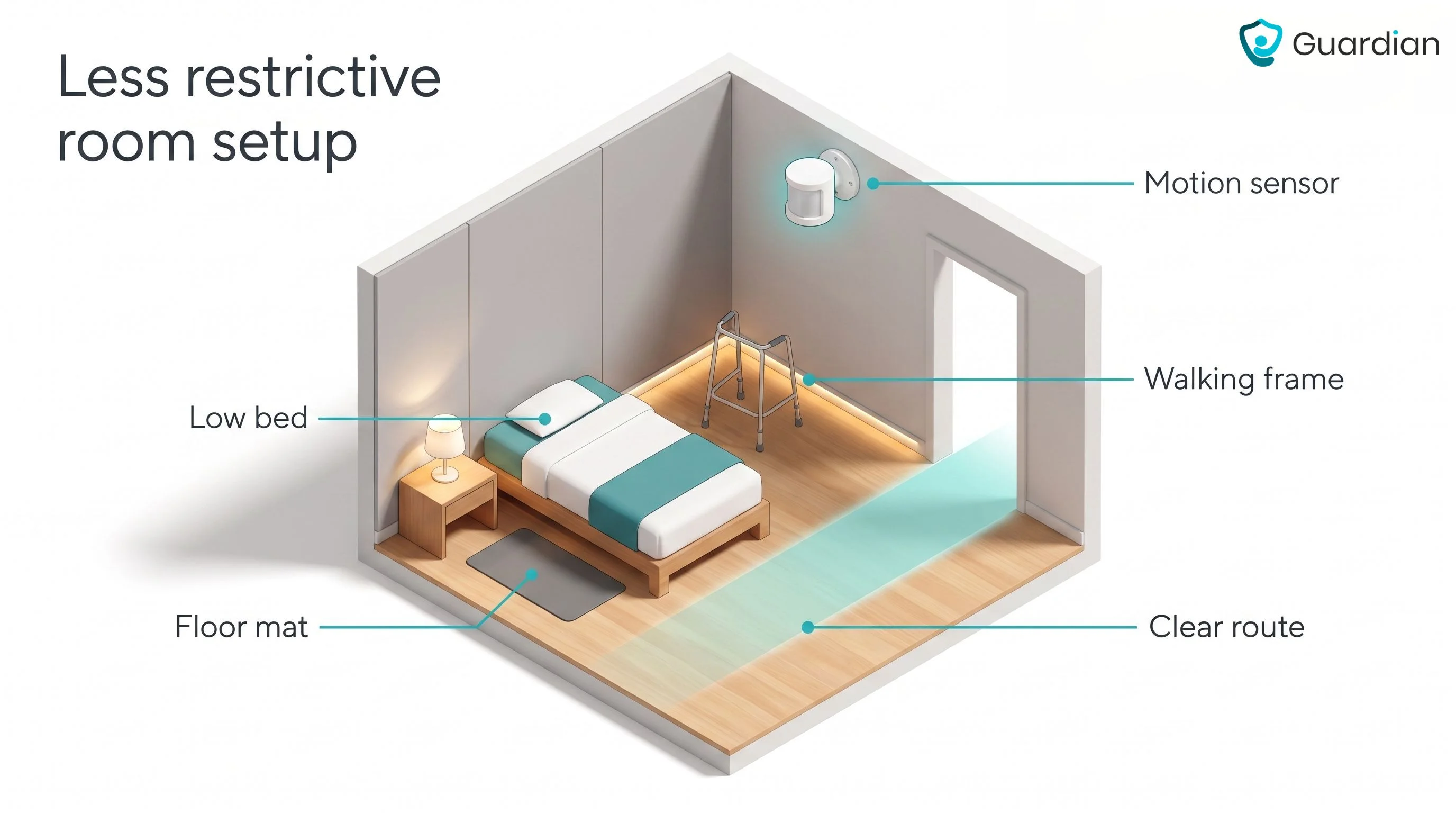
Less restrictive ways to manage bed-exit risk
Less restrictive care addresses the reason for each bed exit and uses monitoring only where it supports timely response. The right mix depends on the person, setting, and assessed risk.
Assess the pattern: For hospital patients, fall-prevention guidance emphasizes specific risk factors over relying on an alarm alone. Review timing, mobility, cognition, medication effects, and recent incidents.
Support predictable needs: Plan toileting, hydration, transfers, mobility aids, seating, and the environment around the person’s routine.
Monitor passively: Bed and room sensors can detect bed exits or unusual inactivity without cameras, wearables, or a button press, then notify staff to respond.
Alert on exceptions: Guardian can notify staff when a resident remains out of bed for more than five minutes during a configured nighttime period, rather than alerting on every movement.
What happens after the alarm sounds?
A basic bedside alarm produces a local sound that staff must notice, locate, and answer before documenting the outcome manually. Distance, noise, and competing work can delay that path.
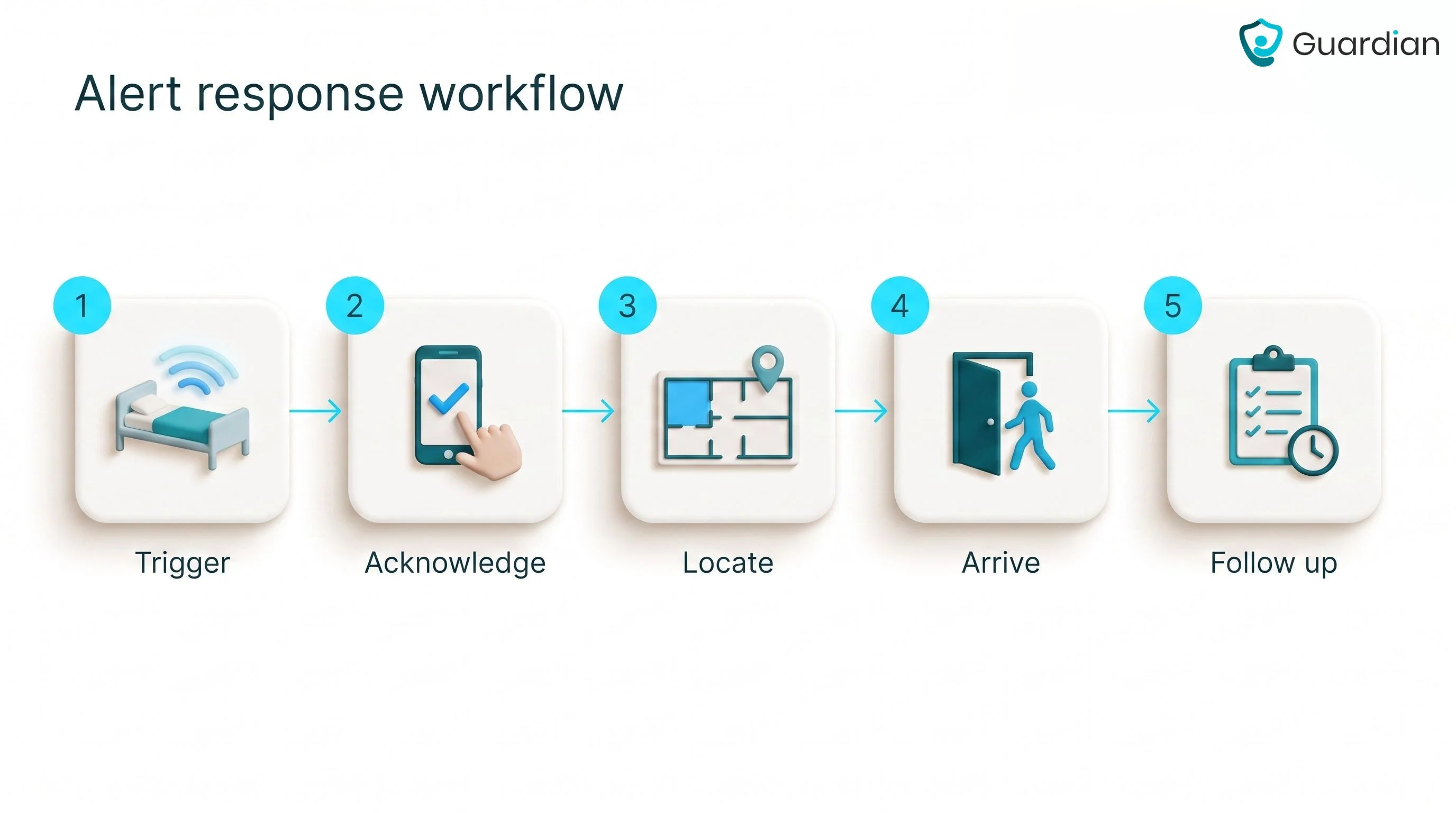
A connected alert system can add timestamps, ownership, location, escalation, and closure:
Trigger: The connected system records the event time and routes the alert.
Acknowledge: A named staff member accepts responsibility, so the alert does not sit unowned.
Locate: The alert identifies the person and destination clearly enough for immediate dispatch.
Arrive: Staff reach the resident, assess immediate safety, and provide the required support.
Follow up: The team closes the alert, records the outcome, and escalates any care concern.
Delays often begin when repetitive alarms make urgent events harder to distinguish or the nearest worker is already supporting another resident.
Unclear ownership adds another delay. Locating the correct room can take longer than it should, and unanswered alerts need an escalation path beyond their original queue.
In Australian acute and rehabilitation hospital services, Brusco et al. (2021) observed that 52% of triggers were false. When staff were not already present, average response time was 65 seconds.
Measure the handoffs
Establish a local baseline from timestamped alarm records or a structured observation sample. Use one consistent audit period, then report results separately by ward and shift.
Acknowledgment time: Trigger to staff acceptance shows whether the queue has clear ownership.
Arrival time: Acceptance to arrival shows travel and staffing delay.
End-to-end response: Trigger to arrival shows the person’s actual wait.
Unacknowledged alerts: The number and share without acceptance reveal routing failures.
False-trigger rate: The share without the defined event shows whether the alarm remains trustworthy.
Escalation and closure: Reassigned, escalated, or unclosed alerts show whether backup coverage works.
Report the median and 90th percentile alongside the mean because an average can hide a small group of very slow responses. Repeat the same measurement after workflow changes, split by ward and shift.
Beyond alarms: room-level response with Guardian
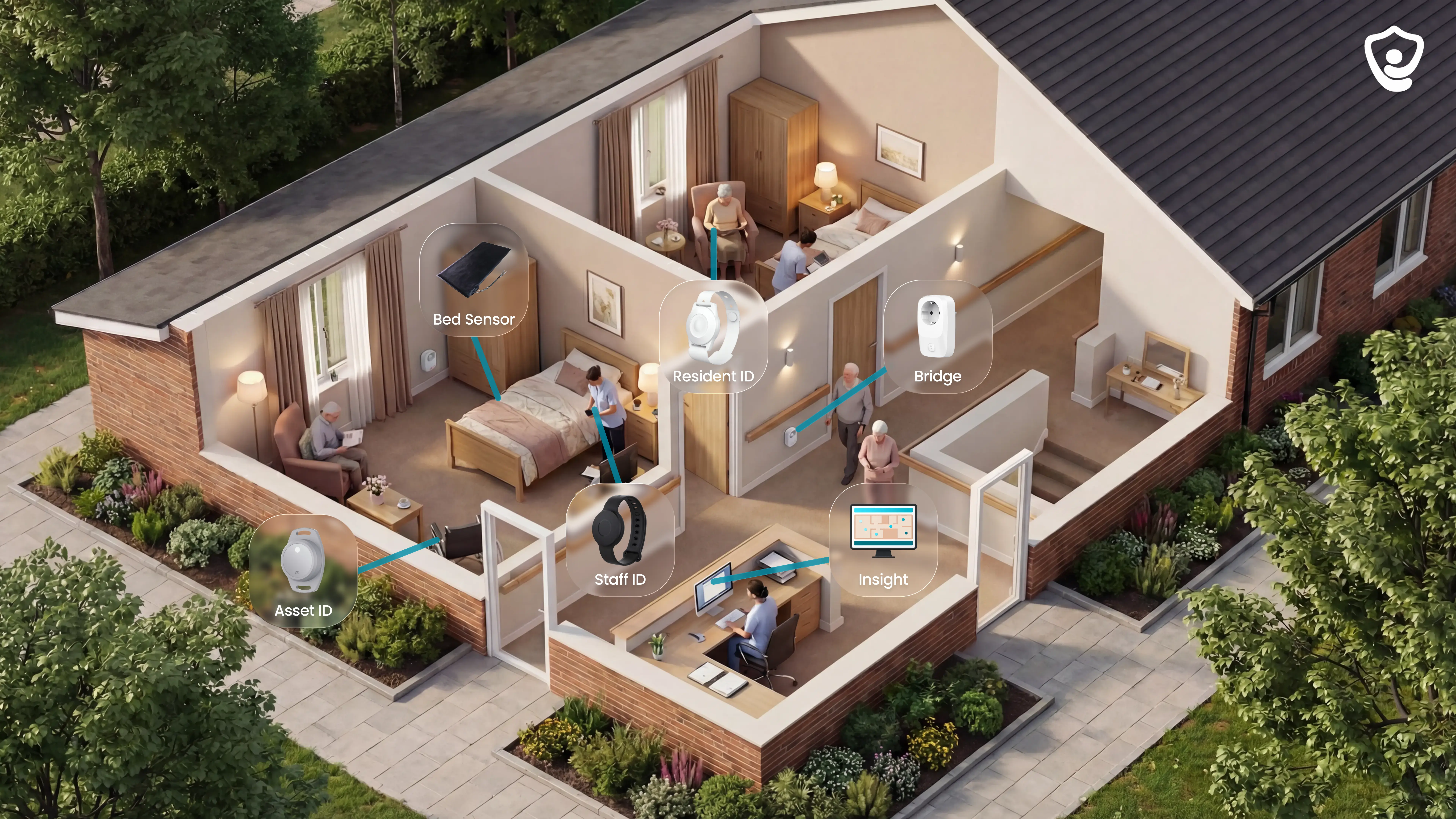
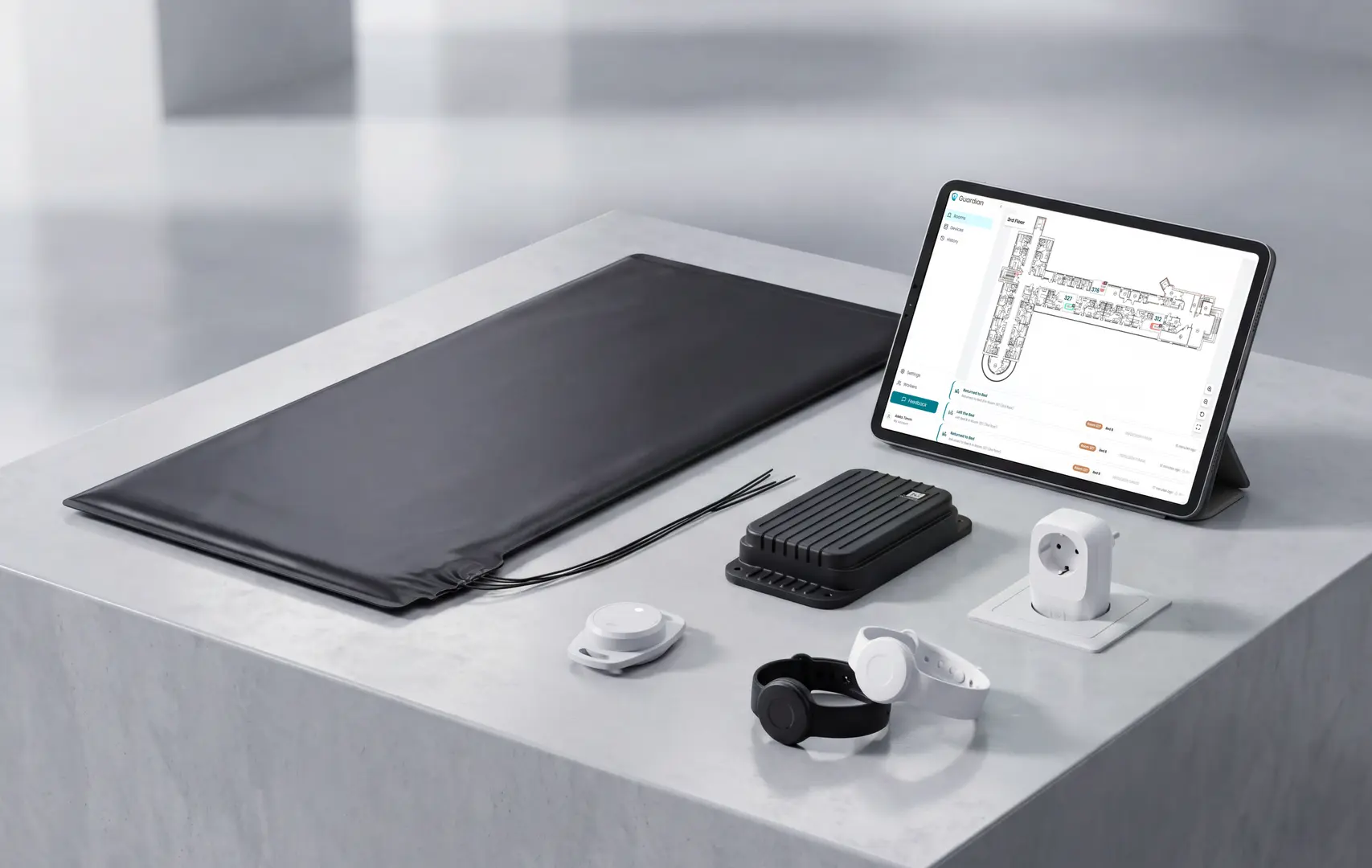
Guardian sends camera-free sensor alerts with the person’s room or bed location, not just a generic bedside sound. Wireless sensors are mapped to the facility floor plan during setup.
Staff can receive the mapped alert on phones, tablets, or nurse-station computers. The digitized floor plan provides a destination before the responder sets off.
Each alert gives a destination: Guardian identifies the resident and exact room or bed on the floor plan, so caregivers know where to go.
Teams tune routine alerts: Thresholds and schedules can filter routine movement, while SOS and fall events remain urgent.
Response records build automatically: Guardian logs alerts and response times, giving managers the data needed to review the handoffs above.
Deployment avoids building work: Preconfigured wireless devices send alerts to phones, tablets, and nurse-station computers already in use.
In one Guardian pilot, the system flagged more than 30 incidents and identified about €1,000 per month in estimated caregiver capacity. These site-specific results are not a benchmark for every pilot.
The 6–8 week pilot ends with an impact and ROI report based on response times, incident data, and staff feedback from your setting.
Federal nursing home rules do not ban bed alarms. A conventional position-change alarm generally monitors movement rather than physically restraining a resident. Loud or indiscriminate use can still cause distress, disrupt sleep, or reduce independence, so the facility should reassess the alarm under resident-rights and person-centred care duties. State rules may add requirements.
Bed rails can be restraints when they prevent a resident from voluntarily leaving the bed. A partial rail used for turning, repositioning, or getting out of bed may instead be an assistive device. Under 42 C.F.R. §§ 483.10(e)(1) and 483.25(n), the facility must assess alternatives and entrapment risk, explain risks and benefits, obtain informed consent before installation, and use the rail correctly.
The record should show the person’s needs, the medical symptom used to justify any restraint, alternatives considered, required orders or approvals, and the care plan. It should also cover purpose, limits, monitoring, staff response, reassessment, and any harm or follow-up. A CMS deficiency and civil liability are separate matters under state law. This is general information, not legal advice.
Residents have the right to participate in and refuse care, but no single federal rule requires consent for every bed alarm. Requirements depend on the alarm’s use, state law, decision-making capacity, representative authority, and facility policy. Record the risk, settings, response plan, preferences, and any consent or refusal required locally. A monitoring alarm does not automatically require practitioner authorization.

Author
Aleks Timm
Aleks Timm leads Guardian and builds privacy-first operations technology for care homes and home care providers. Teams get location-aware alerts they can act on, clearer situational awareness, and measured insight into how care work actually runs.
Read MoreRecommended reads
Keep reading
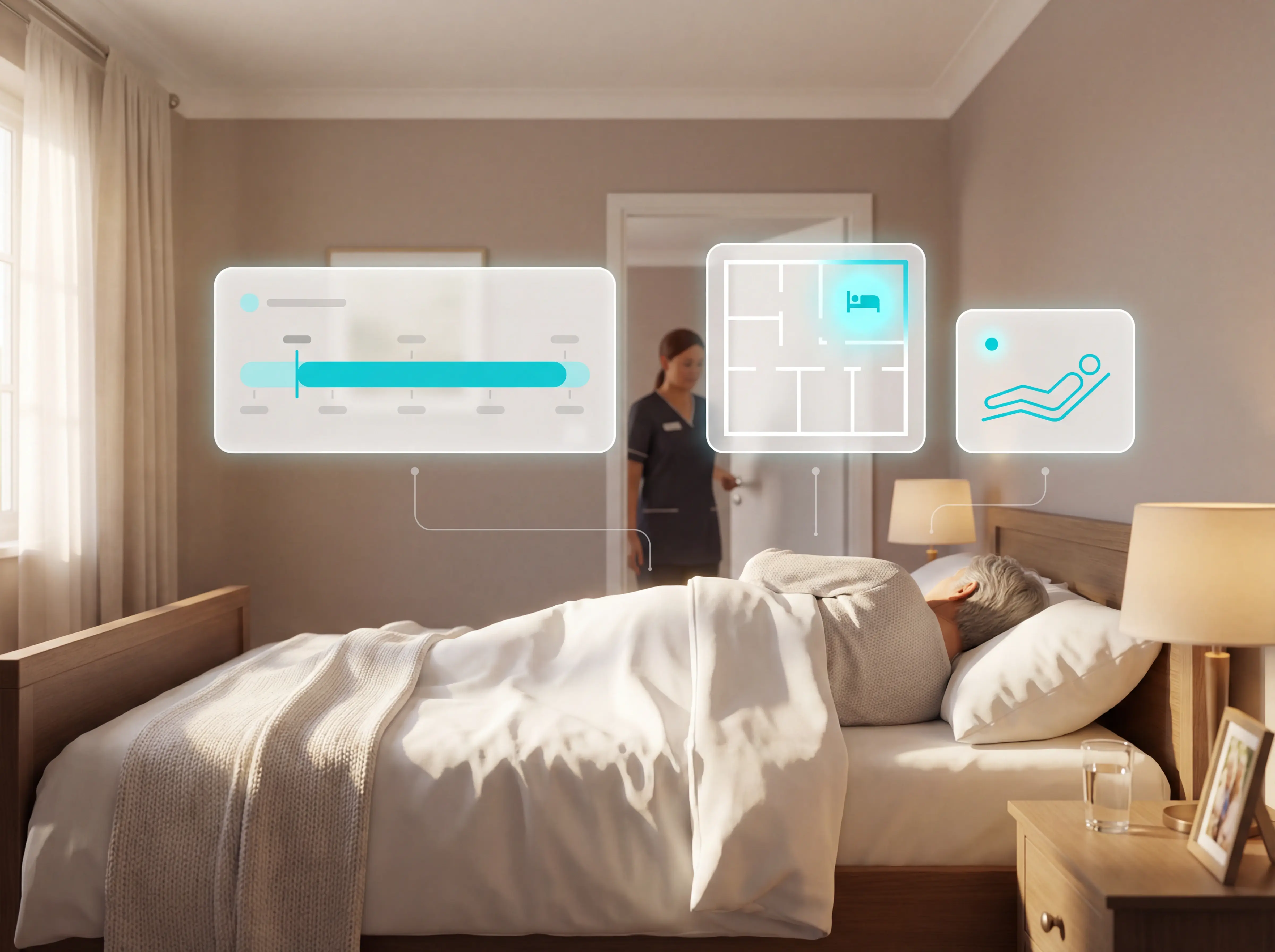
Patient bed alarms for elderly & hospital care
Patient bed alarms help prevent falls in elderly and hospital care. Compare alarm types, choose the right sensor, and protect...
Read more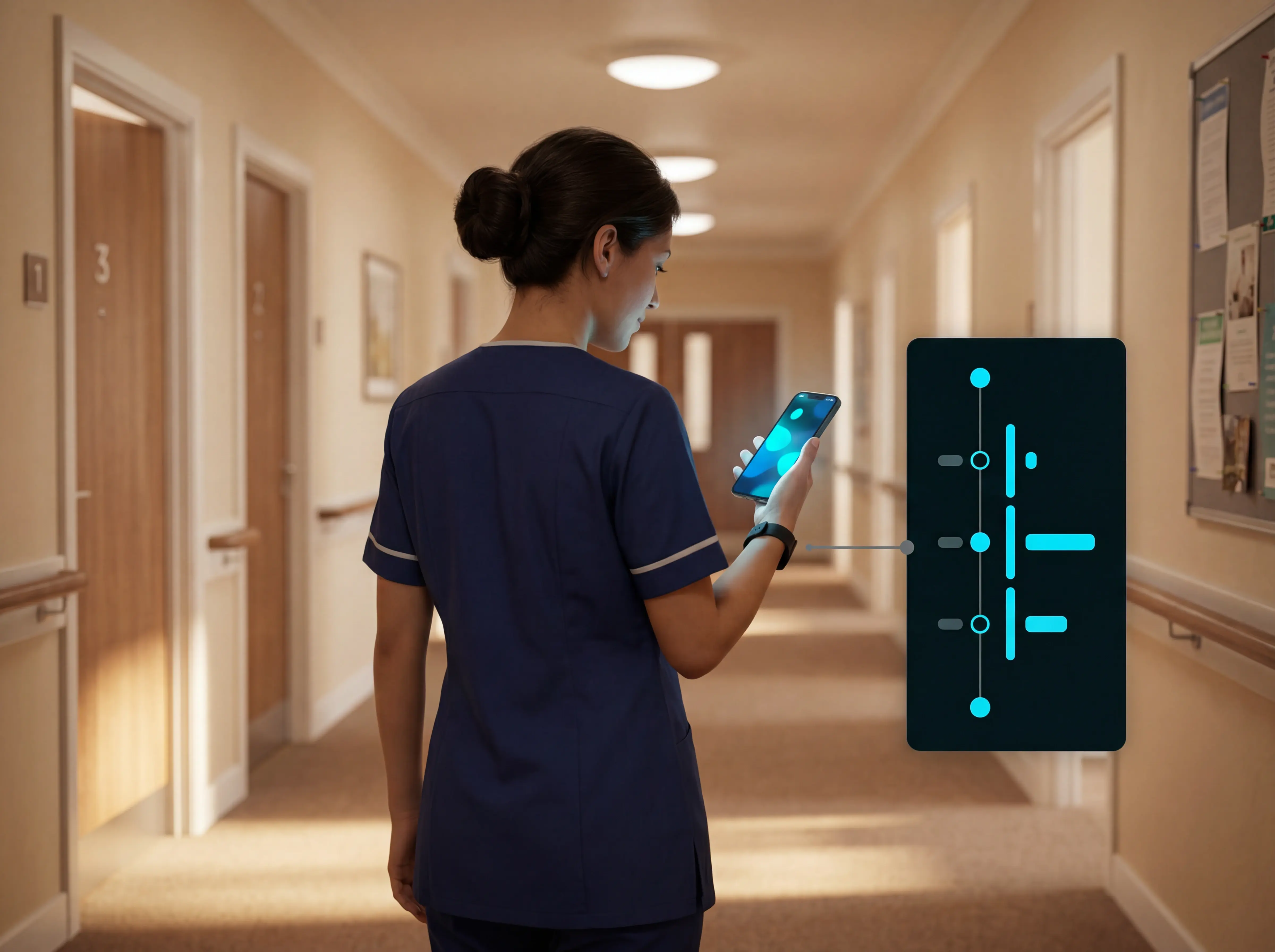
WiFi nurse call system guide for care homes
WiFi nurse call systems explained: alerts, clean records, and no wiring—compare options and choose the right setup for your care...
Read more
Remote patient monitoring: a complete guide
Remote patient monitoring: the complete guide to sensors, benefits, and buying tips for safer care homes and better resident...
Read more