


11 WellSky Competitors Compared by Care Model
In this article
WellSky spans home health, hospice, personal care, and care coordination. The right competitor depends on the product line, service model, and workflow you need to replace.
This guide compares 11 WellSky competitors across three primary groups: home health and hospice, personal and non-medical home care, and enterprise post-acute care. It distinguishes administrative records from live operational proof.
The software comparison focuses on US care workflows and requirements. Guardian appears later as a separate operations layer for professional care and support organizations in Europe and the United States, not as a direct EHR or EVV replacement.
How this comparison is organized
Start with the WellSky product or workflow being replaced. A platform suited to WellSky Personal Care may not cover the clinical and compliance work handled in WellSky Home Health or Hospice.
WellSky scope | Relevant category in this guide | Boundary to note |
|---|---|---|
Home Health or Hospice | Home health and hospice EHR alternatives | Compare clinical documentation, scheduling, billing, assessments, and EVV |
Personal Care | Personal and non-medical home care alternatives | Compare scheduling, caregiver management, payer workflows, and EVV |
CarePort or care coordination | Not directly covered by the 11 profiles | Evaluate referral, transition-of-care, and network workflows separately |
Broader multi-service deployment | Multi-service and enterprise alternatives | Confirm which records and workflows continue across settings |
A platform is included when it serves the same care setting, overlaps with a WellSky clinical or administrative workflow, and has product information that can be checked on a vendor-owned page.
Primary fit: The care model the platform is mainly built around
Workflow coverage: Records, scheduling, billing, EVV, compliance, or facility operations
Buyer check: The point that needs proof in a demo, contract, or implementation plan
Pricing status: Whether a fixed public plan was available
Methodology: Product scope and public pricing status were checked on vendor-owned pages on July 19, 2026. Guardian publishes this guide and is identified separately wherever its role differs from an EHR, billing platform, or EVV system.
Jump to: Home health and hospice · Personal care · Enterprise platforms · Switching checks · Guardian
WellSky competitors compared
The tables show each vendor's primary fit. Several platforms support additional service lines, so use the detailed profiles to confirm wider coverage.
Home health and hospice
Platform | Primary care model | Main workflow role | Public pricing status | Main point to verify |
|---|---|---|---|---|
Homecare Homebase | Home health, hospice, personal care | EHR, mobile field work, back-office operations | No fixed public plan verified | Offline work, modules, implementation |
KanTime | Multi-line home-based post-acute care | Longitudinal EHR, EVV, billing, payroll | No fixed public plan verified | Service-line modules and state EVV path |
Alora | Home health, hospice, home care, private duty | EHR, agency management, EVV | No fixed public plan verified | Census basis, users, add-ons, support |
Careficient | Home health, hospice, home care, palliative care | EMR, assessments, EVV, billing | No fixed public plan verified | Compliance outputs and integrations |
Personal and non-medical home care
Platform | Primary care model | Main workflow role | Public pricing status | Main point to verify |
|---|---|---|---|---|
AxisCare | Home care and private duty | Scheduling, billing, caregiver tools, EVV | No fixed public plan verified | Skilled-care depth and state connections |
CareSmartz360 | Personal and non-medical home care | Agency operations, billing, payroll, EVV | No fixed public plan verified | Payer and state workflow fit |
Sandata | Home care agencies, payers, and states | Agency management and EVV aggregation | No fixed public plan verified | Data ownership and rejected-visit correction |
AlayaCare | Home care, home health, infusion, palliative care | Clinical, field, and back-office operations | No fixed public plan verified | EVV by market, APIs, implementation |
Enterprise and facility-based post-acute care
Platform | Primary care model | Main workflow role | Public pricing status | Main point to verify |
|---|---|---|---|---|
MatrixCare | Skilled nursing, senior living, and multi-setting care | EHR, finance, compliance, ambient intelligence | No fixed public plan verified | Modules, sensors, and interoperability |
PointClickCare | Skilled nursing and senior living | EHR, MDS, PDPM, financial operations | No fixed public plan verified | Packages, migration, and integrations |
Netsmart | Multi-setting post-acute organizations | myUnity EHR and CareFabric services | No fixed public plan verified | Cross-setting continuity and module boundaries |
Guardian is covered later as a live operations and safety layer. It does not replace an EHR, billing platform, clinical documentation system, or state EVV service.
Home health and hospice EHR alternatives
These platforms are primarily evaluated for home health and hospice records, scheduling, billing, assessments, and agency administration. Some also support personal care or other post-acute services.
AxisCare
AxisCare is primarily a home care agency platform, with a separate skilled-care offering.
Primary fit: Home care and private-duty agencies, with additional skilled-care workflows
Core workflows: Scheduling, billing, caregiver mobile tools, custom forms, care plans, and visit documentation
EVV: Built-in visit verification is documented; confirm the required state aggregator, payer connection, telephony option, and correction process
Demo check: Test every required skilled form and clinical approval path rather than assuming the home care workflow covers it
Pricing: No fixed public plan was verified; confirm the census or user basis, implementation, integrations, and support
Homecare Homebase
Homecare Homebase is a home-based care EHR for home health, hospice, and personal care organizations.
Primary fit: Agencies that need clinical and administrative workflows in one platform
Core workflows: Documentation, scheduling, billing, analytics, intake, and back-office operations
Field work: PointCare supports mobile documentation and access to the care record; test offline behavior, synchronization, and correction workflows
Demo check: Run the same referral, visit, review, billing, and support-escalation scenarios with field and office teams
Pricing: No fixed public plan was verified; confirm modules, implementation, interfaces, support terms, and user or census limits
KanTime
KanTime is a post-acute EMR for home health, hospice, pediatric, private-duty, palliative, and self-directed care.
Primary fit: Organizations running several home-based service lines
Core workflows: Intake, scheduling, clinical documentation, eligibility, authorizations, billing, payroll, reporting, and quality assurance
Record model: KanTime describes one longitudinal record that gives teams access to clinical history across service lines
EVV: Visit verification is available; confirm the current state aggregator, payer rules, and exception process for every market
Pricing: No fixed public plan was verified; separate implementation, support, integrations, and service-line modules in the proposal
Alora
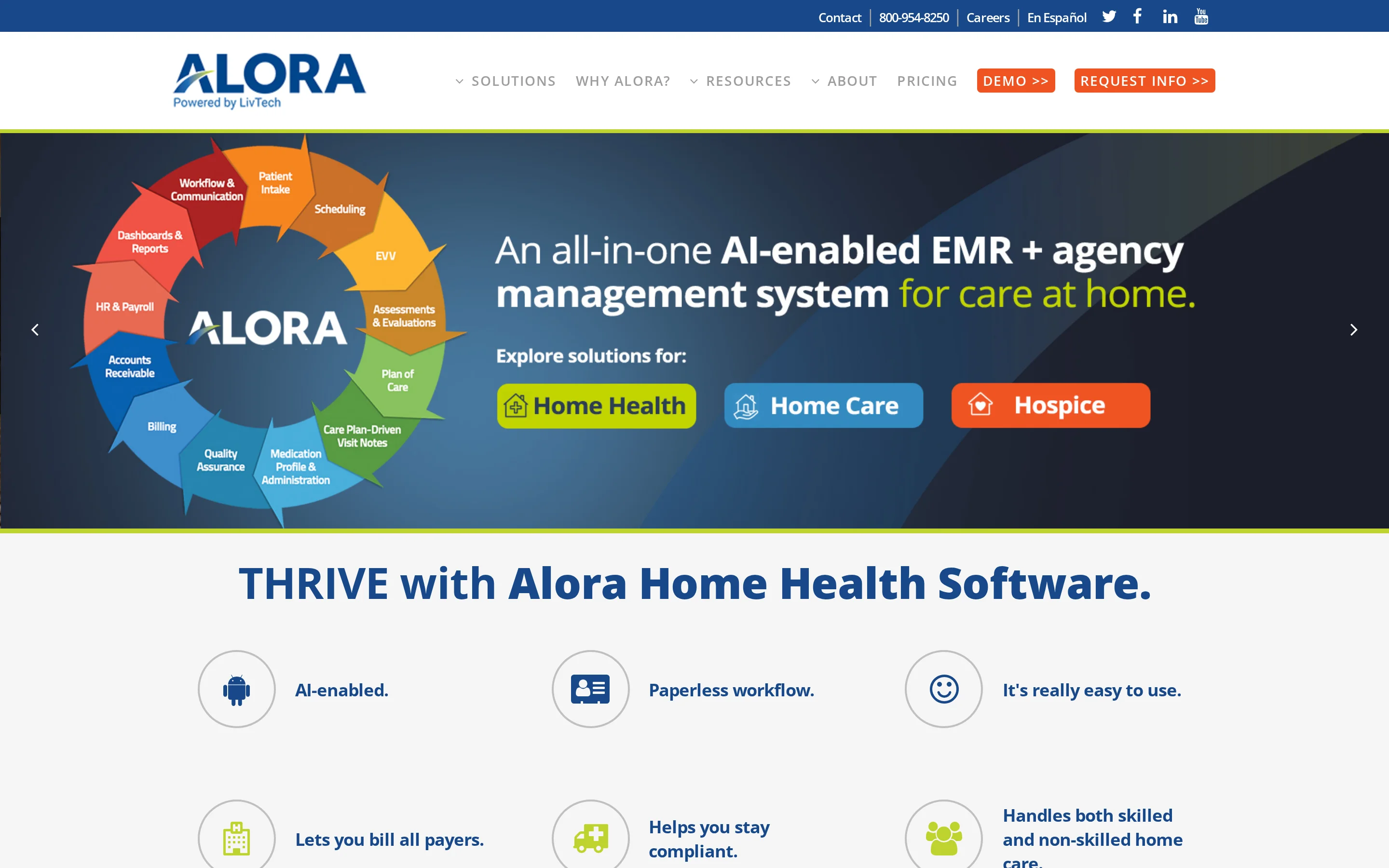
Alora combines EHR and agency-management workflows for home health, hospice, home care, and private-duty providers.
Primary fit: Home-based care agencies that want clinical, administrative, and financial work in one platform
Core workflows: Scheduling, documentation, billing, compliance, revenue-cycle work, and multi-device access
EVV and support: Confirm state and payer connections, visit-correction rules, onboarding, and the documented English and Spanish support model
AI: Alora markets assistive AI features; require a live demonstration of the exact documentation or review task your team expects to use
Pricing: No fixed public plan was verified. Request a dated quote covering census, users, modules, implementation, add-ons, and integrations
MatrixCare
MatrixCare is a post-acute EHR suite spanning skilled nursing, senior living, life plan communities, home health, hospice, palliative care, and private duty.
Primary fit: Multi-setting providers and facility-based post-acute organizations
Core workflows: Clinical records, financial and operations management, regulatory compliance, revenue cycle, analytics, and interoperability
Home-based care: Confirm the EVV, mobile, billing, and clinical modules required for each service line
Ambient intelligence: MatrixCare lists ambient sensing for life plan, senior living, and skilled nursing settings. Confirm current availability, hardware, room coverage, alert routing, implementation, and reporting
Pricing: No fixed public plan was verified; require separate costs for modules, integrations, implementation, support, sensors, and each care setting
Personal care and non-medical home care alternatives
These platforms primarily manage personal and non-medical home care visits. Compare scheduling, caregiver workflows, EVV, payroll, billing, and payer connections for every state or market you serve.
CareSmartz360
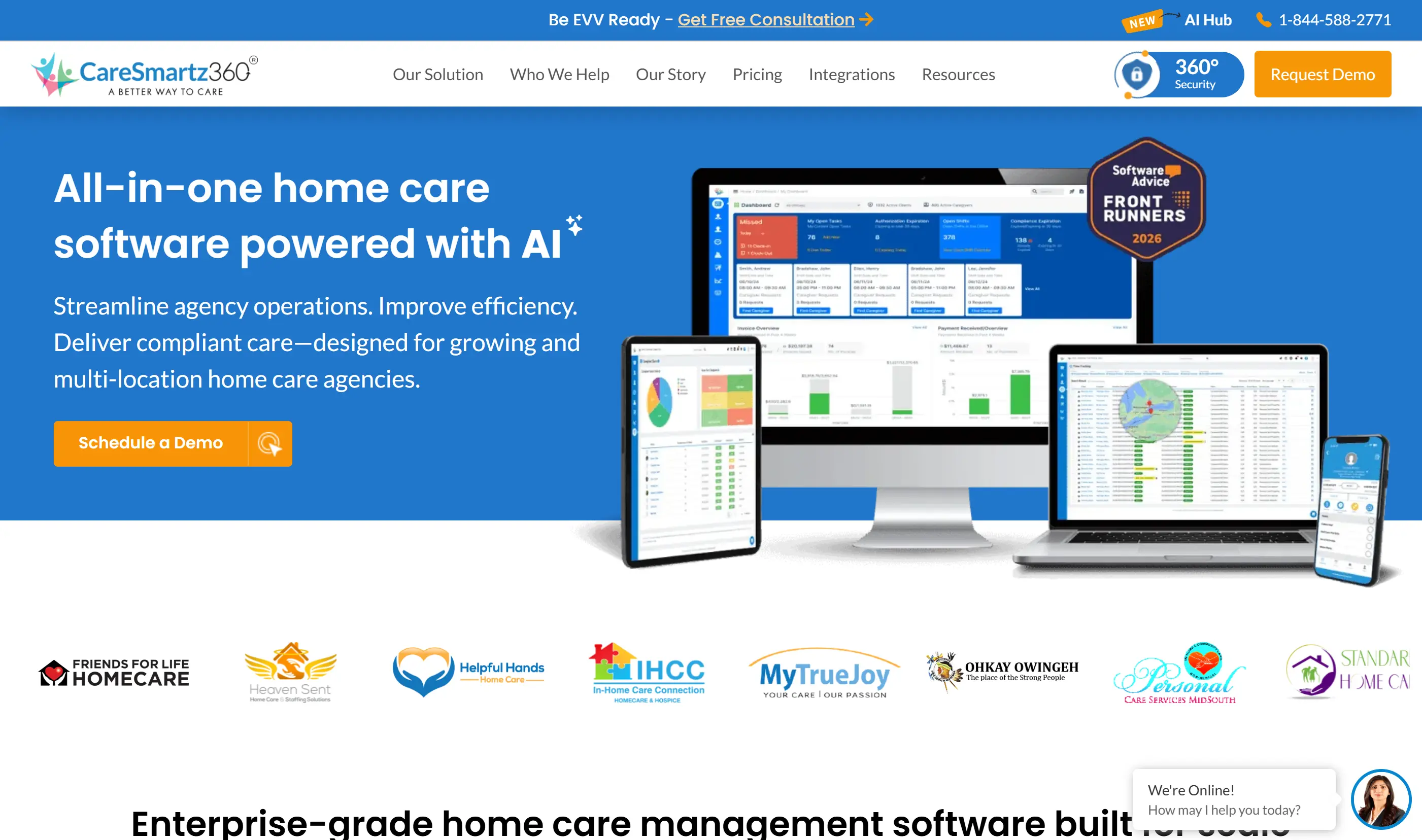
CareSmartz360 is agency-management software for personal and non-medical home care providers.
Primary fit: Growing, multi-location, and franchise home care agencies
Core workflows: Scheduling, caregiver mobile work, multi-payer billing, payroll, communication, reporting, and administration
EVV: State integrations are part of the platform; confirm each payer connection, exception workflow, and responsibility for rejected records
Implementation check: Test data migration, caregiver onboarding, mobile corrections, role permissions, and multi-location reporting
Pricing: No fixed public plan was verified; confirm the charging basis, minimum term, implementation, integrations, and support
Sandata
Sandata serves home care agencies, managed care organizations, and state Medicaid programs. Its role can be an agency system, an EVV service, or an aggregation layer.
Area | What to verify |
|---|---|
Agency system | Scheduling, visit capture, billing, payroll, and caregiver workflow |
State or payer layer | Which system receives and validates the official EVV record |
Data path | How records move from capture through aggregation, claims, and correction |
Exception ownership | Who fixes rejected, incomplete, or mismatched visits |
Contract scope | Which entity contracts, supports users, and controls configuration |
Pricing | Quote basis, modules, implementation, and state-program dependencies |
Map the complete visit-data path before selecting or replacing any connected system.
AlayaCare
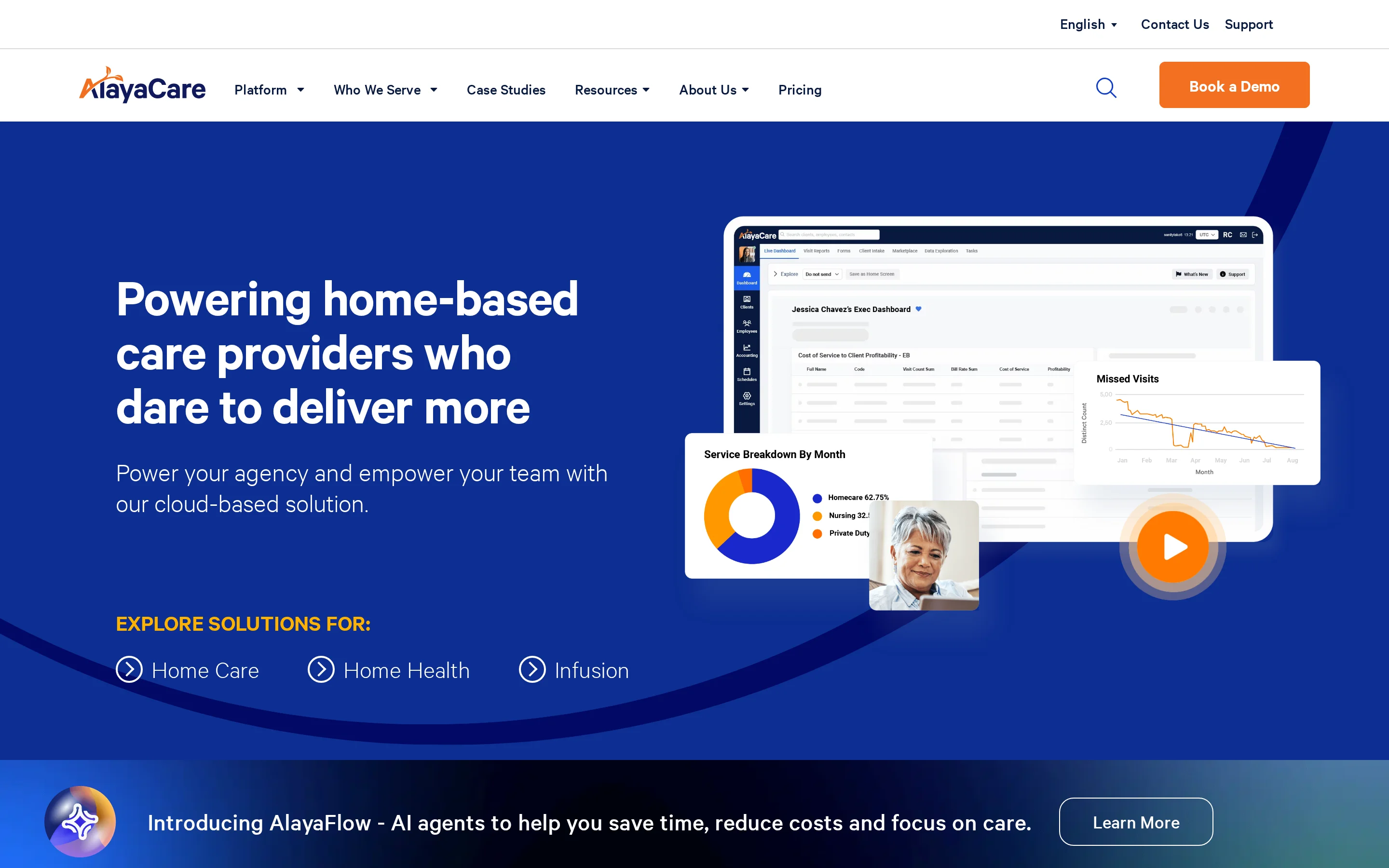
AlayaCare is a cloud platform for home care, home health, infusion, palliative care, and other home-based services.
Primary fit: Agencies coordinating clinical, field, and back-office work across one or more service lines
Core workflows: Intake, scheduling, care management, billing, payroll, caregiver work, reporting, and mobile access
Automation: The platform offers AI assistants and workflow tools. Test the specific documentation, matching, routing, or form task included in the proposed package
Interoperability and EVV: Confirm APIs, state or payer connections, data ownership, and responsibility for failed transactions
Pricing: No fixed public plan was verified; request a dated quote for modules, implementation, integrations, training, and support
Careficient
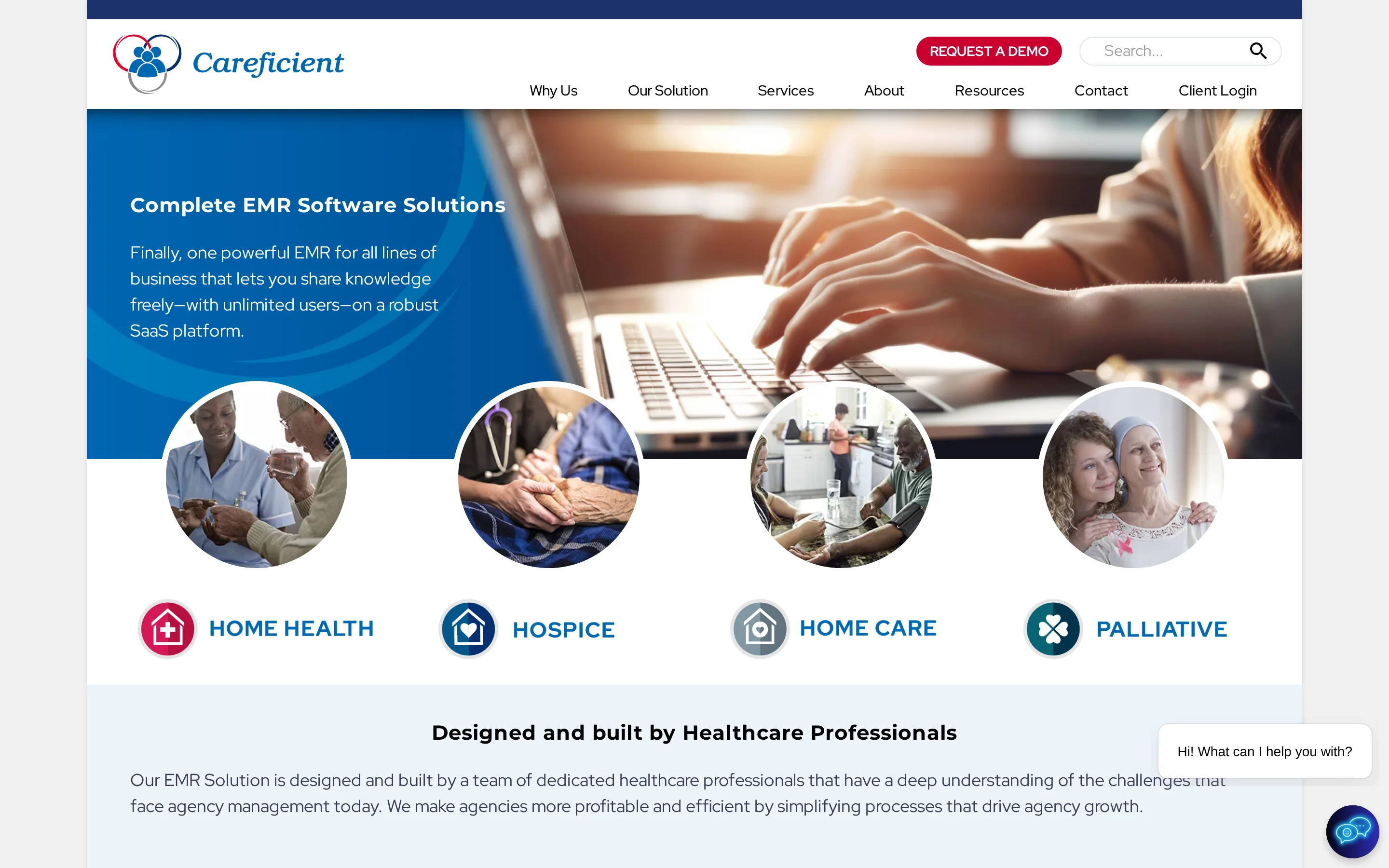
Careficient provides EMR and agency-management software for home health, hospice, home care, and palliative care.
Primary fit: Agencies that need clinical, compliance, scheduling, and financial workflows in one system
Core workflows: Patient records, scheduling, billing, payroll, orders, eligibility, authorizations, invoicing, and accounts receivable
Assessments and EVV: The platform documents OASIS and EVV support; confirm required hospice outputs, state models, aggregator connections, and submission workflow
Demo check: Run one complete referral-to-claim scenario for each service line, including corrections and audit history
Pricing: No fixed public plan was verified; confirm implementation, interfaces, training, support, and module charges
Multi-service and enterprise alternatives
These platforms primarily serve facility-based or multi-service post-acute organizations. Their wider coverage makes module boundaries, cross-setting records, implementation, and interoperability central to the evaluation.
PointClickCare
PointClickCare centers its EHR products on skilled nursing and senior living, with additional tools for care coordination and post-acute networks.
Primary fit: Skilled nursing facilities, senior living communities, and larger post-acute networks
Core workflows: Clinical records, financial operations, MDS, PDPM, medication workflows, and facility reporting
Add-ons: Chart Advisor and other packages sit alongside the core platform; confirm which package contains each required workflow
Implementation check: Test migration, pharmacy and laboratory connections, mobile use, role permissions, audit history, and marketplace integrations
Pricing: No fixed public plan was verified; require facility, module, implementation, interface, and support costs separately
Netsmart
Netsmart covers a broad range of post-acute and human-services settings through CareFabric and products including myUnity.
Primary fit: Multi-service organizations that need records and workflows across home health, hospice, senior living, skilled nursing, palliative, adult day, or personal care
Core workflows: EHR records, scheduling, documentation, billing, reporting, assessments, and care coordination
EVV and services: Mobile Caregiver+ supports visit verification, while other CareFabric services cover data, workforce, interoperability, and revenue-cycle needs
Implementation check: Prove which data follows the person across settings, which product owns each record, and where staff must switch modules
Pricing: No fixed public plan was verified; separate EHR, CareFabric, implementation, interface, hosting, and support costs
Which WellSky competitor should you shortlist?
Argentum's 2025 technology report found that 74% of surveyed senior care organizations cited legacy-system incompatibility as a digital-transformation hurdle. Test real data exchange with existing systems before comparing feature lists.
Use primary fit to build the first shortlist. Some vendors span more than one row, so confirm the exact service-line modules in the detailed profiles.
Care model | Shortlist | First workflow check |
|---|---|---|
Home health or hospice | Homecare Homebase, KanTime, Alora, MatrixCare, Careficient | Clinical documentation and EVV |
Personal and non-medical home care | AxisCare, CareSmartz360, Sandata, AlayaCare | EVV, scheduling, payer needs |
Skilled nursing and senior living | PointClickCare, MatrixCare, Netsmart | MDS, PDPM, facility records |
Multiple post-acute settings | Netsmart, KanTime, MatrixCare | Cross-setting record continuity |
Live operations and safety monitoring | Guardian, alongside selected EHR | Alerts, location, response, and operational records |
Three rules keep the decision focused:
Start with care setting: Remove vendors built around a different operating model before assessing features.
Filter for EVV and compliance: Confirm that each system covers the required workflow for your service line, because EVV and facility documentation solve different obligations.
Match enterprise scope: Compare multi-service platforms against the exact settings your organization operates, not the number of modules on offer.
What to verify before switching
Treat the switch as a go/no-go decision: every critical workflow, connection, compliance output, and staff role should pass a documented test before you sign or set a cutover date.
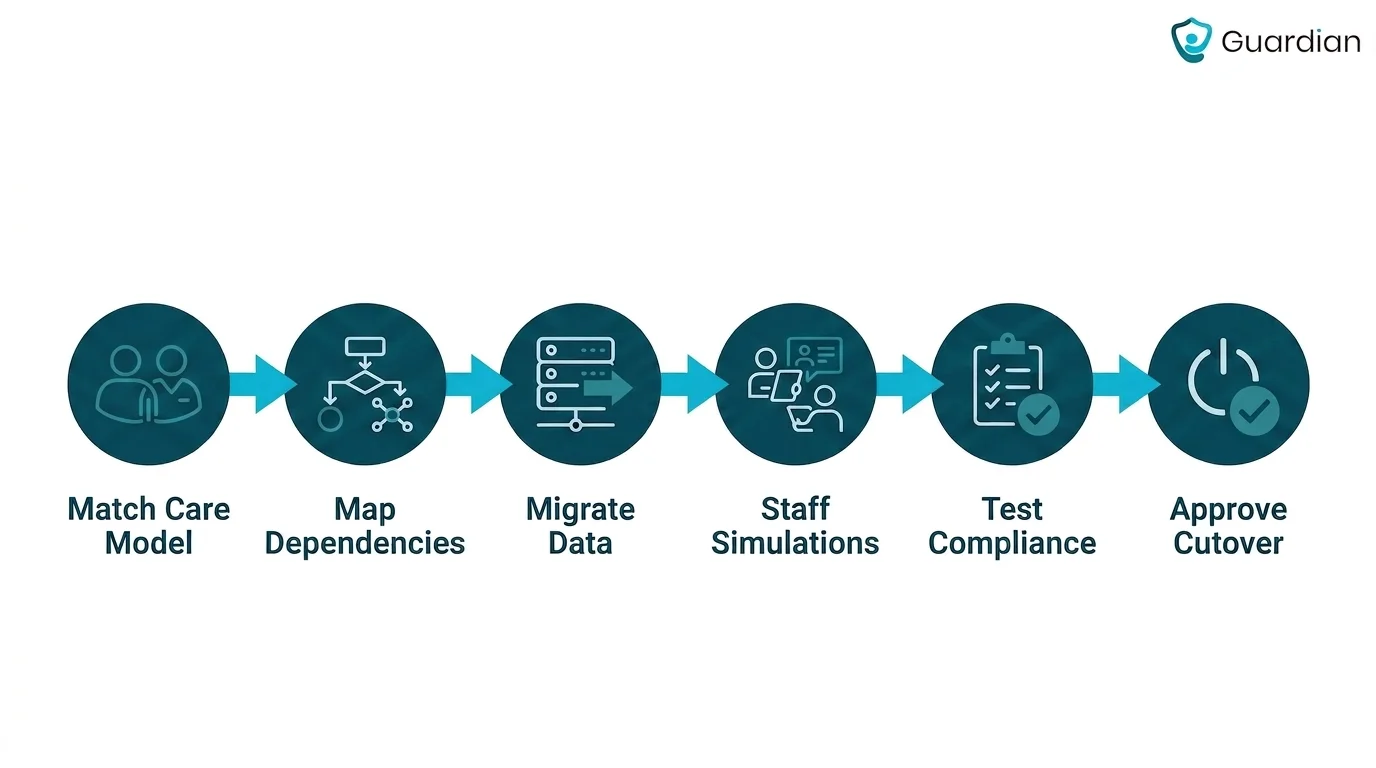
Match the care model. Confirm the platform supports your mix of home health, hospice, personal care, skilled nursing, and multi-service operations, including the workflows staff use each shift.
Map every day-one dependency. Assign an owner and test path for each connection that cannot fail at cutover:
Financial: Billing, payroll, payer, and revenue-cycle connections
Workforce: EVV aggregators, telephony, scheduling, and timekeeping
Intake: Referral sources, CRM feeds, physician signatures, and fax
Clinical: Pharmacy, eMAR, laboratory, and medication workflows
Assessments: OASIS, HOPE, MDS, assessment, and QA feeds
Reconcile migrated data. Test representative active and discharged records, then check for missing fields, duplicates, changed meanings, broken links, and inaccessible audit history.
Confirm data ownership and export. Test the export format, attachments, audit history, and access after contract termination.
Review commercial terms. Record implementation fees, minimum term, renewal rules, module charges, usage limits, and exit costs.
Verify security controls. Review HIPAA documentation, BAA terms, role-based access, audit logging, incident procedures, and data location where applicable.
Test mobile and offline work. Confirm what staff can complete without connectivity, how records synchronize, and how conflicts or failed uploads are handled.
Set support expectations. Document support hours, escalation routes, response commitments, implementation ownership, and after-hours coverage.
Prove staff readiness. Require each affected role to complete training and a realistic shift simulation, then monitor adoption and support demand after launch.
Test compliance by setting and payer. A generic compliance claim is not enough. Verify the exact outputs your organization must submit and audit:
Medicaid-funded personal care and home health: EVV where required by the state or payer
Medicare-certified home health: OASIS where applicable
Medicare-certified hospice: HOPE where applicable
Medicare or Medicaid skilled nursing: MDS, with PDPM checks where applicable
All settings: Payer rules and internal QA reporting
Approve the cutover evidence. Set pass thresholds, named owners, downtime procedures, rollback steps, and a phased rollout plan before the final decision.
Use this table as the final sign-off record:
Verification area | Must pass | Evidence |
|---|---|---|
Care model | Critical workflows complete | Signed scenario test |
Day-one connections | Every dependency exchanges data | Interface test log |
Migrated records | Complete and correctly mapped | Reconciled record sample |
Staff readiness | Roles complete shift simulation | Training and adoption log |
Compliance | Setting-specific outputs validate | Submission-ready test |
Cutover control | Owners and rollback confirmed | Approved launch plan |
See care operations live with Guardian
Guardian is a standalone operations and safety layer for professional care and support organizations in Europe and the United States. It supports care homes, home care services, specialist-care facilities, and mental-health settings without replacing an EHR, billing platform, clinical documentation system, or regulated EVV service.
For care homes, specialist care, and mental-health facilities
See live events in room or bed context. Guardian links camera-free bed, motion, door, fridge, stove, and wearable events to a digitized floor plan, then sends clear alerts to the devices staff already use.
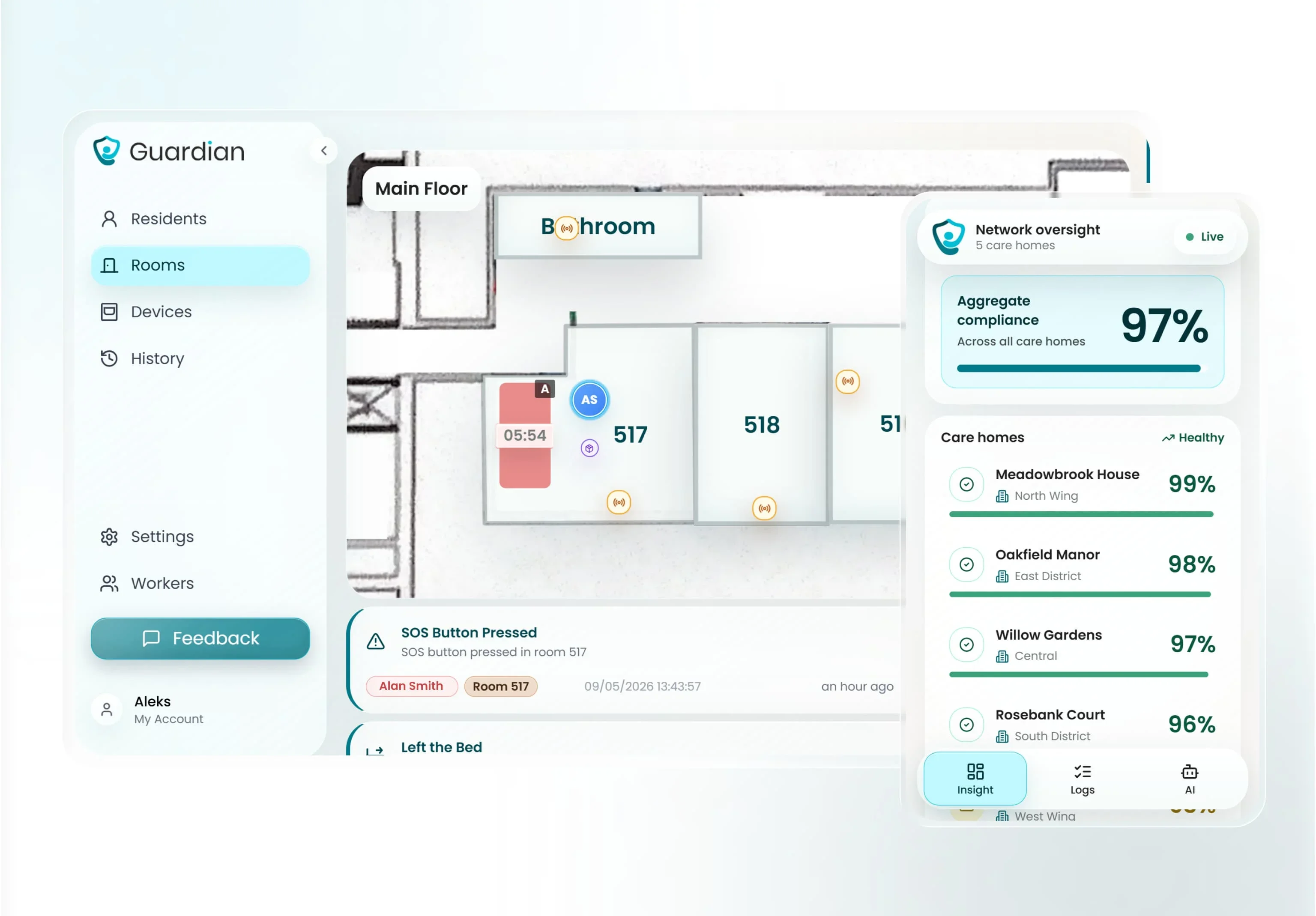
People do not need to depend on a wearable. Passive sensors can flag extended time out of bed, missing movement, exits, restricted-area entries, SOS events, or changes in routine.
For home care teams

See staff, clients, vehicles, and assets in one live view. Guardian records operational visits, shift timing, and response activity automatically, while the agency's clinical, billing, and regulated EVV systems remain separate.
Measure the pilot with your own data
Guardian Insight brings live activity, alerts, locations, and response records into one dashboard.
Average response time to alerts
Time spent finding a resident, caregiver, vehicle, or asset
Verified operational visits and shift timing
Alert volume and the rules creating unnecessary noise
Time spent preparing operational reports
A ward or home care team can go live in about a week without drilling, cabling, cameras, or extra pagers. The 6 to 8 week pilot ends with a written impact and ROI report, so you can decide what to roll out using your own data.
The answer depends on the workflow. This guide covers alternatives for WellSky Home Health, Hospice, Personal Care, and broader multi-service deployments. It does not treat the 11 vendors as direct CarePort replacements.
Start with Homecare Homebase, KanTime, Alora, and Careficient. Compare documentation, assessments, scheduling, billing, EVV, mobile work, and the exact service-line modules in the proposal.
Start with AxisCare, CareSmartz360, Sandata, and AlayaCare. Compare caregiver scheduling, payer workflows, EVV connections, rejected-visit correction, payroll, and mobile use.
No. CarePort is a WellSky care-coordination product line, while WellSky is the broader healthcare software company. A CarePort replacement should be evaluated around referrals, transitions, network data, and coordination workflows.
No. Guardian provides live operations and safety monitoring, location-aware alerts, and automatic operational records for care homes, home care services, specialist-care facilities, and mental-health settings. WellSky and the competitors in this guide handle EHR, clinical, billing, administrative, or regulated EVV workflows.
Guardian currently runs as a standalone operations and safety layer. It does not claim a current data integration with WellSky or another named EHR.
Test the complete workflow with real scenarios: migration, interfaces, mobile and offline work, security, compliance outputs, billing, EVV corrections, support escalation, data export, and rollback. Require written evidence before approving the cutover.
Match the platform to the work your team delivers. Home health and hospice center on clinical records and assessments, personal care centers on visits and EVV, and enterprise platforms coordinate facility or multi-service operations.

Author
Aleks Timm
Aleks Timm leads Guardian and builds privacy-first operations technology for care homes and home care providers. Teams get location-aware alerts they can act on, clearer situational awareness, and measured insight into how care work actually runs.
Read MoreRecommended reads
Keep reading
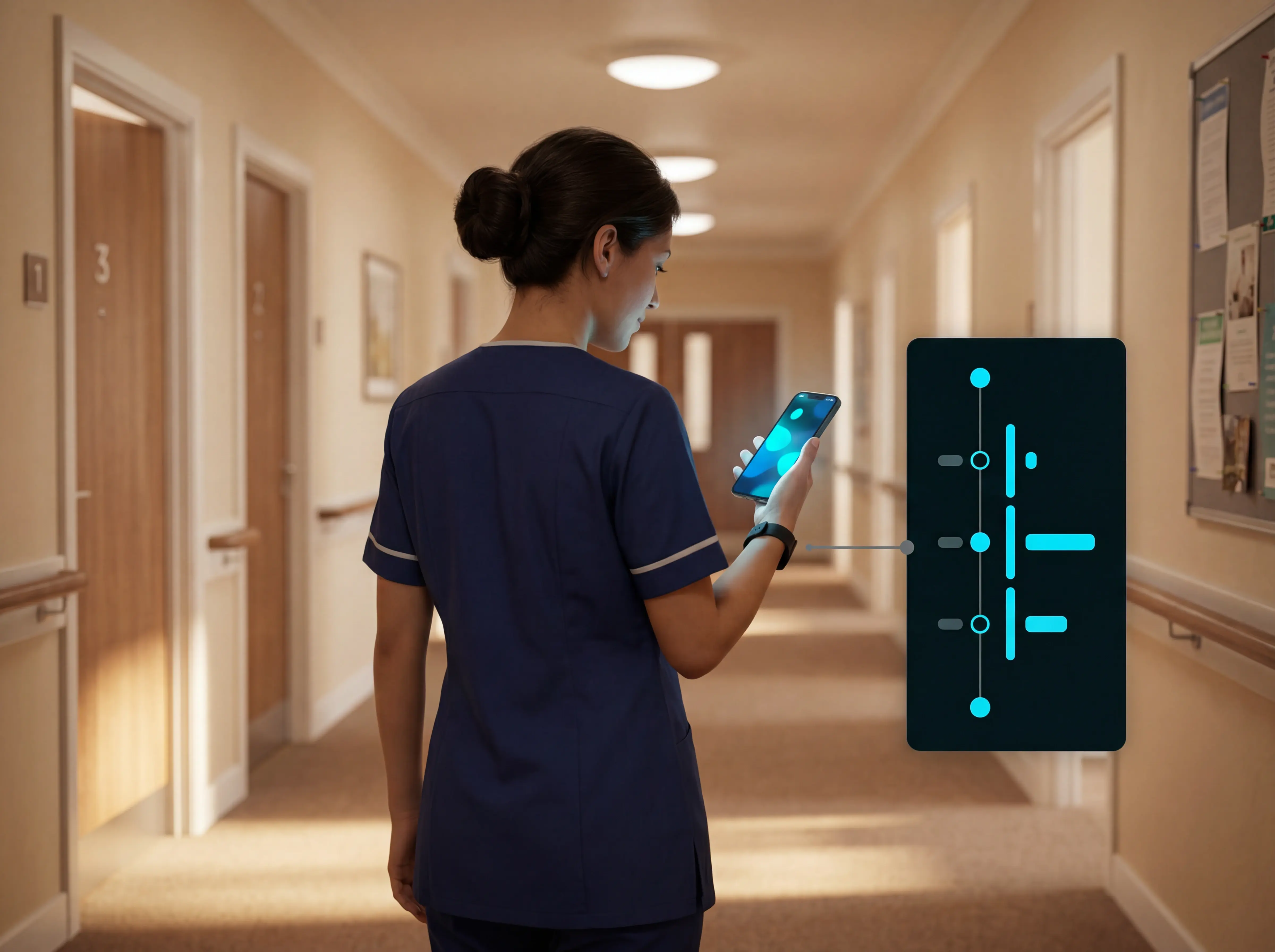
WiFi nurse call system guide for care homes
WiFi nurse call systems explained: alerts, clean records, and no wiring—compare options and choose the right setup for your care...
Read more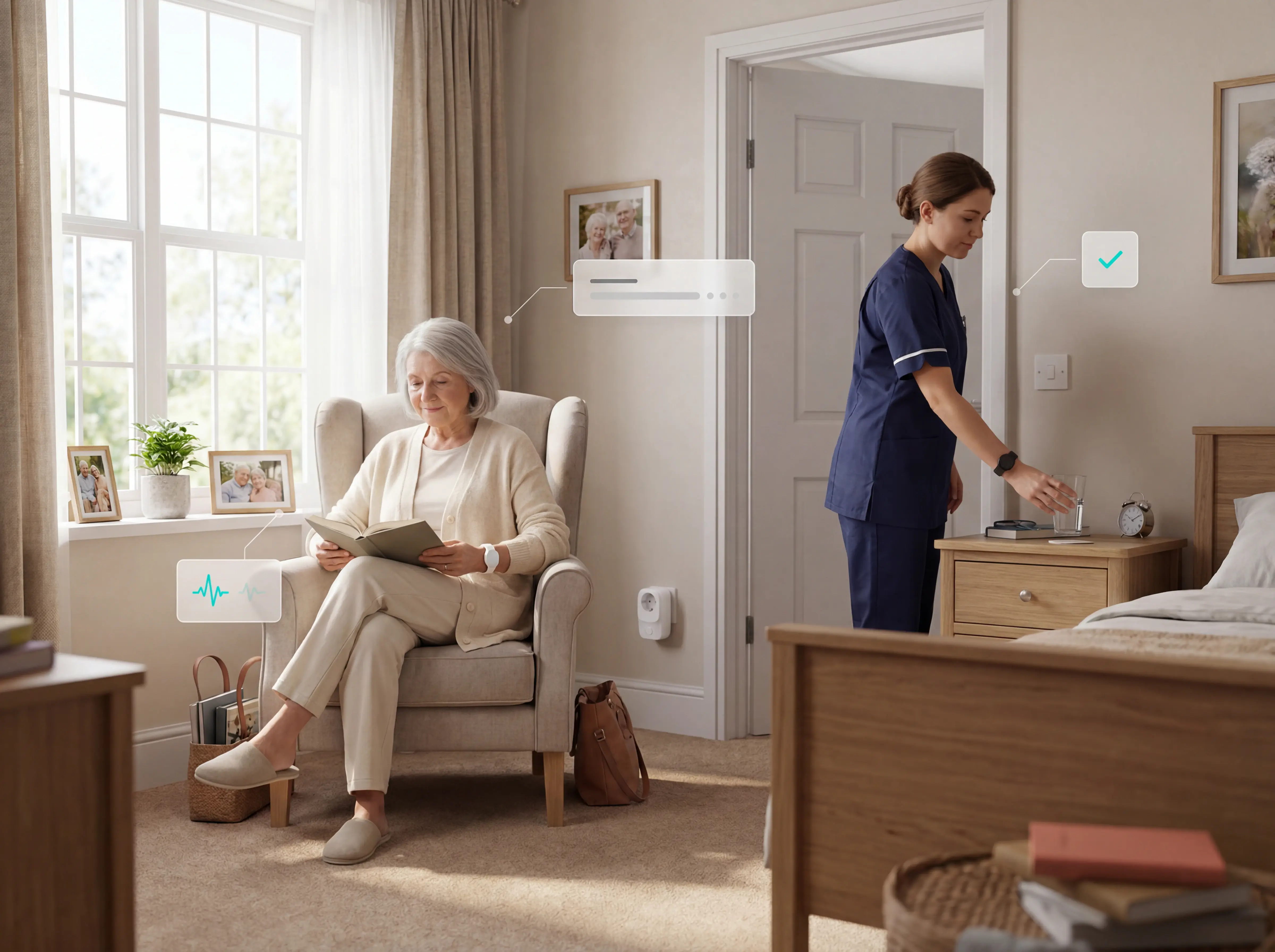
Remote patient monitoring: a complete guide
Remote patient monitoring: the complete guide to sensors, benefits, and buying tips for safer care homes and better resident...
Read more
Indoor positioning systems for care homes
Indoor positioning systems for care homes help staff locate falls, exits, and nurse calls by room or bed, improving response,...
Read more